Recognition: no theorem link
Classifying Prime Character Degree Graphs With Eight Vertices
Pith reviewed 2026-05-15 10:11 UTC · model grok-4.3
The pith
Finite solvable groups realize only 37 of the 11,117 connected eight-vertex prime character degree graphs.
A machine-rendered reading of the paper's core claim, the machinery that carries it, and where it could break.
Core claim
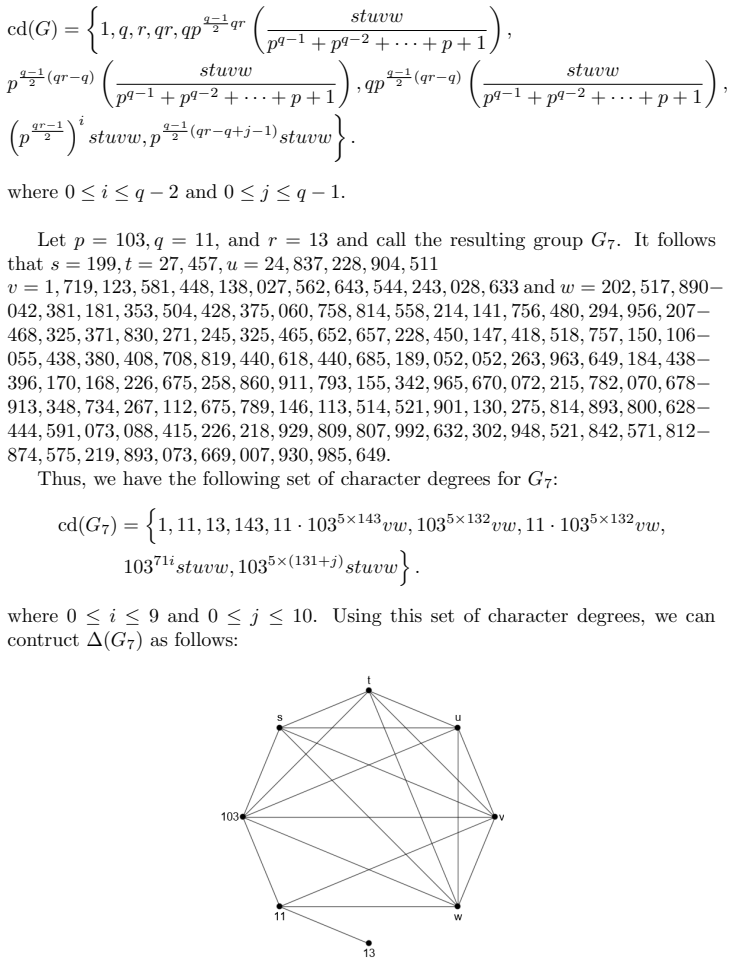
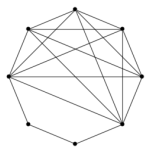
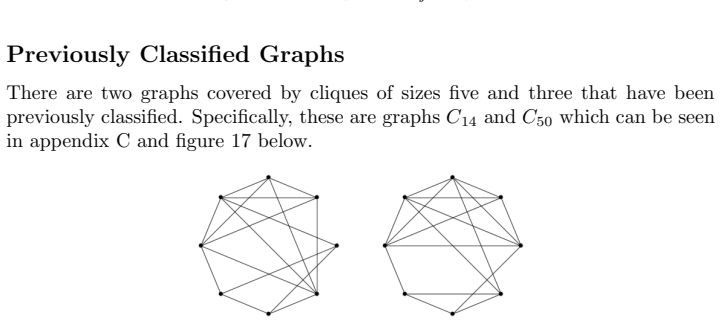
Among the 11,117 non-isomorphic connected graphs with eight vertices, exactly 37 occur as the prime character degree graph of some finite solvable group, with 34 constructed via direct products and three having diameter three, while 56 graphs are shown not to occur for any finite solvable group.
What carries the argument
The general algorithm built from compiled known constructions and prohibitions, which systematically checks whether each eight-vertex graph can be realized as a prime character degree graph of a finite solvable group.
If this is right
- Direct products of smaller solvable groups account for nearly all realizable eight-vertex graphs.
- Graphs of diameter three can occur, extending beyond the diameter-two cases studied earlier.
- Certain families of graphs are prohibited by existing theorems and remain impossible.
- All 1,229 disconnected eight-vertex graphs are classified as possible or impossible.
- The same algorithmic approach applies in principle to graphs of any order.
Where Pith is reading between the lines
- Applying the algorithm to nine or more vertices would reveal whether the proportion of realizable graphs changes with size.
- The undecided graphs may require new non-direct-product constructions to decide.
- The classification supplies concrete test cases for broader questions about bounding the number of distinct prime divisors in character degrees of solvable groups.
Load-bearing premise
The known results and algorithm together account for every possible way a solvable group could realize one of these graphs without missing additional constructions.
What would settle it
Finding even one finite solvable group whose prime character degree graph is one of the 206 undecided graphs would show that more than 37 graphs occur.
Figures







read the original abstract
In this paper, an effort is made to classify which prime character degree graphs having eight vertices occur for some finite solvable group. To approach this, we compile known results and constructions from the literature which are used to develop a general algorithm to begin classifying graphs of any order. We then apply the algorithm to the graphs of order eight. Of the 12,346 non-isomorphic graphs with eight vertices, 1,229 are disconnected and are fully classified. Meanwhile, 37 of the 11,117 non-isomorphic connected graphs are shown to occur; 34 of which are constructed via direct products and 3 of which have diameter three. Fifty-six graphs are shown not to occur, several of which fall into previously studied families, while the classification of 206 graphs is still unknown.
Editorial analysis
A structured set of objections, weighed in public.
Referee Report
Summary. The manuscript compiles known results from the literature on prime character degree graphs of finite solvable groups to develop a general algorithm for classifying such graphs of any order. It then applies the algorithm to all 12,346 non-isomorphic graphs on eight vertices, fully classifying the 1,229 disconnected graphs, exhibiting explicit constructions for 37 connected graphs that occur (34 via direct products and 3 of diameter three), prohibiting 56 graphs, and leaving the status of 206 graphs undecided.
Significance. If the algorithm is verified to be correct, the work advances the program of classifying prime character degree graphs by providing a reusable general method, explicit constructions for 37 realizable order-8 graphs, and prohibitions for 56 others. These concrete results and the algorithmic framework constitute a useful contribution that can be extended to higher orders.
major comments (1)
- [§3] The section describing the algorithm does not include any cross-validation against the known complete classifications for graphs on 4, 5, or 6 vertices. Because the reported counts for order 8 (37 occurring, 56 prohibited) rest entirely on the algorithm's faithful reproduction of all literature constructions and prohibitions, the absence of this check leaves open the possibility that some of the 37 constructions are missed or that some of the 56 prohibitions are erroneous.
minor comments (2)
- [Abstract] The abstract and introduction would be clearer if they stated the precise numbers (37 occurring, 56 prohibited, 206 undecided) in the opening paragraph rather than burying them later.
- A summary table listing the final counts for disconnected, occurring, prohibited, and undecided graphs would improve readability of the main results.
Simulated Author's Rebuttal
We thank the referee for their positive assessment of the manuscript's contribution and for the constructive major comment. We address it point by point below and will incorporate the requested verification in the revised version.
read point-by-point responses
-
Referee: [§3] The section describing the algorithm does not include any cross-validation against the known complete classifications for graphs on 4, 5, or 6 vertices. Because the reported counts for order 8 (37 occurring, 56 prohibited) rest entirely on the algorithm's faithful reproduction of all literature constructions and prohibitions, the absence of this check leaves open the possibility that some of the 37 constructions are missed or that some of the 56 prohibitions are erroneous.
Authors: We agree that explicit cross-validation would strengthen the presentation. In the revised manuscript we will add a dedicated subsection to §3 that runs the algorithm on all non-isomorphic graphs of orders 4, 5, and 6 and confirms that every known construction and prohibition from the literature is recovered exactly. This verification will directly support the reliability of the 37 constructions and 56 prohibitions reported for order 8. revision: yes
Circularity Check
No circularity: classification rests on compiled external literature and explicit constructions
full rationale
The paper compiles known results and constructions from the literature, develops a general algorithm, and applies it to the 11,117 connected graphs on eight vertices. It reports 37 realizable graphs (34 via direct products, 3 of diameter three) with explicit constructions, 56 prohibited graphs, and 206 undecided. No derivation step reduces by construction to the paper's own inputs, fitted parameters, or self-citation chain; all load-bearing claims are grounded in external literature results and concrete group constructions rather than self-definitional or renamed quantities.
Axiom & Free-Parameter Ledger
axioms (1)
- standard math Standard results on character degrees of solvable groups and prime graphs from the cited literature
Reference graph
Works this paper leans on
-
[1]
Zeinab Akhlaghi, Carlo Casolo, Silvio Dolfi, Khatoon Khedri, and Emanuele Pacifici. On the character degree graph of solvable groups.Proceedings of the American Mathematical Society, 146(4):1505–1513, 2018
work page 2018
-
[2]
Mark Bissler and Jacob Laubacher. Classifying families of character degree graphs of solvable groups.International Journal of Group Theory, 8(4):37–46, 2019
work page 2019
-
[3]
Mark W Bissler, Jacob Laubacher, and Mark L Lewis. Classifying character degree graphs with six vertices.Beitr¨ age zur Algebra und Geometrie/Contributions to Algebra and Geometry, 60(3):499–511, 2019
work page 2019
-
[4]
Mark W Bissler, Jacob Laubacher, and Mark L Lewis. A family of graphs that cannot occur as character degree graphs of solvable groups.Beitr¨ age zur Algebra und Geometrie/Contributions to Algebra and Geometry, 66(3):727– 738, 2025
work page 2025
-
[5]
Carlo Casolo, Silvio Dolfi, Emanuele Pacifici, and Lucia Sanus. Groups whose character degree graph has diameter three.Israel Journal of Mathematics, 215(2):523–558, 2016. 27
work page 2016
-
[6]
Sara DeGroot, Jacob Laubacher, and Mark Medwid. On prime character degree graphs occurring within a family of graphs (ii).Communications in Algebra, 50(8):3307–3319, 2022
work page 2022
-
[7]
PhD thesis, Kent State University, 2007
Carrie T Dugan.Solvable groups whose character degree graphs have diameter three. PhD thesis, Kent State University, 2007
work page 2007
-
[8]
Research in representation theory at mainz (1984–1990)
Bertram Huppert. Research in representation theory at mainz (1984–1990). InRepresentation Theory of Finite Groups and Finite-Dimensional Algebras: Proceedings of the Conference at the University of Bielefeld from May 15–17, 1991, and 7 Survey Articles on Topics of Representation Theory, pages 17–36. Springer, 1991
work page 1984
-
[9]
I Martin Isaacs.Character theory of finite groups, volume 69. Courier Corporation, 1994
work page 1994
-
[10]
Jacob Laubacher and Mark Medwid. On prime character degree graphs occurring within a family of graphs.Communications in Algebra, 49(4):1534– 1547, 2021
work page 2021
-
[11]
Jacob Laubacher, Mark Medwid, and Dylan Schuster. Classifying character degree graphs with seven vertices.Advances in Group Theory and Applications, 22:79–121, 2025
work page 2025
-
[12]
Mark L. Lewis. Solvable groups whose degree graphs have two connected components.Journal of Group Theory, pages 255–275, 2001
work page 2001
-
[13]
Mark L. Lewis. A solvable group whose character degree graph has diameter 3.Proceedings of the American Mathematical Society, pages 625–630, 2002
work page 2002
-
[14]
Mark L. Lewis. Solvable groups with character degree graphs having 5 vertices and diameter 3.Communications in Algebra, 30(11):5485–5503, 2002
work page 2002
-
[15]
Mark L. Lewis. An overview of graphs associated with character degrees and conjugacy class sizes in finite groups.The Rocky Mountain Journal of Mathematics, 38(1):175–211, 2008
work page 2008
-
[16]
Mark L. Lewis and Qingyun Meng. Solvable groups whose prime divisor character degree graphs are 1-connected.Monatsh. Math., 190(3):541–548, 2019
work page 2019
-
[17]
Mark L. Lewis and Andrew Summers. On the number of disconnected character degree graphs satisfying p´ alfy’s inequality.arXiv preprint arXiv:2504.01158, 2025
-
[18]
M.L. Lewis. Classifying character degree graphs with 5 vertices, finite groups 2003, 2004. 28
work page 2003
-
[19]
Number 185 in London Mathematical Society Lecture Note Series
Olaf Manz and Thomas R Wolf.Representations of solvable groups. Number 185 in London Mathematical Society Lecture Note Series. Cambridge University Press, 1993
work page 1993
-
[20]
Brendan D. McKay and Adolfo Piperno. Practical graph isomorphism, ii. Journal of Symbolic Computation, 60:94–112, 2014
work page 2014
-
[21]
Regular character degree graphs.Journal of Algebra, 411:215–224, 2014
Claudio Paolo Morresi Zuccari. Regular character degree graphs.Journal of Algebra, 411:215–224, 2014
work page 2014
-
[22]
P´ eter P´ al P´ alfy. On the character degree graph of solvable groups, i three primes.Periodica Mathematica Hungarica, 36(1):61–65, 1998
work page 1998
-
[23]
On the character degree graph of solvable groups
P´ eter P´ al P´ alfy. On the character degree graph of solvable groups. ii. discon- nected graphs.Studia Scientiarum Mathematicarum Hungarica, 38(1-4):339– 355, 2001
work page 2001
-
[24]
Catherine B Sass. Character degree graphs of solvable groups with diameter three.Journal of Group Theory, 19(6):1097–1127, 2016
work page 2016
-
[25]
Th R Wolf, O Manz, and W Willems. The diameter of the character degree graph..Journal f¨ ur die reine und angewandte Mathematik (Crelles Journal), 1989(402):181–198, 1989. Appendix A: connected graphs covered by cliques of seven & one A1 A2 A3 A4 A5 A6 A7 29 Appendix B: connected graphs covered by cliques of six & two B1 B2 B3 B4 B5∗ B6 B7 B8∗ B9∗ B10∗ B1...
work page 1989
discussion (0)
Sign in with ORCID, Apple, or X to comment. Anyone can read and Pith papers without signing in.