Data-efficient Bayesian-guided design selection from large candidate sets: Application to hyperelastic stochastic metamaterials
Pith reviewed 2026-05-15 09:33 UTC · model grok-4.3
The pith
Bayesian-guided selection identifies optimal hyperelastic metamaterial designs from 50,000 candidates using under 0.5 percent of high-fidelity evaluations.
A machine-rendered reading of the paper's core claim, the machinery that carries it, and where it could break.
Core claim
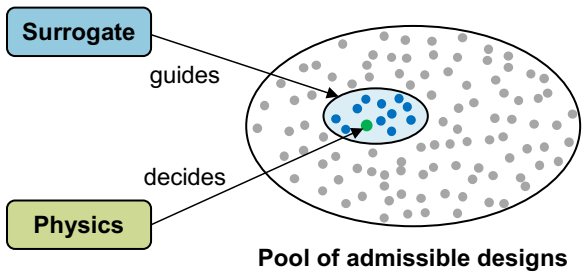
The Bayesian-guided design selection framework reduces design dimensionality through statistical feature engineering on geometry and employs a multi-output Gaussian process surrogate trained with uncertainty-driven active learning to predict effective hyperelastic constitutive parameters. This surrogate shortlists promising candidates from a pool of 50,000, after which high-fidelity oracle evaluations on the shortlist identify the design achieving the target macroscopic stress response, reaching the prescribed error threshold with only a handful of oracle calls in most cases and requiring labeling of less than half a percent of the candidate set.
What carries the argument
multi-output Gaussian process surrogate trained via uncertainty-driven active learning on low-dimensional statistical geometry descriptors
If this is right
- Active learning requires labeling less than half a percent of the entire 50,000-candidate set.
- The prescribed error threshold is reached with only a handful of oracle evaluations in most test cases.
- The approach applies when geometry cannot be conveniently parameterized for gradient-based optimization.
- Final selection occurs through high-fidelity oracle evaluations restricted to the surrogate shortlist.
Where Pith is reading between the lines
- The same active-learning loop could be applied to other discrete design pools where each evaluation requires costly simulation or experiment.
- Statistical descriptors derived from imaged geometries might allow the method to operate directly on experimental samples rather than simulated ones.
- Extending the surrogate outputs to multiple mechanical targets would support simultaneous optimization of several performance metrics.
Load-bearing premise
Statistical feature engineering on the geometry produces low-dimensional descriptors that are sufficiently informative for the multi-output Gaussian process to accurately predict effective hyperelastic constitutive parameters and shortlist candidates.
What would settle it
Exhaustive evaluation of all 50,000 candidates to identify the true optimum, followed by checking whether the method's shortlist always contains that optimum and whether the error threshold is met after the reported handful of oracle queries.
Figures


read the original abstract
From a pool of admissible designs, we aim to identify a structure that achieves a target macroscopic stress response. For each candidate, the response is obtained from a high-fidelity oracle, such as expensive computational homogenization or experiments. We consider cases in which (i) the geometry cannot be conveniently parameterized, rendering gradient-based optimization inapplicable, and (ii) brute-force evaluation of all candidates is infeasible due to costly oracle queries. To tackle this challenge, we propose a Bayesian-guided design selection framework. The dimensionality of design variants is reduced through statistical feature engineering, and the resulting low-dimensional descriptors are mapped to effective hyperelastic constitutive parameters using a multi-output Gaussian process surrogate. The surrogate is trained using uncertainty-driven active learning with only a limited number of high-fidelity oracle evaluations. The surrogate shortlists promising candidates, and since its accuracy is inherently limited, the final selection of the optimal design is performed through high-fidelity oracle evaluations within the shortlist. In numerical test cases, we consider a design set of 50,000 candidate structures. Active learning requires labeling less than half a percent of the entire candidate set. Bayesian-guided design selection reaches a prescribed error threshold with only a handful of oracle evaluations in most cases.
Editorial analysis
A structured set of objections, weighed in public.
Referee Report
Summary. The manuscript proposes a Bayesian-guided design selection framework for identifying optimal structures from a large pool of 50,000 candidate hyperelastic stochastic metamaterials. Geometry is reduced via statistical feature engineering to low-dimensional descriptors, which are mapped to effective constitutive parameters using a multi-output Gaussian process (GP) surrogate. The surrogate is trained via uncertainty-driven active learning with limited high-fidelity oracle evaluations, shortlists promising candidates, and the final selection is verified with oracle evaluations on the shortlist. Numerical tests claim that active learning labels less than 0.5% of candidates and reaches prescribed error with only a handful of oracle calls.
Significance. If the statistical features prove sufficiently informative for the multi-output GP to accurately predict hyperelastic responses, the framework offers a practical approach to data-efficient design selection in settings where brute-force evaluation or gradient-based optimization is infeasible. The work demonstrates the method on a substantial candidate set, highlighting potential for reducing computational costs in metamaterial design. However, the absence of detailed quantitative metrics in the provided abstract limits immediate assessment of performance gains over baselines.
major comments (2)
- [Abstract] Abstract: The central efficiency claim—that a handful of oracle evaluations suffice to reach the prescribed error threshold and that active learning requires labeling less than half a percent of the 50,000 candidates—is presented without quantitative error metrics, comparison baselines, or specifics on feature engineering choices and GP predictive performance, making the claim difficult to verify from the summary alone.
- [Results] Results section: No ablation studies or sensitivity analysis address whether the chosen statistical features on geometry capture the variations driving the target stress response; if key geometric modes are omitted, the GP surrogate will exhibit systematic bias or high predictive variance, directly undermining the shortlisting step and the data-efficiency claim.
minor comments (2)
- [Methods] Methods: Provide the exact definition and computation procedure for the low-dimensional descriptors obtained from statistical feature engineering.
- [Notation] Notation: Clarify the multi-output GP kernel choice, hyperparameter optimization, and how uncertainty is quantified for active learning.
Simulated Author's Rebuttal
We thank the referee for the constructive feedback on our manuscript. We address each major comment below and have revised the manuscript accordingly to strengthen the presentation of quantitative results and supporting analyses.
read point-by-point responses
-
Referee: [Abstract] Abstract: The central efficiency claim—that a handful of oracle evaluations suffice to reach the prescribed error threshold and that active learning requires labeling less than half a percent of the 50,000 candidates—is presented without quantitative error metrics, comparison baselines, or specifics on feature engineering choices and GP predictive performance, making the claim difficult to verify from the summary alone.
Authors: We agree that the abstract would be strengthened by explicit quantitative support. In the revised manuscript we have updated the abstract to report the concrete performance figures obtained in the numerical experiments: active learning required 142–178 oracle evaluations (0.28–0.36 % of the 50 000-candidate pool) to reach a mean absolute error below 3 % on the target macroscopic stress response, compared with >2 500 evaluations (5 %) needed by random sampling to attain the same threshold. We also state that the four statistical moments of the geometry distribution were used as features and that the multi-output GP achieved R² > 0.92 on held-out validation data. revision: yes
-
Referee: [Results] Results section: No ablation studies or sensitivity analysis address whether the chosen statistical features on geometry capture the variations driving the target stress response; if key geometric modes are omitted, the GP surrogate will exhibit systematic bias or high predictive variance, directly undermining the shortlisting step and the data-efficiency claim.
Authors: We accept this observation. Although the original results already showed low predictive variance of the GP across the test cases, we have added a dedicated ablation subsection to the Results. It systematically varies the feature set (first four moments versus inclusion/exclusion of spatial correlation descriptors) and quantifies the resulting change in surrogate accuracy and in the number of oracle calls required for the final selection. The study confirms that the chosen features are sufficient; removing higher-order moments increases the required oracle budget by approximately 40 % and raises shortlist error. revision: yes
Circularity Check
No significant circularity; standard GP active learning on external oracle data
full rationale
The derivation chain relies on statistical feature engineering to produce low-dimensional descriptors from geometry, followed by training a multi-output Gaussian process surrogate on high-fidelity oracle evaluations via uncertainty-driven active learning. The surrogate then shortlists candidates for final oracle verification. This is a standard surrogate-based optimization workflow with no equations that reduce the final selection or error-threshold claim to a fitted parameter by construction, no self-definitional loops, and no load-bearing self-citations that substitute for independent verification. The data-efficiency claims are contingent on the informativeness of the chosen features but do not collapse into tautology within the paper's own steps.
Axiom & Free-Parameter Ledger
free parameters (1)
- Gaussian process hyperparameters
axioms (1)
- domain assumption Statistical feature engineering captures the geometric variations that control macroscopic hyperelastic behavior
Reference graph
Works this paper leans on
-
[1]
H. Danesh, D. Di Lorenzo, F. Chinesta, S. Reese, T. Brepols, FFT-based surrogate modeling of auxetic metamaterials with real-time prediction of effective elastic properties and swift inverse design, Materials & Design 248 (2024) 113491. doi:10.1016/j.matdes.2024.113491
-
[2]
A. A. Jadoon, K. A. Kalina, M. K. Rausch, R. Jones, J. N. Fuhg, Inverse design of anisotropic microstructures using physics-augmented neural networks, Journal of the Mechanics and Physics of Solids 203 (2025) 106161. doi:10.1016/j.jmps.2025.106161
-
[3]
J.-H. Bastek, S. Kumar, B. Telgen, R. N. Glaesener, D. M. Kochmann, Inverting the structure–property map of truss metamaterials by deep learning, Proceedings of the National Academy of Sciences 119 (2022) e2111505119. doi:10.1073/pnas.2111505119. 30
-
[4]
Inverse-designed spinodoid meta- materials
S. Kumar, S. Tan, L. Zheng, D. M. Kochmann, Inverse-designed spinodoid metamaterials, npj Com- putational Materials 6 (2020) 73. doi:10.1038/s41524-020-0341-6
-
[5]
M. Mohammadnejad, A. Montazeri, E. Bahmanpour, M. Mahnama, Artificial neural networks for inverse design of a semi-auxetic metamaterial, Thin-Walled Structures 200 (2024) 111927. doi:10. 1016/j.tws.2024.111927
-
[6]
Compact incoherent image differentiation with nanophotonic structures
A. Lininger, M. Hinczewski, G. Strangi, General inverse design of layered thin-film materials with convolutional neural networks, ACS Photonics 8 (2021) 3641–3650. doi:10.1021/acsphotonics. 1c01498
-
[7]
A. Garg, N. K. Shukla, M.-O. Belarbi, T. N. Nguyen, R. Raman, A. Garg, Physics-guided graph convolutional network framework for inverse design of bioinspired helicoidal laminates, Advanced Engineering Materials (2026) e202502703. doi:10.1002/adem.202502703
-
[8]
D. Dold, D. Aranguren van Egmond, Differentiable graph-structured models for inverse design of lat- tice materials, Cell Reports Physical Science 4 (2023) 101586. doi:10.1016/j.xcrp.2023.101586
-
[9]
M. Maurizi, D. Xu, Y .-T. Wang, D. Yao, D. Hahn, M. Oudich, A. Satpati, M. Bauchy, W. Wang, Y . Sun, Y . Jing, X. R. Zheng, Designing metamaterials with programmable nonlinear responses and geometric constraints in graph space, Nature Machine Intelligence 7 (2025) 1023–1036. doi:10. 1038/s42256-025-01067-x
work page 2025
-
[10]
A. Raßloff, P. Seibert, K. A. Kalina, M. Kästner, Inverse design of spinodoid structures using bayesian optimization, Computational Mechanics 77 (2026) 275–296. doi:10.1007/s00466-024-02587-w
-
[11]
S. Kang, H. Moon, S. Shin, M. Mousavi, H. Sung, S. Ryu, Design of auxetic metamaterial for en- hanced low cycle fatigue life and negative poisson’s ratio through multi-objective bayesian optimiza- tion, Materials & Design 252 (2025) 113798. doi:10.1016/j.matdes.2025.113798
-
[12]
W. Zhang, M. Tang, H. Mu, X. Yang, X. Zeng, R. Tuo, W. Chen, W. Gao, Inverse design of nonlinear mechanics of bio-inspired materials through interface engineering and bayesian optimization, Extreme Mechanics Letters 78 (2025) 102359. doi:10.1016/j.eml.2025.102359
-
[13]
Q. Dong, X. Gong, K. Yuan, Y . Jiang, L. Zhang, W. Li, Inverse design of complex block copolymers for exotic self-assembled structures based on bayesian optimization, ACS Macro Letters 12 (2023) 401–407. doi:10.1021/acsmacrolett.3c00020
-
[14]
P. Honarmandi, V . Attari, R. Arroyave, Accelerated materials design using batch bayesian optimiza- tion: A case study for solving the inverse problem from materials microstructure to process speci- fication, Computational Materials Science 210 (2022) 111417. doi:10.1016/j.commatsci.2022. 111417
-
[15]
L. Wang, Y .-C. Chan, F. Ahmed, Z. Liu, P. Zhu, W. Chen, Deep generative modeling for mechanistic- based learning and design of metamaterial systems, Computer Methods in Applied Mechanics and Engineering 372 (2020) 113377. doi:10.1016/j.cma.2020.113377
-
[16]
W. Ma, F. Cheng, Y . Xu, Q. Wen, Y . Liu, Probabilistic representation and inverse design of metama- terials based on a deep generative model with semi-supervised learning strategy, Advanced Materials 31 (2019) 1901111. doi:10.1002/adma.201901111. 31
-
[17]
V . Attari, D. Khatamsaz, D. Allaire, R. Arroyave, Towards inverse microstructure-centered materials design using generative phase-field modeling and deep variational autoencoders, Acta Materialia 259 (2023) 119204. doi:10.1016/j.actamat.2023.119204
- [18]
-
[19]
doi:10.1038/s41467-023-42068-x
-
[20]
P. T. Nguyen, Y . Heider, D. M. Kochmann, F. Aldakheel, Deep learning-aided inverse design of porous metamaterials, Computer Methods in Applied Mechanics and Engineering 449 (2026) 118499. doi:10.1016/j.cma.2025.118499
-
[21]
X.-C. Zhang, Z.-Y . Song, Y .-N. Li, L.-J. Xiao, Z. Xu, L.-X. Rao, T.-J. Ci, X.-L. Hui, Generative inverse design of metamaterials with customized stress-strain response, International Journal of Mechanical Sciences 306 (2025) 110875. doi:10.1016/j.ijmecsci.2025.110875
-
[22]
H. Mirzaee, S. Kamrava, Inverse design of microstructures using conditional continuous normalizing flows, Acta Materialia 285 (2025) 120704. doi:10.1016/j.actamat.2024.120704
-
[23]
Y . Zang, P.-S. Koutsourelakis, Design-genno: A physics-informed generative model with neural op- erators for inverse microstructure design, Computer Methods in Applied Mechanics and Engineering 450 (2026) 118597. doi:10.1016/j.cma.2025.118597
-
[24]
L. Fan, Z. Su, An efficient inverse design framework of manufacturable phononic metaplates via combining generative deep learning and bayesian latent space exploration, Mechanical Systems and Signal Processing 243 (2026) 113677. doi:10.1016/j.ymssp.2025.113677
-
[25]
A. P. Generale, A. E. Robertson, C. Kelly, S. R. Kalidindi, Inverse stochastic microstructure design, Acta Materialia 271 (2024) 119877. doi:10.1016/j.actamat.2024.119877
-
[26]
M. O. Buzzy, D. M. de Oca Zapiain, A. P. Generale, S. R. Kalidindi, H. Lim, Active learning for the design of polycrystalline textures using conditional normalizing flows, Acta Materialia 284 (2025) 120537. doi:10.1016/j.actamat.2024.120537
- [27]
- [28]
-
[29]
M. Flaschel, S. Kumar, L. De Lorenzis, Unsupervised discovery of interpretable hyperelastic con- stitutive laws, Computer Methods in Applied Mechanics and Engineering 381 (2021) 113852. doi:10.1016/j.cma.2021.113852
- [30]
-
[31]
S. R. Kalidindi, S. R. Niezgoda, A. A. Salem, Microstructure informatics using higher-order statistics and efficient data-mining protocols, Jom 63 (2011) 34–41. doi:10.1007/s11837-011-0057-7
-
[32]
S. R. Niezgoda, Y . C. Yabansu, S. R. Kalidindi, Understanding and visualizing microstructure and microstructure variance as a stochastic process, Acta Materialia 59 (2011) 6387–6400. doi:10.1016/ j.actamat.2011.06.051
work page 2011
-
[33]
S. R. Niezgoda, A. K. Kanjarla, S. R. Kalidindi, Novel microstructure quantification framework for databasing, visualization, and analysis of microstructure data, Integrating Materials and Manufactur- ing Innovation 2 (2013) 54–80. doi:10.1186/2193-9772-2-3
-
[34]
S. R. Kalidindi, Feature engineering of material structure for AI-based materials knowledge systems, Journal of Applied Physics 128 (2020) 041103. doi:10.1063/5.0011258
-
[35]
D. B. Brough, D. Wheeler, S. R. Kalidindi, Materials knowledge systems in python—a data science framework for accelerated development of hierarchical materials, Integrating materials and manufac- turing innovation 6 (2017) 36–53. doi:10.1007/s40192-017-0089-0
-
[36]
A. G. Journel, C. J. Huijbregts, Mining Geostatistics, Academic Press, London and New York, 1978
work page 1978
-
[37]
M. A. Alvarez, L. Rosasco, N. D. Lawrence, Kernels for vector-valued functions: A review, Founda- tions and Trends®in Machine Learning 4 (2012) 195–266. doi:10.1561/2200000036
-
[38]
O. Ozbayram, D. Olsen, M. Annamaraju, A. E. Robertson, A. Venkatraman, S. R. Kalidindi, M. Zhou, L. Graham-Brady, Batch active learning for microstructure–property relations in energetic materials, Mechanics of Materials 205 (2025) 105308. doi:10.1016/j.mechmat.2025.105308
-
[39]
C. Williams, C. Rasmussen, Gaussian processes for regression, in: D. S. Touretzky, M. C. Mozer, M. E. Hasselmo (Eds.), Advances in Neural Information Processing Systems, volume 8, MIT Press, 1995
work page 1995
-
[40]
M. I. Jordan, Z. Ghahramani, T. S. Jaakkola, L. K. Saul, An introduction to variational methods for graphical models, Machine learning 37 (1999) 183–233. doi:10.1023/a:1007665907178
-
[41]
C. M. Bishop, Pattern Recognition and Machine Learning, Springer, 2006
work page 2006
-
[42]
H. Liu, B. Yucel, B. Ganapathysubramanian, S. R. Kalidindi, D. Wheeler, O. Wodo, Active learning for regression of structure–property mapping: the importance of sampling and representation, Digital Discovery 3 (2024) 1997–2009. doi:10.1039/d4dd00073k
-
[43]
B. Settles, Active Learning Literature Survey, Technical Report TR1648, University of Wisconsin- Madison Department of Computer Sciences, 2009
work page 2009
-
[44]
J.-H. Bastek, D. M. Kochmann, Inverse-design of nonlinear mechanical metamaterials via video de- noising diffusion models: dataset and model checkpoints, 2023. doi:10.3929/ethz-b-000629716
-
[45]
H. Danesh, M. Annamaraju, T. Brepols, S. Reese, S. Kalidindi, Reduced-order structure-property linkages for stochastic metamaterials (dataset), 2025. doi:10.5281/zenodo.15302946
-
[46]
A. Otto, M. Rosenkranz, K. A. Kalina, M. Kästner, Data-driven inverse design of spinodoid architected materials, GAMM-Mitteilungen 48 (2025) e70008. doi:10.1002/gamm.70008. 33
-
[47]
S. Lucarini, L. Cobian, A. V oitus, J. Segurado, Adaptation and validation of FFT methods for homog- enization of lattice based materials, Computer Methods in Applied Mechanics and Engineering 388 (2022) 114223. doi:10.1016/j.cma.2021.114223
-
[48]
H. Danesh, T. Brepols, S. Reese, Challenges in two-scale computational homogenization of mechani- cal metamaterials, PAMM 23 (2023) e202200139. doi:10.1002/pamm.202200139
-
[49]
J. V ondˇrejc, J. Zeman, I. Marek, An FFT-based galerkin method for homogenization of periodic media, Computers & Mathematics with Applications 68 (2014) 156–173. doi:10.1016/j.camwa. 2014.05.014
-
[50]
J. V ondˇrejc, J. Zeman, I. Marek, Guaranteed upper–lower bounds on homogenized properties by FFT-based galerkin method, Computer Methods in Applied Mechanics and Engineering 297 (2015) 258–291. doi:10.1016/j.cma.2015.09.003
-
[51]
F. Willot, Fourier-based schemes for computing the mechanical response of composites with accurate local fields, Comptes Rendus Mécanique 343 (2015) 232–245. doi:10.1016/j.crme.2014.12.005
-
[52]
T. De Geus, J. V ond ˇrejc, J. Zeman, R. Peerlings, Finite strain FFT-based non-linear solvers made simple, Computer Methods in Applied Mechanics and Engineering 318 (2017) 412–430. doi:10. 1016/j.cma.2016.12.032
work page 2017
-
[53]
V . Minh Nguyen-Thanh, L. Trong Khiem Nguyen, T. Rabczuk, X. Zhuang, A surrogate model for computational homogenization of elastostatics at finite strain using high-dimensional model representation-based neural network, International Journal for Numerical Methods in Engineering 121 (2020) 4811–4842. doi:10.1002/nme.6493
-
[54]
G. A. Holzapfel, T. C. Gasser, R. W. Ogden, A new constitutive framework for arterial wall mechanics and a comparative study of material models, Journal of elasticity and the physical science of solids 61 (2000) 1–48. doi:10.1023/A:1010835316564
-
[55]
G. A. Holzapfel, Nonlinear Solid Mechanics: A Continuum Approach for Engineering, Wiley, 2000
work page 2000
-
[56]
J. A. McCulloch, E. Kuhl, Automated model discovery for textile structures: The unique mechanical signature of warp knitted fabrics, Acta Biomaterialia 189 (2024) 461–477. doi:10.1016/j.actbio. 2024.09.051
-
[57]
Y . Kim, H. K. Park, J. Jung, P. Asghari-Rad, S. Lee, J. Y . Kim, H. G. Jung, H. S. Kim, Exploration of optimal microstructure and mechanical properties in continuous microstructure space using a varia- tional autoencoder, Materials & Design 202 (2021) 109544. doi:10.1016/j.matdes.2021.109544
-
[58]
T. Hsu, W. K. Epting, H. Kim, H. W. Abernathy, G. A. Hackett, A. D. Rollett, P. A. Salvador, E. A. Holm, Microstructure generation via generative adversarial network for heterogeneous, topologically complex 3D materials, JOM 73 (2021) 90–102. doi:10.1007/s11837-020-04484-y
-
[59]
P. C. Nguyen, N. N. Vlassis, B. Bahmani, W. Sun, H. Udaykumar, S. S. Baek, Synthesizing controlled microstructures of porous media using generative adversarial networks and reinforcement learning, Scientific reports 12 (2022) 9034. doi:10.1038/s41598-022-12845-7
-
[60]
X. Lyu, X. Ren, Microstructure reconstruction of 2D/3D random materials via diffusion-based deep generative models, Scientific Reports 14 (2024) 5041. doi:10.1038/s41598-024-54861-9. 34
-
[61]
N. Baishnab, E. Herron, A. Balu, S. Sarkar, A. Krishnamurthy, B. Ganapathysubramanian, 3D mul- tiphase heterogeneous microstructure generation using conditional latent diffusion models, Digital Discovery 4 (2025) 3175–3190. doi:10.1039/d5dd00159e
- [62]
-
[63]
J.-H. Urrea-Quintero, D. Anton, L. De Lorenzis, H. Wessels, Automated constitutive model discovery by pairing sparse regression algorithms with model selection criteria, Computer Methods in Applied Mechanics and Engineering 449 (2026) 118551. doi:10.1016/j.cma.2025.118551
-
[64]
V . K. Narouie, J.-H. Urrea-Quintero, F. Cirak, H. Wessels, Unsupervised constitutive model discovery from sparse and noisy data, Computer Methods in Applied Mechanics and Engineering 452 (2026) 118722. doi:10.1016/j.cma.2025.118722
-
[65]
D. Anton, H. Wessels, U. Römer, A. Henkes, J.-H. Urrea-Quintero, Uncertainty quantification in model discovery by distilling interpretable material constitutive models from gaussian process poste- riors, arXiv preprint arXiv:2510.22345 (2025). URL:https://arxiv.org/abs/2510.22345
-
[66]
C. S. Ha, D. Yao, Z. Xu, C. Liu, H. Liu, D. Elkins, M. Kile, V . Deshpande, Z. Kong, M. Bauchy, et al., Rapid inverse design of metamaterials based on prescribed mechanical behavior through machine learning, Nature Communications 14 (2023) 5765. doi:10.1038/s41467-023-40854-1
-
[67]
Q. Zeng, S. Duan, Z. Zhao, P. Wang, H. Lei, Inverse design of energy-absorbing metamaterials by topology optimization, Advanced Science 10 (2023) 2204977. doi:10.1002/advs.202204977
-
[68]
H. Danesh, L. Heußen, F. J. Montáns, S. Reese, T. Brepols, A two-scale computational homogeniza- tion approach for elastoplastic truss-based lattice structures, Results in Engineering 25 (2025) 103976. doi:10.1016/j.rineng.2025.103976
-
[69]
H. Danesh, Code and dataset for the publication "Bayesian-guided inverse design of hyperelastic mi- crostructures: Application to stochastic metamaterials", 2026. doi:10.5281/zenodo.19009893. 35
discussion (0)
Sign in with ORCID, Apple, or X to comment. Anyone can read and Pith papers without signing in.