A Full-Density Approach to Simulating Random Iteration Equations with Applications
Pith reviewed 2026-05-15 09:05 UTC · model grok-4.3
The pith
A computational method propagates full probability densities through random iteration equations without relying on repeated Monte Carlo simulations.
A machine-rendered reading of the paper's core claim, the machinery that carries it, and where it could break.
Core claim
The paper claims that full probability densities of state vectors can be propagated stepwise through iterations of random equations, enabling accurate simulation without repetitive pathwise Monte Carlo runs, and this is applicable even to nonsmooth nonlinearities, nonstandard densities, and diffusion processes.
What carries the argument
Stepwise full-density propagation of state vectors in random iteration equations, which carries the full probabilistic information forward without sampling individual trajectories.
Where Pith is reading between the lines
- Such density propagation might naturally lead to partial differential equations in the continuous-time limit.
- Applications could extend to high-dimensional systems if computational scaling is addressed.
- The method may integrate with existing numerical schemes for density evolution in dynamical systems.
Load-bearing premise
The premise that full-density propagation remains accurate and computationally feasible without hidden approximations when dealing with nonsmooth nonlinearities and nonstandard densities.
What would settle it
Compare the densities obtained from this propagation method against exact analytical solutions or very high-sample Monte Carlo results for a simple random iteration equation with known distribution.
Figures




read the original abstract
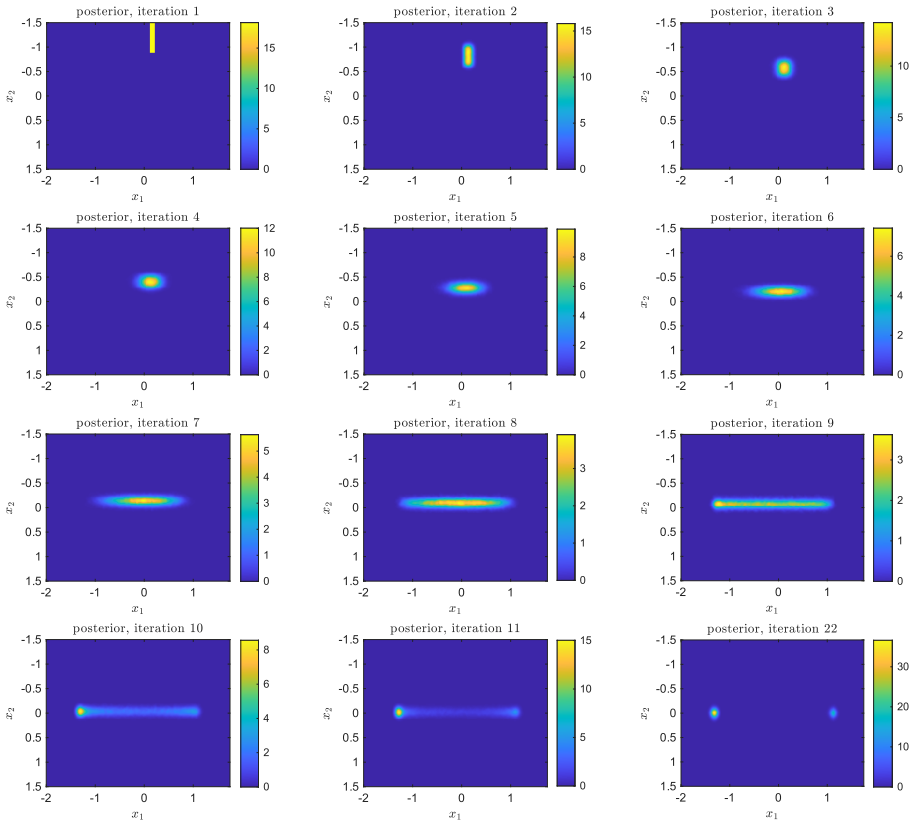
The goal of this study is to introduce a unified computational framework for simulating random iteration equations (RIE), understood as iteration equations containing random variables. The novelty of this work is that full probability densities of the state vectors are propagated stepwise through the iterations avoiding the need of repetitive pathwise Monte Carlo simulations of the iteration equation. The presentation of the methodology is conceptually efficient based on recent work on static random equations and intentionally accessible. Based on previous work, the modeling requirements for RIEs allow for potential nonsmooth nonlinearities and stochasticities in the transfer function, as well as nonstandard probability densities and diffusion processes. As results, illustrative applications of nonlinear random and stochastic differential equation simulations, a novel full-density gradient descent method (FDGD) for global optimization under uncertainty and examples of chaotic mappings are presented in order to demonstrate the breadth of the utility of this framework. In total, the character of the presentation is explorative and encourages new applications and theoretical studies.
Editorial analysis
A structured set of objections, weighed in public.
Referee Report
Summary. The manuscript introduces a unified computational framework for simulating random iteration equations (RIEs) by propagating full probability densities of state vectors stepwise through iterations. This approach is claimed to avoid repetitive pathwise Monte Carlo simulations while accommodating nonsmooth nonlinearities, nonstandard densities, and diffusion processes. Applications include simulations of nonlinear random and stochastic differential equations, a novel full-density gradient descent (FDGD) method for global optimization under uncertainty, and examples of chaotic mappings. The presentation builds on prior work on static random equations and is described as conceptually efficient and explorative.
Significance. If the full-density propagation can be shown to be accurate with controllable error for the stated class of problems, the framework would offer a deterministic alternative to Monte Carlo sampling for uncertainty quantification in iterative dynamical systems. The FDGD optimization technique could be particularly useful if density gradients are reliably obtained. The work's explorative character and emphasis on accessibility may encourage further studies, but its significance is currently limited by the absence of explicit error analysis or implementation details for the core propagation step.
major comments (2)
- [Abstract] Abstract: The central claim that full probability densities are propagated 'avoiding the need of repetitive pathwise Monte Carlo simulations' is load-bearing for the no-sampling advantage. However, the abstract provides no description of the density representation (grid, kernel, parametric, or functional) or how the push-forward is computed under nonsmooth nonlinear transfer functions, where the standard formula p_{n+1}(y) = sum p_n(x)/|f'(x)| fails at kinks and requires distributional terms such as Dirac deltas. Without this, it is impossible to verify whether the method remains exact or introduces uncontrolled approximations.
- [Applications] Applications section (chaotic mappings and SDEs): For chaotic maps and diffusion processes, density propagation must handle expanding or nonsmooth dynamics while preserving measure-theoretic properties. No verification against known invariant densities (e.g., for the logistic map) or error bounds independent of discretization is provided, which undermines the claim that the method supports 'potential nonsmooth nonlinearities' without hidden sampling or smoothing steps.
minor comments (2)
- [Abstract] The abstract is lengthy and contains redundant phrasing; a shorter version focused on the algorithmic novelty and one key application would improve readability.
- Notation for the random iteration equation and the modeling requirements (e.g., how stochasticities enter the transfer function) is not introduced early enough, making the connection to prior static random-equation work difficult to follow.
Simulated Author's Rebuttal
We thank the referee for their constructive comments on our manuscript. We address each major point below, providing clarifications from the full text and indicating revisions where appropriate to strengthen the presentation.
read point-by-point responses
-
Referee: [Abstract] Abstract: The central claim that full probability densities are propagated 'avoiding the need of repetitive pathwise Monte Carlo simulations' is load-bearing for the no-sampling advantage. However, the abstract provides no description of the density representation (grid, kernel, parametric, or functional) or how the push-forward is computed under nonsmooth nonlinear transfer functions, where the standard formula p_{n+1}(y) = sum p_n(x)/|f'(x)| fails at kinks and requires distributional terms such as Dirac deltas. Without this, it is impossible to verify whether the method remains exact or introduces uncontrolled approximations.
Authors: We agree the abstract is overly brief on implementation specifics. Section 2 of the manuscript details a uniform-grid histogram discretization of the density, with the push-forward realized by evaluating the (possibly nonsmooth) transfer function on grid nodes and conservatively redistributing mass into target bins via a piecewise-linear accumulation scheme. This binning procedure automatically accommodates kinks and discontinuities by allowing probability mass to concentrate without explicit Dirac-delta terms. We will revise the abstract to include a concise clause: 'via a conservative grid-based push-forward operator on discretized densities'. This makes the no-sampling claim directly verifiable while preserving the abstract's length. revision: yes
-
Referee: [Applications] Applications section (chaotic mappings and SDEs): For chaotic maps and diffusion processes, density propagation must handle expanding or nonsmooth dynamics while preserving measure-theoretic properties. No verification against known invariant densities (e.g., for the logistic map) or error bounds independent of discretization is provided, which undermines the claim that the method supports 'potential nonsmooth nonlinearities' without hidden sampling or smoothing steps.
Authors: The applications are presented as illustrative demonstrations rather than exhaustive benchmarks. We will add, in the revised chaotic-maps subsection, a direct comparison for the logistic map showing that iterated densities converge to the known invariant arcsine measure under successive grid refinements. For the SDE examples we will include a short grid-convergence study (comparing successive refinements to a reference Monte Carlo ensemble) and a brief discussion of how discretization error scales with grid size. We do not claim discretization-independent error bounds, as the method is inherently numerical; the added material will clarify this dependence while confirming that no hidden sampling or smoothing is used. revision: partial
Circularity Check
No significant circularity; extension from static to iterative case remains independent
full rationale
The paper positions its core contribution as a stepwise full-density propagation for random iteration equations, explicitly building on prior static random equation results. The abstract and description reference previous work for modeling requirements but do not define the iterative density update in terms of parameters fitted from the present paper's own outputs. No equations are shown reducing by construction to self-citations or fitted inputs; the applications (chaotic maps, SDEs, FDGD) are presented as demonstrations rather than tautological verifications. This yields only minor self-citation load without forcing the central claim.
Axiom & Free-Parameter Ledger
Lean theorems connected to this paper
-
IndisputableMonolith/Foundation/RealityFromDistinction.leanreality_from_one_distinction unclear?
unclearRelation between the paper passage and the cited Recognition theorem.
full probability densities of the state vectors are propagated stepwise through the iterations avoiding the need of repetitive pathwise Monte Carlo simulations
-
IndisputableMonolith/Cost/FunctionalEquation.leanwashburn_uniqueness_aczel unclear?
unclearRelation between the paper passage and the cited Recognition theorem.
linear RIE operator ... regularized stochastic transfer operator
What do these tags mean?
- matches
- The paper's claim is directly supported by a theorem in the formal canon.
- supports
- The theorem supports part of the paper's argument, but the paper may add assumptions or extra steps.
- extends
- The paper goes beyond the formal theorem; the theorem is a base layer rather than the whole result.
- uses
- The paper appears to rely on the theorem as machinery.
- contradicts
- The paper's claim conflicts with a theorem or certificate in the canon.
- unclear
- Pith found a possible connection, but the passage is too broad, indirect, or ambiguous to say the theorem truly supports the claim.
Reference graph
Works this paper leans on
-
[1]
Li, J., Chen, J.The principle of preservation of probability and the generalized density evolution equation, Structural Safety 30 (2008) 65–77, https://doi.org/10.1016/j.strusafe.2006.08.001
-
[2]
Caluya, K. F., Halder, A.Gradient Flow Algorithms for Density Propagation in Stochas- tic Systems, IEEE Transactions on Automatic Control, Volume 65, Issue: 10, 2020. https://doi.org/10.1109/TAC.2019.2951348
-
[3]
DOI: 10.1007/978-3-319-23395-6
Sullivan, T.J., Introduction to Uncertainty Quantification, Springer International Publishing, 2015. DOI: 10.1007/978-3-319-23395-6
-
[4]
Garc´ ıa-S´ anchez, G., Mancho, A.M., Wiggins, S.A bridge between invariant dynamical structures and uncertainty quantification, Communications in Nonlinear Science and Numerical Simulation 104 (2022), https://doi.org/10.1016/j.cnsns.2021.106016
-
[5]
Rubinstein R. Y., Kroese D. P.,Simulation and the Monte Carlo Method, 3. Auflage, John Wiley & Sons, 2017
work page 2017
-
[6]
Kloeden, P. E., Platen, E.,Numerical Solution of Stochastic Differential Equations, Springer Berlin, Heidelberg, 1992
work page 1992
-
[7]
696-715, 2026, https://doi.org/10.1016/j.matcom.2025.07.033
Hoegele, W.Combinatorial potential of random equations with mixture models: Model- ing and simulation, Mathematics and Computers in Simulation 239, pp. 696-715, 2026, https://doi.org/10.1016/j.matcom.2025.07.033
-
[8]
Sandri´ c, N.Rademacher learning rates for iterated random functions, Journal of Complexity, Volume 91, https://doi.org/10.1016/j.jco.2025.101971
-
[9]
Diaconis, P., Freedman D.Iterated Random Functions. SIAM Review, Vol. 41, Iss. 1, 1999 https://doi.org/10.1137/S0036144598338446
-
[10]
Surasinghe S, Fish J, Bollt EM.Learning transfer operators by kernel density estimation.Chaos. 2024 Feb 1;34(2):023126. doi: 10.1063/5.0179937
-
[11]
Jornet, M.Theory and methods for random differential equations: a survey.SeMA 80, 549–579,
-
[12]
https://doi.org/10.1007/s40324-022-00314-0
-
[13]
Higham D. J.,An Algorithmic Introduction to Numerical Simulation of Stochastic Differential Equa- tions, SIAM Review, Vol. 43,No. 3,pp. 525–546, Society for Industrial and Applied Mathematics, 2001
work page 2001
-
[14]
Jian Zu,Random walk numerical scheme for the steady-state of stochastic differential equations, Communications in Nonlinear Science and Numerical Simulation 121 (2023), https://doi.org/10.1016/j.cnsns.2023.107200
-
[15]
Goodfellow, J., Bengio, Y., Courville, A.Deep Learning, MIT Press, 2016
work page 2016
-
[16]
Mandt, S., Hoffmann, M. D., Blei, D. M.,Stochastic Gradient Descent as Approximate Bayesian Inference, Journal of Machine Learning Research, 18 1-35, 2017
work page 2017
-
[17]
Przyby lowicz, P., Sobieraj, M.On the randomized Euler scheme for stochastic differential equa- tions with integral-form drift, Journal of Computational and Applied Mathematics 483, 2026, https://doi.org/10.1016/j.cam.2026.117367
-
[18]
N. Stollenwerk, M. Aguiar, B.W. Kooi,Modelling Holling type II functional response in deterministic and stochastic food chain models with mass conservation, Ecological Complexity 49, 100982, 2022, https://doi.org/10.1016/j.ecocom.2022.100982
-
[19]
Sarah K. Wyse, Maria M. Martignoni, May Anne Mata, Eric Foxall, Rebecca C. Tyson,Structural sensitivity in the functional responses of predator–prey models, Ecological Complexity 51, 101014, 2022, https://doi.org/10.1016/j.ecocom.2022.101014. 21
-
[20]
Hoegele, W.Steady State Distribution and Stability Analysis of Random Differential Equations with Uncertainties and Superpositions: Application to a Predator Prey Model, 2026, arXiv:2603.03845 [math.DS], https://doi.org/10.48550/arXiv.2603.03845
-
[21]
Louis Shuo Wang, Jiguang Yu,Well-Posedness for the Rosenzweig-MacArthur Model with Internal Stochasticity, arXiv:2505.16904 [math.PR], 2025, https://doi.org/10.48550/arXiv.2505.16904
- [22]
-
[23]
Wang,M., Yi, Z., Li, Z.A memristive Ikeda map and its application in image encryption, Chaos, Solitons & Fractals, Volume 190, 2025, https://doi.org/10.1016/j.chaos.2024.115740
-
[24]
Lozi R.Survey of Recent Applications of the Chaotic Lozi Map. Algorithms. 2023; 16(10):491. https://doi.org/10.3390/a16100491
-
[25]
Penenko, A.V., Kazakov, G.I., Ivanov, K.O.Algorithms for Approximate Solution of ODE En- sembles Using Clustering and Sensitivity Matrices.Numer. Analys. Appl. 18, 157–172 (2025). https://doi.org/10.1134/S1995423925020053
-
[26]
Sadegh Amiri, S. Mohammad HosseiniA class of weak second order split-drift stochastic Runge–Kutta schemes for stiff SDE systems.Journal of Computational and Applied Mathematics 275, 27-43 (2015). https://doi.org/10.1016/j.cam.2014.07.023 22
discussion (0)
Sign in with ORCID, Apple, or X to comment. Anyone can read and Pith papers without signing in.