Recognition: no theorem link
Cyberlanguage: Native Communication for the Cyber-Physical-Social-Thinking Fusion Space
Pith reviewed 2026-05-15 08:43 UTC · model grok-4.3
The pith
Cyberlanguage is introduced as a native communicative framework for the unified cyber-physical-social-thinking fusion space.
A machine-rendered reading of the paper's core claim, the machinery that carries it, and where it could break.
Core claim
We introduce Cyberlanguage, a theoretically grounded communicative framework that is native to the CPST fusion space. Grounded in the philosophical orientation of cyberism and employing CPST theory as an analytical framework, Cyberlanguage possesses four core characteristics: native four-dimensional fusion, multi-agent universality, dynamic compilability, and contextual adaptability. We have constructed a semiotic model based on the Cybersign unit, a four-dimensional synchronous grammar, a five-layer architectural stack, and a context-driven pragmatic mechanism. We also present testable empirical predictions and a staged implementation roadmap.
What carries the argument
The Cybersign unit as the basic semiotic element enabling a four-dimensional synchronous grammar and five-layer architectural stack for fused communication.
If this is right
- It can coordinate heterogeneous agents including humans, artificial intelligences, robots, and digital entities within the fused space.
- It serves as a meta-communication infrastructure capable of operating alongside natural and programming languages.
- Dynamic compilability and contextual adaptability enable real-time adjustment to changing multi-dimensional contexts.
- A staged implementation roadmap with testable empirical predictions supports practical development.
Where Pith is reading between the lines
- This framework might enable new forms of real-time coordination in smart environments where physical actions, social intent, and digital code interact seamlessly.
- Extensions could involve hybrid systems that use Cyberlanguage as an overlay on existing programming interfaces for AI-physical integration.
- Empirical tests in virtual or augmented settings simulating fusion scenarios could reveal whether traditional languages truly fail at four-dimensional tasks.
Load-bearing premise
The cyber-physical-social-thinking fusion space exists as an inseparable unified domain that existing natural and programming languages cannot serve, necessitating an entirely new native communicative framework.
What would settle it
A demonstration that existing languages with minor extensions can successfully coordinate agents across all four fused dimensions in a CPST simulation without requiring the proposed four characteristics or Cybersign-based architecture would challenge the central claim.
Figures


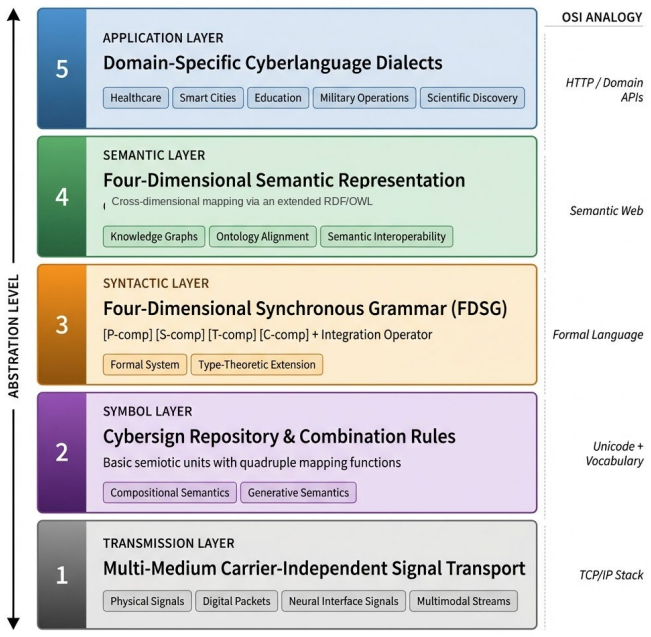
read the original abstract
Human communication is undergoing a fundamental paradigm shift. Physical space, social relations, mental states, and digital information are converging into a unified cyber-physical-social-thinking (CPST) fusion space, rendering them no longer separable domains. However, all existing communication systems, including natural and programming languages, as well as interaction protocols, were designed for a world in which these four dimensions remained distinct. We introduce Cyberlanguage, a theoretically grounded communicative framework that is native to the CPST fusion space. Grounded in the philosophical orientation of cyberism and employing CPST theory as an analytical framework, Cyberlanguage possesses four core characteristics: native four-dimensional fusion, multi-agent universality, dynamic compilability, and contextual adaptability. We have constructed a semiotic model based on the Cybersign unit, a four-dimensional synchronous grammar, a five-layer architectural stack, and a context-driven pragmatic mechanism. We also present testable empirical predictions and a staged implementation roadmap. Cyberlanguage is not intended to replace natural or programming languages, but rather to serve as a meta-communication infrastructure capable of coordinating heterogeneous agents, humans, artificial intelligences, robots, and digital entities, within an increasingly fused cyber-physical-social-cognitive reality.
Editorial analysis
A structured set of objections, weighed in public.
Referee Report
Summary. The manuscript introduces Cyberlanguage as a theoretically grounded communicative framework native to the cyber-physical-social-thinking (CPST) fusion space. It posits that physical, social, mental, and digital domains are converging into an inseparable unified space for which existing languages are inadequate, and proposes a framework with four core characteristics—native four-dimensional fusion, multi-agent universality, dynamic compilability, and contextual adaptability—supported by a semiotic model using Cybersign units, a four-dimensional synchronous grammar, a five-layer architectural stack, and a context-driven pragmatic mechanism. The paper also outlines testable empirical predictions and a staged implementation roadmap.
Significance. If the central claims are substantiated through formal derivations and empirical validation, Cyberlanguage could provide a novel meta-communication infrastructure for coordinating heterogeneous agents including humans, AIs, and robots in fused environments. This has potential significance for advancing multi-agent systems, cyber-physical systems, and human-computer interaction by addressing the limitations of current communication paradigms in integrated spaces. The inclusion of testable predictions and a roadmap is a positive step toward falsifiability.
major comments (4)
- Introduction: The claim that all existing communication systems were designed for distinct domains and cannot serve the CPST fusion space lacks specific analysis or counterexamples demonstrating the inadequacy of extensions to current systems such as multimodal LLMs or agent communication languages like FIPA-ACL.
- Core Characteristics section: The four core characteristics are asserted as properties of Cyberlanguage but are not derived from CPST theory through explicit logical steps or formal arguments; they appear as definitional rather than consequential.
- Semiotic Model and Architecture sections: The Cybersign unit, four-dimensional synchronous grammar, and five-layer stack are named and described at a high level but receive no operational definitions, formal specifications, or examples that would enable implementation, testing, or verification of the claimed characteristics.
- Empirical Predictions section: While testable empirical predictions are mentioned, the manuscript does not provide concrete, falsifiable hypotheses with measurable outcomes or proposed experimental designs to validate the framework's necessity or superiority.
minor comments (2)
- Abstract: The abstract could more clearly distinguish between the philosophical grounding and the technical contributions to improve readability for a technical audience.
- References: Additional references to existing work on cyber-physical systems integration and multi-agent communication protocols would strengthen the positioning of the new framework.
Simulated Author's Rebuttal
We appreciate the referee's constructive feedback, which identifies key areas for strengthening the manuscript's rigor and clarity. We will revise the paper to incorporate specific analyses, explicit derivations, operational details, and concrete empirical designs while preserving the conceptual nature of the proposed framework.
read point-by-point responses
-
Referee: Introduction: The claim that all existing communication systems were designed for distinct domains and cannot serve the CPST fusion space lacks specific analysis or counterexamples demonstrating the inadequacy of extensions to current systems such as multimodal LLMs or agent communication languages like FIPA-ACL.
Authors: We agree that additional concrete analysis is warranted. In the revised manuscript, we will add a dedicated subsection in the Introduction that provides targeted counterexamples. This will include a discussion of how multimodal LLMs, despite their cross-modal capabilities, lack native primitives for simultaneous four-dimensional fusion (e.g., real-time integration of physical sensor data with unobservable mental states), and why FIPA-ACL's performative semantics do not support dynamic compilability or contextual adaptability across heterogeneous agents in inseparable CPST environments. These additions will substantiate the claim with focused limitations rather than broad assertions. revision: yes
-
Referee: Core Characteristics section: The four core characteristics are asserted as properties of Cyberlanguage but are not derived from CPST theory through explicit logical steps or formal arguments; they appear as definitional rather than consequential.
Authors: The characteristics are intended as direct consequences of CPST fusion. We will revise the Core Characteristics section to include explicit logical derivations: for example, native four-dimensional fusion follows from the premise that the four domains are no longer separable, necessitating primitives that operate synchronously rather than through post-hoc integration; multi-agent universality derives from the requirement to coordinate entities with differing representational capacities within the same fused space. Similar step-by-step arguments will be added for dynamic compilability and contextual adaptability, grounding each in CPST theory. revision: yes
-
Referee: Semiotic Model and Architecture sections: The Cybersign unit, four-dimensional synchronous grammar, and five-layer stack are named and described at a high level but receive no operational definitions, formal specifications, or examples that would enable implementation, testing, or verification of the claimed characteristics.
Authors: We acknowledge that the current presentation remains at a conceptual level. The revised manuscript will expand these sections with operational definitions, including a formal grammar specification (e.g., using extended BNF notation for the synchronous grammar), pseudocode for the five-layer stack's compilation and execution mechanisms, and at least two concrete examples of Cybersign units applied to a sample scenario involving human-AI-robot coordination in a fused physical-digital task. These additions will support initial verification and testing. revision: yes
-
Referee: Empirical Predictions section: While testable empirical predictions are mentioned, the manuscript does not provide concrete, falsifiable hypotheses with measurable outcomes or proposed experimental designs to validate the framework's necessity or superiority.
Authors: We will substantially expand the Empirical Predictions section. We will formulate specific, falsifiable hypotheses with measurable outcomes, such as: 'In a CPST simulation environment, multi-agent teams employing Cyberlanguage will exhibit at least 25% higher coordination efficiency (measured by reduced task completion time and conflict resolution latency) compared to teams using FIPA-ACL extensions.' We will also describe proposed experimental designs, including simulation parameters, participant configurations (human, AI, robotic agents), and evaluation metrics to enable empirical validation of necessity and superiority. revision: yes
Circularity Check
Cyberlanguage's four core characteristics are stipulated as necessary for CPST fusion and then defined into the framework by construction
specific steps
-
self definitional
[Abstract]
"We introduce Cyberlanguage, a theoretically grounded communicative framework that is native to the CPST fusion space. Grounded in the philosophical orientation of cyberism and employing CPST theory as an analytical framework, Cyberlanguage possesses four core characteristics: native four-dimensional fusion, multi-agent universality, dynamic compilability, and contextual adaptability."
The paper first asserts that CPST fusion makes existing languages inadequate and therefore necessitates a new framework with precisely these four characteristics; it then defines Cyberlanguage as possessing exactly those characteristics. The characteristics are both the claimed necessary consequence of CPST theory and the definitional content of the proposed solution, with no separate derivation showing they must arise from the theory rather than being stipulated to fit the premise.
full rationale
The paper's central derivation asserts that the CPST fusion space renders prior languages inadequate and therefore requires a new native framework possessing exactly four listed characteristics. It then introduces Cyberlanguage as possessing those same characteristics by definition, grounded in the same CPST theory invoked to establish the premise. No independent derivation, formal necessity proof, or external benchmark is supplied to show the characteristics follow from CPST theory rather than being chosen to match the asserted need. This matches the self-definitional pattern: the solution is constructed to contain the properties that were posited as required. The claim remains partially self-contained because the paper does not rely on load-bearing self-citations or fitted parameters, but the core necessity argument reduces to internal stipulation.
Axiom & Free-Parameter Ledger
axioms (2)
- domain assumption The cyber-physical-social-thinking (CPST) fusion space is a unified domain in which physical, social, mental, and digital elements are no longer separable.
- domain assumption Cyberism supplies the appropriate philosophical orientation for designing communication in the CPST space.
invented entities (3)
-
Cybersign unit
no independent evidence
-
Four-dimensional synchronous grammar
no independent evidence
-
Five-layer architectural stack
no independent evidence
Reference graph
Works this paper leans on
-
[1]
Wiener.Cybernetics or Control and Communication in the Animal and the Machine
N. Wiener.Cybernetics or Control and Communication in the Animal and the Machine. MIT Press, 1961
work page 1961
-
[2]
Gerovitch.From Newspeak to Cyberspeak: A History of Soviet Cybernetics
S. Gerovitch.From Newspeak to Cyberspeak: A History of Soviet Cybernetics. MIT Press, 2002
work page 2002
-
[3]
H. Ning, J. Ding, and K. Michael. Cyberism: the fourth paradigm for the digital age. Computer, 2026. DOI: 10.1109/MC.2026.3655852
-
[4]
Floridi.The Fourth Revolution: How the Infosphere is Reshaping Human Reality
L. Floridi.The Fourth Revolution: How the Infosphere is Reshaping Human Reality. Oxford University Press, 2014
work page 2014
-
[5]
C. E. Shannon and W. Weaver. A mathematical theory of communication.The Bell System Technical Journal, 27(3):379–423, 1948
work page 1948
-
[6]
H. Ning. The fourth guiding principle for humans in the digital age: an initial exploration and framework construction of Cybersophy.Chinese Journal of Engineering, 47(12):2470– 2478, 2025
work page 2025
-
[7]
H. Ning et al. Cyberology: Cyber–Physical–Social-Thinking spaces-based discipline and in- terdiscipline hierarchy for metaverse (general cyberspace).IEEE Internet of Things Journal, 10:4420–4430, 2023
work page 2023
-
[8]
H. Ning and H. Liu. Cyber-physical-social-thinking space based science and technology framework for the Internet of Things.Science China Information Sciences, 58(3):1–19, 2015
work page 2015
- [9]
-
[10]
Stiegler.Technics and Time, 1: The Fault of Epimetheus
B. Stiegler.Technics and Time, 1: The Fault of Epimetheus. Stanford University Press, 1998
work page 1998
-
[11]
J. L. Austin.How to Do Things with Words. Oxford University Press, 1962
work page 1962
-
[12]
J. R. Searle.Speech Acts: An Essay in the Philosophy of Language. Cambridge University Press, 1969
work page 1969
-
[13]
J. J. Gibson.The Ecological Approach to Visual Perception. Houghton Mifflin, 1979
work page 1979
-
[14]
J. J. Gibson.The Ecological Approach to Visual Perception: Classic Edition. Taylor & Francis, 2015
work page 2015
-
[15]
Latour.Reassembling the Social: An Introduction to Actor-Network Theory
B. Latour.Reassembling the Social: An Introduction to Actor-Network Theory. Oxford University Press, 2005
work page 2005
-
[16]
Castells.The Rise of the Network Society
M. Castells.The Rise of the Network Society. Blackwell, 1996
work page 1996
- [17]
- [18]
-
[19]
Bateson.Steps to an Ecology of Mind
G. Bateson.Steps to an Ecology of Mind. University of Chicago Press, 2000
work page 2000
-
[20]
R. Kitchin and M. Dodge.Code/Space: Software and Everyday Life. MIT Press, 2011
work page 2011
-
[21]
Hui.On the Existence of Digital Objects
Y. Hui.On the Existence of Digital Objects. University of Minnesota Press, 2016. 15
work page 2016
-
[22]
McLuhan.Understanding Media: The Extensions of Man
M. McLuhan.Understanding Media: The Extensions of Man. MIT Press, 1994
work page 1994
-
[23]
Kittler.Gramophone, Film, Typewriter
F. Kittler.Gramophone, Film, Typewriter. Stanford University Press, 1999
work page 1999
- [24]
-
[25]
Parikka.What is Media Archaeology?Polity Press, 2012
J. Parikka.What is Media Archaeology?Polity Press, 2012
work page 2012
-
[26]
B. H. Bratton.The Stack: On Software and Sovereignty. MIT Press, 2015
work page 2015
-
[27]
Benkler.The Wealth of Networks: How Social Production Transforms Markets and Free- dom
Y. Benkler.The Wealth of Networks: How Social Production Transforms Markets and Free- dom. Yale University Press, 2006
work page 2006
-
[28]
W. J. Mitchell.City of Bits: Space, Place, and the Infobahn. MIT Press, 1995
work page 1995
-
[29]
F. R. Willett et al. A high-performance speech neuroprosthesis.Nature, 620:1031–1036, 2023
work page 2023
-
[30]
S. L. Metzger et al. A high-performance neuroprosthesis for speech decoding and avatar control.Nature, 620:1037–1046, 2023
work page 2023
-
[31]
A. Rasheed et al. Digital twins: values, challenges and enablers from a modeling perspective. IEEE Access, 8:21980–22012, 2020
work page 2020
-
[32]
Clark.Natural-Born Cyborgs: Minds, Technologies, and the Future of Human Intelli- gence
A. Clark.Natural-Born Cyborgs: Minds, Technologies, and the Future of Human Intelli- gence. Oxford University Press, 2003
work page 2003
-
[33]
N. K. Hayles.How We Became Posthuman: Virtual Bodies in Cybernetics, Literature, and Informatics. University of Chicago Press, 1999
work page 1999
-
[34]
D. Haraway. A cyborg manifesto. InSimians, Cyborgs and Women: The Reinvention of Nature, pages 149–181. Routledge, 1991
work page 1991
-
[35]
M. B. N. Hansen.Bodies in Code: Interfaces with Digital Media. Routledge, 2006
work page 2006
-
[36]
C. S. Peirce.Collected Papers of Charles Sanders Peirce, Vols. 1–8. Harvard University Press, 1931–1958
work page 1931
-
[37]
de Saussure.Course in General Linguistics
F. de Saussure.Course in General Linguistics. Open Court, 1916/1983
work page 1916
-
[38]
H. H. Clark.Using Language. Cambridge University Press, 1996
work page 1996
-
[39]
R. A. Brooks. Intelligence without representation.Artificial Intelligence, 47:139–159, 1991
work page 1991
-
[40]
J. S. Park et al. Generative agents: interactive simulacra of human behavior. InProc. 36th Annual ACM Symposium on User Interface Software and Technology, pages 1–22. ACM, 2023
work page 2023
- [41]
-
[42]
W. X. Zhao et al. A survey of large language models. Preprint at arXiv, 2023.https: //doi.org/10.48550/arXiv.2303.18223
work page internal anchor Pith review Pith/arXiv arXiv doi:10.48550/arxiv.2303.18223 2023
-
[43]
The Rise and Potential of Large Language Model Based Agents: A Survey
Z. Xi et al. The rise and potential of large language model based agents: a survey. Preprint at arXiv, 2023.https://doi.org/10.48550/arXiv.2309.07864
work page internal anchor Pith review Pith/arXiv arXiv doi:10.48550/arxiv.2309.07864 2023
-
[44]
LLaMA: Open and Efficient Foundation Language Models
H. Touvron et al. LLaMA: open and efficient foundation language models. Preprint at arXiv, 2023.https://doi.org/10.48550/arXiv.2302.13971. 16
work page internal anchor Pith review Pith/arXiv arXiv doi:10.48550/arxiv.2302.13971 2023
- [45]
- [46]
-
[47]
L. Wang et al. A survey on large language model based autonomous agents.Frontiers of Computer Science, 18:186345, 2024
work page 2024
- [48]
-
[49]
Z. Qin et al. Semantic communications: principles and challenges. Preprint at arXiv, 2022. https://doi.org/10.48550/arXiv.2212.00032
-
[50]
D. Gündüz et al. Beyond transmitting bits: context, semantics, and task-oriented commu- nications.IEEE Journal on Selected Areas in Communications, 41:5–41, 2023
work page 2023
-
[51]
S. Harnad. The symbol grounding problem.Physica D, 42:335–346, 1990
work page 1990
-
[52]
G. Lakoff and M. Johnson.Metaphors We Live By. University of Chicago Press, 1980
work page 1980
-
[53]
Wittgenstein.Philosophical Investigations
L. Wittgenstein.Philosophical Investigations. Blackwell, 1953
work page 1953
-
[54]
A. M. Turing. Computing machinery and intelligence.Mind, 59:433–460, 1950
work page 1950
-
[55]
Clark.Being There: Putting Brain, Body, and World Together Again
A. Clark.Being There: Putting Brain, Body, and World Together Again. MIT Press, 1997
work page 1997
-
[56]
D. C. Dennett.Consciousness Explained. Little, Brown, 1991
work page 1991
-
[57]
N. Chomsky.Syntactic Structures. Mouton de Gruyter, 2002
work page 2002
-
[58]
C. D. Manning and H. Schütze.Foundations of Statistical Natural Language Processing. MIT Press, 1999
work page 1999
-
[59]
A. Newell and H. A. Simon. Computer science as empirical inquiry: symbols and search. Communications of the ACM, 19:113–126, 1976
work page 1976
-
[60]
H. P. Grice. Further notes on logic and conversation. InSyntax and Semantics, Vol. 9, pages 113–127, 1978
work page 1978
-
[61]
J. Z. Pan et al. Unifying large language models and knowledge graphs: a roadmap.IEEE Transactions on Knowledge and Data Engineering, 36:3580–3599, 2024
work page 2024
- [62]
-
[63]
T. Berners-Lee, J. Hendler, and O. Lassila. The semantic web.Scientific American, 284:34– 43, 2001
work page 2001
-
[64]
G. Kress and T. van Leeuwen.Multimodal Discourse: The Modes and Media of Contempo- rary Communication. Arnold, 2001
work page 2001
-
[65]
Tomasello.Origins of Human Communication
M. Tomasello.Origins of Human Communication. MIT Press, 2008
work page 2008
-
[66]
I. Shumailov et al. AI models collapse when trained on recursively generated data.Nature, 631:755–759, 2024
work page 2024
- [67]
-
[68]
On the Opportunities and Risks of Foundation Models
R. Bommasani et al. On the opportunities and risks of foundation models. Preprint at arXiv, 2022.https://doi.org/10.48550/arXiv.2108.07258
work page internal anchor Pith review Pith/arXiv arXiv doi:10.48550/arxiv.2108.07258 2022
-
[69]
J. Achiam et al. GPT-4 technical report. Preprint at arXiv, 2023.https://doi.org/10. 48550/arXiv.2303.08774
work page internal anchor Pith review Pith/arXiv arXiv 2023
- [70]
- [71]
-
[72]
A. Vaswani et al. Attention is all you need. InAdvances in Neural Information Processing Systems, 30, 2017
work page 2017
-
[73]
T. Brown et al. Language models are few-shot learners. InAdvances in Neural Information Processing Systems, 33:1877–1901, 2020
work page 1901
- [74]
-
[75]
D. Silver et al. Mastering the game of Go with deep neural networks and tree search.Nature, 529:484–489, 2016
work page 2016
-
[76]
S. J. Russell and P. Norvig.Artificial Intelligence: A Modern Approach, 4th edn. Pearson, 2020
work page 2020
-
[77]
Lévy.Collective Intelligence: Mankind’s Emerging World in Cyberspace
P. Lévy.Collective Intelligence: Mankind’s Emerging World in Cyberspace. Plenum Press, 1997
work page 1997
-
[78]
Lessig.Code and Other Laws of Cyberspace
L. Lessig.Code and Other Laws of Cyberspace. Basic Books, 1999
work page 1999
-
[79]
Manovich.The Language of New Media
L. Manovich.The Language of New Media. MIT Press, 2001
work page 2001
-
[80]
E. J. Aarseth.Cybertext: Perspectives on Ergodic Literature. Johns Hopkins University Press, 1997
work page 1997
discussion (0)
Sign in with ORCID, Apple, or X to comment. Anyone can read and Pith papers without signing in.