Chain recurrent shifts on trees
Pith reviewed 2026-05-15 08:36 UTC · model grok-4.3
The pith
A weighted backward shift on a directed tree is chain recurrent precisely when its weights diverge along every forward branch of descendants and every backward branch of ancestors.
A machine-rendered reading of the paper's core claim, the machinery that carries it, and where it could break.
Core claim
A weighted backward shift on the ℓ^p (1 ≤ p < ∞) or c0 space of a directed tree is chain recurrent if and only if the weights satisfy a forward divergence condition along the descendants of each vertex and, in the unrooted case, a backward divergence condition along the descendants of each ancestor. When the tree and weights are symmetric, the two conditions collapse to the classical divergence criteria known for shifts on ℓ^p(ℕ), ℓ^p(ℤ), c0(ℕ), and c0(ℤ).
What carries the argument
Weighted backward shift operator on the sequence space of a directed tree, whose chain recurrence is decided by forward and backward divergence of the weight products along descendant paths.
If this is right
- Chain recurrence holds on both ℓ^p and c0 spaces once the divergence conditions are met.
- Only the forward condition is needed when the tree is rooted.
- The result recovers the known characterizations for symmetric shifts on the line and half-line.
- The same divergence tests decide chain recurrence for the adjoint forward shifts under the dual conditions.
Where Pith is reading between the lines
- The same divergence language may classify chain recurrence for weighted shifts on more general directed graphs once a suitable notion of descendant is fixed.
- One can ask whether analogous criteria exist for other recurrence notions such as topological mixing or specification on the same tree spaces.
- The conditions supply a practical test that could be checked numerically on finite truncations of infinite trees to decide approximate recurrence.
Load-bearing premise
Every vertex of the directed tree has a unambiguously defined set of descendants and, when unrooted, ancestors, with the sequence space norms taken in the usual way from the vertex weights.
What would settle it
A concrete directed tree together with explicit weights for which the forward (and backward) divergence conditions hold yet the backward shift fails to be chain recurrent, or the converse.
Figures
read the original abstract
We characterize when a weighted backward shift is chain recurrent on the $\ell^p$ ($1\leq p<\infty$) and $c_0$ spaces of a directed tree. The characterization is given in terms of two divergence conditions on the weights: a forward condition on the descendants of each vertex and, in the unrooted case, a backward condition on the descendants of each ancestor. The conditions reduce, in the case of symmetric weighted shifts on symmetric trees, to the classical characterizations of chain recurrence on the sequence spaces $\ell^p(\mathbb{N})$, $\ell^p(\mathbb{Z})$, $c_0(\mathbb{N})$, and $c_0(\mathbb{Z})$.
Editorial analysis
A structured set of objections, weighed in public.
Referee Report
Summary. The manuscript characterizes chain recurrence of weighted backward shifts on the ℓ^p (1≤p<∞) and c0 spaces over a directed tree. The if-and-only-if conditions are stated in terms of divergence of weight products along forward descendant chains for every vertex and, in the unrooted case, along backward ancestor chains; these reduce exactly to the classical divergence criteria when the tree is the half-line or the line.
Significance. If the stated characterization holds, the work supplies a clean, verifiable extension of the known chain-recurrence criteria from ℕ and ℤ to arbitrary directed trees. The explicit reduction to the linear cases is a strength, as it shows the tree conditions are natural generalizations rather than ad-hoc constructions. The result is likely to be useful for researchers studying linear dynamics on graphs or infinite-dimensional operators indexed by combinatorial structures.
minor comments (3)
- §1 (Introduction): the statement that the conditions 'reduce, in the case of symmetric weighted shifts on symmetric trees' to the classical criteria should be accompanied by a short explicit verification or reference to the precise specialization, to make the reduction claim immediately checkable.
- Definition of the spaces (presumably §2): confirm that the ℓ^p and c0 norms are the standard vertex-sum norms with no additional weighting; if any vertex-dependent normalization is used, it should be stated explicitly.
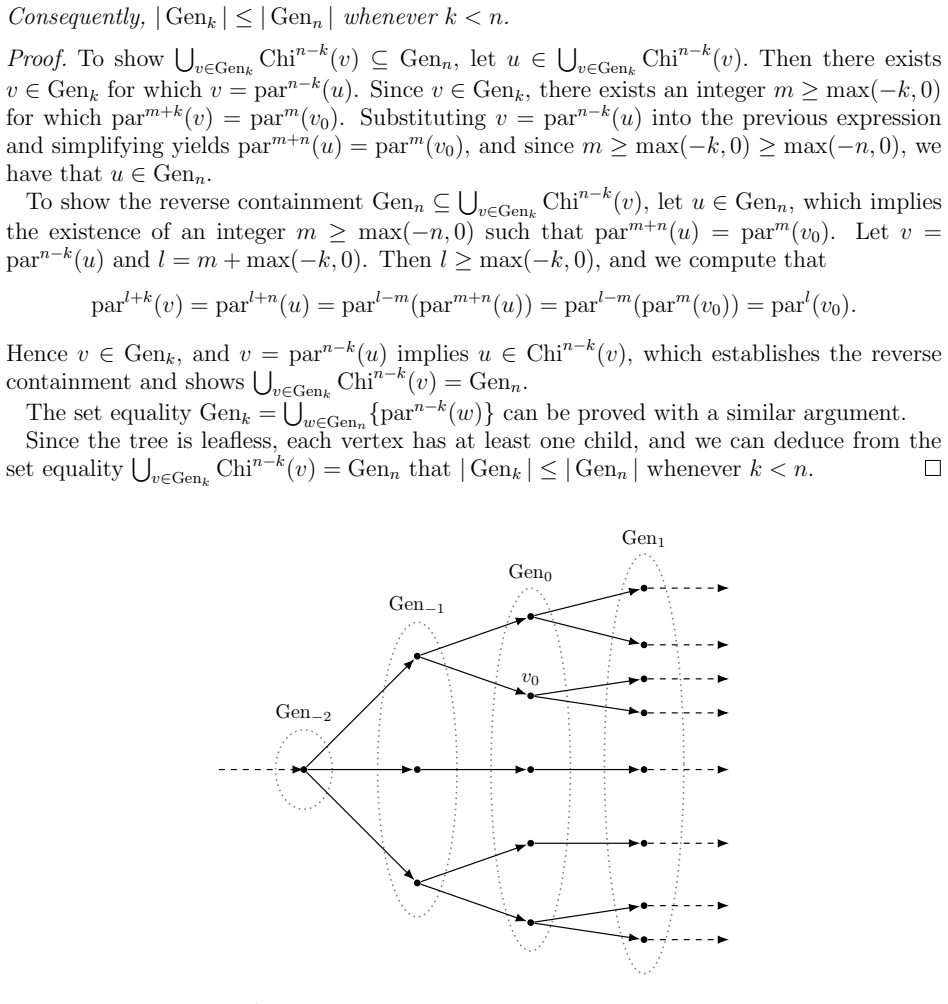
- Notation for descendants/ancestors: the manuscript should include a single diagram or short paragraph clarifying the partial order on a small finite tree so that readers can immediately visualize the forward and backward chains appearing in the divergence conditions.
Simulated Author's Rebuttal
We thank the referee for the positive report and the recommendation for minor revision. We are pleased that the referee recognizes the result as a natural and verifiable generalization of the classical chain-recurrence criteria on ℕ and ℤ.
Circularity Check
No significant circularity in the derivation chain
full rationale
The paper states its characterization of chain recurrence directly in terms of explicit forward and backward divergence conditions on products of the weights along descendant and ancestor chains. These conditions are formulated independently of any fitted parameters and are shown to reduce to the classical known criteria on the line and half-line as a consistency verification rather than a definitional or fitted derivation. No load-bearing step relies on self-citation of an unverified uniqueness result, no ansatz is smuggled via prior work, and no quantity is renamed or redefined in terms of itself. The tree merely indexes the standard sequence spaces, leaving the core divergence statements self-contained against external benchmarks.
Axiom & Free-Parameter Ledger
axioms (2)
- standard math Chain recurrence is defined via the standard ε-chains in the dynamical-systems sense on the Banach space.
- domain assumption The directed tree supplies a partial order with well-defined descendant and ancestor sets for each vertex.
Lean theorems connected to this paper
-
IndisputableMonolith/Cost/FunctionalEquation.leanwashburn_uniqueness_aczel unclear?
unclearRelation between the paper passage and the cited Recognition theorem.
We characterize when a weighted backward shift is chain recurrent on the ℓ^p (1≤p<∞) and c0 spaces of a directed tree. The characterization is given in terms of two divergence conditions on the weights: a forward condition on the descendants of each vertex and, in the unrooted case, a backward condition on the descendants of each ancestor.
-
IndisputableMonolith/Foundation/RealityFromDistinction.leanreality_from_one_distinction unclear?
unclearRelation between the paper passage and the cited Recognition theorem.
The conditions reduce, in the case of symmetric weighted shifts on symmetric trees, to the classical characterizations of chain recurrence on the sequence spaces ℓ^p(ℕ), ℓ^p(ℤ), c0(ℕ), and c0(ℤ).
What do these tags mean?
- matches
- The paper's claim is directly supported by a theorem in the formal canon.
- supports
- The theorem supports part of the paper's argument, but the paper may add assumptions or extra steps.
- extends
- The paper goes beyond the formal theorem; the theorem is a base layer rather than the whole result.
- uses
- The paper appears to rely on the theorem as machinery.
- contradicts
- The paper's claim conflicts with a theorem or certificate in the canon.
- unclear
- Pith found a possible connection, but the passage is too broad, indirect, or ambiguous to say the theorem truly supports the claim.
Reference graph
Works this paper leans on
-
[1]
Fabricio F. Alves, Nilson C. Bernardes, Jr., and Ali Messaoudi. Chain recurrence and average shadowing in dynamics.Monatsh. Math., 196(4):665–697, 2021
work page 2021
-
[2]
Chain recurrence and positive shadowing in linear dynamics.J
Mayara Braz Antunes, Gabriel Elias Mantovani, and R´ egis Var˜ ao. Chain recurrence and positive shadowing in linear dynamics.J. Math. Anal. Appl., 506(1):Paper No. 125622, 17, 2022
work page 2022
-
[3]
N. Aoki and K. Hiraide.Topological theory of dynamical systems, volume 52 ofNorth- Holland Mathematical Library. North-Holland Publishing Co., Amsterdam, 1994. Re- cent advances
work page 1994
-
[4]
Nilson C. Bernardes, Jr., Patricia R. Cirilo, Udayan B. Darji, Ali Messaoudi, and En- rique R. Pujals. Expansivity and shadowing in linear dynamics.J. Math. Anal. Appl., 461(1):796–816, 2018
work page 2018
-
[5]
Nilson C. Bernardes, Jr. and Ali Messaoudi. Shadowing and structural stability for operators.Ergodic Theory Dynam. Systems, 41(4):961–980, 2021
work page 2021
-
[6]
Nilson C. Bernardes, Jr. and Alfred Peris. On shadowing and chain recurrence in linear dynamics.Adv. Math., 441:Paper No. 109539, 46, 2024
work page 2024
-
[7]
Differential Equations, 18(2):333–339, 1975
Rufus Bowen.ω-limit sets for axiom A diffeomorphisms.J. Differential Equations, 18(2):333–339, 1975. 17
work page 1975
-
[8]
Dynamics of generalized hyperbolic linear operators.Adv
Patricia Cirilo, Bryce Gollobit, and Enrique Pujals. Dynamics of generalized hyperbolic linear operators.Adv. Math., 387:Paper No. 107830, 37, 2021
work page 2021
-
[9]
C. Conley. The gradient structure of a flow. I.Ergodic Theory Dynam. Systems, 8 ∗:11– 26, 9, 1988. With a comment by R. Moeckel
work page 1988
-
[10]
Devaney.An introduction to chaotic dynamical systems
Robert L. Devaney.An introduction to chaotic dynamical systems. Addison-Wesley Studies in Nonlinearity. Addison-Wesley Publishing Company, Advanced Book Program, Redwood City, CA, second edition, 1989
work page 1989
-
[11]
Grosse-Erdmann and Dimitris Papathanasiou
Karl-G. Grosse-Erdmann and Dimitris Papathanasiou. Dynamics of weighted shifts on directed trees.Indiana Univ. Math. J., 72(1):263–299, 2023
work page 2023
-
[12]
Grosse-Erdmann and Dimitris Papathanasiou
Karl-G. Grosse-Erdmann and Dimitris Papathanasiou. Chaotic weighted shifts on di- rected trees, 2024
work page 2024
-
[13]
Weighted shifts on directed trees
Zenon Jan Jab l o´ nski, Il Bong Jung, and Jan Stochel. Weighted shifts on directed trees. Mem. Amer. Math. Soc., 216(1017):viii+106, 2012
work page 2012
-
[14]
Cam- bridge University Press, Cambridge, 1995
Anatole Katok and Boris Hasselblatt.Introduction to the modern theory of dynam- ical systems, volume 54 ofEncyclopedia of Mathematics and its Applications. Cam- bridge University Press, Cambridge, 1995. With a supplementary chapter by Katok and Leonardo Mendoza
work page 1995
-
[15]
Shifts on trees versus classical shifts in chain recurrence.J
Antoni L´ opez-Mart´ ınez and Dimitris Papathanasiou. Shifts on trees versus classical shifts in chain recurrence.J. Differential Equations, 433:Paper No. 113230, 25, 2025
work page 2025
-
[16]
Kluwer Academic Publishers, Dordrecht, 2000
Ken Palmer.Shadowing in dynamical systems, volume 501 ofMathematics and its Applications. Kluwer Academic Publishers, Dordrecht, 2000. Theory and applications
work page 2000
-
[17]
Pilyugin.Shadowing in dynamical systems, volume 1706 ofLecture Notes in Mathematics
Sergei Yu. Pilyugin.Shadowing in dynamical systems, volume 1706 ofLecture Notes in Mathematics. Springer-Verlag, Berlin, 1999
work page 1999
- [18]
-
[19]
Springer-Verlag, New York, 1987
Michael Shub.Global stability of dynamical systems. Springer-Verlag, New York, 1987. With the collaboration of Albert Fathi and R´ emi Langevin, Translated from the French by Joseph Christy
work page 1987
-
[20]
Ja. ˜G. Sina˘ i. Gibbs measures in ergodic theory.Uspehi Mat. Nauk, 27(4(166)):21–64, 1972. 18
work page 1972
discussion (0)
Sign in with ORCID, Apple, or X to comment. Anyone can read and Pith papers without signing in.