Tendon-Actuated Robots with a Tapered, Flexible Polymer Backbone: Design, Fabrication, and Modeling
Pith reviewed 2026-05-15 08:06 UTC · model grok-4.3
The pith
Tendon-actuated continuum robots with tapered flexible polymer backbones achieve accurate shape prediction through an extended Cosserat rod model that accounts for varying cross-sectional geometry.
A machine-rendered reading of the paper's core claim, the machinery that carries it, and where it could break.
Core claim
We develop a generalized forward kinetostatic model of the tapered backbone based on Cosserat rod theory using a Newtonian approach, extending existing tendon-actuated Cosserat rod formulations to explicitly account for spatially varying backbone cross-sectional geometry. The model captures the graded stiffness profile induced by the tapering and enables systematic exploration of the configuration space as a function of the geometric design parameters. Specifically, we analyze how the backbone taper angle influences the robot's configuration space and manipulability. The model is validated against motion capture data, achieving centimeter-level shape prediction accuracy after calibrating the
What carries the argument
The generalized forward kinetostatic model of the tapered backbone based on Cosserat rod theory using a Newtonian approach, which extends prior formulations to incorporate spatially varying cross-sectional geometry and thereby accounts for the graded stiffness induced by tapering.
If this is right
- The taper angle directly influences achievable configurations and manipulability of the robot.
- The calibrated model supports accurate prediction of shapes across different geometric design parameters.
- Integrated electronics and compression load cells enable direct tendon tension control and sensing in a scalable 3D-printed assembly.
- The design facilitates high curvature and distal compliance suitable for inspection and manipulation tasks.
Where Pith is reading between the lines
- The parametric scripts could support rapid iteration of taper profiles to optimize for task-specific reach or compliance needs.
- Mounting the continuum robot on a 6-DoF arm as demonstrated suggests hybrid rigid-soft systems for enhanced dexterity in confined environments.
- The line-search calibration method for Young's modulus may extend to other variable-geometry soft robots where material properties are uncertain.
Load-bearing premise
The Newtonian Cosserat rod formulation with calibrated Young's modulus accurately captures the graded stiffness and configuration space of the tapered TPU backbone without significant unmodeled effects from material nonlinearity or fabrication tolerances.
What would settle it
Motion capture measurements of backbone shapes under varied tendon tensions and taper angles that show prediction errors substantially larger than one centimeter after Young's modulus calibration.
Figures




read the original abstract
This paper presents the design, modeling, and fabrication of 3D-printed, tendon-actuated continuum robots featuring a flexible, tapered backbone constructed from thermoplastic polyurethane (TPU). Our scalable design incorporates an integrated electronics base housing that enables direct tendon tension control and sensing via actuators and compression load cells. Unlike many continuum robots that are single-purpose and costly, the proposed design prioritizes customizability, rapid assembly, and low cost while enabling high curvature and enhanced distal compliance through geometric tapering, thereby supporting a broad range of compliant robotic inspection and manipulation tasks. We develop a generalized forward kinetostatic model of the tapered backbone based on Cosserat rod theory using a Newtonian approach, extending existing tendon-actuated Cosserat rod formulations to explicitly account for spatially varying backbone cross-sectional geometry. The model captures the graded stiffness profile induced by the tapering and enables systematic exploration of the configuration space as a function of the geometric design parameters. Specifically, we analyze how the backbone taper angle influences the robot's configuration space and manipulability. The model is validated against motion capture data, achieving centimeter-level shape prediction accuracy after calibrating Young's modulus via a line search that minimizes modeling error. We further demonstrate teleoperated grasping using an endoscopic gripper routed along the continuum robot, mounted on a 6-DoF robotic arm. Parameterized iLogic/CAD scripts are provided for rapid geometry generation and scaling. The presented framework establishes a simple, rapid, and reproducible pathway from parametric design to controlled tendon actuation for tapered, tendon-driven continuum robots manufactured using fused deposition modeling 3D printers.
Editorial analysis
A structured set of objections, weighed in public.
Referee Report
Summary. The paper presents the design, fabrication, and modeling of low-cost 3D-printed tendon-actuated continuum robots featuring a tapered TPU backbone. It develops a generalized forward kinetostatic model based on Cosserat rod theory via a Newtonian approach that explicitly incorporates spatially varying cross-sectional geometry, validates the model to cm-level shape accuracy against motion-capture data after line-search calibration of Young's modulus, analyzes taper-angle effects on configuration space and manipulability, and demonstrates teleoperated grasping with an integrated endoscopic gripper on a 6-DoF arm, while providing parameterized CAD scripts for rapid scaling.
Significance. If the central modeling claim holds under independent verification, the work offers a practical, reproducible pathway for customizable continuum robots with graded stiffness, supported by open design scripts. The explicit treatment of taper-induced stiffness variation in a Cosserat framework and the integrated actuation/sensing base could support broader adoption in inspection and manipulation tasks.
major comments (2)
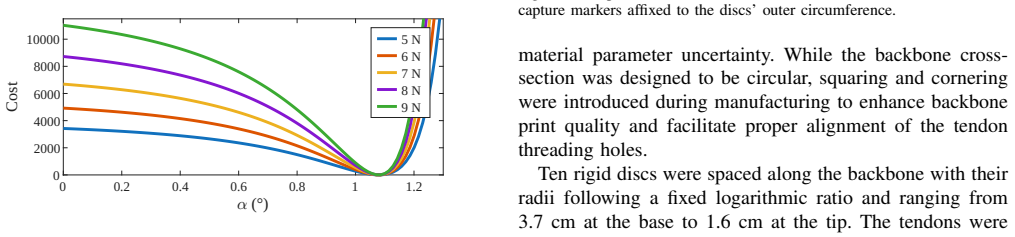
- [Abstract] Abstract: the reported centimeter-level validation accuracy is achieved only after line-search calibration of Young's modulus to minimize error on the same motion-capture data used for assessment. This makes the accuracy a fitted quantity rather than an independent test of whether the Newtonian formulation correctly propagates the graded geometry into the internal force/moment balances, particularly for TPU which may exhibit strain-stiffening or viscoelasticity.
- [Modeling] Modeling section: the extension of existing tendon-actuated Cosserat formulations to spatially varying cross-section is central to the claim, yet the abstract provides no derivation details on how the Newtonian force and moment balance equations are modified for the taper (e.g., position-dependent area and second-moment terms). Without these, it is unclear whether unmodeled effects from fabrication tolerances or material nonlinearity are absorbed into the single calibrated E parameter.
minor comments (2)
- [Abstract] Abstract: no error bars, sensitivity analysis to the calibrated Young's modulus, or cross-validation on held-out tension profiles are mentioned, which would strengthen the validation claim.
- [Abstract] The availability and format of the 'parameterized iLogic/CAD scripts' should be clarified with a repository link or explicit description to support the reproducibility emphasis.
Simulated Author's Rebuttal
We thank the referee for the constructive comments, which help clarify the distinction between model structure and parameter fitting. We address each point below and will revise the manuscript accordingly to improve transparency on calibration and derivation details.
read point-by-point responses
-
Referee: [Abstract] Abstract: the reported centimeter-level validation accuracy is achieved only after line-search calibration of Young's modulus to minimize error on the same motion-capture data used for assessment. This makes the accuracy a fitted quantity rather than an independent test of whether the Newtonian formulation correctly propagates the graded geometry into the internal force/moment balances, particularly for TPU which may exhibit strain-stiffening or viscoelasticity.
Authors: We agree that the reported accuracy relies on calibration of Young's modulus via line search on the validation dataset, which is standard for 3D-printed TPU to account for batch variability but does limit claims of fully independent prediction. The single-parameter fit tests whether the Newtonian balances with graded geometry can reproduce observed shapes across tensions once E is set; however, we will revise the abstract to explicitly note that accuracy is post-calibration and add a short discussion of potential viscoelastic effects in the modeling section. revision: yes
-
Referee: [Modeling] Modeling section: the extension of existing tendon-actuated Cosserat formulations to spatially varying cross-section is central to the claim, yet the abstract provides no derivation details on how the Newtonian force and moment balance equations are modified for the taper (e.g., position-dependent area and second-moment terms). Without these, it is unclear whether unmodeled effects from fabrication tolerances or material nonlinearity are absorbed into the single calibrated E parameter.
Authors: The full modeling section derives the modified Newtonian balances by substituting position-dependent A(s) and I(s) into the internal force and moment equilibrium equations, following the standard Cosserat rod discretization but with tapered geometry. The abstract omits these equations per convention. To address the concern, we will add a concise statement in the abstract and introduction clarifying that the taper enters directly via the spatially varying stiffness terms rather than being absorbed only into E, and we will highlight the key equation modifications in a revised modeling section. revision: partial
Circularity Check
Validation accuracy obtained by fitting Young's modulus to the same motion-capture data used for assessment
specific steps
-
fitted input called prediction
[Abstract (validation paragraph)]
"The model is validated against motion capture data, achieving centimeter-level shape prediction accuracy after calibrating Young's modulus via a line search that minimizes modeling error."
The quoted accuracy is achieved only after the line search tunes E to minimize error on the same motion-capture data that is subsequently used to report the accuracy. The performance number is therefore the minimized residual of the fit rather than an independent forward prediction of the tapered Cosserat model.
full rationale
The paper's central modeling claim is a forward kinetostatic Cosserat-rod model extended for spatially varying cross-section. This derivation itself is independent and draws on standard Newtonian balance equations. However, the reported performance metric (centimeter-level shape prediction accuracy) is obtained only after a line-search calibration of the single free parameter E that explicitly minimizes modeling error on the identical motion-capture dataset later used to declare validation success. By the paper's own wording, the accuracy figure therefore reduces to a post-fit residual rather than an independent prediction. No held-out tension profiles, independent E measurement, or cross-validation is described, satisfying the fitted-input-called-prediction pattern. No other load-bearing steps (self-citation chains, ansatz smuggling, or self-definitional loops) are present in the provided text.
Axiom & Free-Parameter Ledger
free parameters (1)
- Young's modulus =
line-search optimized value
axioms (1)
- domain assumption Cosserat rod theory assumptions hold for the tapered TPU backbone under tendon loading
Reference graph
Works this paper leans on
-
[1]
F. Qi, F. Ju, D. Bai, Y . Wang, and B. Chen, “Kinematic analysis and navigation method of a cable-driven continuum robot used for minimally invasive surgery,”The International Journal of Medical Robotics and Computer Assisted Surgery, vol. 15, no. 4, p. e2007, 2019
work page 2019
-
[2]
Real-time dynamics of soft and continuum robots based on Cosserat rod models,
J. Till, V . Aloi, and C. Rucker, “Real-time dynamics of soft and continuum robots based on Cosserat rod models,”The International Journal of Robotics Research, vol. 38, no. 6, pp. 723–746, May 2019
work page 2019
-
[3]
An accuracy enhancement method for a cable-driven continuum robot with a flexible backbone,
W. Shen, G. Yang, T. Zheng, Y . Wang, K. Yang, and Z. Fang, “An accuracy enhancement method for a cable-driven continuum robot with a flexible backbone,”IEEE Access, vol. 8, pp. 37 474–37 481, 2020
work page 2020
-
[4]
Design, implementation, and control of a deformable manipulator robot based on a compliant spine,
T. Morales Bieze, A. Kruszewski, B. Carrez, and C. Duriez, “Design, implementation, and control of a deformable manipulator robot based on a compliant spine,”The International Journal of Robotics Research, vol. 39, no. 14, pp. 1604–1619, Dec. 2020
work page 2020
-
[5]
Y .-J. Kim, S. Cheng, S. Kim, and K. Iagnemma, “A stiffness-adjustable hyperredundant manipulator using a variable neutral-line mechanism for minimally invasive surgery,”IEEE Transactions on Robotics, vol. 30, no. 2, pp. 382–395, 2013
work page 2013
-
[6]
Soft robotics: A review of recent developments of pneumatic soft actuators,
J. Walker, T. Zidek, C. Harbel, S. Yoon, F. S. Strickland, S. Kumar, and M. Shin, “Soft robotics: A review of recent developments of pneumatic soft actuators,” inActuators, vol. 9, no. 1. MDPI, 2020, p. 3
work page 2020
-
[7]
Design and control of a new electrostrictive polymer based continuum actuator for endoscopic robot,
Q. Jacquemin, Q. Sun, D. Thuau, E. Monteiro, S. Tence-Girault, S. Doizi, O. Traxer, and N. Mechbal, “Design and control of a new electrostrictive polymer based continuum actuator for endoscopic robot,”Journal of Intelligent Material Systems and Structures, vol. 34, no. 12, pp. 1355–1365, July 2023
work page 2023
-
[8]
Programming tension in 3d printed networks inspired by spiderwebs,
T. Masmeijer, C. Swain, J. Hill, and E. Habtour, “Programming tension in 3d printed networks inspired by spiderwebs,”Materials & Design, p. 115281, 2025
work page 2025
-
[9]
Spirobs: Logarithmic spiral- shaped robots for versatile grasping across scales,
Z. Wang, N. M. Freris, and X. Wei, “Spirobs: Logarithmic spiral- shaped robots for versatile grasping across scales,”Device, vol. 3, no. 4, 2025
work page 2025
-
[10]
O. Weeger, S.-K. Yeung, and M. L. Dunn, “Fully isogeometric modeling and analysis of nonlinear 3D beams with spatially varying geometric and material parameters,”Computer Methods in Applied Mechanics and Engineering, vol. 342, pp. 95–115, Dec. 2018
work page 2018
-
[11]
Statics and Dynamics of Con- tinuum Robots With General Tendon Routing and External Loading,
D. C. Rucker and R. J. Webster III, “Statics and Dynamics of Con- tinuum Robots With General Tendon Routing and External Loading,” IEEE Transactions on Robotics, vol. 27, no. 6, pp. 1033–1044, Dec. 2011
work page 2011
-
[12]
Cosserat Rod Modeling of Continuum Robots from Newtonian and Lagrangian Perspectives,
M. Tummers, V . Lebastard, F. Boyer, J. Troccaz, B. Rosa, and M. T. Chikhaoui, “Cosserat Rod Modeling of Continuum Robots from Newtonian and Lagrangian Perspectives,”IEEE Transactions on Robotics, vol. 39, no. 3, pp. 2360–2378, June 2023
work page 2023
-
[13]
Dynamics of Con- tinuum and Soft Robots: A Strain Parameterization Based Approach,
F. Boyer, V . Lebastard, F. Candelier, and F. Renda, “Dynamics of Con- tinuum and Soft Robots: A Strain Parameterization Based Approach,” IEEE Transactions on Robotics, vol. 37, no. 3, pp. 847–863, June 2021
work page 2021
-
[14]
Encoding Desired Deformation Profiles in Endoscope-Like Soft Robots,
D. S. Esser, M. F. Rox, R. P. Naftel, D. C. Rucker, E. J. Barth, A. Kuntz, and R. J. Webster, “Encoding Desired Deformation Profiles in Endoscope-Like Soft Robots,”IEEE Transactions on Medical Robotics and Bionics, vol. 7, no. 1, pp. 392–403, Feb. 2025
work page 2025
-
[15]
Continuum Robot Dynamics Utilizing the Principle of Virtual Power,
W. S. Rone and P. Ben-Tzvi, “Continuum Robot Dynamics Utilizing the Principle of Virtual Power,”IEEE Transactions on Robotics, vol. 30, no. 1, pp. 275–287, Feb. 2014
work page 2014
-
[16]
P. Kheradmand, B. Moradkhani, R. Sankaranarayanan, K. K. Yamamoto, T. J. Zachem, P. J. Codd, Y . Chitalia, and P. E. Dupont, “A comprehensive general model of tendon-actuated concentric tube robots with multiple tubes and tendons,” 2025. [Online]. Available: https://arxiv.org/abs/2510.23954
-
[17]
Continuum Robots for Medical Interventions,
P. E. Dupont, N. Simaan, H. Choset, and C. Rucker, “Continuum Robots for Medical Interventions,”Proceedings of the IEEE, vol. 110, no. 7, pp. 847–870, July 2022
work page 2022
-
[18]
Continuum Robots for Medical Applications: A Survey,
J. Burgner-Kahrs, D. C. Rucker, and H. Choset, “Continuum Robots for Medical Applications: A Survey,”IEEE Transactions on Robotics, vol. 31, no. 6, pp. 1261–1280, Dec. 2015
work page 2015
-
[19]
V . Marco, G. Massimo, and G. Manuela, “Additive manufacturing of flexible thermoplastic polyurethane (TPU): Enhancing the material elongation through process optimisation,”Progress in Additive Man- ufacturing, vol. 10, no. 4, pp. 2877–2891, Apr. 2025
work page 2025
-
[20]
Least-squares fitting of two 3-d point sets,
K. S. Arun, T. S. Huang, and S. D. Blostein, “Least-squares fitting of two 3-d point sets,”IEEE Trans. Pattern Anal. Mach. Intell., vol. 9, no. 5, pp. 698–700, May 1987
work page 1987
discussion (0)
Sign in with ORCID, Apple, or X to comment. Anyone can read and Pith papers without signing in.