REVIEW 3 major objections 4 minor 106 references
Radial Velocity Orbital Solutions for Candidate Black Hole and Neutron Star Binary Systems in the Gaia Data Release 3 Catalog
T0 review · 3 major / 4 minor · reviewed 2026-08-02 · deepseek-v4-flash
Pith's one-line read Spectroscopic follow-up shows that, apart from the three previously confirmed systems, every Gaia DR3 binary with a candidate dark companion above two solar masses has an incorrect orbital solution, leaving only two wide black-hole binaries
desk verdict Solid per-object RV refutation of the DR3 compact-object candidates; the 'only two BH binaries' census claim outruns the selection completeness. read the letter →
The pith
A machine-rendered reading of the paper's core claim, the machinery that carries it, and where it could break.
The reading
What carries the argument
The binary mass function f = K1^3 P (1 - e^2)^{3/2} / (2πG), computed from the radial-velocity semi-amplitude K1, orbital period P, and eccentricity e, is the load-bearing quantity. It yields a strict lower limit on the unseen companion's mass, so a small measured K1 rules out a multi-solar-mass companion regardless of inclination. Orbital parameters are found by sampling the posterior with a rejection-sampling algorithm and refining with Markov-chain Monte Carlo, using radial velocities from new spectra plus archival data. Stellar masses of the primaries come from fitting spectra and photometry to evolutionary isochrones. The same orbital parameters are then used to predict the astrometric
What would settle it
If dense radial-velocity monitoring of Gaia DR3 3640889032890567040 over a full orbit confirms the longer-period (≈940 d) solution with a semi-amplitude near 18 km/s, that system's minimum companion mass would be 1.3 solar masses—invalidating the paper's claim that no unconfirmed DR3 candidate has a compact companion above two solar masses.
Extended reading notes
Core claim
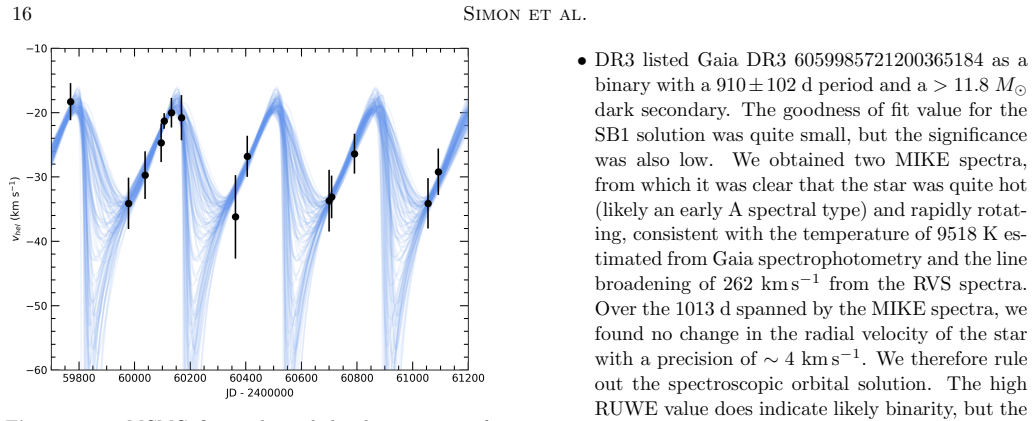
The authors derive independent radial-velocity orbits for eleven systems selected from the Gaia DR3 binary catalogs as having candidate dark companions above two solar masses. In every case except the previously confirmed Gaia BH1, Gaia BH2, and Gaia NS1, the spectroscopic orbit is incompatible with the published Gaia solution: periods change (for one star, from 1039 days to 20 days), and velocity semi-amplitudes are typically several times smaller than the Gaia orbit would predict. The resulting mass functions place the companions at sub-solar masses—brown dwarfs, M dwarfs, or white dwarfs—or show a second set of stellar absorption lines, indicating a luminous companion. For the one system
Load-bearing premise
The conclusion rests on the assumption that the new radial-velocity data—sometimes sparse or phase-incomplete—correctly identify the true orbit of each system, so that the disagreement with the Gaia solution is not hiding a hierarchical triple, an alias period, or a nearly face-on orbit with a genuinely massive companion.
Editorial extensions
If this is right
- The number of wide black-hole binaries known from Gaia DR3 drops from a few dozen published candidates to two, so the local census of such systems is much smaller than the raw catalog suggested.
- Future Gaia catalogs should apply the stricter quality cuts suggested here—significance greater than 10 and goodness of fit below 4—to keep candidate lists clean of spurious massive companions.
- Hot, rapidly rotating stars are a systematic source of bad Gaia radial velocities; candidate searches should flag them for independent confirmation rather than accepting their orbital solutions.
- The acceleration catalogs, which lack full orbital solutions, are a better place than the orbital-solution catalogs to look for the next confirmed neutron-star or black-hole binary, since the one fully characterized accelerating system here is a likely neutron star or ultramassive white dwarf.
- Wide black-hole binaries with periods of several years and small velocity amplitudes will be missed entirely by short monitoring campaigns, so confirming them will require sustained, multi-year spectroscopy.
Reading between the lines
- If the proposed quality cuts are applied retroactively to DR3, the number of 'reliable' orbital solutions with high-mass dark companions shrinks to near zero, implying that the Milky Way's wide black-hole binary population may be at the low end of pre-Gaia theoretical predictions.
- The hierarchical-triple interpretation raised for at least one rejected candidate (a 20-day inner binary embedded in a roughly 3-year outer orbit) suggests that some of the discarded systems could still contain compact objects as outer components; future epoch astrometry could test this for each rejected candidate.
- The accelerating system with a 1.16-solar-mass minimum companion is a natural target for Gaia DR4 astrometry, which could measure its inclination directly and settle whether the companion is a neutron star or an ultramassive white dwarf.
- Combining dense radial-velocity orbits with forward models of Gaia's detection probability, as done case-by-case here, could be developed into a formal selection function for the binary catalogs, enabling unbiased population statistics instead of informal quality cuts.
Editorial analysis
A structured set of objections, weighed in public.
Referee Report
Summary. This paper presents spectroscopic radial-velocity follow-up of 31 systems from Gaia DR3: 20 stars with orbital solutions (astrometric, SB1, or AstroSpectroSB1) flagged as candidate black-hole/neutron-star binaries and 11 stars with large accelerations but no orbital solution. The authors derive stellar parameters and new RV orbits using MIKE, APF, IMACS, FEROS, and HIRES data, supplemented by archival velocities. Their main result is that, apart from the previously confirmed Gaia BH1, Gaia BH2, and Gaia NS1, the Gaia DR3 orbital solutions for all other selected candidate systems with inferred dark companions above 2 Msun are inconsistent with the new RVs; most are lower-amplitude binaries with low-mass companions, several are SB2 or eclipsing systems, and a few hot stars show no detectable variability. They propose stricter quality cuts (significance > 10, F2 < 4) and report one acceleration source with Msini = 1.16 +/- 0.01 Msun, likely an ultramassive white dwarf or neutron star. The paper concludes that only two wide binaries with black-hole secondaries are contained in the Gaia DR3 binary catalogs.
Significance. The per-object refutations are largely convincing: the RV measurements are independent of the Gaia values being tested, the paper is transparent about ambiguous cases, and forward modeling with gaiamock and the Lam et al. framework strengthens the interpretations for several systems. If the per-object results stand, the paper substantially sharpens our understanding of the false-positive rate in the high-mass-function tail of the Gaia DR3 binary catalogs and gives practical guidance for DR4. The identification of the acceleration source with Msini = 1.16 Msun is also a valuable result. However, the global census conclusion - 'only two wide binaries with black hole secondaries are contained in the Gaia DR3 binary catalogs' - is a load-bearing claim that goes beyond the selected sample and needs to be either relaxed or supported by a completeness argument.
major comments (3)
- [Abstract; Sec. 5; Sec. 2.1.1] The abstract and conclusions state that only two wide binaries with black-hole secondaries are contained in the Gaia DR3 binary catalogs. This census claim is not supported by the sample definition. In Sec. 2.1.1 the direct catalog selection requires m2_lower >= 5 Msun and m2_lower > m1; candidates with inferred dark companions between 2 and 5 Msun are included only if they appear in the Shahaf et al. or Andrews et al. lists. A genuine black-hole binary viewed at low inclination (small RV mass function) or with a primary more massive than the secondary would not enter the sample. Footnote 9 explicitly concedes the face-on assumption for the accelerating sources, but the same limitation applies to the SB1 and astrometric candidates. The data demonstrate that the particular Gaia orbits examined are wrong, but they do not establish that no other DR3 orbital solution hides a massive dark com
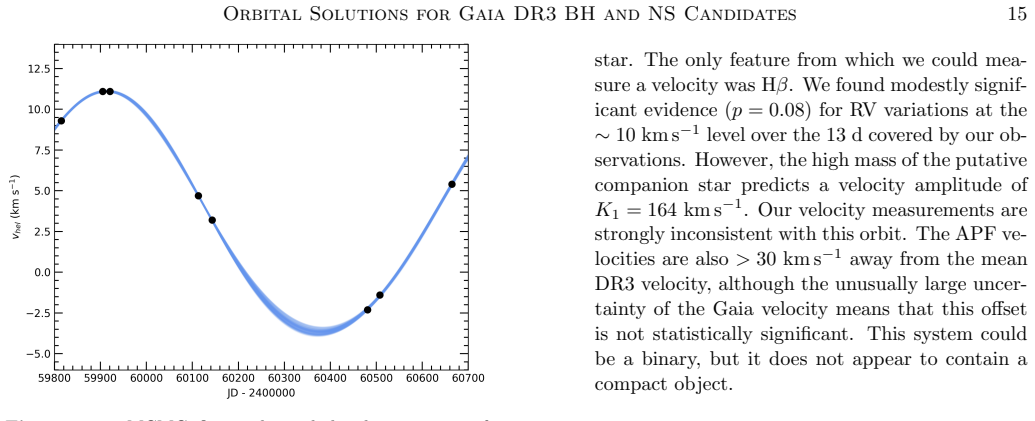
- [Sec. 3.2; Table 4; Sec. 5] For some objects the new RV solutions are too ambiguous to support the blanket statement in Sec. 5 that all remaining candidates have brown-dwarf or M-dwarf companions. For Gaia DR3 5846362195472084992, Sec. 3.2 states that the RVs cover only half of the orbit and 'we cannot currently rule out a higher mass secondary'; Table 4 gives K1 = 12.8 +21.2/-5.6 km/s and f = 0.045 +0.183/-0.032 Msun, so the allowed companion mass extends well above 1 Msun. Similarly, for Gaia DR3 3640889032890567040, Sec. 3.1 presents two acceptable RV solutions, with the longer-period solution giving Msini = 1.30 Msun. Both systems are inconsistent with their claimed Gaia orbits, so the core refutation stands, but the per-object caveats should be carried into the conclusions rather than replaced by a stronger universal statement.
- [Sec. 4.1] The proposed quality cuts (significance > 10, F2 < 4) are fit to the same sample they are used to clean. The thresholds are chosen post hoc to retain the three known compact-object binaries and exclude the false solutions in Table 1; no independent validation set is used, and the paper does not quantify how many genuine binaries would be lost. The statement that the cuts 'would retain the known genuine compact objects while excluding all but one of the false solutions' is a description of the training sample, not a validated selection function. This is a recommendation rather than the paper's central proof, but it should be explicitly labeled provisional, and ideally tested on simulated Gaia-like catalogs or withheld DR4-like data before being applied to future catalogs.
minor comments (4)
- [Abstract] The header abstract says 'radial velocity orbital solutions for 12 binaries' while the body abstract and Table 4 list 11 solutions. Please make the number consistent.
- [Table 2] As printed, Table 2 contains entries for only one star. Please state explicitly that the full machine-readable table is available and describe its format.
- [Sec. 2.5.2] The hot-star metallicity prior (-0.2 <= [Fe/H] <= 0.2) is introduced to avoid unphysical metallicities. Its effect on the inferred primary masses and hence on the companion-mass limits should be quantified or at least discussed.
- [Sec. 3.1] For Gaia DR3 3509370326763016704, the interpretation that the astrometric signal could be due to an almost-resolved luminous tertiary is plausible but speculative; the sentence 'something beyond a brown dwarf orbiting a low-mass star may be present' could be worded more cautiously.
Circularity Check
Core refutations rest on independent RV data; only the post-hoc quality-cut recommendation is mildly circular, and the 'only two BHs' census claim depends on an untested completeness/face-on assumption rather than on a circular derivation.
-
other
[Section 4.1 and Section 5 (Conclusions)]
"Adopting a minimum significance of 10 and a maximum goodness of fit of 4 would retain the known genuine compact objects while excluding all but one of the false solutions. This goodness of fit threshold is much more conservative than the F2 < 25 criterion suggested by Halbwachs et al. (2023)."
The thresholds are chosen after the true/false classifications are already known from the follow-up campaign, so the sentence restates the labels used to select the cuts. It is a post-hoc fit to the training set, not an independent validation: by construction the chosen cuts separate the same objects that defined them. The paper honestly frames the cuts as a suggestion ('may be helpful'), so this is a minor circularity in a recommendation and not in the central RV refutation.
full rationale
The paper's core result is that newly obtained MIKE/APF/FEROS/IMACS radial velocities contradict the published Gaia orbital solutions for the selected candidates. These velocities are independent measurements, not derived from the Gaia astrometry or the DR3 mass functions being tested, so the per-object refutations are not circular. The same-group tools (gaiamock, Lam et al. 2025a) are used only as consistency checks on detection probabilities and RUWE, and are not load-bearing for the refutations. The only genuinely circular element is the post-hoc recommendation of significance > 10 and F2 < 4: the cut values are calibrated on the very classifications they are then said to 'retain' and 'exclude,' so the claim is a restatement of the fit rather than a validated selection rule; however, the paper explicitly presents this as a suggestion, not a prediction. The broader census statement that only two BH binaries exist in the DR3 catalogs is a limitation, not circularity: it depends on the completeness of the Shahaf et al. (2023) and Andrews et al. (2022) candidate lists for the 2-5 Msun range and on the untested assumption in footnote 9 that no systems are viewed nearly face-on (e.g., for Gaia DR3 5846362195472084992 the paper admits 'we cannot currently rule out a higher mass secondary'). These gaps affect the strength of the census claim but do not make the RV-based refutations circular.
Assumptions & free parameters
free parameters (4)
- significance threshold for reliable Gaia orbits =
10
- goodness-of-fit threshold (F2) =
4
- acceleration sample RV amplitude cut =
>50 km/s
- hot-star metallicity prior =
-0.2 to 0.2 dex
assumptions (6)
- standard math Keplerian binary mass function f = (M2 sin i)^3 / (M1+M2)^2 = P K1^3 (1-e^2)^(3/2) / (2 pi G)
- domain assumption The target is a binary whose visible star dominates the spectrum unless explicitly identified as SB2.
- domain assumption Disagreement between the new RV orbit and the Gaia astrometric orbit means the Gaia orbit is wrong, not that the RV traces an inner binary in a hierarchical triple.
- domain assumption The binaries are not viewed close to face-on, so minimum companion masses are representative of actual masses.
- domain assumption MIST isochrone models with the assumed priors give correct primary masses.
- ad hoc to paper The proposed cuts (significance>10, F2<4) are valid for future Gaia catalogs.
Cite this review
Pith. "Pith review of Radial Velocity Orbital Solutions for Candidate Black Hole and Neutron Star Binary Systems in the Gaia Data Release 3 Catalog." pith.science (2026). https://pith.science/paper/2YANW66I
@misc{pith2026260320371,
  author       = {Pith},
  title        = {Pith review of: Radial Velocity Orbital Solutions for Candidate Black Hole and Neutron Star Binary Systems in the Gaia Data Release 3 Catalog},
  year         = {2026},
  howpublished = {\url{https://pith.science/paper/2YANW66I}},
  note         = {Machine review of arXiv:2603.20371}
}
read the original abstract
We present spectroscopic followup observations of binary systems from the Gaia Data Release 3 (DR3) binary catalog that were selected to have large enough mass functions for their companions to be black holes or neutron stars. The selection includes 20 stars that are astrometric and/or spectroscopic binaries, as well as 11 stars with large accelerations both in the plane of the sky and along the line of sight but no DR3 orbital solution. We provide classifications for this entire sample, including radial velocity orbital solutions for 12 binaries. Apart from the previously published binaries Gaia BH1, Gaia BH2, and Gaia NS1, we show that the Gaia orbits are incorrect for all of the stars with candidate dark companions above 2 Msun. We suggest more conservative cuts on the significance and goodness of fit parameters that may be useful for identifying reliable orbital solutions in the tail of the binary star distribution. Although we find no new confirmed black hole or neutron star companions, one accelerating system has a minimum companion mass of 1.16 +/- 0.01 Msun that is likely to be a neutron star or an ultramassive white dwarf. The acceleration catalogs may therefore provide a largely unexplored source of additional wide binaries containing compact objects.
Figures


Figures from the paper (9 more)




Reference graph
Works this paper leans on
-
[1]
P., Abbott, R., Abbott, T
Abbott, B. P., Abbott, R., Abbott, T. D., et al. 2016, Phys. Rev. D, 93, 122003
2016
-
[2]
2020, ApJS, 249, 3
Ahumada, R., Allende Prieto, C., Almeida, A., et al. 2020, ApJS, 249, 3
2020
-
[3]
Andrews, J. J., Taggart, K., & Foley, R. 2022, arXiv e-prints, arXiv:2207.00680
arXiv 2022
-
[4]
2018, A&A, 616, A17
Arenou, F., Luri, X., Babusiaux, C., et al. 2018, A&A, 616, A17
2018
-
[5]
M., & Grevesse, N
Asplund, M., Amarsi, A. M., & Grevesse, N. 2021, A&A, 653, A141 Astropy Collaboration, Price-Whelan, A. M., Sip˝ ocz, B. M., et al. 2018, AJ, 156, 123
2021
-
[6]
2023, A&A, 674, A32
Babusiaux, C., Fabricius, C., Khanna, S., et al. 2023, A&A, 674, A32
2023
-
[7]
A., et al
Badenes, C., Mazzola, C., Thompson, T. A., et al. 2018, ApJ, 854, 147
2018
-
[8]
2021, AJ, 161, 147
Demleitner, M., & Andrae, R. 2021, AJ, 161, 147
2021
Show all 106 references
-
[9]
A., Gunnels, S
Bernstein, R., Shectman, S. A., Gunnels, S. M., Mochnacki, S., & Athey, A. E. 2003, in Society of Photo-Optical Instrumentation Engineers (SPIE) Conference Series, Vol. 4841, Instrument Design and Performance for Optical/Infrared Ground-based Telescopes, ed. M. Iye & A. F. M. ...
2003
-
[10]
2024, ApJ, 976, 131
Bianchi, L., Hutchings, J., Bohlin, R., Thilker, D., & Berti, E. 2024, ApJ, 976, 131
2024
-
[11]
1960, Properties of double stars; a survey of parallaxes and orbits
Binnendijk, L. 1960, Properties of double stars; a survey of parallaxes and orbits
1960
-
[12]
2020, A&A, 641, A43
Bodensteiner, J., Shenar, T., Mahy, L., et al. 2020, A&A, 641, A43
2020
-
[13]
Breivik, K., Chatterjee, S., & Larson, S. L. 2017, ApJ, 850, L13
2017
-
[14]
2014, A&A, 564, A125
Buchner, J., Georgakakis, A., Nandra, K., et al. 2014, A&A, 564, A125
2014
-
[15]
J., & Pickering, E
Cannon, A. J., & Pickering, E. C. 1993, VizieR Online Data Catalog: Henry Draper Catalogue and Extension (Cannon+ 1918-1924; ADC 1989), VizieR On-line Data Catalog: III/135A. Originally published in: Harv. Ann. 91-100 (1918-1924)
1993
-
[16]
D., Craig, P
Chakrabarti, S., Simon, J. D., Craig, P. A., et al. 2023, AJ, 166, 6
2023
-
[17]
2025, submitted to ApJ, arXiv:2508.21805
Chawla, C., Chatterjee, S., & Breivik, K. 2025, submitted to ApJ, arXiv:2508.21805
2025 arXiv
-
[18]
2022, ApJ, 931, 107
Chawla, C., Chatterjee, S., Breivik, K., et al. 2022, ApJ, 931, 107
2022
-
[19]
2016, ApJ, 823, 102
Choi, J., Dotter, A., Conroy, C., et al. 2016, ApJ, 823, 102
2016
-
[20]
C., Newman, J
Cooper, M. C., Newman, J. A., Davis, M., Finkbeiner, D. P., & Gerke, B. F. 2012, spec2d: DEEP2 DEIMOS Spectral Pipeline, Astrophysics Source Code Library, ascl:1203.003
2012
-
[21]
M., Casares, J., Mu˜ noz-Darias, T., et al
Corral-Santana, J. M., Casares, J., Mu˜ noz-Darias, T., et al. 2016, A&A, 587, A61
2016
-
[22]
2012, Research in Astronomy and Astrophysics, 12, 1197
Cui, X.-Q., Zhao, Y.-H., Chu, Y.-Q., et al. 2012, Research in Astronomy and Astrophysics, 12, 1197
2012
-
[23]
C., & Osip, D
Dressler, A., Hare, T., Bigelow, B. C., & Osip, D. J. 2006, in Proc. SPIE, Vol. 6269, Society of Photo-Optical Instrumentation Engineers (SPIE) Conference Series, 62690F
2006
-
[24]
2011, PASP, 123, 288
Dressler, A., Bigelow, B., Hare, T., et al. 2011, PASP, 123, 288
2011
-
[25]
El-Badry, K., & Burdge, K. B. 2022, MNRAS, 511, 24
2022
-
[26]
2020, MNRAS, 493, L22
El-Badry, K., & Quataert, E. 2020, MNRAS, 493, L22
2020
-
[27]
2022, MNRAS, 515, 1266
El-Badry, K., & Rix, H.-W. 2022, MNRAS, 515, 1266
2022
-
[28]
J., Stanway, E
Eldridge, J. J., Stanway, E. R., Breivik, K., et al. 2020, MNRAS, 495, 2786
2020
-
[29]
W., Riello, M., De Angeli, F., et al
Evans, D. W., Riello, M., De Angeli, F., et al. 2018, A&A, 616, A4
2018
-
[30]
2021, A&A, 649, A5
Fabricius, C., Luri, X., Arenou, F., et al. 2021, A&A, 649, A5
2021
-
[31]
Feroz, F., & Hobson, M. P. 2008, MNRAS, 384, 449
2008
-
[32]
P., & Bridges, M
Feroz, F., Hobson, M. P., & Bridges, M. 2009, MNRAS, 398, 1601
2009
-
[33]
P., Cameron, E., & Pettitt, A
Feroz, F., Hobson, M. P., Cameron, E., & Pettitt, A. N. 2019, The Open Journal of Astrophysics, 2, 10
2019
-
[34]
A., Magnier, E
Flewelling, H. A., Magnier, E. A., Chambers, K. C., et al. 2020, ApJS, 251, 7
2020
-
[35]
W., Lang, D., & Goodman, J
Foreman-Mackey, D., Hogg, D. W., Lang, D., & Goodman, J. 2013, PASP, 125, 306 Gaia Collaboration, Prusti, T., de Bruijne, J. H. J., et al. 2016, A&A, 595, A1 Gaia Collaboration, Brown, A. G. A., Vallenari, A., et al. 2018, A&A, 616, A1 —. 2021, A&A, 649, A1 Gaia Collaboration,...
2013
-
[36]
K., & Chatterjee, S
Ganguly, A., Nayak, P. K., & Chatterjee, S. 2023, ApJ, 954, 4
2023
-
[37]
R., & Wang, L
Gies, D. R., & Wang, L. 2020, ApJ, 898, L44
2020
-
[38]
2018, MNRAS, 475, L15
Giesers, B., Dreizler, S., Husser, T.-O., et al. 2018, MNRAS, 475, L15
2018
-
[39]
2019, A&A, 632, A3
Giesers, B., Kamann, S., Dreizler, S., et al. 2019, A&A, 632, A3
2019
-
[40]
Gontcharov, G. A. 2006, Astronomy Letters, 32, 759
2006
-
[41]
2025, A&A, 693, A124
Gosset, E., Damerdji, Y., Morel, T., et al. 2025, A&A, 693, A124
2025
-
[42]
O., & Corbally, J., C
Gray, R. O., & Corbally, J., C. 2009, Stellar Spectral Classification
2009
-
[43]
2019, ApJ, 887, 93
Finkbeiner, D. 2019, ApJ, 887, 93
2019
-
[44]
2023, A&A, 674, A9
Halbwachs, J.-L., Pourbaix, D., Arenou, F., et al. 2023, A&A, 674, A9
2023
-
[45]
C., Cropper, M., Boudreault, S., et al
Hambly, N. C., Cropper, M., Boudreault, S., et al. 2018, A&A, 616, A15
2018
-
[46]
1988, Michigan Catalogue of Two-dimensional Spectral Types for the HD Stars
Houk, N., & Smith-Moore, M. 1988, Michigan Catalogue of Two-dimensional Spectral Types for the HD Stars. Volume 4, Declinations -26.0 to -12.0., Vol. 4
1988
-
[47]
Hunter, J. D. 2007, Computing In Science & Engineering, 9, 90
2007
-
[48]
2023, A&A, 677, L9
Janssens, S., Shenar, T., Degenaar, N., et al. 2023, A&A, 677, L9
2023
-
[49]
2022, A&A, 658, A129
Janssens, S., Shenar, T., Sana, H., et al. 2022, A&A, 658, A129
2022
-
[50]
Z., Thompson, T
Jayasinghe, T., Stanek, K. Z., Thompson, T. A., et al. 2021, MNRAS, 504, 2577
2021
-
[51]
1999, The Messenger, 95, 8
Kaufer, A., Stahl, O., Tubbesing, S., et al. 1999, The Messenger, 95, 8
1999
-
[52]
Kelson, D. D. 2003, PASP, 115, 688
2003
-
[53]
R., Stassun, K
Kounkel, M., Covey, K. R., Stassun, K. G., et al. 2021, AJ, 162, 184
2021
-
[54]
Y., El-Badry, K., & Simon, J
Lam, C. Y., El-Badry, K., & Simon, J. D. 2025a, ApJ, in press, arXiv:2411.00654
-
[55]
Y., Simon, J
Lam, C. Y., Simon, J. D., El-Badry, K., et al. 2025b, submitted to ApJ, arXiv:2510.17746
-
[56]
J., Dufton, P
Lennon, D. J., Dufton, P. L., Villase˜ nor, J. I., et al. 2022, A&A, 665, A180
2022
-
[57]
W., et al
Liu, J., Zhang, H., Howard, A. W., et al. 2019, Nature, 575, 618
2019
-
[58]
2026, VizieR Online Data Catalog: LAMOST DR11 catalogs (Luo+, 2026), VizieR On-line Data Catalog: V/162
Luo, A.-L., Zhao, Y.-H., Zhao, G., & et al. 2026, VizieR Online Data Catalog: LAMOST DR11 catalogs (Luo+, 2026), VizieR On-line Data Catalog: V/162. Originally published in: 2026RAA..in.prep..L
2026
-
[59]
2022, A&A, 664, A159
Mahy, L., Sana, H., Shenar, T., et al. 2022, A&A, 664, A159
2022
-
[60]
2011, ApJ, 743, 156
Mainzer, A., Grav, T., Bauer, J., et al. 2011, ApJ, 743, 156
2011
-
[61]
2017, MNRAS, 470, 2611
Mashian, N., & Loeb, A. 2017, MNRAS, 470, 2611
2017
-
[62]
Morton, T. D. 2015, isochrones: Stellar model grid package, ascl:1503.010 M¨ uller-Horn, J., Rix, H.-W., El-Badry, K., et al. 2025, submitted to A&A, arXiv:2510.05982 M¨ uller-Horn, J., Ramachandran, V., El-Badry, K., et al. 2026, submitted to A&A, arXiv:2601.14403
2015 arXiv
-
[63]
M., Schlaufman, K
Nataf, D. M., Schlaufman, K. C., Reggiani, H., & Hahn, I. 2024, ApJ, 976, 87
2024
-
[64]
A., Cooper, M
Newman, J. A., Cooper, M. C., Davis, M., et al. 2013, ApJS, 208, 5
2013
-
[65]
2017, COSMOS: Carnegie Observatories System for MultiObject Spectroscopy, Astrophysics Source Code Library, ascl:1705.001
Villanueva, E. 2017, COSMOS: Carnegie Observatories System for MultiObject Spectroscopy, Astrophysics Source Code Library, ascl:1705.001
2017
-
[66]
2020, A&A, 638, A94
Olejak, A., Belczynski, K., Bulik, T., & Sobolewska, M. 2020, A&A, 638, A94
2020
-
[67]
A., Wolf, C., Bessell, M
Onken, C. A., Wolf, C., Bessell, M. S., et al. 2024, PASA, 41, e061
2024
-
[68]
2011, ApJS, 192, 3
Paxton, B., Bildsten, L., Dotter, A., et al. 2011, ApJS, 192, 3
2011
-
[69]
2013, ApJS, 208, 4
Paxton, B., Cantiello, M., Arras, P., et al. 2013, ApJS, 208, 4
2013
-
[70]
2015, ApJS, 220, 15
Paxton, B., Marchant, P., Schwab, J., et al. 2015, ApJS, 220, 15
2015
-
[71]
B., et al
Paxton, B., Schwab, J., Bauer, E. B., et al. 2018, ApJS, 234, 34
2018
-
[72]
2019, ApJS, 243, 10
Paxton, B., Smolec, R., Schwab, J., et al. 2019, ApJS, 243, 10
2019
-
[73]
J., Mamajek, E
Pecaut, M. J., Mamajek, E. E., & Bubar, E. J. 2012, ApJ, 746, 154
2012
-
[74]
M., Hogg, D
Price-Whelan, A. M., Hogg, D. W., Rix, H.-W., et al. 2020, ApJ, 895, 2
2020
-
[75]
C., Casey, A
Reggiani, H., Schlaufman, K. C., Casey, A. R., Simon, J. D., & Ji, A. P. 2021, AJ, 162, 229
2021
-
[76]
C., Healy, B
Reggiani, H., Schlaufman, K. C., Healy, B. F., Lothringer, J. D., & Sing, D. K. 2022, AJ, 163, 159 Orbital Solutions for Gaia DR3 BH and NS Candidates25
2022
-
[77]
R., Winn, J
Ricker, G. R., Winn, J. N., Vanderspek, R., et al. 2015, Journal of Astronomical Telescopes, Instruments, and Systems, 1, 014003
2015
-
[78]
W., et al
Riello, M., De Angeli, F., Evans, D. W., et al. 2018, A&A, 616, A3
2018
-
[79]
2020, A&A, 637, L3
Klement, R. 2020, A&A, 637, L3
2020
-
[80]
J., Fulton, B
Rosenthal, L. J., Fulton, B. J., Hirsch, L. A., et al. 2021, ApJS, 255, 8
2021
-
[81]
G., et al
Saracino, S., Kamann, S., Guarcello, M. G., et al. 2022, MNRAS, 511, 2914
2022
-
[82]
K., Finkbeiner, D
Saydjari, A. K., Finkbeiner, D. P., Wheeler, A. J., et al. 2025, AJ, 169, 167
2025
-
[83]
F., & Finkbeiner, D
Schlafly, E. F., & Finkbeiner, D. P. 2011, ApJ, 737, 103
2011
-
[84]
J., Finkbeiner, D
Schlegel, D. J., Finkbeiner, D. P., & Davis, M. 1998, ApJ, 500, 525
1998
-
[85]
2023, MNRAS, 518, 2991
Shahaf, S., Bashi, D., Mazeh, T., et al. 2023, MNRAS, 518, 2991
2023
-
[86]
2022, Nature Astronomy, 6, 1085
Shenar, T., Sana, H., Mahy, L., et al. 2022, Nature Astronomy, 6, 1085
2022
-
[87]
2022, ApJ, 928, 13
Shikauchi, M., Tanikawa, A., & Kawanaka, N. 2022, ApJ, 928, 13
2022
-
[88]
2023, ApJ, 953, 52
Shikauchi, M., Tsuna, D., Tanikawa, A., & Kawanaka, N. 2023, ApJ, 953, 52
2023
-
[89]
D., & Geha, M
Simon, J. D., & Geha, M. 2007, ApJ, 670, 313
2007
-
[90]
D., Li, T
Simon, J. D., Li, T. S., Drlica-Wagner, A., et al. 2017, ApJ, 838, 11
2017
-
[91]
D., Li, T
Simon, J. D., Li, T. S., Erkal, D., et al. 2020, ApJ, 892, 137
2020
-
[92]
F., Cutri, R
Skrutskie, M. F., Cutri, R. M., Stiening, R., et al. 2006, AJ, 131, 1163
2006
-
[93]
2018, A&A, 616, A7
Soubiran, C., Jasniewicz, G., Chemin, L., et al. 2018, A&A, 616, A7
2018
-
[94]
P., Latham, D
Stefanik, R. P., Latham, D. W., & Torres, G. 1999, in Astronomical Society of the Pacific Conference Series, Vol. 185, IAU Colloquium 170: Precise Stellar Radial Velocities, ed. J. B. Hearnshaw & C. D. Scarfe, 354
1999
-
[95]
2023, ApJ, 946, 79
Tanikawa, A., Hattori, K., Kawanaka, N., et al. 2023, ApJ, 946, 79
2023
-
[96]
A., Kochanek, C
Thompson, T. A., Kochanek, C. S., Stanek, K. Z., et al. 2019, Science, 366, 637
2019
-
[97]
2020, ApJS, 249, 22
Tian, Z., Liu, X., Yuan, H., et al. 2020, ApJS, 249, 22
2020
-
[98]
2021, A&A, 649, A10 Van Der Walt, S., Colbert, S
Torra, F., Casta˜ neda, J., Fabricius, C., et al. 2021, A&A, 649, A10 Van Der Walt, S., Colbert, S. C., & Varoquaux, G. 2011, Computing in Science & Engineering, 13, 22
2021
-
[99]
S., Allen, S
Vogt, S. S., Allen, S. L., Bigelow, B. C., et al. 1994, in Society of Photo-Optical Instrumentation Engineers (SPIE) Conference Series, Vol. 2198, Instrumentation in Astronomy VIII, ed. D. L. Crawford & E. R. Craine, 362
1994
-
[100]
S., Radovan, M., Kibrick, R., et al
Vogt, S. S., Radovan, M., Kibrick, R., et al. 2014, PASP, 126, 359
2014
-
[101]
2025, Data File data v3.fits.gz Used by the Python Package dustmaps3d, doi:10.12149/101662
Wang, T. 2025, Data File data v3.fits.gz Used by the Python Package dustmaps3d, doi:10.12149/101662
2025 doi
-
[102]
2025, ApJS, 280, 15
Wang, T., Yuan, H., Chen, B., et al. 2025, ApJS, 280, 15
2025
-
[103]
2020, ApJ, 905, 134
Wiktorowicz, G., Lu, Y., Wyrzykowski, L., et al. 2020, ApJ, 905, 134
2020
-
[104]
L., Eisenhardt, P
Wright, E. L., Eisenhardt, P. R. M., Mainzer, A. K., et al. 2010, AJ, 140, 1868
2010
-
[105]
S., Kawanaka, N., Bulik, T., & Piran, T
Yamaguchi, M. S., Kawanaka, N., Bulik, T., & Piran, T. 2018, ApJ, 861, 21
2018
-
[106]
2026, PASP, 138, 024201
Shahaf, S. 2026, PASP, 138, 024201
2026
Reviewed August 2, 2026 · model on record in the stance chip above.
Discussion (0). Continue with ORCID to comment.