REVIEW 4 major objections 4 minor 46 references
Colossal Terahertz Magnetoresistance from Magnetic Polarons in EuZn$_2$P$_2$
T0 review · 4 major / 4 minor · reviewed 2026-08-04 · deepseek-v4-flash
Pith's one-line read This paper reports that magnetic polarons dominate terahertz conductivity in EuZn2P2, producing colossal magnetoresistance reaching ~90% at 1.5 THz in 7 T.
desk verdict First magneto-THz study of EuZn2P2 with a plausible polaron story, but the 'colossal ~90% MR' headline leans on a near-zero conductivity baseline and an extrapolated dc value rather than direct transport. read the letter →
The pith
A machine-rendered reading of the paper's core claim, the machinery that carries it, and where it could break.
The reading
What carries the argument
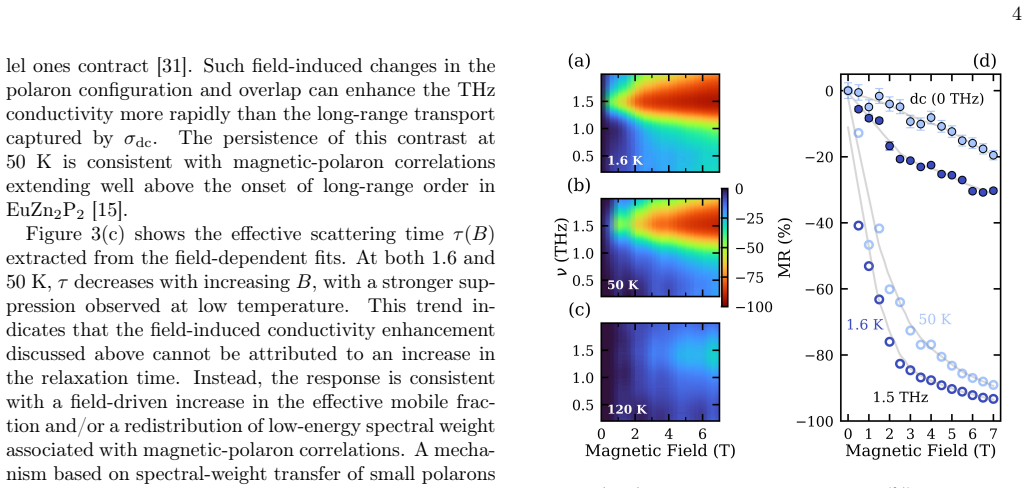
The central object is the magnetic polaron, a charge carrier dressed by a ferromagnetically aligned spin cloud whose size and overlap depend on temperature and magnetic field. The quantitative machinery is the offset power-law parameterization sigma1(nu) = sigma_p + A(nu - nu0)^(2q), which isolates the low-energy electronic response from the phonon tail and yields the conductivity baseline sigma_p, a sub-terahertz offset frequency nu0, and an effective scattering time tau from the spectral width. This parameterization defines the zero-frequency extrapolation and the conductivity-based magnetoresistance ratio MR(nu,B) = [sigma1(nu,0) - sigma1(nu,B)]/sigma1(nu,B).
What would settle it
Measure the dc magnetoresistance of the same EuZn2P2 crystals by four-probe transport at 1.6 K and 50 K in fields up to 7 T and compare with the zero-frequency extrapolation from the terahertz fits; alternatively, re-measure the zero-field terahertz spectrum with a different crystal thickness and independent phonon/background subtraction to see whether sigma1(1.5 THz,0) remains near zero.
Extended reading notes
Core claim
The paper's central claim is that magnetic polarons govern the low-energy electrodynamics of EuZn2P2 and that this polaron-driven response produces a frequency-dependent magnetoresistance that becomes colossal at terahertz frequencies. The real part of the optical conductivity shows non-Drude, offset power-law frequency dependence consistent with isolated to overlapping polarons on cooling. The effective polaron relaxation time reaches a maximum near the Néel temperature and decreases under magnetic field. The paper defines a conductivity-based terahertz magnetoresistance and finds that at 1.5 THz and 7 T it reaches about 93% at 1.6 K and 89% at 50 K, compared with about 30% and 20% for the
Load-bearing premise
The colossal 90% figure assumes that the nearly zero zero-field conductivity near 1.5 THz is a physical baseline rather than an artifact of fitting or background/phonon subtraction, and that the 'three times larger than dc' comparison relies on an extrapolated zero-frequency value rather than a directly measured dc transport value.
Editorial extensions
If this is right
- If the central claim is correct, terahertz magnetoresistance in EuZn2P2 can exceed 90% at 1.5 THz in a 7 T field, roughly three times the extrapolated dc value.
- The peak in the effective polaron relaxation time near the Néel temperature indicates that magnetic correlations directly shape sub-picosecond charge dynamics.
- Field-induced conductivity enhancement is not driven by longer relaxation times, but by an increased effective mobile fraction or spectral-weight redistribution associated with polaron alignment.
- Polaronic correlations persist above the Néel temperature and even below the antiferromagnetic transition, consistent with ferromagnetic clusters embedded in antiferromagnetic order.
- Magnetic polarons are established as a terahertz-scale magnetoresistance mechanism distinct from the band-gap-renormalization mechanism reported in other Eu-based compounds.
Reading between the lines
- Extension: if the zero-field conductivity baseline near 1.5 THz is robust, the same offset power-law analysis should reveal comparable terahertz magnetoresistance enhancement in other Eu-based Zintl compounds where dc colossal magnetoresistance has been reported.
- Extension: a direct four-probe dc magnetoresistance measurement on the same crystals would test whether the factor-of-three comparison is quantitative or an artifact of the extrapolated zero-frequency baseline.
- Extension: the polaron-overlap picture suggests that chemical substitution or pressure could tune the polaron overlap, potentially shifting the colossal response to lower fields or different frequencies.
- Extension: tracking the cone-like magnetoresistance feature across a wider frequency range could distinguish dynamic spectral-weight transfer from static band effects, a testable prediction beyond the reported data.
Editorial analysis
A structured set of objections, weighed in public.
Referee Report
Summary. The paper reports magneto-terahertz time-domain spectroscopy of the Zintl antiferromagnet EuZn2P2 from 0.2–2 THz, at 1.6–150 K and fields up to 7 T. The real part of the optical conductivity σ1(ν) is modeled below the conductivity minimum with an offset power law σ1 = σp + A(ν−ν0)^{2q}. The authors extract a zero-frequency extrapolation σdc, an effective scattering time τ, and define a frequency-dependent magnetoresistance MR(ν,B) = [σ1(ν,0)−σ1(ν,B)]/σ1(ν,B). They report a large negative THz MR reaching about 90% at 1.5 THz and 7 T, which they state is roughly three times larger than the zero-frequency limit, and interpret this as evidence of magnetic-polaron dynamics with a relaxation-time maximum near TN.
Significance. If the quantitative claims are correct, this is the first report of colossal terahertz magnetoresistance in a magnetic-polaron semiconductor, and it would establish THz spectroscopy as a sensitive probe of polaron magnetotransport. The dataset—temperature-, field-, and frequency-resolved complex conductivity of a well-characterized Eu-based Zintl compound—is valuable and would be of broad interest to the correlated-electron and terahertz communities. The central novelty, however, depends on the robustness of the 90% MR value and on the comparison with an extrapolated dc baseline. The paper currently lacks the absolute conductivity values, error propagation, and independent dc transport data needed to validate those claims. The machine-readable fit parameters in the Supplementary Material are a strength, but they are not sufficient without uncertainty quantification.
major comments (4)
- [Results, Fig. 4(a,b) and MR definition] The MR at 1.5 THz is normalized by σ1(1.5 THz, B), while Fig. 1(b) shows that the zero-field σ1 at this frequency is 'nearly zero' at low temperatures. A small absolute field-induced increase in σ1 then produces a large percentage MR. The paper does not provide absolute values of σ1(1.5 THz) with uncertainties, nor does it report the raw field-induced change or the integral of the spectral weight. Consequently, the 90% value may be an artifact of dividing by a near-zero baseline. Please report absolute σ1(ν,B) with propagated errors at 1.5 THz, show that the field-induced change is significant relative to noise and phonon-tail/systematic uncertainties, and consider presenting unnormalized Δσ1 as well.
- [Eq. (1), Fig. 4(d)] The zero-frequency MR is not measured by dc transport but is obtained by extrapolating the same fitted form σ1 = σp + A(ν−ν0)^{2q} to ν=0. The 'roughly three times larger than the zero-frequency limit' claim therefore compares two quantities that both derive from the same fit, making the factor-of-three comparison circular. The authors should measure dc MR on the same crystals, or at least quantify the extrapolation uncertainty and explicitly state that the dc value is a fit extrapolation rather than an experimental zero-frequency measurement.
- [Eq. (1), Fig. 1(a) fit range] The function σ1(ν) = σp + A(ν−ν0)^{2q} is not real-valued for ν < ν0 when 2q is non-integer, which is the case here (q ≈ 0.7–1, so 2q ≈ 1.4–2). The fit is applied to data spanning a range that includes ν0 (0.3–0.6 THz), since νmin ≈ 1.5 THz and the fits extend to low frequencies. Unless the fitting is restricted to ν > ν0 or the function is explicitly defined with an absolute value |ν−ν0|, the extraction of σdc, τ, and the regime boundaries is mathematically ill-defined. Please specify the exact fitting domain and the real-valued form used.
- [Results, Fig. 1(c) and Fig. 3(c)] The 'effective scattering time τ' is said to be extracted from the fitted spectra, but no formula connecting the fit parameters (σp, A, q, ν0) to τ is provided. Since τ is a central quantity used to support the polaron-relaxation interpretation, the definition and extraction procedure must be explicit. Without it, the maximum near TN and the field dependence of τ cannot be evaluated.
minor comments (4)
- [Abstract, Conclusions] The statement 'roughly three times larger' is accurate only at 1.6 K (93%/30% ≈ 3.1); at 50 K the ratio is about 4.5 (89%/20%). Consider specifying the temperature or saying 'roughly three to four times'.
- [Fig. 4(d)] The filled symbols representing dc MR should be explicitly labeled as extrapolations from the power-law fits, not as direct dc transport measurements, to avoid misleading readers.
- [Supplementary Material, Samples] There are typos: 'comercial' should be 'commercial' and 'weighted' should be 'weighed'.
- [Supplementary Material, Fit parameters] It would be helpful to report representative uncertainties for the fit parameters and for σ1 at 1.5 THz, since the near-zero baseline argument hinges on the noise level.
Circularity Check
No significant circularity: the THz MR is a direct measured ratio; the zero-frequency comparison is an acknowledged extrapolation, and the polaron scenario rests on external as well as self-citations.
full rationale
The central headline result, MR ≈ 90% at 1.5 THz, is computed directly from measured σ1(ν,B) values using the standard definition MR(ν,B)=[σ1(ν,0)-σ1(ν,B)]/σ1(ν,B). The magnitude is large partly because the zero-field σ1 at 1.5 THz is near the conductivity minimum and is small, but this is a property of the measured data and the ratio definition, not a fitted parameter renamed as a prediction. The paper explicitly states that σ1 at 1.5 THz is 'extracted directly from the measured spectra' and that the zero-frequency value is 'obtained by extrapolating the power law to zero frequency.' The factor-of-three comparison uses this extrapolated dc value, but the Discussion acknowledges that this inferred value differs from the large dc CMR measured in transport experiments, so the comparison is an internal model-dependent statement rather than a hidden fit-to-fit identity. The polaron interpretation is supported by external prior work (e.g., refs. 15 and 16) in addition to overlapping-author refs. 13 and 21; no uniqueness theorem or ansatz is imported solely from self-citations. The offset power-law parameterization σ1=σp+A(ν−ν0)^{2q} is a phenomenological fit cited to external literature and is used to extract scales, not to define the headline MR. No equation in the paper reduces to its own inputs by construction, and no fitted parameter is presented as an independent prediction. The near-zero baseline concern is a legitimate correctness/robustness caveat, but it does not constitute circularity under the stated criteria.
Assumptions & free parameters
free parameters (6)
- σp (power-law offset/baseline) =
Per spectrum; not tabulated in text
- A (amplitude coefficient) =
A < 0 for all temperatures; values in SM Figs. S2/S3
- q (non-Drude exponent) =
0.7–1 at zero field; ~0.5–0.9 with field
- ν0 (offset frequency / conductivity peak) =
0.3–0.6 THz
- Ea (activation energy) =
3.5 ± 0.3 THz (~14.5 meV)
- τ (effective scattering time) =
Sub-picosecond; maximum near TN
assumptions (4)
- domain assumption The offset power-law form σ1 = σp + A(ν − ν0)^{2q} adequately describes the isolated electronic conductivity below the ~1.5 THz minimum.
- domain assumption The conductivity minimum near 1.5 THz and its temperature/field evolution are dominated by the electronic polaronic response, not by the Eu phonon tail or measurement artifacts.
- domain assumption Magnetic polarons exist in EuZn2P2 and their growth/overlap governs transport.
- standard math Standard Fresnel inversion for a plane-parallel slab yields the complex THz conductivity from transmission.
Cite this review
Pith. "Pith review of Colossal Terahertz Magnetoresistance from Magnetic Polarons in EuZn$_2$P$_2$." pith.science (2026). https://pith.science/paper/A76YRJKI
@misc{pith2026260321423,
  author       = {Pith},
  title        = {Pith review of: Colossal Terahertz Magnetoresistance from Magnetic Polarons in EuZn$_2$P$_2$},
  year         = {2026},
  howpublished = {\url{https://pith.science/paper/A76YRJKI}},
  note         = {Machine review of arXiv:2603.21423}
}
abstract
Magnetic polarons can generate colossal magnetoresistance in magnetic semiconductors, yet their terahertz electrodynamics remain largely unexplored. Here we report magneto-terahertz spectroscopy of the Eu-based Zintl antiferromagnet EuZn$_2$P$_2$. The low-frequency conductivity shows pronounced non-Drude behavior consistent with an evolution from isolated to overlapping magnetic polarons upon cooling. The polaron relaxation time reaches a maximum near the N\'eel temperature at zero field and exhibits a strong magnetic-field dependence. This polaron-driven reshaping of the conductivity leads to a strongly frequency-dependent magnetoresistance that becomes colossal in the terahertz range, reaching about 90~\% at 1.5~THz, roughly three times larger than the zero-frequency limit value. These results demonstrate that magnetic polarons strongly govern the low-energy electrodynamics and highlight the sensitivity of terahertz spectroscopy to polaronic magnetotransport in correlated magnetic semiconductors.
Figures


Reference graph
Works this paper leans on
-
[1]
P. Rosa, Y. Xu, M. Rahn, J. Souza, S. Kushwaha, L. Veiga, A. Bombardi, S. Thomas, M. Janoschek, E. Bauer, M. Chan, Z. Wang, J. Thompson, N. Harrison, P. Pagliuso, A. Bernevig, and F. Ronning, npj Quantum Materials5, 52 (2020)
2020
-
[2]
Z.-C. Wang, J. D. Rogers, X. Yao, R. Nichols, K. Atay, B. Xu, J. Franklin, I. Sochnikov, P. Ryan, D. Haskel, and F. Tafti, Advanced Materials33, 2005755 (2021)
2021
-
[3]
X. Chen, S. Dong, and Z.-C. Wang, J. Phys. Condens. Matter37, 033001 (2024)
2024
-
[4]
S. Luo, Y. Xu, F. Du, L. Yang, Y. Chen, C. Cao, Y. Song, and H. Yuan, Phys. Rev. B108, 205140 (2023)
2023
-
[5]
F. Tang, Y. Chen, W. Yu, Y. Chen, S. Wang, W. Zhao, X. Yin, Y. Liu, X. Zhang, Z. Han, and Y. Fang, Phys. Rev. Mater.9, 064205 (2025)
2025
-
[6]
R.P.Day, K.Yamakawa, L.P.Cairns, J.Singleton, W.L. Cao, C. Wu, M. Allen, J. E. Moore, and J. G. Analytis, Phys. Rev. B111, 054406 (2025)
2025
-
[7]
Z. Zhou, Z. Wang, X. Chen, J.-Y. Lu, J. Zhang, X. Luo, G.-H. Cao, S. Dong, and Z.-C. Wang, Phys. Rev. Mater. 8, 114421 (2024)
2024
-
[8]
Ronning, P
J.C.Souza, S.M.Thomas, E.D.Bauer, J.D.Thompson, F. Ronning, P. G. Pagliuso, P. F. S. Rosa, and P. Rosa, Phys. Rev. B105, 035135 (2022)
2022
Show all 46 references
-
[9]
M. Kopp, C. Garg, S. Krebber, K. Kliemt, C. Krellner, S. R. Balguri, M. Mahendru, F. Tafti, T. L. Breeze, N. P. Bentley, F. L. Pratt, T. J. Hicken, H. Luetkens, J. A. Krieger, S. J. Blundell, T. Lancaster, M. V. A. Criv- illero, S. Wirth, and J. Müller, npj Quantum Materials 1...
2026 doi
-
[10]
Pohlit, S
M. Pohlit, S. Rößler, Y. Ohno, H. Ohno, S. von Molnár, Z. Fisk, J. Müller, and S. Wirth, Phys. Rev. Lett.120, 257201 (2018)
2018
-
[11]
Ulbricht, E
R. Ulbricht, E. Hendry, J. Shan, T. F. Heinz, and M. Bonn, Rev. Mod. Phys.83, 543 (2011)
2011
-
[12]
C. C. Homes, Z.-C. Wang, K. Fruhling, and F. Tafti, Phys. Rev. B107, 045106 (2023)
2023
-
[13]
Dutra, G
M. Dutra, G. G. Vasques, P. C. Sabino, J. G. Dias, J. F. Oliveira, M. A. V. Heringer, M. Cabrera-Baez, E. B. Saitovitch, A. R. V. Benvenho, M. A. Avila, and J. Munevar, Phys. Rev. Mater.10, 016204 (2026)
2026
-
[14]
Berry, V
T. Berry, V. J. Stewart, B. Y. Redemann, C. Lygouras, N. Varnava, D. Vanderbilt, and T. M. McQueen, Phys. Rev. B106, 054420 (2022)
2022
-
[15]
Krebber, M
S. Krebber, M. Kopp, C. Garg, K. Kummer, J. Sichelschmidt, S. Schulz, G. Poelchen, M. Mende, 6 A. V. Virovets, K. Warawa, M. D. Thomson, A. V. Tarasov, D. Y. Usachov, D. V. Vyalikh, H. G. Roskos, J. Müller, C. Krellner, and K. Kliemt, Phys. Rev. B108, 045116 (2023)
2023
-
[16]
M. S. Cook, E. A. Peterson, C. S. Kengle, E. R. Kennedy, J. Sheeran, C. Girod, G. S. Freitas, S. M. Greer, P. Abba- monte, P. G. Pagliuso, J. D. Thompson, S. M. Thomas, and P. F. S. Rosa, Phys. Rev. Mater.9, 104403 (2025)
2025
-
[17]
Baydin, T
A. Baydin, T. Makihara, N. M. Peraca, and J. Kono, Front. Optoelectron.14, 110 (2021)
2021
-
[18]
M. Koch, D. M. Mittleman, J. Ornik, and E. Castro- Camus, Nat. Rev. Methods Primers3(2023)
2023
-
[19]
E. D. Stefanato, N. M. Kawahala, B. A. Kawata, P. H. O. Rappl, E. Abramof, and F. G. G. Hernandez, Commun. Phys.8(2025)
2025
-
[20]
D. N. Basov, R. D. Averitt, D. van der Marel, M. Dressel, and K. Haule, Rev. Mod. Phys.83, 471 (2011)
2011
-
[21]
Dutra, E
M. Dutra, E. Marulanda, G. G. Vasques, J. F. Oliveira, P. C. Sabino, R. B. Delgado, L. Mendonça- Ferreira, A. R. V. Benvenho, E. Baggio-Saitovitch, R. K. Machado, N. M. Kawahala, J. Munevar, M. A. Avila, and F. G. G. Hernandez, (2025), arXiv:2512.17123 [cond- mat.str-el]
2025 arXiv
-
[22]
See Supplemental Material at [URL will be inserted by publisher] for additional fit details and parameters
-
[23]
Rybicki, K
D. Rybicki, K. Komędera, J. Przewoźnik, L. Gondek, C. Kapusta, K. Podgórska, W. Tabiś, J. Żukrowski, L. M. Tran, M. Babij, Z. Bukowski, L. Havela, V. Buturlim, J. Prchal, M. Divis, P. Kral, I. Turek, I. Halevy, J. Kastil, M. Misek, U. Dutta, and D. Legut, Phys. Rev. B110, 0144...
2024
-
[24]
U. Yu, J. Chatterjee, and B. I. Min, Journal of Applied Physics97, 10A903 (2005)
2005
-
[25]
A. K. Jonscher, Nature267, 673 (1977)
1977
-
[26]
S. R. Elliott, Adv. Phys.36, 135 (1987)
1987
-
[27]
F. Tay, S. Chaudhary, J. He, N. M. Peraca, A. Baydin, G. A. Fiete, J. Zhou, and J. Kono, Optica10, 932 (2023)
2023
-
[28]
Zhang, K
Y. Zhang, K. Deng, X. Zhang, M. Wang, Y. Wang, C. Liu, J.-W. Mei, S. Kumar, E. F. Schwier, K. Shimada, C. Chen, and B. Shen, Phys. Rev. B101, 205126 (2020)
2020
-
[29]
J. Y. Chan, S. M. Kauzlarich, P. Klavins, R. N. Shelton, and D. J. Webb, Phys. Rev. B57, R8103 (1998)
1998
-
[30]
Dawczak-Dębicki, M
H. Dawczak-Dębicki, M. V. Ale Crivillero, M. S. Cook, S. M. Thomas, P. F. S. Rosa, J. Müller, U. K. Rößler, P. Schlottmann, and S. Wirth, Commun. Mater.5, 248 (2024)
2024
-
[31]
Emin and M
D. Emin and M. S. Hillery, Phys. Rev. B37, 4060 (1988)
1988
-
[32]
A. S. Alexandrov and A. M. Bratkovsky, Journal of Physics: Condensed Matter11, L531 (1999)
1999
-
[33]
Hartinger, F
C. Hartinger, F. Mayr, A. Loidl, and T. Kopp, Phys. Rev. B73, 024408 (2006)
2006
-
[34]
Rahman, M
A. Rahman, M. U. Rehman, Y. Zhang, W. Zhao, J. Wang, Z. Chen, Z. Muhammad, and L. Zhang, Phys. Rev. B110, 064407 (2024)
2024
-
[35]
F. Tang, Y. Chen, X. Yin, W. Zhao, L. Zhang, Z. Han, R. Zheng, X. Zhang, and Y. Fang, Phys. Rev. B110, 174408 (2024)
2024
-
[36]
Karki Chhetri, G
S. Karki Chhetri, G. Acharya, D. Graf, R. Basnet, S. Rahman, M. M. Sharma, D. Upreti, M. R. U. Nabi, S. Kryvyi, J. Sakon, M. Mortazavi, B. Da, H. Churchill, and J. Hu, Phys. Rev. B111, 014431 (2025)
2025
-
[37]
Balguri, M
S. Balguri, M. B. Mahendru, E. O. G. Delgado, K. Fruh- ling, X. Yao, D. E. Graf, J. A. Rodriguez-Rivera, A. A. Aczel, T. J. Hicken, H. Luetkens, M. J. Graf, A. Rydh, J. Gaudet, and F. Tafti, Phys. Rev. B111, 115114 (2025)
2025
-
[38]
Q. Dong, P. Yang, Z. Liu, Y. Wang, H. Wen, Z. Liu, T. Shi, Z. Tian, J. Sun, Y. Uwatoko, Q. Wu, G. Chen, B. Wang, and J. Cheng, Phys. Rev. B112, L140405 (2025)
2025
-
[39]
Singh, J
K. Singh, J. Skolimowski, G. Cuono, R. M. Sattigeri, A. Ptok, O. Pavlosiuk, T. Romanova, T. Toliński, P. Wiśniewski, C. Autieri, and D. Kaczorowski, Phys. Rev. B112, 134440 (2025)
2025
-
[40]
M. S. Cook, B. R. Ortiz, P. Park, K. Gornicka, S. Sarker, J. Yan, and M. A. McGuire, Phys. Rev. Mater.9, 124410 (2025)
2025
-
[41]
Y. Wang, Z. Liu, Y. Wang, C. Li, X. Wang, K. Liao, Q. Wu, and G. Wang, Phys. Rev. B113, 024425 (2026)
2026
-
[42]
Lloyd-Hughes, C
J. Lloyd-Hughes, C. D. W. Mosley, S. P. P. Jones, M. R. Lees, A. Chen, Q. X. Jia, E.-M. Choi, and J. L. MacManus-Driscoll, Nano Letters17, 2506 (2017)
2017
-
[43]
Mukhin, Y
A.Pimenov, M.Biberacher, D.Ivannikov, A.Loidl, A.A. Mukhin, Y. G. Goncharov, and A. M. Balbashov, Physi- cal Review B73, 220407 (2006)
2006
-
[44]
P. Hao, Z. Ren, B. Huang, X. Chang, Z. Xu, Y. Guo, Z. Zhong, X. Liu, and Z. Sheng, ACS Applied Materials & Interfaces18, 5467 (2026)
2026
-
[45]
Marulanda, F
E. Marulanda, F. L. Costa, N. M. Kawahala, and F. G. G. Hernandez, J. Infrared Millim. Terahertz Waves 46(2025)
2025
-
[46]
Lloyd-Hughes and T.-I
J. Lloyd-Hughes and T.-I. Jeon, J. Infrared Millim. Ter- ahertz Waves33, 871 (2012). 7 SUPPLEMENTARY MATERIAL SAMPLES High-purity single crystals of EuZn2P2 were synthesized by the Sn-flux method. High-purity elements, Eu (99.9%), Zn (99.999%), P (99.999%), and Sn (99.999%) fr...
2012
Reviewed August 4, 2026 · model on record in the stance chip above.
Discussion (0). Sign in to comment.