REVIEW 5 minor 18 references
A Simulation Framework for Ramsey Interferometry
T0 review · 0 major / 5 minor · reviewed 2026-07-13 · grok-4.5
Pith's one-line read A new spin-dynamics code shows that time-shaped RF pulses can cut flip-angle spread fourfold and raise Ramsey phase sensitivity by a factor of four on a pulsed neutron beam.
desk verdict Solid methods paper that ships open-source RamseyProp and shows a clean ~4 imes sensitivity gain from 1/t RF modulation on the full ESS spectrum under stated analytic fields. read the letter →
The pith
A machine-rendered reading of the paper's core claim, the machinery that carries it, and where it could break.
The reading
What carries the argument
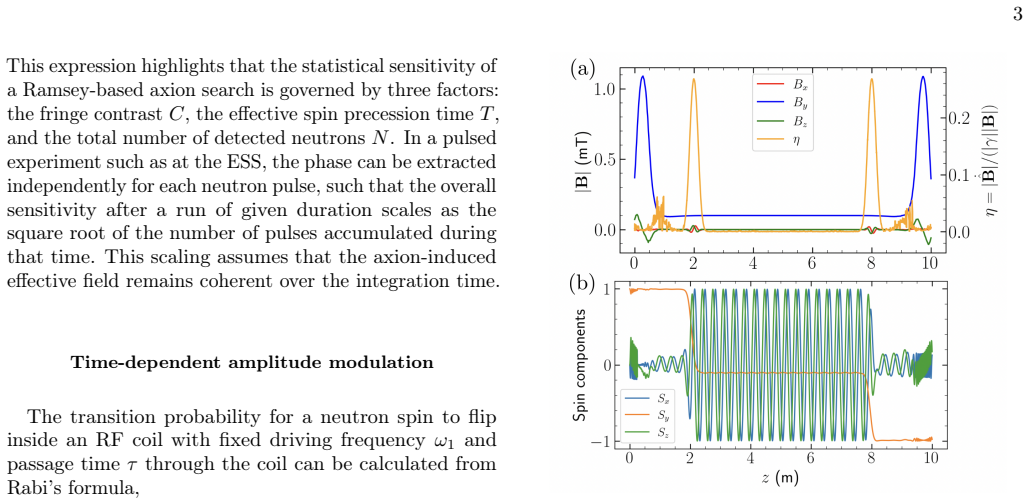
RamseyProp: a Python/Numba solver of the Bloch equation that takes Monte-Carlo particle lists and analytic or COMSOL field maps, applies optional time-dependent coil envelopes, and returns flip-angle distributions, adiabaticity maps and Ramsey fringes.
What would settle it
Repeat the same Monte-Carlo trajectories with realistic dual-layer mu-metal and coil field maps from COMSOL; if the steepest-slope phase uncertainty no longer improves by a factor near four, the claim fails for the planned hardware.
Extended reading notes
Core claim
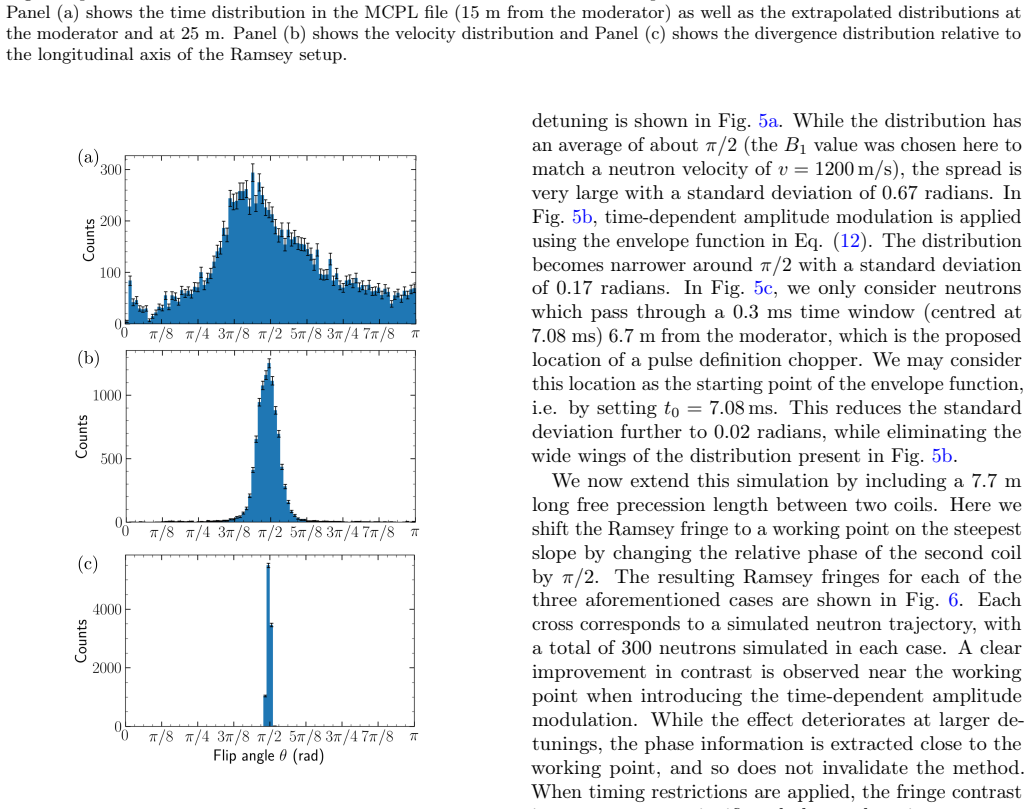
When the full velocity spectrum of a pulsed neutron beam is accepted without choppers, a time-dependent RF amplitude proportional to 1/t reduces the standard deviation of the spin flip angle at zero detuning from 0.67 rad to 0.17 rad and improves the extracted phase sensitivity by a factor of approximately four for a ten-metre free-precession region beginning fifteen metres from the source.
Load-bearing premise
The quoted factor-of-four gain is calculated with ideal constant B0 and circularly polarised B1 rather than the full inhomogeneous shield and coil maps that the real apparatus will use.
Editorial analysis
A structured set of objections, weighed in public.
Referee Report
Summary. The manuscript presents RamseyProp, a Python-based spin-dynamics code that couples McStas neutron phase-space distributions (via MCPL) with analytic or COMSOL magnetic-field maps and integrates the Bloch equation along individual trajectories. The framework is validated against the analytic Ramsey formula for a monochromatic test case (RMSE 5e-4). It is then applied to a conceptual ALP search at ESS/HIBEAM: with the full pulsed spectrum and no velocity cuts, a 1/t RF amplitude envelope reduces the zero-detuning flip-angle standard deviation from 0.67 to 0.17 rad and improves the steepest-slope phase uncertainty by a factor of approximately 4 for a ~10 m setup starting 15 m from the moderator. Additional chopper gating further tightens the distributions. The authors release the source under GPL and note that the same tools are already being used for magnetics/optics optimisation of the real experiment.
Significance. A publicly available, trajectory-level Ramsey simulator that consistently treats optics, magnetostatics and spin dynamics fills a genuine gap for precision neutron experiments. The open-source release, analytic validation, and explicit demonstration that ESS pulse structure can be exploited via simple amplitude modulation are concrete strengths. Even under the idealised constant-B0/circular-B1 fields used here, the quantitative gains (factor ~4 without choppers) supply a useful design benchmark and a clear path for subsequent COMSOL-based optimisation. The work is therefore of direct practical value to the ESS/HIBEAM ALP programme and to other pulsed-source Ramsey experiments.
minor comments (5)
- Methodology, Simulation inputs: the authors correctly flag that analytic B0/B1 are used to decouple the methodological study from geometry. A short quantitative estimate (or one additional figure) of how residual inhomogeneities from a dual-layer mu-metal shield would degrade the reported contrast would strengthen the bridge to the real experiment.
- Eq. (12) and surrounding text: the half-pulse-width shift t0 = 1.5 ms is stated as approximate; a brief sensitivity scan of t0 would clarify how robust the 0.17 rad width is to this choice.
- Fig. 6 caption and Results: the relative phase of the second coil is shifted by pi/2 to place the working point on the steepest slope; this is clear in the text but could be restated in the figure caption for readers who start with the plots.
- Introduction and Conclusions: intermediate pi pulses for partial T2 recovery are mentioned only briefly; a sentence on whether RamseyProp already supports them (or will) would help readers planning multi-pulse sequences.
- Typographical: THEORY heading is split as THEOR Y; abstract and body use both ~4 and factor of 4 consistently enough, but a single style would be cleaner.
Circularity Check
No significant circularity: numerical simulation results from independent inputs, not forced by definition or self-citation.
full rationale
The paper presents a simulation framework (McStas + COMSOL + RamseyProp) and reports numerical outcomes for flip-angle distributions and Ramsey fringe slopes under analytic B0/B1 and the ESS pulse. The sensitivity relations (Eqs. 7–9) are standard error propagation from the linearised polarisation slope b = ∓CT; they do not encode the reported factor-of-4 gain. The amplitude envelope f(t) ∝ 1/t (Eq. 12) is derived from the requirement that the integrated pulse area equal π/2 for every velocity (Eq. 11); it is not fitted to the final fringe contrast or phase uncertainty. The quantitative claims (std 0.67 → 0.17 rad; phase uncertainty 0.6 → 0.14 Hz) are outputs of Monte-Carlo trajectories through that fixed envelope, validated against the analytic Ramsey formula (RMSE 5×10⁻⁴). Self-citations point to the authors’ experimental proposal and to open tools; none is load-bearing for a uniqueness claim or for the numerical gains. The derivation chain is therefore self-contained and non-circular.
Assumptions & free parameters
free parameters (4)
- B0 (static field) =
100 µT
- B1 (RF amplitude) =
34.4 µT
- envelope time offset t0 =
1.5 ms (or 7.08 ms with chopper)
- coil length and free-precession length =
0.3 m / 7.7 m
assumptions (4)
- domain assumption Spin evolution obeys the classical Bloch equation dS/dt = γ S × B(r(t),t) with no decoherence or quantum corrections.
- domain assumption The McStas model of the ESS E5/HIBEAM extraction system (elliptical m=3 guide, slits at 11.5 m) faithfully represents the phase-space distribution at 15 m.
- domain assumption A circularly polarised RF field of constant amplitude (or 1/t envelope) can be realised inside the coils without significant higher harmonics or phase jitter.
- domain assumption Statistical polarisation uncertainty scales as 1/√N and the axion-induced field remains coherent over the integration time.
Cite this review
Pith. "Pith review of A Simulation Framework for Ramsey Interferometry." pith.science (2026). https://pith.science/paper/2HFJLQZQ
@misc{pith2026260324049,
  author       = {Pith},
  title        = {Pith review of: A Simulation Framework for Ramsey Interferometry},
  year         = {2026},
  howpublished = {\url{https://pith.science/paper/2HFJLQZQ}},
  note         = {Machine review of arXiv:2603.24049}
}
read the original abstract
The sensitivity of Ramsey interferometry experiments is governed by the interplay between the beam phase-space distribution and the magnetic field environment through which the spins propagate. Quantitative optimisation thus requires a consistent treatment of optics, magnetics and spin dynamics. We present a simulation framework that enables such an analysis by combining neutron optics simulations in McStas, magnetic field modelling in COMSOL and spin-dynamics simulation in the new RamseyProp program. We describe how important experimental parameters such as adiabaticity, flip angle distributions and Ramsey fringe contrast can be studied. The code is being applied to design an experiment to search for axion-like particles at the European Spallation Source (ESS). We examine how the pulsed time structure of the ESS can be exploited to perform Ramsey interferometry on a broad neutron velocity spectrum. In the absence of velocity or timing restrictions, the standard deviation of the spin flip angle at zero detuning can be reduced from 0.67 to 0.17 radians using time-dependent amplitude modulation. Similarly, the phase sensitivity can be improved by a factor of 4 for a 10 m long setup starting 15 m from the ESS moderator.
Figures


Figures from the paper (4 more)



Reference graph
Works this paper leans on
-
[1]
N. F. Ramsey, Phys. Rev.78, 695 (1950)
1950
-
[2]
A. D. Ludlow, M. M. Boyd, J. Ye, E. Peik, and P. O. Schmidt, Rev. Mod. Phys.87, 637 (2015)
2015
-
[3]
Budker and M
D. Budker and M. Romalis, Nat. Phys.3, 227 (2007)
2007
-
[4]
T. E. Chupp, P. Fierlinger, M. J. Ramsey-Musolf, and J. T. Singh, Rev. Mod. Phys.91, 015001 (2019)
2019
-
[5]
Fierlinger, V
P. Fierlinger, V. Santoro, W. Snow, M. Holl, Y. Stadnik, and D. Milstead, Phys. Rev. Lett.133, 181001 (2024)
2024
-
[6]
K. Choi, S. H. Im, and C. S. Shin, Annu. Rev. Nucl. Part. Sci.71, 225 (2021)
2021
-
[7]
C. B. Adamset al., Axion Dark Matter (2023), arXiv:2203.14923 [hep-ex]
arXiv 2023
-
[8]
P. W. Graham and S. Rajendran, Phys. Rev. D88, 035023 (2013)
2013
Show all 18 references
-
[9]
Y. V. Stadnik and V. V. Flambaum, Phys. Rev. D89, 043522 (2014)
2014
-
[10]
Santoroet al., J
V. Santoroet al., J. Phys. G: Nucl. Part. Phys.52, 040501 (2025)
2025
-
[11]
S. D. Penn, E. G. Adelberger, B. R. Heckel, D. M. Markoff, and H. E. Swanson, Nucl. Instrum. Methods Phys. Res. A457, 332 (2001)
2001
-
[12]
Maruyamaet al., Phys
R. Maruyamaet al., Phys. B: Condens. Matter335, 238 (2003)
2003
-
[13]
Kittelmann, E
T. Kittelmann, E. Klinkby, E. B. Knudsen, P. Willendrup, X. X. Cai, and K. Kanaki, Comput. Phys. Commun.218, 17 (2017)
2017
-
[14]
P. K. Willendrup and K. Lefmann, J. Neutron Res.22, 1 (2019)
2019
-
[15]
Satoet al., J
T. Satoet al., J. Nucl. Sci. Technol.61, 127 (2024)
2024
-
[16]
6.4, https://www.comsol
COMSOL Multiphysics® v. 6.4, https://www.comsol. com, COMSOL AB, Stockholm, Sweden
-
[17]
S. K. Lam, A. Pitrou, and S. Seibert, inProceedings of the Second Workshop on the LL VM Compiler Infrastructure in HPC, LLVM ’15 (Association for Computing Machinery, New York, NY, USA, 2015) pp. 1–6
2015
-
[18]
L. B. Persson, RamseyProp: A Simulation Frame- work for Ramsey Interferometry,https://github.com/ HIBEAM-NNBAR/RamseyProp(2026), GitHub
2026
Reviewed July 13, 2026 · model on record in the stance chip above.
Discussion (0). Sign in to comment.