A fractal geometry enhanced topology optimization design for high-performance liquid cooling plates
Pith reviewed 2026-05-14 22:33 UTC · model grok-4.3
The pith
Adding fractal dimension to topology optimization produces liquid cooling plates with 46% more heat transfer area and 15-17 K lower temperatures.
A machine-rendered reading of the paper's core claim, the machinery that carries it, and where it could break.
Core claim
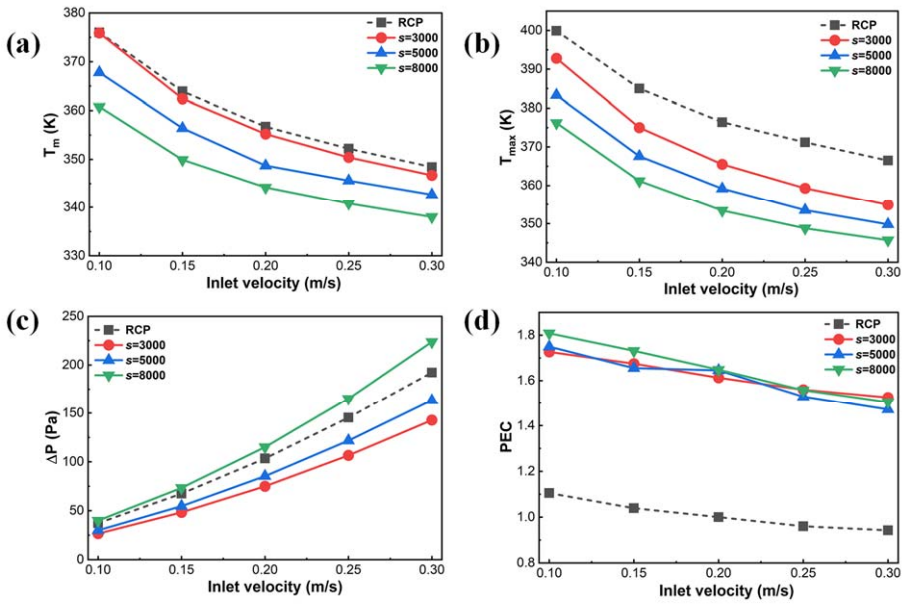
Embedding fractal dimension as an additional design freedom into density-based topology optimization explicitly includes the convective heat transfer area in the objective function. The method therefore generates cooling-plate topologies with 46% larger heat transfer area than standard TO, yielding average and maximum temperature reductions of 15.6 K and 16.9 K respectively. Increasing the input parameter s that sets the fractal dimension further improves thermal performance at the expense of pressure drop, and the added sensitivity difference between solid and liquid phases promotes better solid-liquid separation.
What carries the argument
The fractal geometry topology optimization (FGTO) method, in which fractal dimension (controlled by input parameter s) is introduced as an extra design variable inside density-based TO to make the solid-liquid interface area explicit in the objective function.
If this is right
- Raising the fractal parameter s improves thermal performance while increasing pressure drop, allowing tunable trade-offs between cooling and pumping power.
- The intensified difference in objective-function sensitivity between solid and liquid phases helps the optimizer escape local optima and achieve clearer solid-liquid separation.
- The resulting topologies are more complex than those from conventional TO and deliver measurably lower average and peak temperatures.
- Direct optimization of heat transfer area becomes possible once fractal dimension is treated as a design variable.
Where Pith is reading between the lines
- The same fractal-dimension variable could be added to topology optimization for other devices where interface area dominates performance, such as heat exchangers or porous reactors.
- Real prototypes tested under turbulent flow would be needed to check whether the simulated gains survive manufacturing tolerances and actual fluid dynamics.
- Tuning s could serve as a practical knob for balancing thermal resistance against hydraulic resistance in engineering design workflows.
Load-bearing premise
Varying the fractal parameter s will produce manufacturable structures whose simulated temperature reductions hold up in physical tests without being erased by unmodeled effects such as turbulence or fabrication limits.
What would settle it
Fabricate one conventional TO plate and one FGTO plate at the same s value, then measure their steady-state average and maximum surface temperatures under identical heat input and coolant flow rate; a difference near 15-17 K would support the claim.
Figures




read the original abstract
The density-based bi-objective topology optimization (TO) has been widely adopted in liquid cooling plate design, where the design domain is treated as porous media with porosity as the design variable. However, conventional TO method struggles to directly optimize the convective heat transfer due to its incapabilities of explicitly depicting the heat transfer area in objective function, which limits the optimization of thermal performance. In this study, a fractal geometry topology optimization (FGTO) method is proposed, which incorporates fractal dimension as an additional design freedom into the density-based TO framework. Different from the conventional TO methods, the FGTO explicitly describes the heat transfer area, and achieves a direct optimization of convective heat transfer through the objective function. Compared to the conventional TO, the FGTO achieves a more complex structural topology in the optimized liquid cooling plate with a 46% improvement in heat transfer area. The fractal dimension is manipulated by varying the input parameter s, and increasing s can improve thermal performance of the FGTO results at the cost of larger pressure drop. Superior thermal-hydraulic performance can be achieved by varying s, with the average and maximum temperatures of the FGTO results reduced by 15.6 K and 16.9 K, respectively, compared with those of the conventional TO results. The integration of fractal geometry into the TO intensifies the difference in objective function sensitivity between solid and liquid phases, which is conducive to facilitating solid-liquid separation and contributes to escape from local optimal solutions.
Editorial analysis
A structured set of objections, weighed in public.
Referee Report
Summary. The manuscript proposes a fractal geometry topology optimization (FGTO) method that augments conventional density-based bi-objective TO for liquid cooling plates by treating fractal dimension as an additional design freedom controlled by input parameter s. This is claimed to enable explicit optimization of convective heat transfer area in the objective function, yielding more complex topologies with a 46% increase in heat transfer area and reductions of 15.6 K (average) and 16.9 K (maximum) in temperature relative to standard TO, at the expense of higher pressure drop; the approach is said to intensify solid-liquid phase sensitivity differences and help escape local optima.
Significance. If the numerical gains prove robust, the FGTO framework could provide a practical extension to topology optimization for thermal management devices, offering a route to higher-performance liquid cooling plates in electronics and power systems by directly targeting heat transfer area rather than relying solely on porosity variables.
major comments (3)
- [Abstract and Results] Abstract and Results section: The central claims of 46% heat transfer area improvement and temperature reductions (15.6 K average, 16.9 K maximum) are presented without mesh convergence studies, error bars on the CFD results, or explicit baseline details on the conventional TO implementation (including turbulence model and boundary conditions), which are load-bearing for establishing superiority.
- [Methodology] Methodology: The mechanism by which varying s controls fractal dimension and intensifies objective-function sensitivity between solid and liquid phases to facilitate escape from local optima is asserted but not supported by explicit equations, sensitivity derivations, or analysis showing how the modification alters the optimization landscape.
- [Validation] Validation: No physical prototypes, experimental flow-loop tests, or measured pressure-drop and temperature data are reported, leaving open whether the simulated gains persist under real turbulence, fabrication limits, or interface effects that are not captured in the idealized model.
minor comments (2)
- [Notation] The range and physical interpretation of parameter s should be stated explicitly in the early methodology paragraphs to aid reproducibility.
- [Figures] Topology figures would benefit from side-by-side quantitative overlays (e.g., area values) and clearer indication of fractal features versus conventional results.
Simulated Author's Rebuttal
We thank the referee for the constructive and detailed comments, which have helped us identify areas for improvement in the manuscript. We provide point-by-point responses below and have revised the manuscript accordingly where feasible.
read point-by-point responses
-
Referee: [Abstract and Results] The central claims of 46% heat transfer area improvement and temperature reductions (15.6 K average, 16.9 K maximum) are presented without mesh convergence studies, error bars on the CFD results, or explicit baseline details on the conventional TO implementation (including turbulence model and boundary conditions), which are load-bearing for establishing superiority.
Authors: We agree that these elements are essential for rigorously establishing the reported improvements. In the revised manuscript, we will add mesh convergence studies confirming that the key metrics (heat transfer area and temperatures) are mesh-independent. Error bars derived from variations in numerical tolerances and solver settings will be included on the CFD results. We will also expand the Methodology section to explicitly document the conventional TO baseline, including the k-ε turbulence model, all boundary conditions, and solver settings used for comparison. These additions will appear in both the Methodology and Results sections. revision: yes
-
Referee: [Methodology] The mechanism by which varying s controls fractal dimension and intensifies objective-function sensitivity between solid and liquid phases to facilitate escape from local optima is asserted but not supported by explicit equations, sensitivity derivations, or analysis showing how the modification alters the optimization landscape.
Authors: We acknowledge that the original description was insufficiently detailed. The revised manuscript will include the explicit mathematical formulation of how the input parameter s modulates the fractal dimension within the density-based topology optimization framework. We will derive and present the sensitivity expressions of the objective function with respect to the design variables, demonstrating the intensified phase sensitivity between solid and liquid regions. Additionally, we will add an analysis (with supporting equations and a new figure) illustrating how this modification alters the optimization landscape to aid escape from local optima. revision: yes
-
Referee: [Validation] No physical prototypes, experimental flow-loop tests, or measured pressure-drop and temperature data are reported, leaving open whether the simulated gains persist under real turbulence, fabrication limits, or interface effects that are not captured in the idealized model.
Authors: The referee is correct that the study is purely numerical and does not include experimental validation. We will add a new subsection in the Conclusions explicitly discussing the limitations of the idealized CFD model, including assumptions on turbulence modeling and solid-liquid interfaces. We will also state that experimental fabrication and flow-loop testing of the optimized fractal topologies is planned as future work to verify performance under real conditions. However, such experiments require substantial additional resources and fabrication capabilities beyond the scope of this numerical development paper. revision: partial
- Absence of experimental validation data (physical prototypes and flow-loop measurements), which cannot be generated within the current numerical study.
Circularity Check
No circularity: FGTO adds independent fractal parameter s to standard density-based TO without reducing results to fitted inputs or self-definitions
full rationale
The paper extends conventional density-based topology optimization by introducing fractal dimension as an explicit additional design variable controlled by input parameter s. Reported gains (46% heat-transfer-area increase and temperature drops of 15.6 K / 16.9 K) are obtained from comparative numerical simulations of the optimized topologies, not from any algebraic reduction, parameter fitting to the target metrics, or self-citation chain. No equations are shown that equate the objective-function sensitivity or area improvement directly to the definition of s itself. The method therefore remains self-contained against external simulation benchmarks.
Axiom & Free-Parameter Ledger
free parameters (1)
- s
axioms (1)
- domain assumption Density-based TO treats the design domain as porous media with porosity as the design variable.
invented entities (1)
-
fractal dimension as additional design freedom
no independent evidence
Reference graph
Works this paper leans on
-
[1]
S. Waelveerakup, K. Thanomthong, P. Tantivimonkajorn, V . Wa nittansirichok, K. Mongkholphan, K. Sakamatapan, P. Promoppatum, S. Wongwises, Com prehensive examination of topologically optimized thermo-fluid heat sinks, Energy, 298 (2024) 131364
work page 2024
-
[2]
K. Chen, Z. Zhang, B. Wu, M. Song, X. Wu, An air-cooled sys tem with a control strategy for efficient battery thermal management, Applied Thermal Engineering, 236 (2024) 121578
work page 2024
-
[3]
Y . Luo, X. Qiu, S. Wang, Z. J ia, Optimizing a direct flow c ooling battery thermal management with bod baffles for electric vehicles: An experimen tal and simulation study, Journal of Energy Storage, 74 (2023) 109410
work page 2023
-
[4]
S. Feng, S. Shan, C. Lai, J. Chen, X. Li, S. Mori, Multi-ob jective optimization on thermal performance and energy efficienc y for battery module using grad ient distributed Tesla cold plate, Energy Conversion and Management, 308 (2024) 118383
work page 2024
-
[5]
C. Lee, Thermofluid topology optimization of liquid-based c ooling plate for lithium-ion battery pack of EVs, Energy, 323 (2025) 135712
work page 2025
- [6]
-
[7]
H. Wang, Y . Gan, R. Li, F. Liu, Y . Li, Experimental study on the thermal performance of a liquid-cooled heat sink integratin g heat pipes for dual CPU ser vers, Applied Thermal Engineering, 236 (2024) 121851. 43
work page 2024
-
[8]
J. Moradi, A.M. Andwari, A. Gharehghani, J. Könnö, Advanced thermal management strategies for electric vehicles : enhancing efficiency, reliabi lity, and performance, Future Energy, 4 (2025) 43-49
work page 2025
- [9]
- [10]
-
[11]
J. Wang, B. Liu, X. Ding, Q. Li, B. Yu, U. Desideri, Multi-objective topology optimization design of nanofluid cooling plate for thermal management of lithium ion battery pack, Energy, 337 (2025) 138600
work page 2025
-
[12]
M.P. Bendsøe, N. Kikuchi, Generating optimal topologies in structural design using a homogenization method, Computer Methods in Applied Mechanics and Engineering, 71 (1988) 197-224
work page 1988
-
[13]
T. Borrvall, J. Petersson, Topology optimization of fluids in Stokes flow, International Journal for Numerical Methods in Fluids, 41 (2003) 77-107
work page 2003
-
[14]
E.M. Dede, Multiphysics t opology optimization of heat tran sfer and fluid flow systems, proceedings of the COMSOL Users Conference, 2009
work page 2009
-
[15]
G.H. Yoon, Topological design of heat dissipating structur e with forced convective heat transfer, Journal of Mechanical Science and Technology, 24 (2010) 1225-1233
work page 2010
-
[16]
A.A. Koga, E.C.C. Lopes, H.F.V . Nova, C.R. De Lima, E.C.N. Silva, Development of heat sink device by using topology optim ization, International Journal of Heat and Mass Transfer, 64 (2013) 759-772
work page 2013
- [17]
-
[18]
Q. Yang, L. Chen, H. Ke, L. Gu, X. Zheng, S. Li, W. Tao, Multi-layer topology optimization of dual-fluid convective heat tra nsfer in printed circuit heat exchangers, Applied Thermal Engineering, 257 (2024) 124434
work page 2024
-
[19]
K. Yaji, S. Yamasaki, K. Fujita, Multifidelity design guid ed by topology optimization, Structural and Multidisciplinary Optimization, 61 (2020) 1071-1085
work page 2020
-
[20]
Y . Yuan, L. Chen, Q.R. Yang, H.B. Ke, L.R. Gu, W.Q. Tao, M ulti-fidelity topology optimization of flow boiling heat transfer in microchannels, In ternational Journal of Heat and 44 Mass Transfer, 239 (2025) 126585
work page 2025
- [21]
-
[22]
Y . Wu, Z. Li, C. Zhi, Z. Li, C. Shi, G. Tan, T. Ming, Pseudo three-dimensional topology optimization of cold plates for e lectric vehicle power packs, International Journal of Heat and Mass Transfer, 232 (2024) 125966
work page 2024
-
[23]
X. Tang, H. Liu, L. Wei, C. Tang, X. Shao, H. Shen, G. Xie, Numerical investigation and experimental verification of t opological optimized double-layer mini-channels, International Journal of Heat and Mass Transfer, 215 (2023) 124513
work page 2023
-
[24]
Y . Xia, L. Chen, J. Luo, W. Tao, Numerical investigation of microchannel heat sinks with different inlets and outlets based on topology optimization, Applied Energy, 330 (2023) 120335
work page 2023
-
[25]
A.Q. Zou, R. Chuan, F. Qian, W.Y . Zhang, Q.W. Wang, C.L. Zhao, Topology optimization for a water-cooled heat sink in micro-electronics based on Pare to frontier, Applied Thermal Engineering, 207 (2022) 118128
work page 2022
-
[26]
W. Sun, P. Li, T. Zhou, Y . Li, C. Li, X. Shao, H. Shen, Thermo-fluids performance analysis and experimental verification of topologically optimized mini-c hannel heat sinks integrated with impact jet, International Journal of Thermal Sciences, 211 (2025) 109705
work page 2025
-
[27]
J. Wang, F. Chen, Z. Shao, L. He, Study of the influence o f objective functions on the topology optimization design of bat tery cold plate, Applied Thermal Engineering, 226 (2023) 120326
work page 2023
-
[28]
J. Wang, U. Desideri, X. Liu, Multi-objective structure op timization and performance analysis of catalytic micro-reactor channel designed by an impr oved topology optimization model, Applied Thermal Engineering, 244 (2024) 122742
work page 2024
-
[29]
T.W. Athan, P.Y . Papalambros, A note on weighted criteria methods for compromise solutions in multi-objective optimization, Engineering Optimization, 27 (1996) 155-176
work page 1996
-
[30]
W. Stadler, Caveats and boons of multicriteria optimizatio n, Computer-Aided Civil and Infrastructure Engineering, 10 (1995) 291-299
work page 1995
-
[31]
J.H. Wang, D. Melideo, X.M. Liu, U. Desideri, Comparative study on topology optimization of microchannel heat sink by using different multi -objective algorithms and objective functions, Applied Thermal Engineering, 252 (2024) 123606
work page 2024
- [32]
-
[33]
J. Zhou, Q. Li, X. Chen, Micro pin fins with topologically optimized configurations enhance flow boiling heat transfer in manifold microchannel hea t sinks, International Journal of Heat and Mass Transfer, 206 (2023) 123956
work page 2023
- [34]
-
[35]
E. Duplain, B.R. Baliga, C omputational optimization of the thermal performance of internally finned ducts, International Journal of Heat and Mass Transfer, 52 (2009) 3929-3942
work page 2009
-
[36]
D. Chen, Y . Hasegawa, Level-set based topology optimization in conjugate heat transfer with large solid-to-fluid thermal conductivity ratios, Applied Thermal Engineering, 279 (2025) 127626
work page 2025
- [37]
- [38]
-
[39]
X. Qin, W. Yin, A novel fractal model for effective thermal conductivity in granular porous media, Geothermics, 108 (2023) 102625
work page 2023
-
[40]
J. Xu, B. Yu, A new model for heat conduction of nanofluids based on fractal distributions of nanoparticles, Journal of Physics D: Applied Physics, 39.20 (2006) 4486
work page 2006
-
[41]
P. Xu, B. Yu, M. Yun, M. Zou, Heat conduction in fractal t ree-like branched networks, International Journal of Heat and Mass Transfer, 49 (2006) 3746-3751
work page 2006
-
[42]
Y . Wang, L. Sun, C. Qi, J. Yu, W. Zhang, Topology optimization of a novel bionic fractal microchannel applied in thermal management of electronic compon ents, Asia-Pacific Journal of Chemical Engineering, 18 (2023) e2900
work page 2023
-
[43]
C. Dong, C. Zhang, G. He, D. Li, Z. Zhang, J. Cong, Z.M. M eng, S. Asim, M. Ashraf, Study on bionic leaf-vein like heat sinks topology optimization method, Energy, 319 (2025) 135027
work page 2025
-
[44]
Y . Zhao, X. Mou, Z. Chen, M. Hao, L. Chen, B. Xu, Topology optimization and bionic analysis of heat sink fin configuration based on additive manuf acturing technology, International Communications in Heat and Mass Transfer, 155 (2024) 107544
work page 2024
-
[45]
Z. Song, J. Wang, S. Tang, W. Li, M. Ma, D. Andronov, X. Fan, J. Cheng, Dual-objective topology optimization design for latent heat storage systems us ing composite phase change 46 materials, Energy, 319 (2025) 135069
work page 2025
-
[46]
D. Martínez-Maradiaga, A. Damonte, A. Manzo, J.H.K. Haerte l, K. Engelbrecht, Design and testing of topology optimized heat sinks for a tablet, International Journal of Heat and Mass Transfer, 142 (2019) 118429
work page 2019
-
[47]
J. Zhou, M. Lu, Q. Zhao, D. Hu, H. Qin, X. Chen, Thermal d esign of microchannel heat sinks using a contour extraction based on topology optimization (CEBTO) method, International Journal of Heat and Mass Transfer, 189 (2022) 122703
work page 2022
-
[48]
http s://www.arctic-tek.com/blog/electric-vehicle-battery-cold- plate (accessed October 10, 2025)
ARCTIC active cooling. http s://www.arctic-tek.com/blog/electric-vehicle-battery-cold- plate (accessed October 10, 2025)
work page 2025
-
[49]
https://www.kawaso-texcel.com/en/product/li quidcoldplate/igbt.html (accessed October 10, 2025)
Kawaso Texcel. https://www.kawaso-texcel.com/en/product/li quidcoldplate/igbt.html (accessed October 10, 2025)
work page 2025
-
[50]
https://dcx.eu/direct-liquid-cooling/nvidi a-gpu-cpu-coldplates/ (accessed November, 4, 2025)
NVIDIA GPU&CPU. https://dcx.eu/direct-liquid-cooling/nvidi a-gpu-cpu-coldplates/ (accessed November, 4, 2025)
work page 2025
-
[51]
Y . Liu, C. Chen, Y . Yuan, J. Yang, Z. Guo, J. Shi, Study o f microchannel heat transfer characteristics based on topology optimization, International Journal of Thermal Sciences, 214 (2025) 109898
work page 2025
-
[52]
Y . Shen, P. Xu, S. Qiu, B. Rao, B. Yu, A generalized therm al conductivity model for unsaturated porous media with fractal geometry, International J ournal of Heat and Mass Transfer, 152 (2020) 119540
work page 2020
-
[53]
Yu, Analysis of flow in fractal porous media, Applied M echanics Reviews, 61 (2008) 050801
B. Yu, Analysis of flow in fractal porous media, Applied M echanics Reviews, 61 (2008) 050801
work page 2008
-
[54]
N. Sarkar, B.B. Chaudhuri, An efficient differential box-c ounting approach to compute fractal dimension of image, IEEE Transactions on Systems, Man, and Cybernetics, 24 (1994) 115-120
work page 1994
-
[55]
X.L. Li, K. Wu, L.Y . Zhao, X.J. Fan, Topology optimization of regenerative cooling structures under high Reynolds number flow with variable thermo-physical properties, Applied Thermal Engineering, 258 (2025) 124602
work page 2025
-
[56]
B.S. Lazarov, O. Sigmund, Filters in topology optimization based on Helmholtz -type differential equations, International Journal for Numerical Met hods in Engineering, 86 (2011) 765-781
work page 2011
- [57]
-
[58]
Y .J. Guo, X. Li, S.L. Zhang, J.Y . Zuo, J.F. Wei, W. Bao, Mechanisms of turbulence effects on sensitivity analysis and optim ization performance in fluid-t hermal coupled topology optimization, International Journal of Heat and Mass Transfer, 246 (2025) 127108
work page 2025
-
[59]
E.A. Kontoleontos, E.M. Pa poutsis-Kiachagias, A.S. Zymaris , D.I. Papadimitriou, K.C. Giannakoglou, Adjoint-based constrained topology optimization f or viscous flows, including heat transfer, Engineering Optimization, 45 (2013) 941-961
work page 2013
- [60]
-
[61]
K. Svanberg, The method of moving asymptotes—a new method for structural optimization, International Journal for Numerical Methods in Engineering, 24 (1987) 359-373
work page 1987
-
[62]
J. Miao, C. Li, M. Pan, Expe rimental and numerical analysi s of variable cross-section channel liquid cooling plate for server chips thermal managemen t, Thermal Science and Engineering Progress, 49 (2024) 102470
work page 2024
-
[63]
R.T. Marler, J.S. Arora, The weighted sum method for multi -objective optimization: new insights, Structural and Multidisciplinary Optimization, 41 (2010) 853-862
work page 2010
-
[64]
J. Ren, X. Qiu, S. Wang, A liquid cooling plate based on topology optimization and bionics simplified design for battery cooling, Journal of Energy Storage, 102 (2024) 114171
work page 2024
-
[65]
K. Uvodich, V .S. Garimella, N. Miljkovic, A post-processin g method to resolve print failure at resolution limits in additively manufactured microch annels, International Journal of Heat and Mass Transfer, 256 (2026) 128124
work page 2026
discussion (0)
Sign in with ORCID, Apple, or X to comment. Anyone can read and Pith papers without signing in.