Stability Analysis of Monolithic Globally Divergence-Free ALE-HDG Methods for Fluid-Structure Interaction
Pith reviewed 2026-05-14 22:13 UTC · model grok-4.3
The pith
Monolithic ALE-HDG schemes for fluid-structure interaction yield stable, globally divergence-free velocity fields.
A machine-rendered reading of the paper's core claim, the machinery that carries it, and where it could break.
Core claim
The central claim is that the novel Piola-type ALE mapping preserves the divergence-free property under arbitrary mesh motion, allowing the HDG stability analysis to carry through directly. As a result, both the temporally semi-discrete and the fully discrete monolithic schemes are unconditionally stable, and the velocity approximations produced by the fully discrete schemes are globally divergence-free.
What carries the argument
The Piola-type ALE mapping, which transforms the divergence operator so that the discrete velocity field remains divergence-free on the deforming mesh without additional restrictions.
If this is right
- The schemes remain stable for arbitrary-order HDG polynomials on both the fluid and solid subdomains.
- Global divergence-free velocities hold for both the conservative and non-conservative formulations under backward Euler time stepping.
- No additional stabilization or projection steps are needed to enforce the divergence constraint.
- The same mapping and stability argument apply to the fully coupled monolithic system without operator splitting.
Where Pith is reading between the lines
- The divergence-free property may reduce long-term volume drift in FSI simulations compared with standard ALE methods.
- The approach could be tested with other time integrators such as BDF2 if the mapping property is shown to be preserved.
- Interface coupling errors at the fluid-structure boundary may be smaller because no post-processing projection onto divergence-free spaces is required.
Load-bearing premise
The Piola-type ALE mapping must preserve the divergence-free property for any admissible mesh motion without requiring extra regularity on the solution.
What would settle it
A computation on a deforming mesh in which the discrete velocity divergence is measured at successive time steps; if the maximum divergence norm fails to remain at machine-zero level, the preservation claim is false.
Figures





read the original abstract
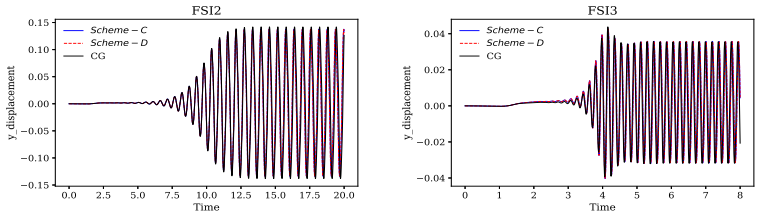
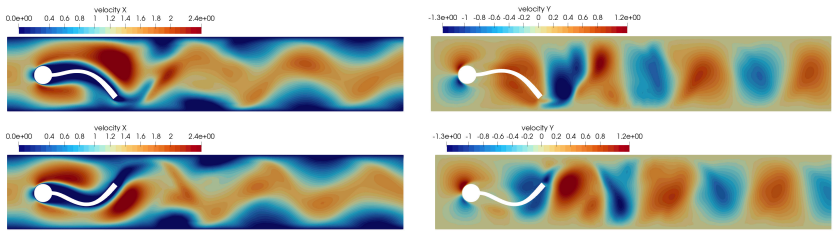
In this paper, we propose two monolithic fully discrete finite element methods for fluid-structure interaction (FSI) based on a novel Piola-type Arbitrary Lagrangian-Eulerian (ALE) mapping. For the temporal discretization, we apply the backward Euler method to both the non-conservative and conservative formulations. For the spatial discretization, we adopt arbitrary order hybridizable discontinuous Galerkin (HDG) methods for the incompressible Navier-Stokes and linear elasticity equations, and a continuous Galerkin (CG) method for the fluid mesh movement. We derive stability results for both the temporal semi-discretization and the fully discretization, and show that the velocity approximations of the fully discrete schemes are globally divergence-free. Several numerical experiments are performed to verify the performance of the proposed methods.
Editorial analysis
A structured set of objections, weighed in public.
Referee Report
Summary. The paper proposes two monolithic fully discrete finite element methods for fluid-structure interaction based on a novel Piola-type ALE mapping. Backward Euler is applied for temporal discretization to both non-conservative and conservative formulations. Arbitrary-order HDG methods discretize the incompressible Navier-Stokes and linear elasticity equations, while CG handles fluid mesh movement. Stability results are derived for the temporal semi-discretization and the fully discrete schemes, with a claim that the velocity approximations of the fully discrete schemes are globally divergence-free. Numerical experiments verify performance.
Significance. If the stability analysis holds and the global divergence-free property is rigorously preserved by the Piola-type mapping without extra restrictions, this would advance structure-preserving discretizations for FSI. Such methods are significant for long-time accuracy in moving-boundary problems, where exact incompressibility prevents error accumulation in applications like fluid dynamics and biomechanics.
major comments (3)
- [Section 3] Section 3 (method formulation), Piola-type ALE mapping definition: The claim that this mapping maps the discrete HDG velocity space (including hybridized facet unknowns) to a globally divergence-free field on the physical domain for arbitrary mesh motion lacks an explicit discrete commutator identity. Standard Piola transforms preserve div=0 continuously, but the time-dependent pull-back must be shown to commute exactly with the discrete divergence operator for non-affine elements and general velocities; without this, both the energy estimate and global div-free property are unsupported.
- [Section 4.2] Section 4.2 (fully discrete stability theorem): The energy stability proof relies on exact cancellation from the Piola mapping in the monolithic scheme coupled to CG mesh motion and FSI interface conditions. The derivation does not address potential residual terms arising from non-commuting discrete operators under large or non-smooth mesh velocities, undermining the unconditional stability claim.
- [Numerical experiments] Numerical experiments section: The tests verify overall performance but omit direct quantitative checks (e.g., time evolution of the discrete divergence norm under large deformations) that would confirm the global div-free property asserted in the abstract and theorems.
minor comments (2)
- [Notation] Notation for reference vs. physical domains and the ALE mapping could be clarified with a summary table or diagram to aid readability.
- [Introduction] The introduction would benefit from a more explicit comparison table contrasting the proposed monolithic ALE-HDG approach with prior splitting or non-div-free ALE methods for FSI.
Simulated Author's Rebuttal
We thank the referee for the careful reading and constructive comments. We address each major comment below and will revise the manuscript to incorporate clarifications and additional material where needed.
read point-by-point responses
-
Referee: [Section 3] Section 3 (method formulation), Piola-type ALE mapping definition: The claim that this mapping maps the discrete HDG velocity space (including hybridized facet unknowns) to a globally divergence-free field on the physical domain for arbitrary mesh motion lacks an explicit discrete commutator identity. Standard Piola transforms preserve div=0 continuously, but the time-dependent pull-back must be shown to commute exactly with the discrete divergence operator for non-affine elements and general velocities; without this, both the energy estimate and global div-free property are unsupported.
Authors: We appreciate the referee highlighting the need for an explicit identity. The Piola-type ALE mapping is constructed to map the reference HDG space (which is pointwise divergence-free) to a globally divergence-free field on the physical domain by design, including the hybridized facet unknowns. This follows from the standard Piola transform properties for H(div) spaces combined with the specific choice of the discrete velocity space. To address the concern directly, we will add a new lemma in Section 3 that states and proves the discrete commutator identity, showing that the pull-back commutes exactly with the discrete divergence operator even for non-affine elements. This will rigorously support the global div-free claim and the subsequent energy estimates. revision: yes
-
Referee: [Section 4.2] Section 4.2 (fully discrete stability theorem): The energy stability proof relies on exact cancellation from the Piola mapping in the monolithic scheme coupled to CG mesh motion and FSI interface conditions. The derivation does not address potential residual terms arising from non-commuting discrete operators under large or non-smooth mesh velocities, undermining the unconditional stability claim.
Authors: The proof in Section 4.2 obtains unconditional stability by testing the monolithic scheme with the velocity and using the exact cancellation that follows from the global div-free property together with the backward Euler time discretization and the interface coupling. Because the Piola mapping is applied consistently to both the fluid equations and the mesh motion (discretized by CG), the relevant operators commute at the discrete level and no residual terms appear. We will add a clarifying remark in Section 4.2 that explicitly notes the absence of residuals under the stated assumptions on the mesh velocity and shows that any discretization error in the mapping is absorbed into the stability bound. This will strengthen the presentation without altering the result. revision: partial
-
Referee: [Numerical experiments] Numerical experiments section: The tests verify overall performance but omit direct quantitative checks (e.g., time evolution of the discrete divergence norm under large deformations) that would confirm the global div-free property asserted in the abstract and theorems.
Authors: We agree that direct numerical verification of the divergence-free property would be valuable. In the revised manuscript we will augment the numerical experiments section with additional plots that display the time evolution of the discrete divergence norm (in the L2 sense) for all test cases involving large deformations. These quantities remain at machine precision (approximately 10^{-14}) throughout the simulations, thereby confirming the theoretical assertion. revision: yes
Circularity Check
Stability derivation is self-contained via standard energy estimates on the mapped equations
full rationale
The paper derives stability for the backward-Euler semi-discretization and the fully discrete ALE-HDG scheme, then proves that the velocity field remains globally divergence-free. The central step is the construction of a Piola-type ALE mapping that is asserted to preserve the discrete divergence-free property of the HDG space under the given mesh motion. Because the abstract and described claims contain no fitted parameters, no self-citation load-bearing uniqueness theorems, and no reduction of the energy estimate to a tautological identity, the derivation chain does not collapse to its own inputs. The analysis therefore stands as an independent verification rather than a circular renaming or self-referential fit.
Axiom & Free-Parameter Ledger
axioms (1)
- domain assumption Standard regularity assumptions on the domain and solution smoothness required for stability analysis of HDG methods.
invented entities (1)
-
Piola-type ALE mapping
no independent evidence
Lean theorems connected to this paper
-
IndisputableMonolith/Cost/FunctionalEquation.leanwashburn_uniqueness_aczel unclear?
unclearRelation between the paper passage and the cited Recognition theorem.
novel Piola-type Arbitrary Lagrangian-Eulerian (ALE) mapping... ensures globally divergence-free velocity approximations
What do these tags mean?
- matches
- The paper's claim is directly supported by a theorem in the formal canon.
- supports
- The theorem supports part of the paper's argument, but the paper may add assumptions or extra steps.
- extends
- The paper goes beyond the formal theorem; the theorem is a base layer rather than the whole result.
- uses
- The paper appears to rely on the theorem as machinery.
- contradicts
- The paper's claim conflicts with a theorem or certificate in the canon.
- unclear
- Pith found a possible connection, but the passage is too broad, indirect, or ambiguous to say the theorem truly supports the claim.
Reference graph
Works this paper leans on
-
[1]
Antonietti P F, Mascotto L, Verani M, et al. Stability analysis of polytopic discontinuous Galerkin approximations of the Stokes problem with applications to fluid–structure interaction problems. J. Sci. Comput., 2022, 90(1): 23. 2
work page 2022
-
[2]
A monolithic fluid-structure interaction approach using mixed LSFEM with high-order time integration
Averweg S, Schwarz A, Schwarz C, et al. A monolithic fluid-structure interaction approach using mixed LSFEM with high-order time integration. Comput. Methods Appl. Mech. Engrg., 2024, 423: 116783. 2
work page 2024
-
[3]
Robin-Robin preconditioned Krylov methods for fluid-structure interaction problems
Badia S, Nobile F, Vergara C. Robin-Robin preconditioned Krylov methods for fluid-structure interaction problems. Comput. Methods Appl. Mech. Engrg., 2009, 198(33-36): 2768-2784. 2
work page 2009
-
[4]
Space-time discontinuous Galerkin method for the solution of fluid-structure interaction
Balázsová M, Feistauer M, Horácek J, et al. Space-time discontinuous Galerkin method for the solution of fluid-structure interaction. Appl. Math., 2018, 63(6): 739-764. 2
work page 2018
-
[5]
Isogeometric fluid-structure interaction: theory, algorithms, and computations
Bazilevs Y, Calo V M, Hughes T J R, et al. Isogeometric fluid-structure interaction: theory, algorithms, and computations. Comput. Mech., 2008, 43: 3-37. 2
work page 2008
-
[6]
Computational fluid-structure interaction: methods and applications
Bazilevs Y, Takizawa K, Tezduyar T E. Computational fluid-structure interaction: methods and applications. John Wiley & Sons, 2013. 1, 2
work page 2013
-
[7]
Challenges and directions in computational fluid–structure interaction
Bazilevs Y, Takizawa K, Tezduyar T E. Challenges and directions in computational fluid–structure interaction. Math. Models Methods Appl. Sci., 2013, 23(02): 215-221. 1
work page 2013
-
[8]
Mixed finite element methods and applications
Boffi D, Brezzi F, Fortin M. Mixed finite element methods and applications. Heidelberg: Springer, 2013. 6
work page 2013
-
[9]
Braun A L, Awruch A M. A partitioned model for fluid–structure interaction problems using hexahedral finite elements with one-point quadrature. Int. J. Numer. Methods Eng., 2009, 79(5): 505-549. 2
work page 2009
-
[10]
Bukac M, Muha B. Stability and convergence analysis of the extensions of the kinematically coupled scheme for the fluid-structure interaction. SIAM J. Numer. Anal., 2016, 54(5): 3032-
work page 2016
-
[11]
Fluid-structure interaction: modelling, simulation, optimisation
Bungartz H, Schäfer M. Fluid-structure interaction: modelling, simulation, optimisation. Springer Science & Business Media, 2006. 1, 2
work page 2006
-
[12]
Added-mass effect in the design of partitioned algorithms for fluid-structure problems
Causin P, Gerbeau J F, Nobile F. Added-mass effect in the design of partitioned algorithms for fluid-structure problems. Comput. Methods Appl. Mech. Engrg., 2005, 194(42-44): 4506-4527. 2 40
work page 2005
-
[13]
Numerical Models in Fluid Structure Interaction, Advances in fluid mechan- ics, vol
Chakrabarti S K. Numerical Models in Fluid Structure Interaction, Advances in fluid mechan- ics, vol. 42, WIT Press, 2005. 1
work page 2005
-
[14]
Chen G, Feng M, Xie X, Robust globally divergence-free weak Galerkin methods for Stokes equations, J. Comput. Math., 2016, 34: 549-572. 3
work page 2016
-
[15]
Analysis of a class of globally divergence-free HDG methods for stationary Navier-Stokes equations
Chen G, Xie X. Analysis of a class of globally divergence-free HDG methods for stationary Navier-Stokes equations. Sci. China Math., 2024, 67(5): 1133-1158. 2, 3, 28
work page 2024
-
[16]
Cockburn B, Gopalakrishnan J, Lazarov R. Unified hybridization of discontinuous Galerkin, mixed, and continuous Galerkin methods for second order elliptic problems. SIAM J. Numer. Anal., 2009, 47(2): 1319-1365. 2
work page 2009
-
[17]
Divergence-conformingHDGmethodsfor Stokesflows.Math
CockburnB, Sayas FJ. Divergence-conformingHDGmethodsfor Stokesflows.Math. Comput., 2014, 83(288): 1571-1598. 2
work page 2014
-
[18]
An unsymmetric-pattern multifrontal method for sparse LU factorization
Davis T A, Duff I S. An unsymmetric-pattern multifrontal method for sparse LU factorization. SIAM J. Matrix Anal. Appl., 1997, 18(1): 140-158. 31
work page 1997
-
[19]
Stability of a coupling technique for partitioned solvers in FSI applications
Degroote J, Bruggeman P, Haelterman R, et al. Stability of a coupling technique for partitioned solvers in FSI applications. Comput. Struct., 2008, 86(23-24): 2224-2234. 2
work page 2008
-
[20]
Donea J, Giuliani S, Halleux J P. An arbitrary Lagrangian-Eulerian finite element method for transient dynamic fluid-structure interactions. Comput. Methods Appl. Mech. Engrg., 1982, 33(1-3): 689-723. 2
work page 1982
-
[21]
Donea J. Arbitrary Lagrangian-Eulerian finite element analysis, in: Computational Methods for Transient Analysis, 1983: 474-516. 2
work page 1983
-
[22]
Farhat C, Lesoinne M, Maman N. Mixed explicit/implicit time integration of coupled aeroe- lastic problems: three-field formulation, geometric conservation and distributed solution. Int. J. Numer. Methods Fluids, 1995, 21(10): 807-835. 8
work page 1995
-
[23]
Froehle B, Persson P O. A high-order discontinuous Galerkin method for fluid-structure in- teraction with efficient implicit-explicit time stepping. J. Comput. Phys., 2014, 272: 455-470. 2
work page 2014
-
[24]
Parameter-free superconvergent H(div)-conforming HDG methods for the Brinkman equations
Fu G, Jin Y, Qiu W. Parameter-free superconvergent H(div)-conforming HDG methods for the Brinkman equations. IMA J. Numer. Anal., 2019, 39(2): 957-982. 2
work page 2019
-
[25]
Fu G. Arbitrary Lagrangian-Eulerian hybridizable discontinuous Galerkin methods for incom- pressible flow with moving boundaries and interfaces. Comput. Methods Appl. Mech. Engrg., 2020, 367: 113158. 2
work page 2020
-
[26]
FuG.MonolithicandPartitionedFiniteElementSchemesforFSIBasedonanALEDivergence- Free HDG Fluid Solver and a TDNNS Structural Solver. Inter. J. Numer. Anal. Model., 2022, 20(2). 2, 8
work page 2022
-
[27]
García-Archilla B, John V, Novo J. On the convergence order of the finite element error in the kinetic energy for high Reynolds number incompressible flows. Comput. Methods Appl. Mech. Engrg., 2021, 385: 114032. 33 41
work page 2021
-
[28]
Truly monolithic algebraic multigrid for fluid-structure inter- action
Gee M W, Küttler U, Wall W A. Truly monolithic algebraic multigrid for fluid-structure inter- action. Int. J. Numer. Methods Eng., 2011, 85(8): 987-1016. 2
work page 2011
-
[29]
Glowinski R, Pan T W, Hesla T I, et al. A fictitious domain approach to the direct numerical simulation of incompressible viscous flow past moving rigid bodies: application to particulate flow. J. Comput. Phys., 2001, 169(2): 363-426. 1
work page 2001
-
[30]
On the significance of the geometric conservation law for flow computa- tions on moving meshes
Guillard H, Farhat C. On the significance of the geometric conservation law for flow computa- tions on moving meshes. Comput. Methods Appl. Mech. Engrg., 2000, 190(11-12): 1467-1482. 8
work page 2000
-
[31]
Finite-element approximation of the nonstationary Navier-Stokes problem
Heywood J G, Rannacher R. Finite-element approximation of the nonstationary Navier-Stokes problem. Part IV: Error analysis for second-order time discretization. SIAM J. Numer. Anal., 1990, 27(2): 353-384. 17
work page 1990
-
[32]
An arbitrary Lagrangian-Eulerian computing method for all flow speeds
Hirt C W, Amsden A A, Cook J L. An arbitrary Lagrangian-Eulerian computing method for all flow speeds. J. Comput. Phys., 1974, 14(3): 227-253. 2
work page 1974
-
[33]
Numerical methods for fluid-structure interaction—a review
Hou G, Wang J, Layton A. Numerical methods for fluid-structure interaction—a review. Com- mun. Comput. Phys., 2012, 12(2): 337-377. 1
work page 2012
-
[34]
Acoustics of fluid-structure interactions
Howe M S. Acoustics of fluid-structure interactions. Cambridge university press, 1998. 1
work page 1998
-
[35]
A monolithic approach to fluid–structure interaction using space–time finite elements
Hübner B, Walhorn E, Dinkler D. A monolithic approach to fluid–structure interaction using space–time finite elements. Comput. Methods Appl. Mech. Engrg., 2004, 193(23-26): 2087-
work page 2004
-
[36]
Lagrangian-Eulerian finite element formulation for incompressible viscous flows
Hughes T J R, Liu W K, Zimmermann T K. Lagrangian-Eulerian finite element formulation for incompressible viscous flows. Comput. Methods Appl. Mech. Engrg., 1981, 29(3): 329-349. 2
work page 1981
-
[37]
Computational Mechanics of Fluid-Structure Interaction
Jaiman R K, Joshi V. Computational Mechanics of Fluid-Structure Interaction. Springer Sin- gapore, 2022. 1
work page 2022
-
[38]
On the divergence constraint in mixed finite element methods for incompressible flows
John V, Linke A, Merdon C, et al. On the divergence constraint in mixed finite element methods for incompressible flows. SIAM Rev., 2017, 59(3): 492-544. 33
work page 2017
-
[39]
La Spina A, Kronbichler M, Giacomini M, et al. A weakly compressible hybridizable discon- tinuous Galerkin formulation for fluid-structure interaction problems. Comput. Methods Appl. Mech. Engrg., 2020, 372: 113392. 2
work page 2020
-
[40]
Fluid-Structure Interaction: Applied Numerical Methods, Wiley,
Morand H J P, Ohayon R. Fluid-Structure Interaction: Applied Numerical Methods, Wiley,
-
[41]
Fluid-structure interaction withH(div)-conforming finite elements
Neunteufel M, Schöberl J. Fluid-structure interaction withH(div)-conforming finite elements. Comput. Struct., 2021, 243: 106402. 2, 8
work page 2021
-
[42]
An arbitrary Lagrangian-Eulerian velocity potential formulation for fluid-structure interaction
Nitikitpaiboon C, Bathe K J. An arbitrary Lagrangian-Eulerian velocity potential formulation for fluid-structure interaction. Comput. & struct., 1993, 47(4-5): 871-891. 2
work page 1993
-
[43]
Nobile F, Vergara C. An effective fluid-structure interaction formulation for vascular dynamics by generalized Robin conditions. SIAM J. Sci. Comput., 2008, 30(2): 731-763. 2 42
work page 2008
-
[44]
Peskin C S. The immersed boundary method. Acta Numer., 2002, 11: 479-517. 1
work page 2002
-
[45]
Numerical approximation of partial differential equations
Quarteroni A, Valli A. Numerical approximation of partial differential equations. Springer Ver- lag, 1994. 17
work page 1994
-
[46]
Rhebergen S, Wells G N. A hybridizable discontinuous Galerkin method for the Navier-Stokes equations with pointwise divergence-free velocity field. J. Sci. Comput., 2018, 76(3): 1484-1501. 2, 3
work page 2018
-
[47]
Fluid-structure interactions: models, analysis and finite elements
Richter T. Fluid-structure interactions: models, analysis and finite elements. Springer, 2017. 1
work page 2017
-
[48]
A monolithic Lagrangian approach for fluid- structure interaction problems
Ryzhakov P B, Rossi R, Idelsohn S R, et al. A monolithic Lagrangian approach for fluid- structure interaction problems. Comput. Mech., 2010, 46: 883-899. 2
work page 2010
-
[49]
Monolithic cut finite element–based approaches for fluid-structure interaction
Schott B, Ager C, Wall W A. Monolithic cut finite element–based approaches for fluid-structure interaction. Int. J. Numer. Methods Eng., 2019, 119(8): 757-796. 2
work page 2019
-
[50]
NETGEN An advancing front 2D/3D-mesh generator based on abstract rules
Schöberl J. NETGEN An advancing front 2D/3D-mesh generator based on abstract rules. Comput. Vis. Sci., 1997, 1(1): 41-52. 31, 37
work page 1997
-
[51]
C++ 11 implementation of finite elements in NGSolve
Schöberl J. C++ 11 implementation of finite elements in NGSolve. Institute for analysis and scientific computing, Vienna University of Technology, 2014, 30. 31
work page 2014
-
[52]
Schwarzacher S, She B, Tuma K. Stability and error estimates of a linear numerical scheme approximating nonlinear fluid-structure interactions. Numer. Math., 2025, 157(3): 1023-1077. 2
work page 2025
-
[53]
Seboldt A, Bukac M. A non-iterative domain decomposition method for the interaction between a fluid and a thick structure. Numer. Methods PDEs, 2021, 37(4): 2803-2832. 2
work page 2021
-
[54]
A hybridizable discontinuous Galerkin method for modeling fluid-structure interaction
Sheldon J P, Miller S T, Pitt J S. A hybridizable discontinuous Galerkin method for modeling fluid-structure interaction. J. Comput. Phys., 2016, 326: 91-114. 2
work page 2016
-
[55]
Sheldon J P, Miller S T, Pitt J S. An improved formulation for hybridizable discontinuous Galerkin fluid–structure interaction modeling with reduced computational expense. Commun. Comput. Phys. 2018, 24(5): 1279-1299. 2
work page 2018
-
[56]
Arbitrary Lagrangian Eulerian and fluid-structure interaction: numerical simulation
Souli M, Benson D J. Arbitrary Lagrangian Eulerian and fluid-structure interaction: numerical simulation. John Wiley & Sons, 2013. 2
work page 2013
-
[57]
An arbitrary Lagrangian-Eulerian finite element method for inter- action of fluid and a rigid body
Takashi N, Hughes T J R. An arbitrary Lagrangian-Eulerian finite element method for inter- action of fluid and a rigid body. Comput. Methods Appl. Mech. Engrg., 1992, 95(1): 115-138. 2
work page 1992
-
[58]
ALE finite element computations of fluid-structure interaction problems
Takashi N. ALE finite element computations of fluid-structure interaction problems. Comput. Methods Appl. Mech. Engrg., 1994, 112(1-4): 291-308. 2
work page 1994
-
[59]
Turek S, Hron J. Proposal for numerical benchmarking of fluid-structure interaction between an elastic object and laminar incompressible flow, in Fluid-structure interaction: modelling, simulation, optimisation. Berlin, Heidelberg: Springer Berlin Heidelberg, 2006: 371-385. 36, 37 43
work page 2006
-
[60]
Turek S, Hron J, Madlik M, et al. Numerical simulation and benchmarking of a monolithic multigrid solver for fluid-structure interaction problems with application to hemodynamics, in Fluid Structure Interaction II: modelling, simulation, optimization. Berlin, Heidelberg: Springer Berlin Heidelberg, 2010: 193-220. 36
work page 2010
-
[61]
Fluid–structure interaction by the discontinuous-Galerkin method for large deformations
Wang H, Belytschko T. Fluid–structure interaction by the discontinuous-Galerkin method for large deformations. Int. J. Numer. Methods Eng., 2009, 77(1): 30-49. 2
work page 2009
-
[62]
Wang Y, Quaini A, Canić S. A higher-order discontinuous Galerkin/arbitrary Lagrangian Eu- lerian partitioned approach to solving fluid-structure interaction problems with incompressible, viscous fluids and elastic structures. J. Sci. Comput., 2018, 76: 481-520. 2
work page 2018
-
[63]
A projection-based time-segmented reduced order model for fluid-structure interactions
Zhai Q, Zhang S, Sun P, Xie X. A projection-based time-segmented reduced order model for fluid-structure interactions. J. Comput. Phys., 2025, 520:113481. 2
work page 2025
-
[64]
Zhang M, Zhu Z, Zhai Q, Xie X. Robust globally divergence-free HDG finite element method for steady thermally coupled incompressible MHD flow, Appl. Numer. Math., 2026, 219: 19-40. 2 44
work page 2026
discussion (0)
Sign in with ORCID, Apple, or X to comment. Anyone can read and Pith papers without signing in.