Recognition: no theorem link
Modeling the Accretion of High-Velocity Clouds from a Rotating Halo
Pith reviewed 2026-05-14 22:27 UTC · model grok-4.3
The pith
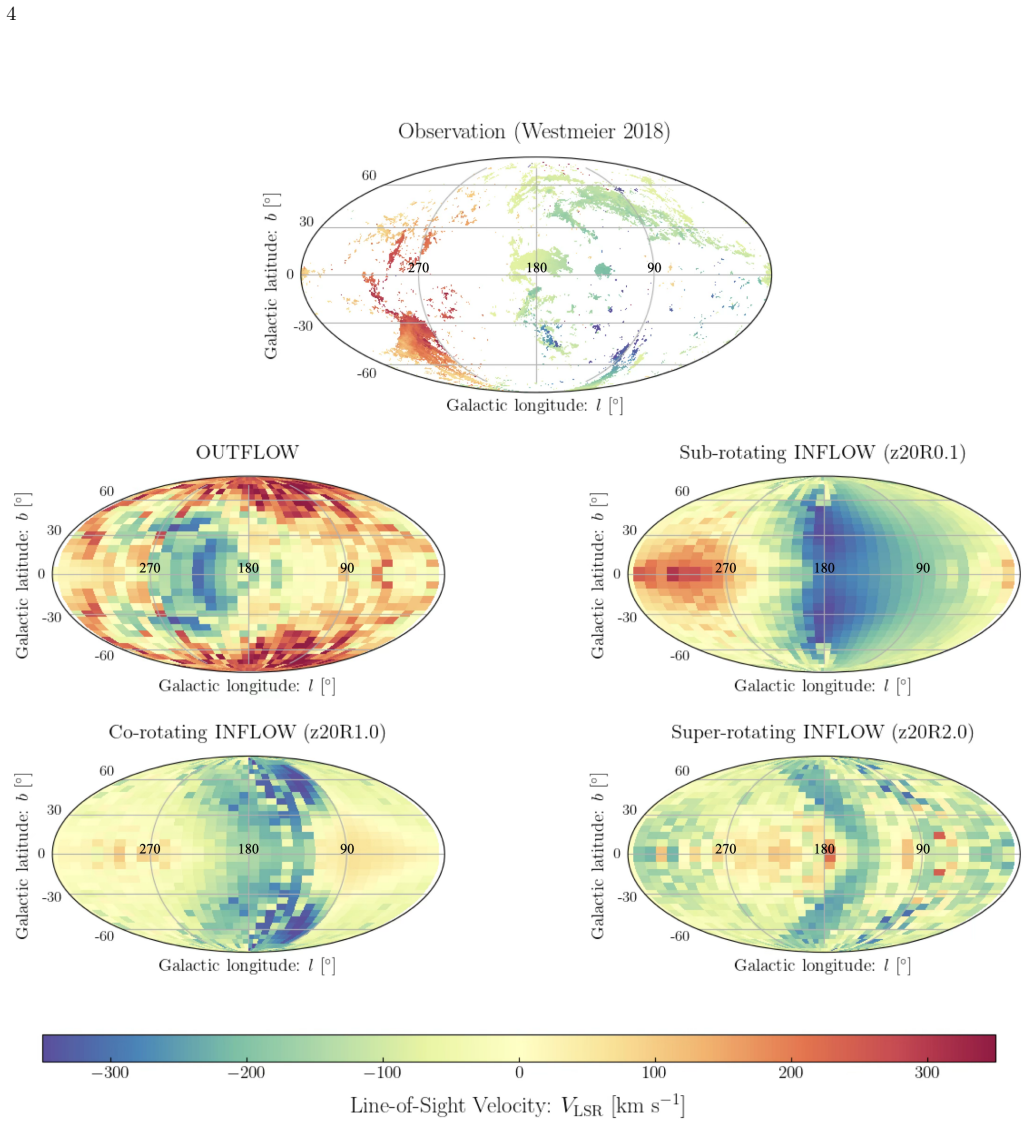
Test-particle models show high-velocity clouds from a rotating halo with low angular momentum at tens of kiloparsec scales reproduce observed velocity trends.
A machine-rendered reading of the paper's core claim, the machinery that carries it, and where it could break.
Core claim
Models assuming low angular momentum and an initial scale of tens of kiloparsecs successfully reproduce the observed kinematic trends for both blue-shifted and red-shifted components, supporting the dominance of intermediate-halo dynamics in regulating Galactic evolution and providing enough gas to sustain ongoing star formation over several Gyr.
What carries the argument
Test-particle simulations that launch clouds from a rotating halo, compute their line-of-sight velocities, and generate maps and probability density functions for direct comparison with observations.
If this is right
- High-velocity clouds form via thermal instability in metal-polluted gas within the halo.
- The total mass accretion rate, counting unobserved diffuse and ionized components, reaches several solar masses per year.
- Accretion from the intermediate halo supplies sufficient gas to maintain Galactic star formation for several billion years.
- Galactic disk evolution is regulated by dynamics operating at tens of kiloparsec scales rather than nearer or farther regions.
Where Pith is reading between the lines
- Similar test-particle modeling applied to external galaxies could test whether intermediate-halo accretion is a common driver of disk evolution.
- Surveys targeting ionized halo gas would provide direct constraints on the diffuse mass fraction that contributes to the calculated accretion rate.
- The kinematic success of low-angular-momentum models suggests that future magnetohydrodynamic simulations should prioritize resolution of structures at tens of kiloparsec scales.
Load-bearing premise
The assumption that a simple test-particle approach without hydrodynamics or other physics sufficiently captures the kinematics of high-velocity clouds from a rotating halo.
What would settle it
A mismatch between observed velocity probability density functions and those produced by the test-particle runs once full hydrodynamics and magnetic fields are added would falsify the kinematic reproduction.
Figures


read the original abstract
High-Velocity Clouds (HVCs) are a major fuel reservoir for star formation in the Galactic disk. Determining their origin and kinematics is thus crucial for understanding Galactic evolution. In this paper, we employ simple test-particle simulations to model HVC kinematics, generating line-of-sight velocity maps and probability density functions (PDFs) for comparison with observational results. We find that models assuming low angular momentum and an initial scale of tens of kiloparsecs (kpc) successfully reproduce the observed kinematic trends for both blue-shifted and red-shifted components. This consistency may support the dominance of intermediate-halo dynamics (tens of kpc scale) in regulating Galactic evolution, consistent with HVC formation via thermal instability in metal-polluted gas in the halo. Furthermore, by considering the entire bulk mass involved in the continuous accretion process -- including diffuse or ionized components that often escape direct observation -- our theoretical estimates yield a total mass accretion rate of several solar masses per year. This indicates that HVC accretion has the potential to supply a sufficient amount of gas to the Galactic disk to sustain ongoing star formation over several Gyr. Our findings suggest that the Galactic baryon cycle and disk evolution are governed by dynamics within the intermediate halo, providing key kinematic constraints for future magnetohydrodynamical simulations that resolve spatial structures of high velocity clouds.
Editorial analysis
A structured set of objections, weighed in public.
Referee Report
Summary. The paper employs test-particle simulations of high-velocity clouds (HVCs) in a rotating Galactic halo potential to generate line-of-sight velocity maps and PDFs. It claims that low-angular-momentum models initialized at scales of tens of kpc reproduce the observed kinematic trends for both blue- and red-shifted components, supporting intermediate-halo dominance in regulating accretion; the work also estimates a total mass accretion rate of several solar masses per year sufficient to sustain disk star formation over Gyr timescales.
Significance. If the central kinematic match holds under more complete physics, the result would provide a simple, falsifiable link between HVC observations and halo-scale dynamics, with direct implications for the Galactic baryon cycle and constraints on future magnetohydrodynamical simulations. The inclusion of diffuse/ionized mass in the accretion-rate estimate is a positive step beyond direct-observation limits.
major comments (3)
- [Results] The manuscript provides no quantitative metrics (e.g., Kolmogorov-Smirnov statistics, reduced chi-squared, or overlap integrals) comparing the modeled velocity PDFs to the observational distributions; only qualitative statements of “successful reproduction” appear in the abstract and results.
- [Methods] The test-particle treatment omits pressure support, radiative cooling, drag, and magnetic tension; no section justifies why these gas-dynamical effects can be neglected or demonstrates that they would not systematically shift the blue/red-shifted velocity trends or broaden the PDFs.
- [Methods] Specific values of angular momentum and initial radius are stated to be chosen to match data, yet no sensitivity analysis or exploration of the parameter space is reported, leaving open whether the reported agreement is robust or tuned.
minor comments (2)
- [Abstract] The abstract and introduction should explicitly state the functional form of the rotating halo potential and the numerical integrator used.
- [Figures] Figure captions for the velocity maps and PDFs should include the exact parameter values (angular momentum, initial scale) and the number of test particles employed.
Simulated Author's Rebuttal
We thank the referee for the constructive and detailed comments, which highlight important areas for strengthening the manuscript. We address each major comment point by point below, outlining specific revisions where appropriate while maintaining the integrity of the test-particle approach as a first-order model.
read point-by-point responses
-
Referee: [Results] The manuscript provides no quantitative metrics (e.g., Kolmogorov-Smirnov statistics, reduced chi-squared, or overlap integrals) comparing the modeled velocity PDFs to the observational distributions; only qualitative statements of “successful reproduction” appear in the abstract and results.
Authors: We agree that quantitative metrics would provide a more rigorous and objective assessment of the agreement between modeled and observed velocity PDFs. In the revised manuscript we will add Kolmogorov-Smirnov tests and overlap integrals (or equivalent measures) for both the blue- and red-shifted components, reporting the resulting p-values and overlap fractions directly in the results section. revision: yes
-
Referee: [Methods] The test-particle treatment omits pressure support, radiative cooling, drag, and magnetic tension; no section justifies why these gas-dynamical effects can be neglected or demonstrates that they would not systematically shift the blue/red-shifted velocity trends or broaden the PDFs.
Authors: The test-particle framework is deliberately simplified to isolate the gravitational and kinematic effects of a rotating halo potential on low-angular-momentum trajectories. We will add a new subsection in Methods that (i) explicitly lists the omitted physics, (ii) provides order-of-magnitude estimates showing that, at the adopted initial radii and velocities, pressure support and drag are sub-dominant compared with the gravitational acceleration over the relevant timescales, and (iii) notes that full MHD simulations are required for quantitative refinement. We acknowledge that a complete demonstration of negligible impact is beyond the scope of the present work. revision: partial
-
Referee: [Methods] Specific values of angular momentum and initial radius are stated to be chosen to match data, yet no sensitivity analysis or exploration of the parameter space is reported, leaving open whether the reported agreement is robust or tuned.
Authors: The adopted low-angular-momentum and tens-of-kpc initial conditions are motivated by thermal-instability and halo-formation arguments. To demonstrate robustness we will include a new figure and accompanying text that vary specific angular momentum by ±20 % and initial radius by ±10 kpc around the fiducial values, showing that the qualitative kinematic trends (sign and magnitude of blue- and red-shifted components) remain consistent across this range. revision: yes
Circularity Check
Parameters tuned to observations but compared to independent data; no reduction by construction
full rationale
The paper selects low angular momentum and initial radii of tens of kpc, then shows that test-particle trajectories in a rotating halo reproduce observed LOS velocity trends and PDFs. These choices are motivated by matching data rather than derived from first principles, but the comparison uses external observational catalogs and the central kinematic result does not reduce to a self-citation chain or definitional identity. The test-particle simplification is an explicit modeling choice whose limitations are acknowledged, not smuggled in via prior self-work. No load-bearing uniqueness theorem or ansatz is imported from the authors' own citations. This yields minor circularity risk at most (score 2) while the derivation remains self-contained against external benchmarks.
Axiom & Free-Parameter Ledger
free parameters (2)
- angular momentum
- initial scale
axioms (2)
- domain assumption HVCs can be modeled as test particles in a gravitational potential of a rotating halo
- domain assumption Observed kinematic trends are representative of the underlying dynamics
Reference graph
Works this paper leans on
-
[1]
Braginskii, S. I. 1965, Reviews of Plasma Physics, 1, 205
work page 1965
-
[2]
Bregman, J. N. 1980, ApJ, 236, 577, doi: 10.1086/157776
-
[3]
Chomiuk, L., & Povich, M. S. 2011, AJ, 142, 197, doi: 10.1088/0004-6256/142/6/197
-
[4]
Clark, S., Bordoloi, R., & Fox, A. J. 2022, MNRAS, 512, 811, doi: 10.1093/mnras/stac504 D’Onghia, E., & Fox, A. J. 2016, ARA&A, 54, 363, doi: 10.1146/annurev-astro-081915-023251
-
[5]
2012, The Astrophysical Journal, 762, 20, doi: 10.1088/0004-637X/762/1/20
Fang, T., Bullock, J., & Boylan-Kolchin, M. 2012, The Astrophysical Journal, 762, 20, doi: 10.1088/0004-637X/762/1/20
-
[6]
Field, G. B. 1965, ApJ, 142, 531, doi: 10.1086/148317
-
[7]
J., Richter, P., Ashley, T., et al
Fox, A. J., Richter, P., Ashley, T., et al. 2019, ApJ, 884, 53, doi: 10.3847/1538-4357/ab40ad
-
[8]
Fox, A. J., Wakker, B. P., Barger, K. A., et al. 2014, ApJ, 787, 147, doi: 10.1088/0004-637X/787/2/147
-
[9]
Fraternali, F., & Binney, J. J. 2006, MNRAS, 366, 449, doi: 10.1111/j.1365-2966.2005.09816.x Gaia Collaboration, Brown, A. G. A., Vallenari, A., et al. 2016, A&A, 595, A2, doi: 10.1051/0004-6361/201629512 Gaia Collaboration, Brown, A. G. A., Vallenari, A., et al. 2018, A&A, 616, A1, doi: 10.1051/0004-6361/201833051 Gaia Collaboration, Brown, A. G. A., Val...
-
[10]
Galactic chemical evolution revisited
Haywood, M. 2014, Mem. Soc. Astron. Italiana, 85, 253, doi: 10.48550/arXiv.1401.1864
work page internal anchor Pith review Pith/arXiv arXiv doi:10.48550/arxiv.1401.1864 2014
-
[11]
Haywood, M., Lehnert, M. D., Di Matteo, P., et al. 2016, A&A, 589, A66, doi: 10.1051/0004-6361/201527567 HI4PI Collaboration, Ben Bekhti, N., Fl¨ oer, L., et al. 2016, A&A, 594, A116, doi: 10.1051/0004-6361/201629178
-
[12]
Kalberla, P. M. W., & Kerp, J. 2009, ARA&A, 47, 27, doi: 10.1146/annurev-astro-082708-101823 Kereˇ s, D., Katz, N., Weinberg, D. H., & Dav´ e, R. 2005, MNRAS, 363, 2, doi: 10.1111/j.1365-2966.2005.09451.x
-
[13]
Lehner, N., & Howk, J. C. 2011, Science, 334, 955, doi: 10.1126/science.1209069 10
-
[14]
C., Marasco, A., & Fraternali, F
Lehner, N., Howk, J. C., Marasco, A., & Fraternali, F. 2022, MNRAS, 513, 3228, doi: 10.1093/mnras/stac987
-
[15]
Licquia, T. C., & Newman, J. A. 2015, ApJ, 806, 96, doi: 10.1088/0004-637X/806/1/96
-
[16]
J., Hernquist, L., Conroy, C., & Fox, A
Lucchini, S., Han, J. J., Hernquist, L., Conroy, C., & Fox, A. J. 2025, ApJ, 990, 118, doi: 10.3847/1538-4357/adf3b3
-
[17]
Miller, E. D., Bregman, J. N., & Wakker, B. P. 2009, ApJ, 692, 470, doi: 10.1088/0004-637X/692/1/470
-
[18]
Miller, M. J., & Bregman, J. N. 2013, ApJ, 770, 118, doi: 10.1088/0004-637X/770/2/118
-
[19]
Miller, M. J., & Bregman, J. N. 2015, ApJ, 800, 14, doi: 10.1088/0004-637X/800/1/14
-
[20]
1975, PASJ, 27, 533, doi: 10.1093/pasj/27.4.533
Miyamoto, M., & Nagai, R. 1975, PASJ, 27, 533, doi: 10.1093/pasj/27.4.533
-
[21]
Moss, V. A., McClure-Griffiths, N. M., Murphy, T., et al. 2013, ApJS, 209, 12, doi: 10.1088/0067-0049/209/1/12
-
[22]
2006, ApJL, 652, L41, doi: 10.1086/509805
Nagashima, M., Inutsuka, S.-i., & Koyama, H. 2006, ApJL, 652, L41, doi: 10.1086/509805
-
[23]
Nagashima, M., Koyama, H., & Inutsuka, S.-i. 2005, MNRAS, 361, L25, doi: 10.1111/j.1745-3933.2005.00057.x
-
[24]
2025, ApJ, 987, 69, doi: 10.3847/1538-4357/addab7
Nagata, M., Egusa, F., Maeda, F., et al. 2025, ApJ, 987, 69, doi: 10.3847/1538-4357/addab7
-
[25]
2018, ApJ, 862, 34, doi: 10.3847/1538-4357/aacceb
Nakashima, S., Inoue, Y., Yamasaki, N., et al. 2018, ApJ, 862, 34, doi: 10.3847/1538-4357/aacceb
-
[26]
Navarro, J. F., Frenk, C. S., & White, S. D. M. 1996, ApJ, 462, 563, doi: 10.1086/177173
-
[27]
Parker, E. N. 1953, ApJ, 117, 431, doi: 10.1086/145707
-
[28]
Peek, J. E. G., Putman, M. E., McKee, C. F., Heiles, C., & Stanimirovi´ c, S. 2007, ApJ, 656, 907, doi: 10.1086/510189
-
[29]
Putman, M. E., Peek, J. E. G., & Joung, M. R. 2012, ARA&A, 50, 491, doi: 10.1146/annurev-astro-081811-125612
-
[30]
Richter, P., Sembach, K. R., Wakker, B. P., & Savage, B. D. 2001, ApJL, 562, L181, doi: 10.1086/338050
-
[31]
Richter, P., Nuza, S. E., Fox, A. J., et al. 2017, A&A, 607, A48, doi: 10.1051/0004-6361/201630081
-
[32]
Robitaille, T. P., & Whitney, B. A. 2010, Highlights of Astronomy, 15, 799, doi: 10.1017/S1743921310011774
-
[33]
Sembach, K. R., Savage, B. D., Lu, L., & Murphy, E. M. 1999, ApJ, 515, 108, doi: 10.1086/306999
-
[34]
2025, Monthly Notices of the Royal Astronomical Society, staf2268, doi: 10.1093/mnras/staf2268
Seno, I., Inutsuka, S.-i., & Shimoda, J. 2025, Monthly Notices of the Royal Astronomical Society, staf2268, doi: 10.1093/mnras/staf2268
-
[35]
Shapiro, P. R., & Field, G. B. 1976, ApJ, 205, 762, doi: 10.1086/154332
-
[36]
2024, ApJ, 973, 78, doi: 10.3847/1538-4357/ad6846
Shimoda, J., & Asano, K. 2024, ApJ, 973, 78, doi: 10.3847/1538-4357/ad6846
-
[37]
2024, PASJ, 76, 81, doi: 10.1093/pasj/psad081
Shimoda, J., Inutsuka, S.-i., & Nagashima, M. 2024, PASJ, 76, 81, doi: 10.1093/pasj/psad081
-
[38]
Shull, J. M., Jones, J. R., Danforth, C. W., & Collins, J. A. 2009, ApJ, 699, 754, doi: 10.1088/0004-637X/699/1/754
-
[39]
2012, PASJ, 64, 75, doi: 10.1093/pasj/64.4.75
Sofue, Y. 2012, PASJ, 64, 75, doi: 10.1093/pasj/64.4.75
-
[40]
2006, Physics of Fully Ionized Gases, Dover Books on Physics (Dover Publications)
Spitzer, L. 2006, Physics of Fully Ionized Gases, Dover Books on Physics (Dover Publications). https://books.google.co.jp/books?id=Vn31DAAAQBAJ
work page 2006
-
[41]
Stewart, K. R., Kaufmann, T., Bullock, J. S., et al. 2011, The Astrophysical Journal, 738, 39, doi: 10.1088/0004-637X/738/1/39
-
[42]
Thom, C., Peek, J. E. G., Putman, M. E., et al. 2008, ApJ, 684, 364, doi: 10.1086/589960
-
[43]
Thom, C., Putman, M. E., Gibson, B. K., et al. 2006, ApJL, 638, L97, doi: 10.1086/501005
-
[44]
Tumlinson, J., Peeples, M. S., & Werk, J. K. 2017, ARA&A, 55, 389, doi: 10.1146/annurev-astro-091916-055240
work page internal anchor Pith review doi:10.1146/annurev-astro-091916-055240 2017
-
[45]
Wakker, B. P. 2001, ApJS, 136, 463, doi: 10.1086/321783
-
[46]
Wakker, B. P., de Boer, K. S., & van Woerden, H. 2004, in Astrophysics and Space Science Library, Vol. 312, High Velocity Clouds, ed. H. van Woerden, B. P. Wakker, U. J. Schwarz, & K. S. de Boer, 1, doi: 10.1007/1-4020-2579-3 1
-
[47]
Wakker, B. P., & van Woerden, H. 1997, ARA&A, 35, 217, doi: 10.1146/annurev.astro.35.1.217
-
[48]
Wakker, B. P., Howk, J. C., Savage, B. D., et al. 1999, Nature, 402, 388, doi: 10.1038/46498
-
[49]
Wakker, B. P., York, D. G., Howk, J. C., et al. 2007, ApJL, 670, L113, doi: 10.1086/524222
-
[50]
2018, MNRAS, 474, 289, doi: 10.1093/mnras/stx2774
Westmeier, T. 2018, MNRAS, 474, 289, doi: 10.1093/mnras/stx2774
discussion (0)
Sign in with ORCID, Apple, or X to comment. Anyone can read and Pith papers without signing in.