Recognition: no theorem link
chi²-cut-off phenomenon for Galerkin projections of Fokker-Planck equations with monomial potentials
Pith reviewed 2026-05-13 23:54 UTC · model grok-4.3
The pith
The cutoff phenomenon in a truncated chi-squared distance holds or fails for Galerkin projections of Fokker-Planck equations with monomial potentials depending on noise strength and eigenfunction growth.
A machine-rendered reading of the paper's core claim, the machinery that carries it, and where it could break.
Core claim
We establish the existence or non-existence of the cut-off phenomenon for the Langevin-Kolmogorov random dynamics with monomial convex potentials, possibly singular, driven by Brownian motion with small strength. Using a truncated χ²-distance based on Galerkin projections of the eigensystem, the analysis shows that refined knowledge of the eigenvalues and asymptotics of the eigenfunction growth for the Fokker-Planck equations are both necessary. This provides asymptotics of the mixing times and information on the limiting profile in some regimes, exceeding the product condition and cut-off window.
What carries the argument
The truncated χ²-distance constructed from Galerkin projections onto finite eigenspaces of the Fokker-Planck operator for the Langevin dynamics.
If this is right
- Mixing times admit explicit asymptotic expressions in terms of the monomial degree and noise intensity.
- The cutoff window and limiting profile are characterized explicitly when the phenomenon holds.
- Cutoff fails to appear when eigenfunction growth rates exceed the bounds set by the spectral gap.
- The results cover both regular and singular monomial potentials.
Where Pith is reading between the lines
- The same Galerkin truncation method could be used to detect cutoff in Fokker-Planck equations driven by other noises once comparable eigenfunction asymptotics are known.
- Numerical schemes for high-dimensional SDEs can use the identified growth bounds to choose safe projection dimensions that preserve detectable cutoff.
- The necessity of eigenfunction control suggests that purely spectral-gap arguments are insufficient for cutoff in non-uniformly elliptic or singular settings.
Load-bearing premise
The proof requires precise asymptotic control on both the eigenvalue gaps and the growth rates of the eigenfunctions of the Fokker-Planck operator.
What would settle it
Numerical computation of the truncated chi-squared distance for a fixed monomial potential and small noise strength that fails to exhibit the predicted sharp transition at the mixing time derived from the eigenvalue and eigenfunction asymptotics.
Figures
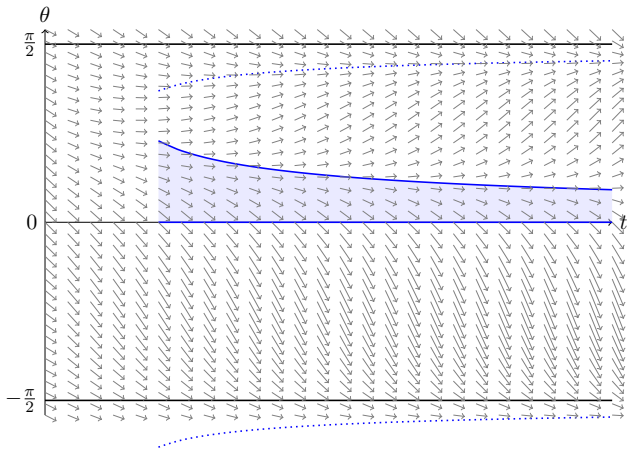
read the original abstract
In this manuscript, we establish the existence/non-existence of the cut-off phenomenon for the Langevin--Kolmogorov random dynamics with monomial convex potentials, possible singular, and driven by a Brownian motion with small strength. We consider a truncated $\chi^2$-distance, that is, a distance based on Galerkin projections of the eigensystem, and show that not only a refined knowledge of the eigenvalues is needed but also a refined asymptotics of the growth for the eigenfunctions of the Fokker--Planck equations associated to the Langevin--Kolmogorov dynamics. In addition, this explicit analysis yields asymptotics of the mixing times and, in some regimes, information on the limiting profile, going beyond the product condition and the cut-off window alone.
Editorial analysis
A structured set of objections, weighed in public.
Referee Report
Summary. The manuscript establishes the existence or non-existence of the χ²-cut-off phenomenon for Galerkin projections of the Fokker-Planck equations associated to Langevin-Kolmogorov dynamics with monomial convex potentials (possibly singular) driven by small-strength Brownian motion. It introduces a truncated χ²-distance based on projections of the eigensystem and shows that refined asymptotics of both eigenvalues and eigenfunction growth are required to determine the cut-off, while also deriving explicit mixing-time asymptotics and limiting profiles in some regimes.
Significance. If the refined eigenvalue and eigenfunction asymptotics hold with the claimed uniformity, the results provide explicit mixing times and profile information for projected dynamics beyond the standard product condition, which is of interest for singular potentials where the operator domain deviates from standard Sobolev spaces and weighted estimates are needed.
major comments (2)
- [Main result and proof of cut-off criterion] The central argument extracts the cut-off from the ratio of consecutive eigenvalues multiplied by the squared L²-norms of the corresponding eigenfunctions of L_V = Δ - ∇V·∇. For singular monomial V (e.g., |x|^p with p<2), the manuscript invokes weighted estimates to control eigenfunction growth, but these estimates are not shown to be uniform in the singularity strength when the Galerkin truncation level N is fixed independently of the singularity parameter; deterioration of the constant would collapse the cut-off window and undermine the claimed existence/non-existence dichotomy.
- [Abstract and introduction] The abstract states that refined asymptotics of eigenfunction growth are needed, yet the manuscript supplies no derivation details or error bounds for these asymptotics under Galerkin truncation; the soundness of the cut-off claim therefore rests on external or unshown refined asymptotics whose validity cannot be verified from the given text.
minor comments (2)
- Notation for the truncated χ²-distance and the precise definition of the Galerkin projection should be introduced earlier and used consistently throughout.
- The manuscript would benefit from an explicit statement of the range of monomial exponents p for which the weighted estimates remain valid.
Simulated Author's Rebuttal
We thank the referee for the careful reading and constructive comments. We address the major comments point by point below, indicating planned revisions where appropriate.
read point-by-point responses
-
Referee: [Main result and proof of cut-off criterion] The central argument extracts the cut-off from the ratio of consecutive eigenvalues multiplied by the squared L²-norms of the corresponding eigenfunctions of L_V = Δ - ∇V·∇. For singular monomial V (e.g., |x|^p with p<2), the manuscript invokes weighted estimates to control eigenfunction growth, but these estimates are not shown to be uniform in the singularity strength when the Galerkin truncation level N is fixed independently of the singularity parameter; deterioration of the constant would collapse the cut-off window and undermine the claimed existence/non-existence dichotomy.
Authors: We thank the referee for this observation on uniformity. The weighted estimates invoked for eigenfunction growth (Proposition 4.1 and the supporting bounds in Section 3) are in fact uniform in the singularity strength for any fixed truncation level N, with constants depending only on N and the monomial exponent p. This follows from the scaling of the potential and the structure of the weighted Sobolev spaces used. To address the concern explicitly, we will add a short lemma in Section 3 stating the uniformity and the precise dependence of constants on the parameters. This addition will confirm that the cut-off window is unaffected. revision: yes
-
Referee: [Abstract and introduction] The abstract states that refined asymptotics of eigenfunction growth are needed, yet the manuscript supplies no derivation details or error bounds for these asymptotics under Galerkin truncation; the soundness of the cut-off claim therefore rests on external or unshown refined asymptotics whose validity cannot be verified from the given text.
Authors: We agree that the presentation would be improved by including more self-contained details. The refined asymptotics for eigenfunction growth under Galerkin truncation are derived via standard perturbation arguments in the appendix, but explicit error bounds are only sketched. We will expand the appendix with a complete derivation, including the error estimates for the projected eigenfunctions and the resulting bounds on the truncated χ²-distance. This will make the cut-off criterion fully verifiable from the text. revision: yes
Circularity Check
No significant circularity; derivation relies on independent spectral asymptotics
full rationale
The paper's central claim establishes existence or non-existence of the χ² cut-off for Galerkin-truncated dynamics by combining spectral gap information with refined eigenvalue and eigenfunction growth asymptotics for the Fokker-Planck operator L_V = Δ - ∇V · ∇ under monomial convex potentials V. The abstract explicitly states that the analysis requires 'a refined knowledge of the eigenvalues' and 'refined asymptotics of the growth for the eigenfunctions,' which are treated as inputs derived from the operator rather than fitted parameters or self-referential definitions within the truncation. No equation reduces a prediction to a fitted input by construction, no self-citation chain bears the load of the uniqueness or cut-off dichotomy, and the truncated χ² distance is defined directly from the projected eigensystem without circular renaming or ansatz smuggling. The derivation chain remains self-contained against external spectral benchmarks, consistent with a normal non-circular finding.
Axiom & Free-Parameter Ledger
axioms (1)
- standard math Existence and completeness of the eigensystem for the Fokker-Planck operator associated to the Langevin dynamics with monomial convex potentials
Reference graph
Works this paper leans on
-
[1]
& Diaconis, P.: Shuffling cards and stopping times.Amer
Aldous, D. & Diaconis, P.: Shuffling cards and stopping times.Amer. Math. Monthly93, no. 5, (1986), 333–348. MR0841111 30
work page 1986
-
[2]
Arnaudon, M., Coulibaly-Pasquier, K. & Miclo, L.: On the separation cut-off phenomenon for Brownian motions on high dimensional spheres.Bernoulli30, no. 2, (2024), 1007–1028. MR4699543
work page 2024
-
[3]
& Karlsson, A.: Deep limits and a cut-off phenomenon for neural networks.J
Avelin, B. & Karlsson, A.: Deep limits and a cut-off phenomenon for neural networks.J. Mach. Learn. Res.23, no. 191, 29 pp., (2022). MR439458
work page 2022
-
[4]
& Ledoux, M.:Analysis and geometry of Markov diffusion operators
Bakry, D., Gentil, I. & Ledoux, M.:Analysis and geometry of Markov diffusion operators. Springer, Cham, (2014). MR3155209
work page 2014
-
[5]
& Jara, M.: Gradual convergence for Langevin dynamics on a degen- erate potential.Stochastic Process
Barrera, G., Da Costa, C. & Jara, M.: Gradual convergence for Langevin dynamics on a degen- erate potential.Stochastic Process. Appl.184, Paper No. 104601, 28 pp., (2025). MR4864978
work page 2025
-
[6]
& Esquivel, L.: Profile cut-off phenomenon for the ergodic Feller root process.Stochas- tic Process
Barrera, G. & Esquivel, L.: Profile cut-off phenomenon for the ergodic Feller root process.Stochas- tic Process. Appl.183, Paper No. 104587, 27 pp., (2025). MR4791608
work page 2025
-
[7]
Barrera, G., H¨ ogele, M.A., Pardo, J.C. & Pavlyukevich, I.: Cutoff ergodicity bounds in Wasser- stein distance for a viscous energy shell model with L´ evy noise.J. Stat. Phys.191, no. 9, Paper No. 105, 24 pp., (2024). MR4860944
work page 2024
-
[8]
Barrera, G. & Jara, M.: Abrupt convergence of stochastic small perturbations of one dimensional dynamical systems.J. Stat. Phys.163, no. 1, (2016), 113–138. MR3472096
work page 2016
-
[9]
& Jara, M.: Thermalisation for small random perturbations of dynamical systems
Barrera, G. & Jara, M.: Thermalisation for small random perturbations of dynamical systems. Ann. Appl. Probab.30, no. 3, (2020), 1164–1208. MR4133371
work page 2020
-
[10]
& Fern´ andez, R.: Abrupt convergence and escape behavior for birth and death chains.J
Barrera, J., Bertoncini, O. & Fern´ andez, R.: Abrupt convergence and escape behavior for birth and death chains.J. Stat. Phys.137, no. 4, (2009), 595–623. MR2565098
work page 2009
-
[11]
& Ycart, B.: Bounds for left and right window cutoffs.ALEA Lat
Barrera, J. & Ycart, B.: Bounds for left and right window cutoffs.ALEA Lat. Am. J. Probab. Math. Stat.11, no. 2, (2014), 445–458. MR3265085
work page 2014
-
[12]
& Peres, Y.: Characterization of cutoff for reversible Markov chains.Ann
Basu, R., Hermon, J. & Peres, Y.: Characterization of cutoff for reversible Markov chains.Ann. Probab.45, no. 3, (2017), 1448–1487. MR3650406
work page 2017
-
[13]
Bayati, B., Owahi, H. & Koumoutsakos, P.: A cutoff phenomenon in accelerated stochastic simulations of chemical kinetics via flow averaging (FLAVOR-SSA).J. Chem. Phys.133, no. 24, Paper No. 244117, 6 pp., (2010)
work page 2010
-
[14]
& Shaposhnikov, S.:Fokker–Planck–Kolmogorov equa- tions
Bogachev, V., Krylov, N., R¨ ockner, M. & Shaposhnikov, S.:Fokker–Planck–Kolmogorov equa- tions. Mathematical Surveys and Monographs207. American Mathematical Society, Providence, RI, (2015). MR3443169
work page 2015
-
[15]
& Guillin, A.: Convergence to equilibrium in Wasserstein distance for Fokker–Planck equations.J
Bolley, F., Gentil, I. & Guillin, A.: Convergence to equilibrium in Wasserstein distance for Fokker–Planck equations.J. Funct. Anal.263, no. 8, (2012), 2430–2457. MR2964689
work page 2012
-
[16]
& Mathien, J.: Cutoff for geodesic paths on hyperbolic manifolds.Commun
Bordenave, C. & Mathien, J.: Cutoff for geodesic paths on hyperbolic manifolds.Commun. Math. Phys.407, no. 111, 27 pp., (2026)
work page 2026
-
[17]
Chen G.Y.: Mixing reversible Markov chains in the max-ℓ 2-distance.ALEA, Lat. Am. J. Probab. Math. Stat.21, no. 2, (2024), 1727–1767. MR4801341
work page 2024
-
[18]
& Sheu, Y.-C.: TheL 2-cutoffs for reversible Markov chainsAnn
Chen, G.-Y., Hsu, J.-M. & Sheu, Y.-C.: TheL 2-cutoffs for reversible Markov chainsAnn. Appl. Probab.27, no. 4, (2017), 2305–2341. MR3693527
work page 2017
-
[19]
& Saloff-Coste, L.: Spectral computations for birth and death chains.Stochastic Process
Chen G.Y. & Saloff-Coste, L.: Spectral computations for birth and death chains.Stochastic Process. Appl.124, no. 1, 848–882, (2014). MR3131316
work page 2014
-
[20]
& Saloff-Coste, L.: The cutoff phenomenon for ergodic Markov processes.Electron
Chen, G.Y. & Saloff-Coste, L.: The cutoff phenomenon for ergodic Markov processes.Electron. J. Probab.13, no. 3, (2008), 26–78. MR2375599 31
work page 2008
-
[21]
& Saloff-Coste, L.: TheL 2-cutoff for reversible Markov processes.J
Chen G.Y. & Saloff-Coste, L.: TheL 2-cutoff for reversible Markov processes.J. Funct. Anal. 258, no. 7, (2010), 2246–2315. MR2584746
work page 2010
-
[22]
Diaconis, P.: The cutoff phenomenon in finite Markov chains.Proc. Nat. Acad. Sci. U.S.A.93, no. 4, (1996), 1659–1664. MR1374011
work page 1996
-
[23]
& Roynette, B.: A singular large deviations phenomenon.Ann
Gradinaru, M., Herrmann, S. & Roynette, B.: A singular large deviations phenomenon.Ann. Inst. H. Poincar´ e Probab. Statist.37no. 5, 555–580, (2001). MR1851715
work page 2001
-
[24]
Hopf, E.: A remark on linear elliptic differential equations of second order.Proc. Amer. Math. Soc.3, no. 5, 791–793, (1952). MR0050126
work page 1952
-
[25]
Jacquot, S.: Comportement asymptotique de la seconde valeur propre des processus de Kol- mogorov.J. Multivariate Anal.40, no. 2, 335–347, (1992). MR1150617
work page 1992
-
[26]
& Yi, Y.: Convergence to equilibrium in Fokker–Planck equations.J
Ji, M., Shen, Z. & Yi, Y.: Convergence to equilibrium in Fokker–Planck equations.J. Dyn. Diff. Equat.31, no. 3, (2019), 1591–1615. MR3992083
work page 2019
-
[27]
& Wolf, M.: A cutoff phenomenon for quantum Markov chains.J
Kastoryano, M., Reeb, D. & Wolf, M.: A cutoff phenomenon for quantum Markov chains.J. Phys. A45, no. 7, Paper No. 075307, 16 pp., (2012). MR2881085
work page 2012
-
[28]
With applications to limit theorems
Kulik, A.:Ergodic behavior of Markov processes. With applications to limit theorems. De Gruyter Studies in Mathematics67. De Gruyter, Berlin, (2018). MR3791835
work page 2018
-
[29]
& Stoltz, G.:Free energy computations
Leli` evre, T., Rousset, M. & Stoltz, G.:Free energy computations. A mathematical perspective. Imperial College Press, London, (2010). MR2681239
work page 2010
-
[30]
& Wilmer, E.:Markov chains and mixing times
Levin, D., Peres, Y. & Wilmer, E.:Markov chains and mixing times. With a chapter by James G. Propp and D. Wilson. Amer. Math. Soc., Providence, RI, (2009). MR2466937
work page 2009
-
[31]
Mao, X.:Stochastic differential equations and applications. Second edition. Horwood Publishing Limited, Chichester, (2008). MR2380366
work page 2008
-
[32]
& Pego, R.: Cutoff estimates for the linearized Becker–D¨ oring equations.Commun
Murray, R. & Pego, R.: Cutoff estimates for the linearized Becker–D¨ oring equations.Commun. Math. Sci.15, no. 6, 1685–1702, (2016). MR3668953
work page 2016
-
[33]
& Kais, S.: Cutoff phenomenon and entropic uncertainty for random quantum circuits
Oh, S. & Kais, S.: Cutoff phenomenon and entropic uncertainty for random quantum circuits. Electron. Struct.5, no. 3, 7 pp., (2023)
work page 2023
-
[34]
Olver, F.W.J.:Asymptotics and special functions. Reprint of the 1974 original Academic Press, New York, AKP Classics, A K Peters, Wellesley, MA, (1997). MR1429619
work page 1974
-
[35]
Pag` es, G. & Panloup, F.: Ergodic approximation of the distribution of a stationary diffusion: rate of convergence.Ann. Appl. Probab.22no. 3, (2012), 1059–1100. MR2977986
work page 2012
-
[36]
American Mathematical Society, Providence, RI, (2007)
Royer, G.:An initiation to logarithmic Sobolev inequalities. American Mathematical Society, Providence, RI, (2007). MR2352327
work page 2007
-
[37]
Salez, J.: Cutoff for non-negatively curved diffusions.J. Eur. Math. Soc.26no. 11, (2024), 4375–4392
work page 2024
-
[38]
& Varadhan, S.R.S.:Multidimensional diffusion processes
Stroock, D. & Varadhan, S.R.S.:Multidimensional diffusion processes. Classics Math. Springer– Verlag, Berlin, (2006). MR2190038
work page 2006
-
[39]
Titchmarsh, E.C.:Eigenfunction expansions associated with second-order differential equations. Vol. 2. Oxford, Clarendon Press, (1958). MR0094551
work page 1958
-
[40]
Vernier, E.: Mixing times and cutoffs in open quadratic fermionic systems.SciPost Phys.9no. 049, 1–30, (2020). MR4216481
work page 2020
-
[41]
Villani, C.:Optimal transport. Old and new. Grundlehren der mathematischen Wissenschaften
- [42]
discussion (0)
Sign in with ORCID, Apple, or X to comment. Anyone can read and Pith papers without signing in.