Excitations across the equilibrium and photoinduced `hidden' states of magnetoresistive manganites
Pith reviewed 2026-05-13 22:00 UTC · model grok-4.3
The pith
Photo-excitation of strained manganite creates long-lived hidden phase with softened polarons and reduced Jahn-Teller distortion
A machine-rendered reading of the paper's core claim, the machinery that carries it, and where it could break.
Core claim
Upon photo-excitation of LCMO-AFI, we uncover a long-lived phase characterized by the softening of the polaron excitations, the partial suppression of the Jahn-Teller distortion, and nearly unchanged phonons, showing the emergence of a photo-excited state absent in the equilibrium phase diagram.
What carries the argument
Resonant inelastic x-ray scattering performed under ultrafast near-infrared photo-excitation, which tracks polaron, phonon, and orbital excitations to distinguish the hidden phase from equilibrium states reached by strain or temperature.
If this is right
- The hidden phase persists for hours and can be erased by modest temperature change or a second light pulse.
- Polaron energy directly tracks transport resistivity across both equilibrium and photo-excited regimes.
- Epitaxial strain and laser fluence together define boundaries between multiple distinct polaronic states.
- The same laser-RIXS method can be applied to other strained correlated materials to locate additional hidden phases.
Where Pith is reading between the lines
- Light may stabilize intermediate electron-lattice coupling strengths unreachable by static strain tuning.
- Reversible optical control of this state could enable fast switching of colossal magnetoresistance in thin-film devices.
- Analogous hidden states are likely to exist in other perovskite manganites or nickelates under combined strain and photo-drive.
- Extending the measurement to femtosecond time resolution would reveal the formation pathway of the hidden phase.
Load-bearing premise
The observed softening of polaron peaks and partial relief of Jahn-Teller distortion in RIXS spectra signal a distinct hidden phase rather than a fluence-dependent variant of the existing antiferromagnetic insulator or a measurement artifact.
What would settle it
If equilibrium RIXS spectra collected at an intermediate temperature or strain value without any laser pulse display the same softened polaron energy and reduced Jahn-Teller signature, the claim that the state is uniquely photo-induced would be falsified.
Figures


read the original abstract
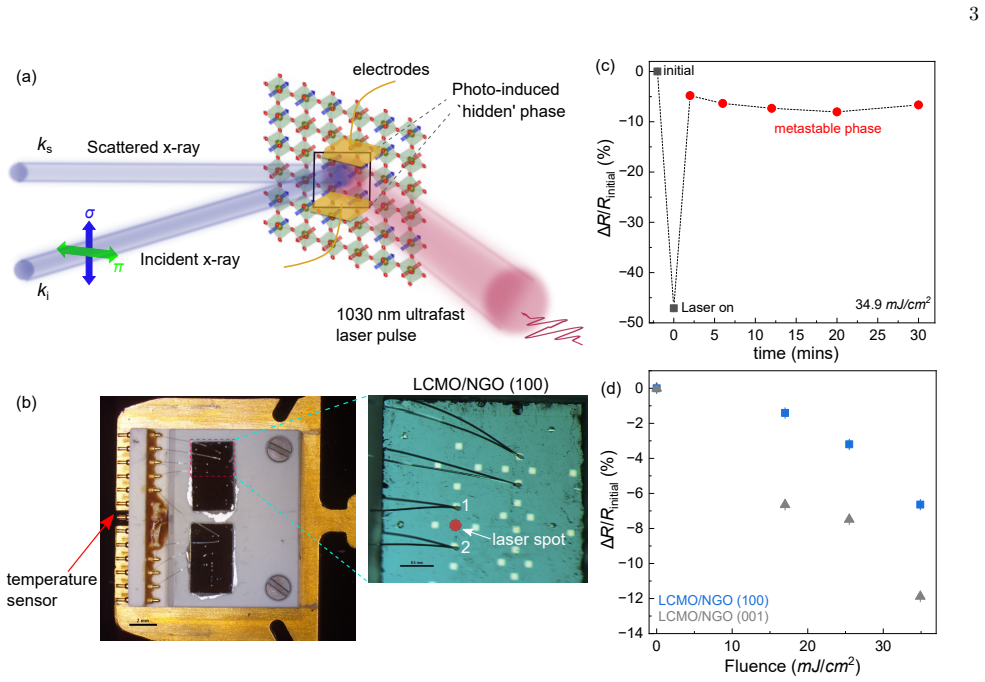
"Hidden" phases, generated using ultrafast laser pulses (few hundred femtoseconds), with properties distinct from thermodynamic equilibrium, are appealing for technologies because they can be long-lived, with lifetimes of hours or weeks, and reversible with temperature sweeping or extra pulses. In this regard, La$_{2/3}$Ca$_{1/3}$MnO$_3$ (LCMO) stands out due to its tunability through epitaxial strain, which can drive the bulk ferromagnetic metal (FMM) into an antiferromagnetic insulator (AFI), and its susceptibility to photo-induced transitions. Indeed, AFI LCMO displays a long-lived photo-induced transition into a putative 'hidden' phase whose exact nature and excitations are still largely unknown. Here, we combine ultrafast photo-excitation in the near infrared with in situ transport, x-ray absorption (XAS), and Resonant Inelastic X-ray Scattering (RIXS) to investigate the excitations (polarons, phonons, and orbital) of the photo-excited phase of LCMO and contrast them with the thermodynamic phases achieved through strain and temperature. In the thermodynamic regime, we establish the correlation between polarons and transport, placing them in the 'strong coupling' regime of the Holstein model. Upon photo-excitation of LCMO-AFI, we uncover a long-lived phase characterized by the softening of the polaron excitations, the partial suppression of the Jahn-Teller distortion, and nearly unchanged phonons, showing the emergence of a photo-excited state absent in the equilibrium phase diagram. Finally, by varying temperature, epitaxial strain, and photo-excitation fluence, we construct a polaron phase diagram and identify the key spectroscopic signatures of each phase. Our laser-RIXS approach establishes a versatile platform for exploring photo-induced 'hidden' phases in quantum materials in non-stroboscopic conditions.
Editorial analysis
A structured set of objections, weighed in public.
Referee Report
Summary. The manuscript investigates photo-induced 'hidden' phases in La_{2/3}Ca_{1/3}MnO_3 (LCMO) using ultrafast near-infrared excitation combined with in situ transport, XAS, and RIXS measurements. It claims to identify a long-lived photo-excited state in the antiferromagnetic insulator (AFI) phase characterized by softened polaron excitations, partial suppression of Jahn-Teller distortion, and stable phonons, which is absent from the equilibrium phase diagram constructed by varying temperature, epitaxial strain, and fluence.
Significance. If the photo-excited state is shown to lie outside all equilibrium states, the work would provide a concrete spectroscopic fingerprint for a non-equilibrium phase in a tunable correlated system, strengthening the case for laser-RIXS as a tool to map hidden phases. The multi-probe approach (transport + XAS + RIXS) and the reported correlation of polarons with transport in the strong-coupling Holstein regime are positive features.
major comments (2)
- [Polaron phase diagram] Polaron phase diagram section: the central claim that the photo-excited state is 'absent in the equilibrium phase diagram' is load-bearing yet unsupported by quantitative bounds. The abstract states that temperature, strain, and fluence were varied to construct the diagram, but no explicit comparison (e.g., tabulated polaron energies or JT indicators with error bars) demonstrates that the photo-induced softening and partial JT suppression fall outside the entire equilibrium range reachable by strain-temperature combinations.
- [RIXS spectral changes] RIXS data analysis: the interpretation that observed spectral changes unambiguously indicate a new phase rather than a fluence- or strain-modified version of an existing equilibrium state requires explicit fitting procedures, resolution limits, and direct overlay of photo-excited versus equilibrium spectra at matched strain-temperature points. Without these, overlap cannot be ruled out.
minor comments (2)
- The statement that phonons are 'nearly unchanged' lacks quantitative metrics (energy shifts, linewidths) or reference to specific figures/tables showing the comparison.
- Clarify how the 'strong coupling' regime of the Holstein model is defined operationally from the observed polaron-transport correlation (e.g., specific coupling strength threshold or functional form).
Simulated Author's Rebuttal
We thank the referee for the careful review and constructive feedback on our manuscript. We have addressed the major comments by planning explicit additions to the polaron phase diagram and RIXS analysis sections. These revisions will strengthen the quantitative support for our claims regarding the photo-induced hidden phase.
read point-by-point responses
-
Referee: Polaron phase diagram section: the central claim that the photo-excited state is 'absent in the equilibrium phase diagram' is load-bearing yet unsupported by quantitative bounds. The abstract states that temperature, strain, and fluence were varied to construct the diagram, but no explicit comparison (e.g., tabulated polaron energies or JT indicators with error bars) demonstrates that the photo-induced softening and partial JT suppression fall outside the entire equilibrium range reachable by strain-temperature combinations.
Authors: We agree that explicit quantitative bounds are essential to substantiate the claim. In the revised manuscript, we will add a dedicated table listing polaron excitation energies and Jahn-Teller distortion indicators (extracted from XAS and RIXS) for all equilibrium states reached by varying temperature and epitaxial strain, each with error bars derived from multiple measurements. We will also plot these values against the photo-excited results to demonstrate that the observed softening and partial JT suppression lie outside the equilibrium range. This addition directly addresses the need for tabulated comparisons. revision: yes
-
Referee: RIXS data analysis: the interpretation that observed spectral changes unambiguously indicate a new phase rather than a fluence- or strain-modified version of an existing equilibrium state requires explicit fitting procedures, resolution limits, and direct overlay of photo-excited versus equilibrium spectra at matched strain-temperature points. Without these, overlap cannot be ruled out.
Authors: We concur that detailed analysis procedures are required for unambiguous interpretation. In the revision, we will describe the fitting model used for the RIXS spectra (including Lorentzian or Gaussian components for polaron and phonon features), specify the instrumental resolution limits, and provide direct spectral overlays comparing the photo-excited state to equilibrium spectra at matched strain-temperature points. These overlays will include quantitative metrics such as peak position shifts and intensity changes to rule out overlap with existing equilibrium states. revision: yes
Circularity Check
No circularity: purely observational experimental claims with empirical phase diagram
full rationale
The manuscript reports RIXS, XAS, and transport measurements on photo-excited LCMO films under controlled strain, temperature, and fluence. All central claims (polaron softening, partial JT suppression, unchanged phonons, and a phase absent from the equilibrium diagram) are direct comparisons of measured spectra to equilibrium reference states obtained by the same experimental knobs. No equations, fitted parameters, or predictions are presented that reduce by construction to the input data; the polaron phase diagram is assembled by enumerating the same external variables used to acquire the data. No self-citation load-bearing steps, uniqueness theorems, or ansatzes appear in the derivation chain. The work is therefore self-contained against external benchmarks.
Axiom & Free-Parameter Ledger
axioms (1)
- domain assumption Polaron excitations in the thermodynamic regime of LCMO lie in the strong-coupling limit of the Holstein model and correlate directly with transport
Lean theorems connected to this paper
-
IndisputableMonolith/Cost/FunctionalEquation.leanwashburn_uniqueness_aczel unclear?
unclearRelation between the paper passage and the cited Recognition theorem.
we use the strong coupling limit of the Holstein polaron model... μ(T) = 1/T^k exp(−Ep/4−t′/T) ... polaron excitations of the FMM, AFI, and PMI phases are all in the ‘strongly-coupled’ regime
-
IndisputableMonolith/Foundation/DimensionForcing.leanalexander_duality_circle_linking unclear?
unclearRelation between the paper passage and the cited Recognition theorem.
construct a polaron phase diagram... key spectroscopic signatures of each phase
What do these tags mean?
- matches
- The paper's claim is directly supported by a theorem in the formal canon.
- supports
- The theorem supports part of the paper's argument, but the paper may add assumptions or extra steps.
- extends
- The paper goes beyond the formal theorem; the theorem is a base layer rather than the whole result.
- uses
- The paper appears to rely on the theorem as machinery.
- contradicts
- The paper's claim conflicts with a theorem or certificate in the canon.
- unclear
- Pith found a possible connection, but the passage is too broad, indirect, or ambiguous to say the theorem truly supports the claim.
Reference graph
Works this paper leans on
-
[1]
and through numerous experimental and theoretical studies showing consistent polaron dynamics across 1D and 3D systems [49, 51, 52]. Thus, Equation 1 provides a reliable and physically meaningful framework for ex- tracting transport-relevant parameters in the ‘strongly- coupled’ small polaronic regime of LCMO. Figure 8(a) displays the calculated resistivi...
work page 2022
-
[2]
A. S. McLeod, J. Zhang, M. Q. Gu, F. Jin, G. Zhang, K. W. Post, X. G. Zhao, A. J. Millis, W. B. Wu, J. M. 14 Rondinelli, R. D. Averitt, and D. N. Basov, Nat. Mater. 19, 397 (2019)
work page 2019
-
[3]
X. Li, T. Qiu, J. Zhang, E. Baldini, J. Lu, A. M. Rappe, and K. A. Nelson, Science364, 1079 (2019)
work page 2019
-
[4]
T. F. Nova, A. S. Disa, M. Fechner, and A. Cavalleri, Science364, 1075 (2019)
work page 2019
- [5]
-
[6]
S. W. Teitelbaum, B. K. Ofori-Okai, Y. H. Cheng, J. Zhang, F. Jin, W. Wu, R. D. Averitt, and K. A. Nelson, Phys. Rev. Lett.123, 267201 (2019)
work page 2019
-
[7]
F. Y. Gao, Z. Zhang, Z. Sun, L. Ye, Y. H. Cheng, Z. J. Liu, J. G. Checkelsky, E. Baldini, and K. A. Nelson, Sci. Adv.8, eabp9076 (2022)
work page 2022
-
[8]
M. P. M. Dean, Y. Cao, X. Liu, S. Wall, D. Zhu, R. Mankowsky, V. Thampy, X. M. Chen, J. G. Vale, D. Casa, J. Kim, A. H. Said, P. Juhas, R. Alonso-Mori, J. M. Glownia, A. Robert, J. Robinson, M. Sikorski, S. Song, M. Kozina, H. Lemke, L. Patthey, S. Owada, T. Katayama, M. Yabashi, Y. Tanaka, T. Togashi, J. Liu, C. R. Serrao, B. J. Kim, L. Huber, C. L. Chan...
work page 2016
- [9]
-
[10]
A. Zong, Y. Q. B. A. Kogar, T. Rohwer, C. Lee, E. Bal- dini, E. Erge¸ cen, M. B. Yilmaz, B. Freelon, E. J. Sie, H. Zhou, J. Straquadine, P. Walmsley, P. E. Dolgirev, A. V. Rozhkov, I. R. Fisher, P. J.-Herrero, B. V. Fine, and N. Gedik, Nat. Phys.15, 27–31 (2019)
work page 2019
-
[11]
R. Mankowsky, A. Subedi, M. Fo¨rst, S. O. Mariager, M. Chollet, H. T. Lemke, J. S. Robinson, J. M. Glow- nia, M. P. Minitti, A. Frano, M. Fechner, N. A. Spaldin, T. Loew, B. Keimer, A. Georges, and A. Cavalleri, Na- ture516, 71 (2014)
work page 2014
-
[12]
P. Beaud, A. Caviezel, S. O. Mariager, L. Rettig, G. Ingold, C. Dornes, S. W. Huang, J. A. Johnson, M. Radovic, T. Huber, T. Kubacka, A. Ferrer, H. T. Lemke, M. Chollet, D. Zhu, J. M. Glownia, M. Siko- rski, A. Robert, H. Wadati, M. Nakamura, M. Kawasaki, Y. Tokura, S. L. Johnson, and U. Staub, Nat. Mater. 13, 923 (2014)
work page 2014
-
[13]
V. Esposito, M. Fechner, R. Mankowsky, H. Lemke, M. Chollet, J. M. Glownia, M. Nakamura, M. Kawasaki, T. Tokura, U. Staub, P. Beaud, and M. F¨ orst, Phys. Rev. Lett.118, 247601 (2017)
work page 2017
-
[14]
V. A. Stoica, D. Puggioni, J. Zhang, R. Singla, G. L. Dakovski, G. Coslovich, M. H. Seaberg, M. Kareev, S. Middey, P. Kissin, R. D. Averitt, J. Chakhalian, H. Wen, J. M. Rondinelli, and J. W. Freeland, Phys. Rev. B106, 165104 (2022)
work page 2022
- [15]
-
[16]
V. R. Morrison, R. P. Chatelain, K. L. Tiwari, A. Hen- daoui, A. Bruh´ acs, M. Chaker, and B. J. Siwick, Science. 346, 445 (2014)
work page 2014
-
[17]
M. Mitrano, S. Johnston, Y. Kim, and M. P. M. Dean, Phys. Rev. X.14, 040501 (2024)
work page 2024
-
[18]
M. Ono, M. Hata, M. Tsunekawa, K. Nozaki, H. Sumikura, H. Chiba, and M. Notomi, Nat. Photonics. 14, 37–43 (2020)
work page 2020
-
[19]
T. Li, A. Patz, L. Mouchliadis, J. Yan, T. A. Lograsso, I. E. Perakis, and J. Wang, Nature496, 69 (2013)
work page 2013
-
[20]
H. Ichikawa, S. Nozawa, T. Sato, A. Tomita, K. Ichiyanagi, M. Chollet, L. Guerin, N. Dean, A. Caval- leri, S. Adachi, T. Arima, H. Sawa, Y. Ogimoto, M. Naka- mura, R. Tamaki, M. K., and S. Koshihara, Nat. Mater. 10, 101 (2011)
work page 2011
- [21]
-
[22]
F. Jin, M. Gu, C. Ma, E. Guo, J. Zhu, L. Qu, Z. Zhang, K. Zhang, L. Xu, B. Chen, F. Chen, G. Gao, J. M. Rondinelli, and W. Wu, Nano Lett.20, 1131 (2020)
work page 2020
-
[23]
S. S. Hong, M. Gu, M. Verma, V. Harbola, B. Wang, D. Lu, A. Vailionis, Y. Hikita, R. Pentcheva, J. M. Rondinelli, and H. Y. Hwang, Science368, 71 (2020)
work page 2020
-
[24]
A. J. Millis, B. I. Shraiman, and R. Mueller, Phys. Rev. Lett.77, 175 (1996)
work page 1996
-
[25]
K. H. Kim, J. Y. Gu, H. S. Choi, G. W. Park, and T. W. Noh, Phys. Rev. Lett.77, 1877 (1996)
work page 1996
- [26]
- [27]
-
[28]
T. Mertelj, M. K. D. Kuscer, and D. Mihailovic, Phys. Rev. B.61, 15102 (2000)
work page 2000
-
[29]
L. J. P. Ament, M. V. Veenendaal, T. P. Devereaux, J. P. Hill, and J. v. D. Brink, Rev. Mod. Phys.83, 705 (2011)
work page 2011
-
[30]
V. K. Bhartiya, R. Hartmann, F. Forte, F. Gabriele, T. Kim, G. Cuono, C. Autieri, S. Fan, K. Kisslinger, F. Camino, M. Lettieri, R. Fittipaldi, C. Mazzoli, D. N. Basov, J. Pelliciari, A. Di Bernardo, A. Vecchione, M. Cuoco, and V. Bisogni, arXiv:2504.17871 (2025), https://doi.org/10.48550/arXiv.2504.17871
- [31]
- [32]
-
[33]
See Supplementary Information at [URL will be inserted by publisher] for sample characterization, additional ex- perimental details, and supplementary figures, which in- cludes Refs. [70–75]
- [34]
-
[35]
F. Jin, S. Fan, M. Gu, Q. Lv, M. Ge, Z. Zhang, J. Zhang, J. Lu, T. Kim, V. Bhartiya, Z. Huang, L. Wang, V. Bisogni, J. Pelliciari, and W. Wu, Adv. Funct. Mater. 250, 1893 (2025)
work page 2025
-
[36]
S. Satpathy, Z. S. Popovic´, and F. R. Vukajlovic, Phys. Rev. Lett.76, 960 (1996)
work page 1996
-
[37]
S. Valencia, A. Gaupp, W. Gudat, L. Abad, L. Balcells, B. Mart´ ınez, and V. Laukhin, Appl. Phys. Lett.89, 172512 (2006)
work page 2006
-
[38]
O. Toulemonde, F. Millange, F. Studer, B. Raveau, J. H. Park, and C. T. Chen, J. Phys.: Condens. Matter.11, 109 (1999)
work page 1999
-
[39]
S. Y. Zhou, Y. Zhu, M. C. Langner, Y. D. Chuang, P. Yu, W. L. Yang, A. G. Cruz Gonzalez, N. Tahir, 15 M. Rini, Y. H. Chu, R. Ramesh, D. H. Lee, Y. Tomioka, Y. Tokura, Z. Hussain, and R. W. Schoenlein, Phys. Rev. Lett.106, 186404 (2011)
work page 2011
-
[40]
C. G. Fatuzzo, M. Dantz, S. Fatale, P. Olalde-Velasco, N. E. Shaik, B. Dalla Piazza, S. Toth, J. Pelliciari, R. Fittipaldi, A. Vecchione, N. Kikugawa, J. S. Brooks, H. M. Rønnow, M. Grioni, C. R¨ uegg, T. Schmitt, and J. Chang, Phys. Rev. B91, 155104 (2015)
work page 2015
-
[41]
D. Jost, H. Y. Huang, M. Rossi, A. Singh, D. J. Huang, Y. Lee, H. Zheng, J. F. Mitchell, B. Moritz, Z. X. Shen, T. P. Devereaux, and W. S. Lee, Phys. Rev. Lett.132, 186502 (2024)
work page 2024
-
[42]
M. Quijada, J. Cerne, J. R. Simpson, H. D. Drew, K. H. Ahn, A. J. Millis, R. Shreekala, R. Ramesh, M. Ra- jeswari, and T. Venkatesan, Phys. Rev. B.58, 16093 (1998)
work page 1998
-
[43]
J. H. Jung, K. H. Kim, T. W. Noh, E. J. Choi, and J. Yu, Phys. Rev. B.57, R11043 (1998)
work page 1998
-
[44]
S. G. Kaplan, M. Quijada, H. D. Drew, D. B. Tanner, G. C. Xiong, R. Ramesh, C. Kwon, and T. Venkatesan, Phys. Rev. Lett.77, 2081 (1996)
work page 2081
-
[45]
C. Hartinger, F. Mayr, J. Deisenhofer, A. Loidl, and T. Kopp, Phys. Rev. B69, 100403(R) (2004)
work page 2004
-
[46]
C. Franchini, M. Reticcioli, M. Setvin, and U. Diebold, Nat. Rev. Mater.6, 560 (2021)
work page 2021
- [47]
-
[48]
L. Braicovich, M. Rossi, R. Fumagalli, Y. Peng, Y. Wang, R. Arpaia, D. Betto, G. M. De Luca, D. D. Castro, K. Kummer, M. M. Sala, M. Pagetti, G. Balestrino, N. B. Brookes, M. Salluzzo, S. Johnston, J. van den Brink, and G. Ghiringhelli, Phys. Rev. Res.2, 023231 (2020)
work page 2020
- [49]
-
[50]
A. S. Mishchenko, N. Nagaosa, G. D. Filippis, A. de Can- dia, and V. Cataudella, Phys. Rev. Lett.114, 146401 (2015)
work page 2015
- [51]
-
[52]
A. S. Mishchenko, L. Pollet, N. V. Prokof’ev, A. Kumar, D. L. Maslov, and N. Nagaosa, Phys. Rev. Lett.123, 076601 (2019)
work page 2019
-
[53]
O. Gunnarsson, M. Calandra, and J. E. Han, Rev. Mod. Phys.75, 1085 (2003)
work page 2003
-
[54]
S. Y. Zhou, M. C. Langner, Y. Zhu, Y. D. Chuang, M. Rini, T. E. Glover, M. P. Hertlein, A. G. C. Gon- zalez, N. Tahir, Y. Tomioka, Y. Tokura, Z. Hussain, and R. W. Schoenlein, Sci. Rep.4, 4050 (2014)
work page 2014
-
[55]
V. Esposito, L. Rettig, E. Abreu, E. M. Bothschafter, G. Ingold, M. Kawasaki, M. Kubli, G. Lantz, M. Naka- mura, J. Rittman, M. Savoini, Y. Tokura, U. Staub, S. L. Johnson, and P. Beaud, Phys. Rev. B.97, 014312 (2018)
work page 2018
-
[56]
T. Hashimoto, S. Ishibashi, and K. Terakura, Phys. Rev. B82, 045124 (2010)
work page 2010
-
[57]
A. d. l. Torre, D. M. Kennes, M. Claassen, S. Gerber, J. W. McIver, and M. A. Sentef, Rev. Mod. Phys.93, 041002 (2021)
work page 2021
-
[58]
M. Lucchini, F. Medeghini, Y. Wu, F. Vismarra, R. B. Varillas, A. Crego, F. Frassetto, L. Poletto, S. A. Sato, H. H¨ ubener, U. D. Giovannini, A. Rubio, and M. Nisoli, Nat. Commun.13, 7103 (2022)
work page 2022
- [59]
-
[60]
L. Stojchevska, I. Vaskivskyi, T. Mertelj, P. Kusar, D. Svetin, S. Brazovskii, and D. Mihailovic, Science344, 177 (2014)
work page 2014
- [61]
-
[62]
Q. M. Liu, D. Wu, Z. A. Li, L. Y. Shi, Z. X. Wang, S. J. Zhang, T. Lin, T. C. Hu, H. F. Tian, J. Q. Li, T. Dong, and N. L. Wang, Nat. Commun.12, 2050 (2021)
work page 2050
- [63]
-
[64]
P. E. Bl¨ ochl, Phys. Rev. B50, 17953 (1994)
work page 1994
-
[65]
J. P. Perdew, A. Ruzsinszky, G. I. Csonka, O. A. Vydrov, G. E. Scuseria, L. A. Constantin, X. Zhou, and K. Burke, Phys. Rev. Lett.100, 136406 (2008)
work page 2008
-
[66]
A. I. Liechtenstein, V. I. Anisimov, and J. Zaanen, Phys. Rev. B52, R5467 (1995)
work page 1995
- [67]
-
[68]
R. Trappen, A. C. Garcia-Castro, V. T. Tra, C.-Y. Huang, W. Ibarra-Hernandez, J. Fitch, S. Singh, J. Zhou, G. Cabrera, Y.-H. Chu, J. M. LeBeau, A. H. Romero, and M. B. Holcomb, Sci. Rep.8, 14313 (2018)
work page 2018
-
[69]
H. J. Monkhorst and J. D. Pack, Phys. Rev. B13, 5188 (1976)
work page 1976
- [70]
-
[71]
L. Hu, L. Q. Yu, P. Xiong, X. L. Wang, J. H. Zhao, L. F. Wang, Z. Huang, and W. B. Wu, Phys. Rev. B97, 214428 (2018)
work page 2018
-
[72]
S. Valencia, A. Gaupp, W. Gudat, L. Abad, L. Balcells, A. Cavallaro, B. Mart´ ınez, and F. J. Palomares, Phys. Rev. B73, 104402 (2006)
work page 2006
-
[73]
S. Grenier, J. P. Hill, V. Kiryukhin, W. Ku, Y. J. Kim, K. J. Thomas, S. W. Cheong, Y. Tokura, Y. Tomioka, D. Casa, and T. Gog, Phys. Rev. Lett.94, 047203 (2005)
work page 2005
- [74]
- [75]
-
[76]
H. J. Lee, K. H. Kim, J. H. Jung, T. W. Noh, R. Surya- narayanan, G. Dhalenne, and A. Revcolevschi, Phys. Rev. B.62, 11320 (2000)
work page 2000
discussion (0)
Sign in with ORCID, Apple, or X to comment. Anyone can read and Pith papers without signing in.