Recognition: 2 theorem links
· Lean TheoremBeaming of polarized radiation in subcritical X-ray pulsars
Pith reviewed 2026-05-13 21:30 UTC · model grok-4.3
The pith
Resonant Compton scattering near the cyclotron energy reduces light-curve modulation amplitude in subcritical X-ray pulsars.
A machine-rendered reading of the paper's core claim, the machinery that carries it, and where it could break.
Core claim
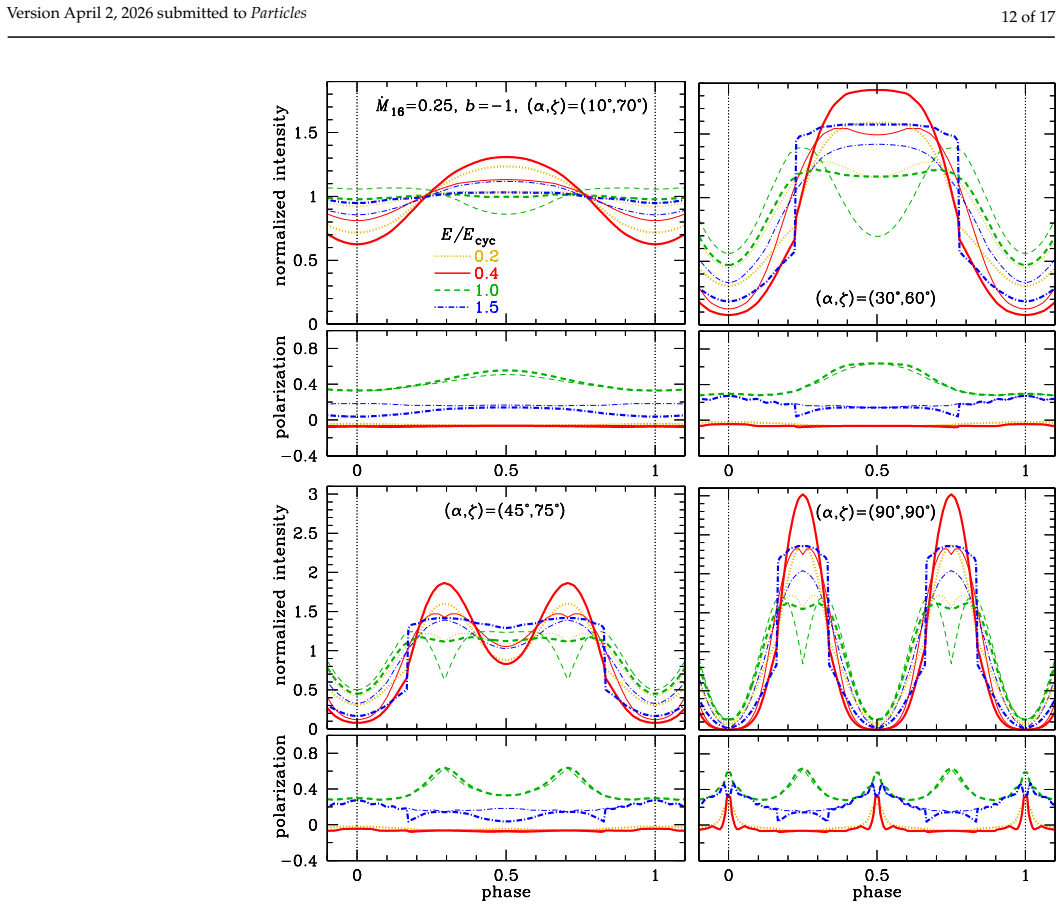
In subcritical X-ray pulsars the beaming patterns are strongly affected by resonant Compton scattering for photon energies comparable with the electron cyclotron energy. In particular, the angular redistribution of radiation near the cyclotron resonance may reduce the light-curve modulation amplitude, which is consistent with observational indications of a suppressed pulsed fraction at these energies.
What carries the argument
Numerical solution of radiative transfer for two coupled polarization modes in the accretion channel, including resonant Compton scattering and vacuum polarization.
Load-bearing premise
The specific models chosen for neutron star surface radiation and the numerical treatment of coupled polarization modes in the accretion channel are accurate enough to capture the dominant beaming effects.
What would settle it
A measurement of X-ray pulsar light curves at energies matching the cyclotron resonance that shows no reduction in modulation amplitude relative to nearby energies would falsify the claimed angular redistribution.
Figures


read the original abstract
Radiation of X-ray pulsars is powered by accretion on the neutron star surface from a binary companion under the influence of a strong magnetic field. We study beaming of this radiation in the case of subcritical X-ray pulsars, where it is formed in the accretion channel close to the neutron star surface. We solve equations of the hydrodynamics and radiative transfer of two coupled polarization modes in the accretion channel numerically, taking into account resonant Compton scattering and vacuum polarization. The beaming patterns are obtained for different accretion rates, photon energies and polarizations, and for different models of the neutron star surface radiation. The calculated beaming patterns are converted into light curves for both the intensity and polarization, taking into account the effects of General Relativity. These beaming patterns and light curves are found to be strongly affected by the resonant Compton scattering for photon energies comparable with the electron cyclotron energy. In particular, the angular redistribution of radiation near the cyclotron resonance may reduce the light-curve modulation amplitude, which is consistent with observational indications of a suppressed pulsed fraction at these energies.
Editorial analysis
A structured set of objections, weighed in public.
Referee Report
Summary. The manuscript numerically solves the coupled hydrodynamic and two-mode radiative-transfer equations inside the accretion column of subcritical X-ray pulsars, incorporating resonant Compton scattering and vacuum polarization. Beaming patterns are computed for varying accretion rates, photon energies, and polarizations using different neutron-star surface emissivity models; these patterns are then folded into intensity and polarization light curves that include general-relativistic light-bending and redshift effects. The central result is that resonant scattering near the electron cyclotron energy produces angular redistribution sufficient to reduce the amplitude of the light-curve modulation, consistent with observed suppression of the pulsed fraction at those energies.
Significance. If the numerical solutions are robust, the work supplies a concrete microphysical mechanism linking cyclotron-resonant radiative transfer to the energy-dependent timing properties of X-ray pulsars. This would strengthen the physical interpretation of suppressed pulsed fractions near cyclotron lines and provide testable predictions for future polarimetric observations.
major comments (2)
- [Methods] Methods section (numerical integration of the two-mode RT equations): no grid-resolution convergence tests, no error estimates on the angular or frequency discretization, and no validation against limiting cases (optically thin, non-resonant, or vacuum-only regimes) are reported. Without these, it is impossible to determine whether the claimed angular redistribution near the cyclotron resonance is numerically converged or an artifact of the chosen discretization and resonance-width treatment.
- [Results] Results (beaming patterns and light curves): the reduction in modulation amplitude is stated only qualitatively for the authors' chosen surface-radiation models and accretion rates. No quantitative measure of the suppression (e.g., change in pulsed fraction versus energy) or sensitivity to the assumed surface emissivity and polarization boundary conditions is provided, leaving the central observational claim unsupported by the presented data.
minor comments (1)
- [Abstract] Abstract: the statement that beaming patterns 'are found to be strongly affected' is not accompanied by any numerical scale or reference to a specific figure or table showing the magnitude of the effect.
Simulated Author's Rebuttal
We thank the referee for the constructive and detailed report. The comments highlight important aspects of numerical robustness and quantitative presentation that we will address in the revised manuscript.
read point-by-point responses
-
Referee: [Methods] Methods section (numerical integration of the two-mode RT equations): no grid-resolution convergence tests, no error estimates on the angular or frequency discretization, and no validation against limiting cases (optically thin, non-resonant, or vacuum-only regimes) are reported. Without these, it is impossible to determine whether the claimed angular redistribution near the cyclotron resonance is numerically converged or an artifact of the chosen discretization and resonance-width treatment.
Authors: We agree that explicit convergence tests and validations are required to establish numerical reliability. In the revised manuscript we will add a new subsection to the Methods section that reports grid-resolution convergence tests for the angular and frequency discretizations, provides quantitative error estimates, and validates the solver against the optically thin limit, the non-resonant regime, and the vacuum-polarization-only case. These additions will confirm that the angular redistribution near the cyclotron resonance is a converged physical result. revision: yes
-
Referee: [Results] Results (beaming patterns and light curves): the reduction in modulation amplitude is stated only qualitatively for the authors' chosen surface-radiation models and accretion rates. No quantitative measure of the suppression (e.g., change in pulsed fraction versus energy) or sensitivity to the assumed surface emissivity and polarization boundary conditions is provided, leaving the central observational claim unsupported by the presented data.
Authors: We accept that the current results are presented qualitatively. The revised manuscript will include quantitative measures of the pulsed-fraction suppression as a function of energy for the explored accretion rates. We will also add calculations for additional surface-emissivity models and polarization boundary conditions to demonstrate the sensitivity of the suppression effect. These quantitative results will directly support the observational interpretation. revision: yes
Circularity Check
No circularity: forward numerical integration of standard radiative-transfer equations
full rationale
The paper solves the coupled hydrodynamics and two-mode radiative-transfer equations numerically inside the accretion column, incorporating resonant Compton scattering, vacuum polarization, and boundary conditions from the neutron-star surface. Beaming patterns and GR-corrected light curves are direct outputs of this integration for chosen accretion rates, energies, and surface models. No parameters are fitted to observational data within the work, no self-definitional loops appear in the equations, and no load-bearing uniqueness theorem or ansatz is imported via self-citation. The central claim (resonant scattering redistributes radiation and can suppress pulsed fraction) follows from the numerical solution rather than reducing to its own inputs by construction.
Axiom & Free-Parameter Ledger
axioms (2)
- standard math Equations of hydrodynamics and radiative transfer for two coupled polarization modes in a magnetized plasma
- domain assumption Resonant Compton scattering and vacuum polarization are the dominant opacity sources near the cyclotron energy
Forward citations
Cited by 1 Pith paper
-
Vacuum polarization and cyclotron resonance effects on radiative transfer and plasma deceleration in subcritical X-ray pulsars
Simulations of subcritical X-ray pulsar accretion channels show vacuum polarization dominating plasma birefringence, enhancing cyclotron features and radiative deceleration, producing a polarization sign change above ...
Reference graph
Works this paper leans on
-
[1]
Mushtukov, A.; Tsygankov, S., Accreting strongly magnetised neutron stars: X-ray pulsars. InHandbook of X-ray and Gamma- ray Astrophysics; Bambi, C.; Santangelo, A., Eds.; Springer: Singapore, 2024; pp. 4105–4136, [arXiv:astro-ph.HE/2204.14185]. https://doi.org/10.1007/978-981-19-6960-7
-
[2]
Yang, J.; Laycock, S.G.T.; Christodoulou, D.M.; Fingerman, S.; Coe, M.J.; Drake, J.J. A comprehensive library of X-ray pulsars in the Small Magellanic Cloud: Time evolution of their luminosities and spin periods.Astrophys. J.2017,839, 119, [arXiv:astro- ph.HE/1703.05196]. https://doi.org/10.3847/1538-4357/aa6898
-
[3]
Bachetti, M.; Harrison, F.A.; Walton, D.J.; Grefenstette, B.W.; Chakrabarty, D.; Fürst, F.; Barret, D.; Beloborodov, A.; Boggs, S.E.; Christensen, F.E.; et al. An ultraluminous X-ray source powered by an accreting neutron star.Nature2014,514, 202–204, [arXiv:astro-ph.HE/1410.3590]. https://doi.org/10.1038/nature13791
-
[4]
Israel, G.L.; Belfiore, A.; Stella, L.; Esposito, P .; Casella, P .; De Luca, A.; Marelli, M.; Papitto, A.; Perri, M.; Puccetti, S.; et al. An accreting pulsar with extreme properties drives an ultraluminous X-ray source in NGC 5907.Science2017,355, 817–819, [arXiv:astro-ph.HE/1609.07375]. https://doi.org/10.1126/science.aai8635
-
[5]
ULXs: Neutron stars versus black holes.Mon
King, A.; Lasota, J.P . ULXs: Neutron stars versus black holes.Mon. Not. R. Astron. Soc.2016,458, L10–L13, [arXiv:astro- ph.HE/1601.03738]. https://doi.org/10.1093/mnrasl/slw011
-
[6]
Pulsing ULXs: tip of the iceberg?Mon
King, A.; Lasota, J.P .; Klu´ zniak, W. Pulsing ULXs: tip of the iceberg?Mon. Not. R. Astron. Soc.2017,468, L59–L62, [arXiv:astro- ph.HE/1702.00808]. https://doi.org/10.1093/mnrasl/slx020
-
[7]
Ultraluminous X-ray sources are beamed.Mon
Lasota, J.P .; King, A. Ultraluminous X-ray sources are beamed.Mon. Not. R. Astron. Soc.2023,526, 2506–2509, [arXiv:astro- ph.HE/2309.00034]. https://doi.org/10.1093/mnras/stad2926
-
[8]
Bright X-ray pulsars: how outflows influence beaming, pulsations and pulse phase lags
Mushtukov, A.A.; Portegies Zwart, S. Bright X-ray pulsars: how outflows influence beaming, pulsations and pulse phase lags. Mon. Not. R. Astron. Soc.2023,518, 5457–5464, [arXiv:astro-ph.HE/2211.08952]. https://doi.org/10.1093/mnras/stac3431
-
[9]
Stable accretion from a cold disc in highly magnetized neutron stars.Astron
Tsygankov, S.S.; Mushtukov, A.A.; Suleimanov, V .F.; Doroshenko, V .; Abolmasov, P .K.; Lutovinov, A.A.; Poutanen, J. Stable accretion from a cold disc in highly magnetized neutron stars.Astron. Astrophys.2017,608, A17, [arXiv:astro-ph.HE/1703.04528]. https://doi.org/10.1051/0004-6361/201630248
-
[10]
Tsygankov, S.S.; Doroshenko, V .; Mushtukov, A.A.; Lutovinov, A.A.; Poutanen, J. Study of the X-ray pulsar IGR J19294+1816 with NuSTAR: Detection of cyclotron line and transition to accretion from the cold disk.Astron. Astrophys.2019,621, A134, [arXiv:astro-ph.HE/1811.08912]. https://doi.org/10.1051/0004-6361/201833786
-
[11]
Why the Number of Galactic X-ray Stars Is so Small?Astron
Illarionov, A.F.; Sunyaev, R.A. Why the Number of Galactic X-ray Stars Is so Small?Astron. Astrophys.1975,39, 185
work page 1975
-
[12]
Cyclotron lines in highly magnetized neutron stars.Astron
Staubert, R.; Trümper, J.; Kendziorra, E.; Klochkov, D.; Postnov, K.; Kretschmar, P .; Pottschmidt, K.; Haberl, F.; Rothschild, R.E.; Santangelo, A.; et al. Cyclotron lines in highly magnetized neutron stars.Astron. Astrophys.2019,622, A61, [arXiv:astro- ph.HE/1812.03461]. https://doi.org/10.1051/0004-6361/201834479
-
[13]
C., Soffitta, P., Baldini, L.,et al
Weisskopf, M.C.; Soffitta, P .; Baldini, L.; Ramsey, B.D.; O’Dell, S.L.; Romani, R.W.; Matt, G.; Deininger, W.D.; Baumgartner, W.H.; Bellazzini, R.; et al. The Imaging X-Ray Polarimetry Explorer (IXPE): Pre-Launch.J. Astron. Telescopes, Instruments, and Systems 2022,8, 026002, [arXiv:astro-ph.IM/2112.01269]. https://doi.org/10.1117/1.JATIS.8.2.026002
-
[14]
Heyl, J. Remembering Yury N. Gnedin at the dawn of X-ray polarimetry: Predictions of IXPE observations of neutron stars. Universe2022,8, 84. https://doi.org/10.3390/universe8020084
-
[15]
Doroshenko, V .; Poutanen, J.; Tsygankov, S.S.; Suleimanov, V .F.; Bachetti, M.; Caiazzo, I.; Costa, E.; Di Marco, A.; Heyl, J.; La Monaca, F.; et al. Determination of X-ray pulsar geometry with IXPE polarimetry.Nature Astronomy2022,6, 1433–1443, [arXiv:astro-ph.HE/2206.07138]. https://doi.org/10.1038/s41550-022-01799-5
-
[16]
Maximum Accretion Efficiency in General Theory of Relativity
Mitra, A. Maximum Accretion Efficiency in General Theory of Relativity.arXiv e-prints1998, [astro-ph/9811402]. https: //doi.org/10.48550/arXiv.astro-ph/9811402
work page internal anchor Pith review Pith/arXiv arXiv doi:10.48550/arxiv.astro-ph/9811402
-
[17]
Nuclear physics of the outer layers of accreting neutron stars.J
Meisel, Z.; Deibel, A.; Keek, L.; Shternin, P .; Elfritz, J. Nuclear physics of the outer layers of accreting neutron stars.J. Phys. G: Nuclear Physics2018,45, 093001, [arXiv:astro-ph.HE/1807.01150]. https://doi.org/10.1088/1361-6471/aad171
-
[18]
Accretion at a magnetic pole of a neutron star.Nature Physical Science1973,246, 1–4
Davidson, K. Accretion at a magnetic pole of a neutron star.Nature Physical Science1973,246, 1–4. https://doi.org/10.1038/ physci246001a0
-
[19]
The limiting luminosity of accreting neutron stars with magnetic fields.Mon
Basko, M.M.; Sunyaev, R.A. The limiting luminosity of accreting neutron stars with magnetic fields.Mon. Not. R. Astron. Soc. 1976,175, 395–417. https://doi.org/10.1093/mnras/175.2.395
-
[20]
X-Ray Emission Accompanying the Accretion of Gas by a Neutron Star.Sov
Zel’dovich, Y.B.; Shakura, N.I. X-Ray Emission Accompanying the Accretion of Gas by a Neutron Star.Sov. Astron.1969,13, 175
work page 1969
-
[21]
X-ray emission from magnetized neutron star atmospheres at low mass-accretion rates
Sokolova-Lapa, E.; Gornostaev, M.; Wilms, J.; Ballhausen, R.; Falkner, S.; Postnov, K.; Thalhammer, P .; Fürst, F.; García, J.A.; Shakura, N.; et al. X-ray emission from magnetized neutron star atmospheres at low mass-accretion rates. I. Phase-averaged spectrum.Astron. Astrophys.2021,651, A12, [arXiv:astro-ph.HE/2104.06802]. https://doi.org/10.1051/0004-6...
-
[22]
Accretion onto neutron stars under adiabatic shock conditions.Astrophys
Shapiro, S.L.; Salpeter, E.E. Accretion onto neutron stars under adiabatic shock conditions.Astrophys. J.1975,198, 671–682. https://doi.org/10.1086/153645
-
[23]
Low-luminosity accretion onto magnetized neutron stars.Astrophys
Langer, S.H.; Rappaport, S. Low-luminosity accretion onto magnetized neutron stars.Astrophys. J.1982,257, 733–751. https://doi.org/10.1086/160028. https://doi.org/10.3390/particles1010000 Version April 2, 2026 submitted toParticles 16 of 17
-
[24]
Dynamics of the Flows Accreting onto a Magnetized Neutron Star
Bykov, A.M.; Krassilchtchikov, A.M. Dynamics of the flows accreting onto a magnetized neutron star.Astronomy Letters2004, 30, 309–318, [arXiv:astro-ph/astro-ph/0412319]. https://doi.org/10.1134/1.1738153
work page internal anchor Pith review Pith/arXiv arXiv doi:10.1134/1.1738153
-
[25]
Markozov, I.D.; Kaminker, A.D.; Potekhin, A.Y. Hydrodynamical simulation of the structure of the X-ray pulsar accretion channel: Accounting for resonant scattering.Astronomy Letters2023,49, 583–590, [arXiv:astro-ph.HE/2311.17488]. https: //doi.org/10.1134/S1063773723100031
-
[26]
Markozov, I.D.; Potekhin, A.Y.; Kaminker, A.D.; Mushtukov, A.A. The influence of vacuum polarization on plasma braking and radiation transfer in subcritical X-ray pulsars.Mon. Not. R. Astron. Soc., to be submitted
-
[27]
Ginzburg, V .L.The Propagation of Electromagnetic Waves in Plasmas, 2nd ed.; Freeman and Co.: New York, 1970
work page 1970
-
[28]
The transfer equations for normal waves and radiation polarization in an anisotropic medium.Sov
Gnedin, Y.N.; Pavlov, G.G. The transfer equations for normal waves and radiation polarization in an anisotropic medium.Sov. Phys. – JETP1974,38, 903–908
-
[29]
The effect of vacuum birefringence on the polarization of X-ray binaries and pulsars.Astrophys
Novick, R.; Weisskopf, M.C.; Angel, J.R.P .; Sutherland, P .G. The effect of vacuum birefringence on the polarization of X-ray binaries and pulsars.Astrophys. J.1977,215, L117–L120. https://doi.org/10.1086/182492
-
[30]
Gnedin, Y.N.; Pavlov, G.G.; Shibanov, Y.A. The effect of vacuum birefringence in a magnetic field on the polarization and beaming of X-ray pulsars.Soviet Astronomy Letters1978,4, 117–119
-
[31]
Vacuum polarization by a magnetic field and its astrophysical manifestations.Sov
Pavlov, G.G.; Gnedin, Y.N. Vacuum polarization by a magnetic field and its astrophysical manifestations.Sov. Sci. Rev. E: Astrophys. Space Phys. Rev.1984,3, 197
work page 1984
-
[32]
Lai, D.; Ho, W.C.G. Resonant Conversion of Photon Modes Due to Vacuum Polarization in a Magnetized Plasma: Implications for X-Ray Emission from Magnetars.Astrophys. J.2002,566, 373–377, [arXiv:astro-ph/astro-ph/0108127]. https://doi.org/10.108 6/338074
work page internal anchor Pith review Pith/arXiv arXiv 2002
-
[33]
Atmospheres and Spectra of Strongly Magnetized Neutron Stars II: Effect of Vacuum Polarization
Ho, W.C.G.; Lai, D. Atmospheres and spectra of strongly magnetized neutron stars - II. The effect of vacuum polarization.Mon. Not. R. Astron. Soc.2003,338, 233–252, [arXiv:astro-ph/astro-ph/0201380]. https://doi.org/10.1046/j.1365-8711.2003.06047.x
work page internal anchor Pith review Pith/arXiv arXiv doi:10.1046/j.1365-8711.2003.06047.x 2003
-
[34]
Lai, D.; Ho, W.C.G. Transfer of Polarized Radiation in Strongly Magnetized Plasmas and Thermal Emission from Magnetars: Effect of Vacuum Polarization.Astrophys. J.2003,588, 962–974, [arXiv:astro-ph/astro-ph/0211315]. https://doi.org/10.1086/374334
work page internal anchor Pith review Pith/arXiv arXiv doi:10.1086/374334 2003
-
[35]
van Adelsberg, M.; Lai, D. Atmosphere models of magnetized neutron stars: QED effects, radiation spectra and polarization signals.Mon. Not. R. Astron. Soc.2006,373, 1495–1522, [arXiv:astro-ph/astro-ph/0607168]. https://doi.org/10.1111/j.1365-2966. 2006.11098.x
work page internal anchor Pith review Pith/arXiv arXiv doi:10.1111/j.1365-2966 2006
-
[36]
Statistical features of multiple Compton scattering in a strong magnetic field.Phys
Mushtukov, A.A.; Markozov, I.D.; Suleimanov, V .F.; Nagirner, D.I.; Kaminker, A.D.; Potekhin, A.Y.; Portegies Zwart, S. Statistical features of multiple Compton scattering in a strong magnetic field.Phys. Rev. D2022,105, 103027, [arXiv:astro-ph.HE/2204.12271]. https://doi.org/10.1103/PhysRevD.105.103027
-
[37]
Mészáros, P .High-Energy Radiation from Magnetized Neutron Stars; University of Chicago Press: Chicago, 1992
work page 1992
-
[38]
Compton and Thomson scattering in strong magnetic fields.Phys
Herold, H. Compton and Thomson scattering in strong magnetic fields.Phys. Rev. D1979,19, 2868–2875. https://doi.org/10.110 3/PhysRevD.19.2868
-
[39]
LeVeque, R.J.Finite Volume Methods for Hyperbolic Problems; Cambridge Texts in Applied Mathematics, Cambridge University Press: Cambridge, 2002
work page 2002
-
[40]
Journal of Computational Physics , keywords =
Colella, P .; Woodward, P .R. The Piecewise Parabolic Method (PPM) for Gas-Dynamical Simulations.J. Computational Phys.1984, 54, 174–201. https://doi.org/10.1016/0021-9991(84)90143-8
-
[41]
The thickness of accretionα-disks: Theory and observations.Astronomy Reports 2007,51, 549–562
Suleimanov, V .F.; Lipunova, G.V .; Shakura, N.I. The thickness of accretionα-disks: Theory and observations.Astronomy Reports 2007,51, 549–562. https://doi.org/10.1134/S1063772907070049
-
[42]
Spectrum formation in X-ray pulsars at very low mass accretion rate: Monte Carlo approach.Mon
Mushtukov, A.A.; Suleimanov, V .F.; Tsygankov, S.S.; Portegies Zwart, S. Spectrum formation in X-ray pulsars at very low mass accretion rate: Monte Carlo approach.Mon. Not. R. Astron. Soc.2021,503, 5193–5203, [arXiv:astro-ph.HE/2006.13596]. https://doi.org/10.1093/mnras/stab811
-
[43]
Vacuum polarization alters the spectra of accreting X-ray pulsars.Astron
Sokolova-Lapa, E.; Stierhof, J.; Dauser, T.; Wilms, J. Vacuum polarization alters the spectra of accreting X-ray pulsars.Astron. Astrophys.2023,674, L2, [arXiv:astro-ph.HE/2305.00475]. https://doi.org/10.1051/0004-6361/202346265
-
[44]
Rotating stars in relativity.Living Reviews in Relativity2003,6, 3, [arXiv:gr-qc/gr-qc/0302034]
Stergioulas, N. Rotating stars in relativity.Living Reviews in Relativity2003,6, 3, [arXiv:gr-qc/gr-qc/0302034]. https://doi.org/10 .12942/lrr-2003-3
-
[45]
Pulse profiles of millisecond pulsars and their Fourier amplitudes
Poutanen, J.; Beloborodov, A.M. Pulse profiles of millisecond pulsars and their Fourier amplitudes.Mon. Not. R. Astron. Soc. 2006,373, 836–844, [arXiv:astro-ph/astro-ph/0608663]. https://doi.org/10.1111/j.1365-2966.2006.11088.x
work page internal anchor Pith review Pith/arXiv arXiv doi:10.1111/j.1365-2966.2006.11088.x 2006
-
[46]
Relativistic rotating vector model for X-ray millisecond pulsars.Astron
Poutanen, J. Relativistic rotating vector model for X-ray millisecond pulsars.Astron. Astrophys.2020,641, A166, [arXiv:astro- ph.HE/2006.10448]. https://doi.org/10.1051/0004-6361/202038689
-
[47]
Accurate analytic formula for light bending in Schwarzschild metric.Astron
Poutanen, J. Accurate analytic formula for light bending in Schwarzschild metric.Astron. Astrophys.2020,640, A24, [arXiv:astro- ph.HE/1909.05732]. https://doi.org/10.1051/0004-6361/202037471
-
[48]
Misner, C.W.; Thorne, K.S.; Wheeler, J.A.Gravitation; Freeman and Co.: New York, 1973
work page 1973
-
[49]
Lutovinov, A.A.; Tsygankov, S.S. Timing characteristics of the hard X-ray emission from bright X-ray pulsars based on INTEGRAL data.Astronomy Letters2009,35, 433–456, [arXiv:astro-ph.HE/0907.4288]. https://doi.org/10.1134/S1063773709070019. https://doi.org/10.3390/particles1010000 Version April 2, 2026 submitted toParticles 17 of 17
-
[50]
Energy-resolved pulse profiles of accreting pulsars: Diagnostic tools for spectral features
Ferrigno, C.; D’Aì, A.; Ambrosi, E. Energy-resolved pulse profiles of accreting pulsars: Diagnostic tools for spectral features. Astron. Astrophys.2023,677, A103, [arXiv:astro-ph.HE/2308.03395]. https://doi.org/10.1051/0004-6361/202347062. https://doi.org/10.3390/particles1010000
discussion (0)
Sign in with ORCID, Apple, or X to comment. Anyone can read and Pith papers without signing in.