Fixed point theorems on perturbed metric space with an application
Pith reviewed 2026-05-16 17:12 UTC · model grok-4.3
The pith
Fixed point theorems hold for F-perturbed mappings in complete perturbed metric spaces and apply to boundary value problems.
A machine-rendered reading of the paper's core claim, the machinery that carries it, and where it could break.
Core claim
In a complete perturbed metric space, every F-perturbed mapping possesses at least one fixed point; the result is justified by a counterexample showing the conditions are necessary and is applied to establish existence of solutions for a second-order boundary value problem.
What carries the argument
The F-perturbed mapping, defined by a contraction-type inequality involving a function F applied to the perturbed distance between points and their images.
If this is right
- Existence of fixed points follows directly once the F-perturbed condition holds in a complete perturbed metric space.
- The same theorems guarantee solutions exist for the second-order boundary value problem when the operator is shown to be F-perturbed.
- The counterexample demonstrates that dropping completeness or the F-condition can destroy the fixed-point guarantee.
Where Pith is reading between the lines
- The approach could be tested on other classes of mappings or on perturbed versions of standard metric spaces arising in optimization.
- If perturbed metrics model small perturbations of distances, the theorems may apply to stability questions in geometric fixed-point problems.
Load-bearing premise
The space must be complete under the perturbed metric and the mapping must obey the F-perturbed condition as stated in the paper.
What would settle it
A concrete counterexample in a complete perturbed metric space where the mapping violates the F-perturbed condition and has no fixed point.
Figures
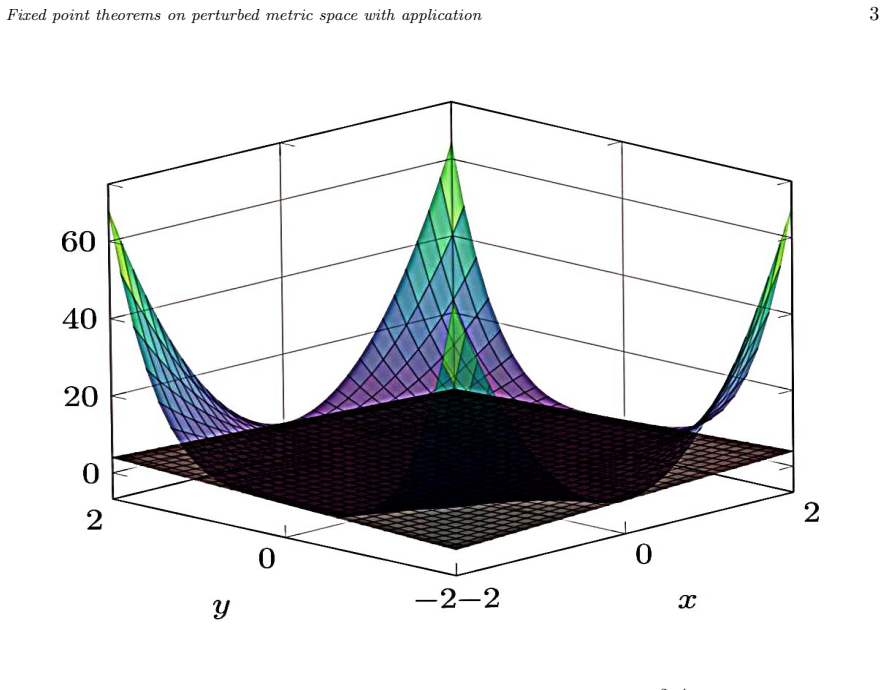


read the original abstract
Following the definition of perturbed metric space, in this paper, some fixed point theorems are established for $ F $-perturbed mappings in complete perturbed metric spaces and justify the result by counter example. Finally, an application of this theorem for the existence of a solution for the second-order boundary value problem is given.
Editorial analysis
A structured set of objections, weighed in public.
Referee Report
Summary. The manuscript defines perturbed metric spaces and proves fixed point theorems for F-perturbed mappings on complete perturbed metric spaces. It includes a counterexample and applies the main result to prove existence of a solution to a second-order boundary value problem.
Significance. If the central theorems are correct, the work extends Banach-type fixed point results to a perturbed setting and supplies a concrete application to BVPs. The counterexample and BVP example are positive features that help anchor the abstract claims.
major comments (2)
- [§3] §3 (proof of the main fixed-point theorem): the argument that the Picard iterates form a Cauchy sequence in the perturbed metric d_F and that the limit is a fixed point does not establish that F(x_n, x) → 0 or that the perturbation preserves the necessary limit passage; without an explicit continuity or vanishing condition on F the standard completeness argument fails to close.
- [Application section] Application section (BVP): the reduction of the boundary-value problem to an F-perturbed contraction on the integral operator is stated but the verification that the operator satisfies the precise F-perturbed inequality with a uniform constant <1 is omitted; this step is load-bearing for the claimed existence result.
minor comments (1)
- [Abstract] The abstract claims the results are 'justified by counter example' but the manuscript never states what property the counterexample is meant to demonstrate (necessity of completeness, sharpness of the contraction constant, etc.).
Simulated Author's Rebuttal
We thank the referee for the careful reading and constructive comments on our manuscript. We address each major point below and will revise the manuscript to strengthen the presentation where the concerns are valid.
read point-by-point responses
-
Referee: [§3] §3 (proof of the main fixed-point theorem): the argument that the Picard iterates form a Cauchy sequence in the perturbed metric d_F and that the limit is a fixed point does not establish that F(x_n, x) → 0 or that the perturbation preserves the necessary limit passage; without an explicit continuity or vanishing condition on F the standard completeness argument fails to close.
Authors: We agree that the limit passage for F(x_n, x) requires explicit justification. The current proof shows the sequence is Cauchy in d_F via the contraction inequality but does not detail why F(x_n, x) → 0 when passing to the limit. We will revise Section 3 by adding a short lemma or remark establishing this limit under the standing assumptions on F (or by introducing a mild continuity condition on F if needed to close the argument). This will make the completeness step fully rigorous. revision: yes
-
Referee: [Application section] Application section (BVP): the reduction of the boundary-value problem to an F-perturbed contraction on the integral operator is stated but the verification that the operator satisfies the precise F-perturbed inequality with a uniform constant <1 is omitted; this step is load-bearing for the claimed existence result.
Authors: We acknowledge that the explicit verification for the integral operator was omitted. In the revised version we will insert the missing calculation: starting from the Green's function representation, we bound the difference of the operator values in the perturbed metric d_F and show that the contraction constant is strictly less than 1 under the stated hypotheses on the nonlinearity. This step is indeed essential and will be written out in full. revision: yes
Circularity Check
No circularity: standard fixed-point derivation from definitions and completeness
full rationale
The paper defines perturbed metric spaces and F-perturbed mappings, then establishes fixed-point results in complete spaces via direct arguments (likely Banach-type iteration) and applies them to a BVP. No quoted step reduces a prediction to a fitted input, renames a known result, or relies on a self-citation chain whose justification is internal to the paper. The derivation remains self-contained against the stated axioms and completeness assumption.
Axiom & Free-Parameter Ledger
Lean theorems connected to this paper
-
IndisputableMonolith/Cost/FunctionalEquation.leanwashburn_uniqueness_aczel unclear?
unclearRelation between the paper passage and the cited Recognition theorem.
Definition 3.2. A mapping T:X→X is said to be an F-perturbed mapping if there exists τ>0 such that D(Tx,Ty)>0 ⟹ τ+F(D(Tx,Ty))≤F(D(x,y))
-
IndisputableMonolith/Foundation/ArithmeticFromLogic.leanLogicNat recovery unclear?
unclearRelation between the paper passage and the cited Recognition theorem.
Theorem 3.3. Let (X,D,P) be a complete perturbed metric space and T an F-perturbed mapping. Then T has a unique fixed point.
What do these tags mean?
- matches
- The paper's claim is directly supported by a theorem in the formal canon.
- supports
- The theorem supports part of the paper's argument, but the paper may add assumptions or extra steps.
- extends
- The paper goes beyond the formal theorem; the theorem is a base layer rather than the whole result.
- uses
- The paper appears to rely on the theorem as machinery.
- contradicts
- The paper's claim conflicts with a theorem or certificate in the canon.
- unclear
- Pith found a possible connection, but the passage is too broad, indirect, or ambiguous to say the theorem truly supports the claim.
Reference graph
Works this paper leans on
-
[1]
Gahler, 2-Metrische raume und ihre topologische struktur,Math Nachr,26 (1993) 115-118
S. Gahler, 2-Metrische raume und ihre topologische struktur,Math Nachr,26 (1993) 115-118
work page 1993
-
[2]
B. C. Dhage, Generalized metric space and mappings with fixed point,Bull. cal. Math. Soc., 84(4) (1992) 329-336
work page 1992
- [3]
-
[4]
S. Czerwik, Contraction mapping inb-metric spaces,Acta mathematica et Informatica Univer- sitatis Ostraviensis,1(1) (1993) 5-11
work page 1993
-
[5]
Z. Mustafa and B. Sims, A new approach to generalized metric spaces,Journal of Nonlinear and Convex Analysis,7(2) (2006) 289-297
work page 2006
-
[6]
M. Jleli and B. Samet, On a new generalization of metric spaces,J. Fixed Point Theory Appl., 20(2018). Art.128
work page 2018
-
[7]
A. Das, H. Kalita, M. Sajid and T. Bag, Generalizedθ-parametric metric spaces : fixed point theorems and application to fractional economic growth model via fractional differential approach,Journal of Inequalities and Applications,2025 : 112 (2025)
work page 2025
- [8]
-
[9]
S. K. Ghosh, O. Ege, J. Ahmad, A. Aloqaily and N. Mlaiki, On elliptic valuedb-metric spaces and some new fixed point results with application,AIMS Mathematics,9(7) (2024) 17184- 17204
work page 2024
-
[10]
A. Bataihah, M. Shatnawi, I. M. Batiha, I. H. Jebril and T. Abdeljawad, Some results on fixed points inb-metric spaces through an auxiliary function,Nonlinear Functional Analysis and Applications,30(1) (2025) 251-263
work page 2025
-
[11]
A. Das, H. Ahmad and T. Bag, Some fixed point theorems in generalized parametric metric spaces and applications to ordinary differential equations,Mathematica Slovaca,74(5) (2024) 1277-1290
work page 2024
-
[12]
E. Petrov and R. K. Bisht, Fixed points theorem for generalized Kannan type mappings, Rendiconti del Circolo Matematico di Palermo Series2 (2024) 73 : 289-2912
work page 2024
- [13]
-
[14]
M. Jleli and B. Samet, On Banach’s fixed point theorem in perturbed metric spaces,Journal of Applied Analysis and Computation15(2) (2025) 993-1001
work page 2025
-
[15]
D. Wardowski, Fixed points of a new type of contractive mappings in complete metric spaces, Fixed Point Theory and Applications942012
discussion (0)
Sign in with ORCID, Apple, or X to comment. Anyone can read and Pith papers without signing in.