Recognition: no theorem link
From Impact to Insight: Dynamics-Aware Proprioceptive Terrain Sensing on Granular Media
Pith reviewed 2026-05-13 20:43 UTC · model grok-4.3
The pith
Robots recover consistent granular stiffness from proprioceptive forces during high-speed hopping by modeling acceleration-dependent added-mass effects from grain entrainment.
A machine-rendered reading of the paper's core claim, the machinery that carries it, and where it could break.
Core claim
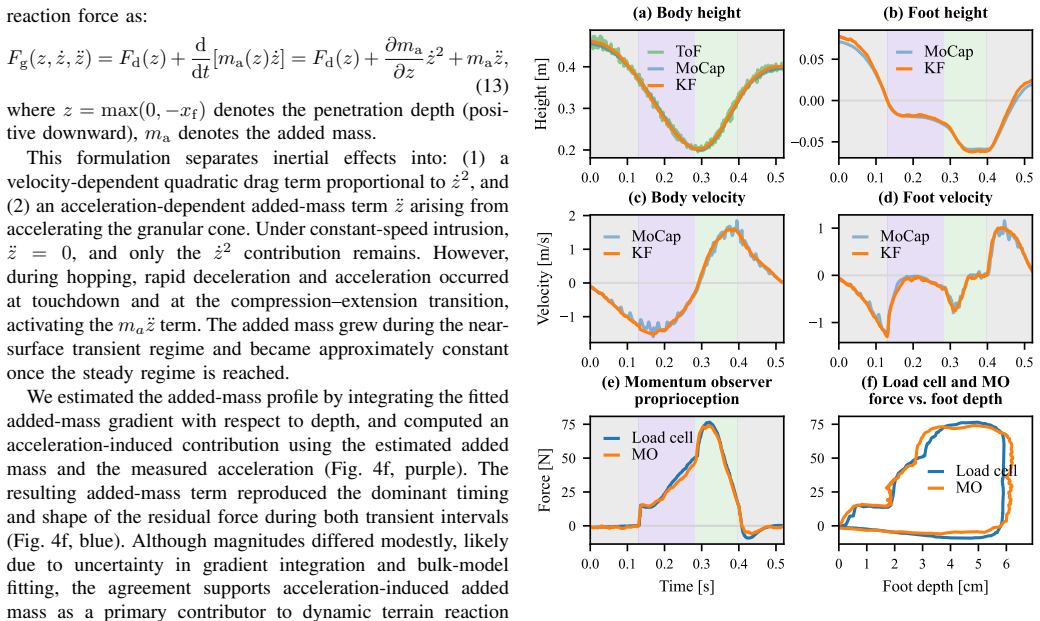
Quasi-static assumptions lead to large discrepancies in granular terrain property estimation during high-speed hopping, particularly at touchdown and stiffness transitions. Velocity-dependent drag alone cannot explain the observed force transients. Acceleration-dependent added-mass effects associated with grain entrainment beneath the foot dominate these responses. Integrating this decomposition with a momentum-observer-based estimator and an acceleration-aware weighted regression enables consistent recovery of granular stiffness parameters across locomotion conditions that match linear-actuator ground truth.
What carries the argument
Momentum-observer-based estimator combined with acceleration-aware weighted regression that isolates granular stiffness by compensating for added-mass effects during dynamic contact.
If this is right
- Robots obtain reliable terrain stiffness values even during rapid impacts and controller-driven stiffness changes without external sensors.
- Proprioceptive sensing suffices for consistent parameter recovery across different hopping speeds and leg compliance settings.
- The method provides a foundation for dynamic terrain characterization during exploration of terrestrial and planetary granular environments.
- Accurate inference requires explicit inclusion of acceleration-dependent granular effects rather than quasi-static or velocity-only models.
Where Pith is reading between the lines
- The same added-mass correction could be adapted for other compliant surfaces such as mud or snow if the entrainment physics prove similar.
- Real-time gait adaptation might become possible by feeding the online stiffness estimates back into the robot's controller.
- Planetary landers or rovers could perform in-situ soil analysis during high-speed traverses without halting for separate tests.
Load-bearing premise
The observed force discrepancies during high-acceleration events are caused primarily by acceleration-dependent added-mass effects rather than other unmodeled dynamics or sensor artifacts.
What would settle it
Stiffness estimates obtained with the full estimator on new hopping trials at untested impact speeds deviate substantially from simultaneous linear-actuator ground-truth measurements.
Figures



read the original abstract
Robots that traverse natural terrain must interpret contact forces generated under highly dynamic conditions. However, most terrain characterization approaches rely on quasi-static assumptions that neglect velocity- and acceleration-dependent effects arising during impact and rapid stance transitions. In this work, we investigate granular terrain interaction during high-speed hopping and develop a physics-based framework for dynamic terrain characterization using proprioceptive sensing alone. Through controlled hopping experiments with systematically varied impact speed and leg compliance, our measurements reveal that quasi-static based assumptions lead to large discrepancies in granular terrain property estimation during high-speed hopping, particularly upon touchdown and controller-induced stiffness transitions. Velocity-dependent drag alone cannot explain these discrepancies. Instead, acceleration-dependent added-mass effects-associated with grain entrainment beneath the foot-dominate transient force responses. We integrate this force decomposition with a momentum-observer-based estimator that compensates for rigid-body inertia and gravity, and introduce an acceleration-aware weighted regression to account for increased force variance during high-acceleration events. Together, these methods enable consistent recovery of granular stiffness parameters across locomotion conditions, closely matching linear-actuator ground truth. Our results demonstrate that accurate terrain inference during high-speed locomotion requires explicit treatment of acceleration-dependent granular effects, and provide a foundation for robots to characterize complex deformable terrain during dynamic exploration of terrestrial and planetary environments.
Editorial analysis
A structured set of objections, weighed in public.
Referee Report
Summary. The paper claims that during high-speed hopping on granular media, acceleration-dependent added-mass effects from grain entrainment dominate transient force responses (beyond velocity-dependent drag), and that a momentum-observer estimator (compensating rigid-body inertia and gravity) combined with acceleration-aware weighted regression enables consistent recovery of granular stiffness parameters across varied impact speeds and leg compliances, closely matching independent linear-actuator ground truth.
Significance. If the central claim holds, the work advances proprioceptive terrain sensing for dynamic locomotion by demonstrating that explicit treatment of acceleration-dependent granular effects is necessary for accurate stiffness inference under impact and rapid stance transitions. The systematic variation of speed and compliance, together with direct comparison to linear-actuator ground truth, provides a concrete experimental foundation that could support more reliable terrain characterization in terrestrial and planetary robotics.
major comments (1)
- [Abstract] Abstract: the claim that the momentum-observer estimator plus acceleration-aware weighted regression cleanly isolates granular stiffness without residual coupling to entrainment-induced added mass is load-bearing for the central result, yet the manuscript does not report an explicit test (e.g., residual analysis under alternative inertia models or varying entrainment conditions) confirming the observer remains unbiased when added mass alters effective inertia during impact.
minor comments (2)
- [Abstract] Abstract and results sections: error bars, data exclusion criteria, and full derivation details for the weighted regression are not provided, making it difficult to assess the statistical robustness of the reported match to ground truth.
- [Results] The post-hoc interpretation of force discrepancies as added-mass effects would benefit from a quantitative comparison against alternative unmodeled dynamics (e.g., grain compaction or foot geometry effects) to strengthen the attribution.
Simulated Author's Rebuttal
We thank the referee for their constructive review and for identifying a point that strengthens the validation of our central claim. We address the major comment below and have revised the manuscript to incorporate the requested analysis.
read point-by-point responses
-
Referee: [Abstract] Abstract: the claim that the momentum-observer estimator plus acceleration-aware weighted regression cleanly isolates granular stiffness without residual coupling to entrainment-induced added mass is load-bearing for the central result, yet the manuscript does not report an explicit test (e.g., residual analysis under alternative inertia models or varying entrainment conditions) confirming the observer remains unbiased when added mass alters effective inertia during impact.
Authors: We agree that an explicit residual analysis would provide stronger confirmation that the momentum observer isolates granular stiffness without residual bias from entrainment-induced added mass. While the original manuscript already shows that stiffness estimates remain consistent with independent linear-actuator ground truth across varied impact speeds and leg compliances, we acknowledge that this indirect evidence does not directly test observer unbiasedness under alternative inertia models. In the revised manuscript we have added a new subsection (Section 4.3) that performs the requested residual analysis: we recompute force residuals using the momentum observer with (i) rigid-body inertia only, (ii) rigid-body plus velocity-dependent drag, and (iii) the full model including acceleration-dependent added mass, across the full range of experimental entrainment conditions. The added analysis demonstrates that residuals are statistically unbiased and minimal only under the full model, thereby directly supporting the claim that the estimator cleanly isolates stiffness parameters. revision: yes
Circularity Check
No circularity; central claims rest on experimental validation against independent ground truth
full rationale
The derivation employs a standard momentum-observer estimator to subtract rigid-body inertia and gravity from measured torques, then applies acceleration-aware weighted regression to recover granular stiffness. These steps are validated by direct comparison to separate linear-actuator ground-truth experiments rather than by construction from the same fitted data. No load-bearing self-citations, uniqueness theorems, or ansatzes imported from prior author work are present; velocity- and acceleration-dependent effects are diagnosed from observed discrepancies in the data itself. The weighting scheme is data-driven but does not rename a fitted input as a prediction.
Axiom & Free-Parameter Ledger
axioms (2)
- domain assumption Contact force decomposes cleanly into rigid-body inertia, gravity, and granular interaction forces
- domain assumption Force variance increases during high-acceleration events
invented entities (1)
-
acceleration-dependent added-mass effect from grain entrainment
no independent evidence
Reference graph
Works this paper leans on
-
[1]
C. Li and K. Lewis, “The need for and feasibility of alternative ground robots to traverse sandy and rocky extraterrestrial terrain,”Advanced Intelligent Systems, vol. 5, no. 3, p. 2100195, 2023
work page 2023
-
[2]
Force and flow at the onset of drag in plowed granular media,
N. Gravish, P. B. Umbanhowar, and D. I. Goldman, “Force and flow at the onset of drag in plowed granular media,”Physical Review E, vol. 89, no. 4, p. 042202, 2014
work page 2014
-
[3]
Stress transmission in wet granular materials,
V . Richefeu, F. Radjaı, and M. S. El Youssoufi, “Stress transmission in wet granular materials,”The european physical journal E, vol. 21, no. 4, pp. 359–369, 2006
work page 2006
-
[4]
Z.-Y . Wang, P. Wang, Z.-Y . Yin, and R. Wang, “Micromechanical inves- tigation of the particle size effect on the shear strength of uncrushable granular materials,”Acta Geotechnica, vol. 17, no. 10, pp. 4277–4296, 2022
work page 2022
-
[5]
Tractable terrain-aware motion planning on granular media: An impulsive jumping study,
C. M. Hubicki, J. J. Aguilar, D. I. Goldman, and A. D. Ames, “Tractable terrain-aware motion planning on granular media: An impulsive jumping study,” in2016 IEEE/RSJ International Conference on Intelligent Robots and Systems (IROS). IEEE, 2016, pp. 3887–3892
work page 2016
-
[6]
Bipedial locomotion up sandy slopes: Systematic experiments using zero moment point methods,
J. R. Gosyne, C. M. Hubicki, X. Xiong, A. D. Ames, and D. I. Goldman, “Bipedial locomotion up sandy slopes: Systematic experiments using zero moment point methods,” in2018 IEEE-RAS 18th International Conference on Humanoid Robots (Humanoids). IEEE, 2018, pp. 994– 1001
work page 2018
-
[7]
Adaptive locomotion on mud through proprioceptive sensing of substrate properties,
S. Liu, J. Tang, S. Meng, and F. Qian, “Adaptive locomotion on mud through proprioceptive sensing of substrate properties,”arXiv preprint arXiv:2504.19607, 2025
-
[8]
The soft-landing problem: Minimizing energy loss by a legged robot impacting yielding terrain,
D. J. Lynch, K. M. Lynch, and P. B. Umbanhowar, “The soft-landing problem: Minimizing energy loss by a legged robot impacting yielding terrain,”IEEE Robotics and Automation Letters, vol. 5, no. 2, pp. 3658– 3665, 2020
work page 2020
-
[9]
Efficient, responsive, and robust hopping on deformable terrain,
D. J. Lynch, J. L. Pusey, S. W. Gart, P. B. Umbanhowar, and K. M. Lynch, “Efficient, responsive, and robust hopping on deformable terrain,” IEEE Transactions on Robotics, 2024
work page 2024
-
[10]
Virtual energy management for physical energy savings in a legged robot hopping on granular media,
S. F. Roberts and D. E. Koditschek, “Virtual energy management for physical energy savings in a legged robot hopping on granular media,” Frontiers in Robotics and AI, vol. 8, p. 740927, 2021
work page 2021
-
[11]
Rhex: A simple and highly mobile hexapod robot,
U. Saranli, M. Buehler, and D. E. Koditschek, “Rhex: A simple and highly mobile hexapod robot,”The International Journal of Robotics Research, vol. 20, no. 7, pp. 616–631, 2001
work page 2001
-
[12]
Sidewinding with minimal slip: Snake and robot ascent of sandy slopes,
H. Marvi, C. Gong, N. Gravish, H. Astley, M. Travers, R. L. Hatton, J. R. Mendelson III, H. Choset, D. L. Hu, and D. I. Goldman, “Sidewinding with minimal slip: Snake and robot ascent of sandy slopes,”Science, vol. 346, no. 6206, pp. 224–229, 2014
work page 2014
-
[13]
A bio-inspired sand-rolling robot: effect of body shape on sand rolling performance,
X. Liao, W. Liu, H. Wu, and F. Qian, “A bio-inspired sand-rolling robot: effect of body shape on sand rolling performance,”arXiv preprint arXiv:2503.13919, 2025
-
[14]
S. Chhaniyara, C. Brunskill, B. Yeomans, M. Matthews, C. Saaj, S. Ransom, and L. Richter, “Terrain trafficability analysis and soil mechanical property identification for planetary rovers: A survey,” Journal of Terramechanics, vol. 49, no. 2, pp. 115–128, 2012
work page 2012
-
[15]
Tactile sensing and terrain-based gait control for small legged robots,
X. A. Wu, T. M. Huh, A. Sabin, S. A. Suresh, and M. R. Cutkosky, “Tactile sensing and terrain-based gait control for small legged robots,” IEEE Transactions on Robotics, vol. 36, no. 1, pp. 15–27, 2019
work page 2019
-
[16]
A. H. Chang, C. M. Hubicki, J. J. Aguilar, D. I. Goldman, A. D. Ames, and P. A. Vela, “Learning to jump in granular media: Unifying optimal control synthesis with gaussian process-based regression,” in2017 IEEE International Conference on Robotics and Automation (ICRA). IEEE, 2017, pp. 2154–2160
work page 2017
-
[17]
——, “Learning terrain dynamics: A gaussian process modeling and optimal control adaptation framework applied to robotic jumping,”IEEE Transactions on Control Systems Technology, vol. 29, no. 4, pp. 1581– 1596, 2020
work page 2020
-
[18]
Learning quadrupedal locomotion on deformable terrain,
S. Choi, G. Ji, J. Park, H. Kim, J. Mun, J. H. Lee, and J. Hwangbo, “Learning quadrupedal locomotion on deformable terrain,”Science Robotics, vol. 8, no. 74, p. eade2256, 2023
work page 2023
-
[19]
Actuator transparency and the energetic cost of proprioception,
G. Kenneally, W.-H. Chen, and D. E. Koditschek, “Actuator transparency and the energetic cost of proprioception,” inInternational Symposium on Experimental Robotics. Springer, 2018, pp. 485–495
work page 2018
-
[20]
Design principles for a family of direct-drive legged robots,
G. Kenneally, A. De, and D. E. Koditschek, “Design principles for a family of direct-drive legged robots,”IEEE Robotics and Automation Letters, vol. 1, no. 2, pp. 900–907, 2016
work page 2016
-
[21]
Effect of gait design on proprioceptive sensing of terrain properties in a quadrupedal robot,
E. Fulcher, J. Caporale, Y . Zhang, J. Ruck, and F. Qian, “Effect of gait design on proprioceptive sensing of terrain properties in a quadrupedal robot,”arXiv preprint arXiv:2509.22065, 2025
-
[22]
S. Liu, J. Caporale, Y . Zhang, X. Liao, W. Hoganson, W. Hu, S. Misra, N. Peddinti, R. Holladay, E. Fulcheret al., “Scout-rover cooperation: on- line terrain strength mapping and traversal risk estimation for planetary- analog explorations,”arXiv preprint arXiv:2602.18688, 2026
-
[23]
Rapid in situ characterization of soil erodibility with a field deployable robot,
F. Qian, D. Lee, G. Nikolich, D. Koditschek, and D. Jerolmack, “Rapid in situ characterization of soil erodibility with a field deployable robot,” Journal of Geophysical Research: Earth Surface, vol. 124, no. 5, pp. 1261–1280, 2019
work page 2019
-
[24]
Downslope weakening of soil revealed by a rapid robotic rheometer,
J. G. Ruck, C. G. Wilson, T. Shipley, D. Koditschek, F. Qian, and D. Jerolmack, “Downslope weakening of soil revealed by a rapid robotic rheometer,”Geophysical Research Letters, vol. 51, no. 1, p. e2023GL106468, 2024
work page 2024
-
[25]
Slow drag in a granular medium,
R. Albert, M. Pfeifer, A.-L. Barab ´asi, and P. Schiffer, “Slow drag in a granular medium,”Physical review letters, vol. 82, no. 1, p. 205, 1999
work page 1999
-
[26]
A terradynamics of legged locomotion on granular media,
C. Li, T. Zhang, and D. I. Goldman, “A terradynamics of legged locomotion on granular media,”science, vol. 339, no. 6126, pp. 1408– 1412, 2013
work page 2013
-
[27]
Scaling and dynamics of sphere and disk impact into granular media,
D. I. Goldman and P. Umbanhowar, “Scaling and dynamics of sphere and disk impact into granular media,”Physical Review E—Statistical, Nonlinear, and Soft Matter Physics, vol. 77, no. 2, p. 021308, 2008
work page 2008
-
[28]
Walking and running on yielding and fluidizing ground,
F. Qian, T. Zhang, C. Li, P. Masarati, A. M. Hoover, P. Birkmeyer, A. Pullin, R. S. Fearing, D. I. Goldman, and F. Olin, “Walking and running on yielding and fluidizing ground,” inRobotics: Science and Systems, 2013, p. 345
work page 2013
-
[29]
S. Godon, M. Kruusmaa, and A. Ristolainen, “Maneuvering on non- newtonian fluidic terrain: a survey of animal and bio-inspired robot locomotion techniques on soft yielding grounds,”Frontiers in Robotics and AI, vol. 10, p. 1113881, 2023
work page 2023
-
[30]
M. H. Raibert,Legged robots that balance. MIT press, 1986
work page 1986
-
[31]
Scaling vertical drag forces in granular media,
G. Hill, S. Yeung, and S. A. Koehler, “Scaling vertical drag forces in granular media,”EPL (Europhysics Letters), vol. 72, no. 1, pp. 137–143, 2005
work page 2005
-
[32]
Preparation of sand beds using fluidization,
Z. Jin, J. Tang, P. B. Umbanhowar, and J. Hambleton, “Preparation of sand beds using fluidization,” 2019
work page 2019
-
[33]
A new approach to linear filtering and prediction problems,
R. E. Kalman, “A new approach to linear filtering and prediction problems,”Journal of Basic Engineering, vol. 82, no. 1, pp. 35–45, 1960
work page 1960
-
[34]
Robot collisions: A survey on detection, isolation, and identification,
S. Haddadin, A. De Luca, and A. Albu-Sch ¨affer, “Robot collisions: A survey on detection, isolation, and identification,”IEEE Transactions on Robotics, vol. 33, no. 6, pp. 1292–1312, 2017
work page 2017
-
[35]
Archimedes’ law explains penetration of solids into granular media,
W. Kang, Y . Feng, C. Liu, and R. Blumenfeld, “Archimedes’ law explains penetration of solids into granular media,”Nature communi- cations, vol. 9, no. 1, p. 1101, 2018
work page 2018
-
[36]
Intrusion into granular media beyond the quasistatic regime,
L. K. Roth, E. Han, and H. M. Jaeger, “Intrusion into granular media beyond the quasistatic regime,”Physical Review Letters, vol. 126, no. 21, p. 218001, 2021
work page 2021
-
[37]
Robophysical study of jumping dynamics on granular media,
J. Aguilar and D. I. Goldman, “Robophysical study of jumping dynamics on granular media,”Nature Physics, vol. 12, no. 3, pp. 278–283, 2016
work page 2016
discussion (0)
Sign in with ORCID, Apple, or X to comment. Anyone can read and Pith papers without signing in.