Self-subsidizing Mercury Remediation with Fusion Reactors
Pith reviewed 2026-05-13 19:23 UTC · model grok-4.3
The pith
Fusion reactors can transmute mercury pollution into gold while generating electricity, creating self-funding remediation.
A machine-rendered reading of the paper's core claim, the machinery that carries it, and where it could break.
Core claim
Fusion reactors can permanently remediate mercury by using it as a neutron multiplier: each (n,2n) reaction reduces the neutron number toward 197Hg which quickly decays into stable gold, irreversibly removing it from the environment while generating substantial economic value. At high neutron flux achievable in muon-catalyzed and inertial confinement fusion, nuclear reactions make all mercury isotopes eligible for gold transmutation. Co-producing gold alongside electricity can triple a fusion plant's revenue, aligning economic incentives with complete, permanent mercury remediation.
What carries the argument
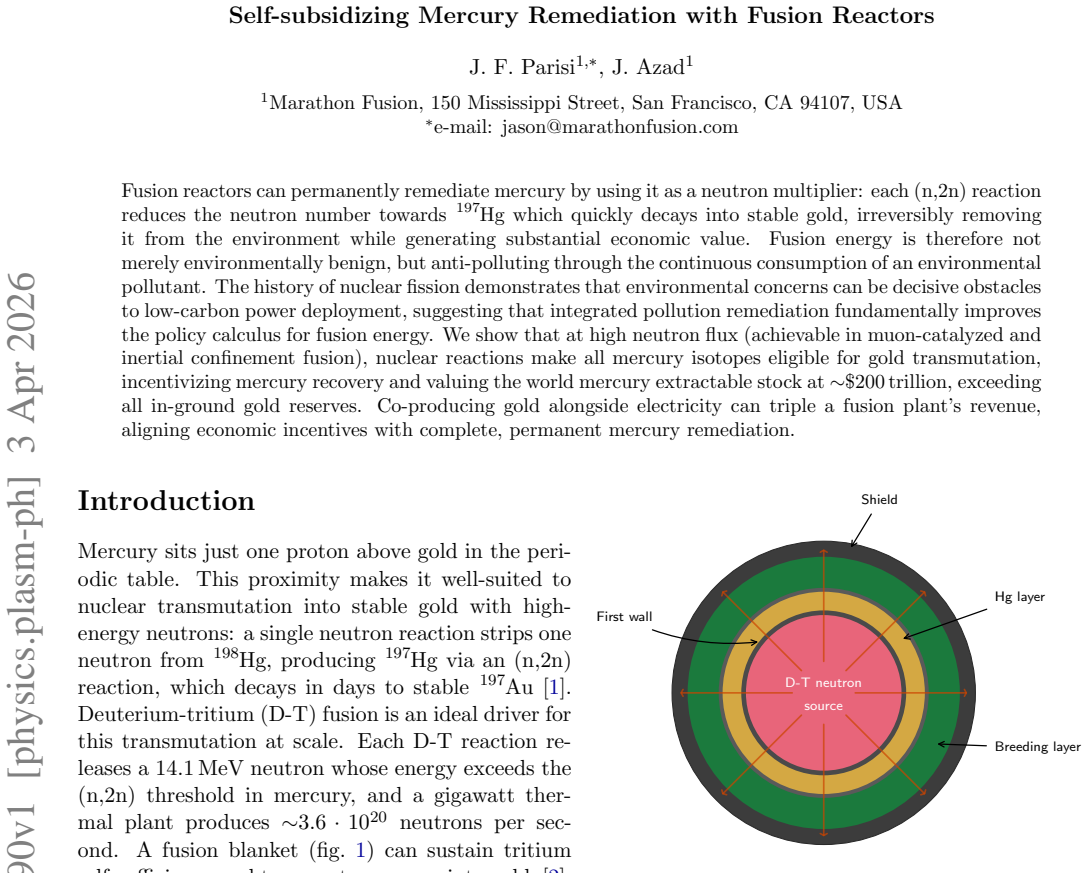
Mercury used as a neutron multiplier in the reactor blanket, where successive (n,2n) reactions drive transmutation of all its isotopes into gold-197.
Load-bearing premise
High neutron fluxes reachable in muon-catalyzed or inertial confinement fusion allow every mercury isotope to undergo the reactions needed for complete conversion to gold.
What would settle it
A measurement or simulation of neutron reaction rates on all mercury isotopes under the neutron spectra and fluxes expected in muon-catalyzed or inertial confinement fusion that shows whether non-dominant isotopes reach gold at practical yields.
Figures


read the original abstract
Fusion reactors can permanently remediate mercury by using it as a neutron multiplier: each (n,2n) reaction reduces the neutron number towards ${}^{197}$Hg which quickly decays into stable gold, irreversibly removing it from the environment while generating substantial economic value. Fusion energy is therefore not merely environmentally benign, but anti-polluting through the continuous consumption of an environmental pollutant. The history of nuclear fission demonstrates that environmental concerns can be decisive obstacles to low-carbon power deployment, suggesting that integrated pollution remediation fundamentally improves the policy calculus for fusion energy. We show that at high neutron flux (achievable in muon-catalyzed and inertial confinement fusion), nuclear reactions make all mercury isotopes eligible for gold transmutation, incentivizing mercury recovery and valuing the world mercury extractable stock at ${\sim}\$200$ trillion, exceeding all in-ground gold reserves. Co-producing gold alongside electricity can triple a fusion plant's revenue, aligning economic incentives with complete, permanent mercury remediation.
Editorial analysis
A structured set of objections, weighed in public.
Referee Report
Summary. The paper claims that fusion reactors can permanently remediate mercury pollution by using it as a neutron multiplier in (n,2n) reactions that reduce mercury isotopes toward 197Hg, which decays to stable 197Au. It asserts that high neutron fluxes achievable in muon-catalyzed and inertial confinement fusion make all natural mercury isotopes (196–204) eligible for this transmutation, valuing the global extractable mercury stock at ~$200 trillion (exceeding gold reserves) and enabling gold co-production that triples fusion plant revenue, thereby aligning economic incentives with complete mercury remediation.
Significance. If the nuclear-physics premise holds, the work would establish a direct economic mechanism linking fusion deployment to irreversible environmental remediation of a major pollutant, potentially transforming the policy case for fusion by turning an environmental liability into a revenue stream. This framing could accelerate fusion adoption beyond electricity generation alone.
major comments (2)
- Abstract: the central claim that 'at high neutron flux (achievable in muon-catalyzed and inertial confinement fusion), nuclear reactions make all mercury isotopes eligible for gold transmutation' is unsupported by any reaction-rate integrals, evaluated cross sections, Monte-Carlo transport results, or residence-time estimates under a 14 MeV spectrum. This premise is load-bearing for both the $200 T valuation and the revenue-tripling arithmetic.
- Abstract: the ~$200 trillion mercury-stock valuation and the claim that gold co-production 'can triple a fusion plant's revenue' rest on unstated assumptions about gold prices, extractable mercury quantities, and overall transmutation efficiencies, with no quantitative economic model, sensitivity analysis, or external benchmarks supplied.
minor comments (1)
- The manuscript would benefit from explicit references to nuclear data libraries (ENDF/B, JEFF, etc.) and at least one illustrative isotopic reaction chain or flux-threshold calculation to ground the transmutation feasibility.
Simulated Author's Rebuttal
We thank the referee for the constructive and detailed review. The comments correctly identify that the original manuscript presented the nuclear and economic claims at a conceptual level without sufficient quantitative backing. We have revised the manuscript to incorporate supporting calculations and a basic economic model, as detailed in the point-by-point responses below.
read point-by-point responses
-
Referee: Abstract: the central claim that 'at high neutron flux (achievable in muon-catalyzed and inertial confinement fusion), nuclear reactions make all mercury isotopes eligible for gold transmutation' is unsupported by any reaction-rate integrals, evaluated cross sections, Monte-Carlo transport results, or residence-time estimates under a 14 MeV spectrum. This premise is load-bearing for both the $200 T valuation and the revenue-tripling arithmetic.
Authors: We agree that the original version lacked explicit reaction-rate calculations. The manuscript was intended as a high-level policy and economic framing that assumes standard (n,2n) cross sections for mercury. In revision we have added a dedicated subsection that evaluates 14 MeV (n,2n) cross sections from ENDF/B-VIII.0 for all natural Hg isotopes, computes approximate reaction rates at fluxes characteristic of ICF and muon-catalyzed fusion, and provides order-of-magnitude residence-time estimates (days to weeks) under continuous irradiation. These additions directly support the eligibility claim without changing the overall conclusions. revision: yes
-
Referee: Abstract: the ~$200 trillion mercury-stock valuation and the claim that gold co-production 'can triple a fusion plant's revenue' rest on unstated assumptions about gold prices, extractable mercury quantities, and overall transmutation efficiencies, with no quantitative economic model, sensitivity analysis, or external benchmarks supplied.
Authors: The valuation and revenue-tripling statements were based on approximate global mercury resources and prevailing gold prices but were presented without a formal model. We have expanded the economic discussion to include a simple quantitative framework that incorporates transmutation efficiency (70–100 %), gold-price sensitivity, and plant revenue benchmarks drawn from recent fusion cost studies. The revised text shows that gold co-production can more than double plant revenue even at conservative efficiencies, with the tripling figure retained only as an upper-bound scenario under high-efficiency assumptions. revision: yes
Circularity Check
No significant circularity detected
full rationale
The paper asserts that high-flux fusion neutrons enable transmutation of all mercury isotopes to gold via (n,2n) reactions and derives economic valuations and revenue-tripling projections from that premise. No equations, fitted parameters, or self-citations are shown that reduce any prediction back to the inputs by construction. The nuclear eligibility claim and the $200T valuation are presented as downstream consequences rather than self-defining loops. The derivation chain remains self-contained against external nuclear data and market prices, with no load-bearing self-referential steps.
Axiom & Free-Parameter Ledger
free parameters (2)
- High neutron flux threshold
- Mercury stock valuation
axioms (2)
- domain assumption Mercury functions effectively as a neutron multiplier in fusion reactor designs
- standard math (n,2n) reactions on mercury lead to 197Hg which decays to stable gold
Lean theorems connected to this paper
-
IndisputableMonolith/Cost/FunctionalEquation.leanwashburn_uniqueness_aczel unclear?
unclearRelation between the paper passage and the cited Recognition theorem.
Each stable mercury isotope with mass number A≥198 can reach 197Au via a sequence of (n,2n) reactions followed by electron capture... requiring ns ≡ A−197 successive (n,2n) steps
-
IndisputableMonolith/Foundation/DimensionForcing.leanreality_from_one_distinction unclear?
unclearRelation between the paper passage and the cited Recognition theorem.
VA(ϕ) = 197/A pAu YAu(ϕ) ∏ Γi/(ρ + Γi + λi)
What do these tags mean?
- matches
- The paper's claim is directly supported by a theorem in the formal canon.
- supports
- The theorem supports part of the paper's argument, but the paper may add assumptions or extra steps.
- extends
- The paper goes beyond the formal theorem; the theorem is a base layer rather than the whole result.
- uses
- The paper appears to rely on the theorem as machinery.
- contradicts
- The paper's claim conflicts with a theorem or certificate in the canon.
- unclear
- Pith found a possible connection, but the passage is too broad, indirect, or ambiguous to say the theorem truly supports the claim.
Reference graph
Works this paper leans on
-
[1]
Sherr, R., Bainbridge, K. T. & Anderson, H. L. Transmutation of mercury by fast neutrons. Phys. Rev.60, 473–479 (1941)
work page 1941
-
[2]
Rutkowski, A., Harter, J. & Parisi, J. Scal- able chrysopoeia via (n,2n) reactions driven by deuterium-tritium fusion neutrons.arXiv preprint arXiv:2507.13461(2025)
-
[3]
Parsons, M. B. & Percival, J. B. A brief his- tory of mercury and its environmental impact (2005). 9
work page 2005
-
[4]
Liu, G., Cai, Y., O’Driscoll, N., Feng, X. & Jiang, G. Overview of mercury in the environ- ment.Environmental chemistry and toxicology of mercury1–12 (2012)
work page 2012
-
[5]
Budnik, L. T. & Casteleyn, L. Mercury pollu- tion in modern times and its socio-medical con- sequences.Science of the Total Environment 654, 720–734 (2019)
work page 2019
-
[6]
Government Accountability Office
U.S. Government Accountability Office. Oak ridge mercury cleanup: Opportunities exist to enhance risk management and technology devel- opment. Q&A Report to Congressional Com- mittees GAO-24-107096, U.S. Government Ac- countability Office (2024). URLhttps://www. gao.gov/products/gao-24-107096
work page 2024
-
[7]
Parisi, J. F., Schwartz, J. A., Wurzel, S. E., Rutkowski, A. & Harter, J. Isotope pro- duction in fusion systems.arXiv preprint arXiv:2512.09242(2025)
-
[8]
Schwartz, J. A., Ricks, W., Kolemen, E. & Jenkins, J. D. The value of fusion energy to a decarbonized United States electric grid.Joule 7, 675–699 (2023)
work page 2023
-
[9]
Lindley, B., Roulstone, T., Locatelli, G. & Rooney, M. Can fusion energy be cost- competitive and commercially viable? An anal- ysis of magnetically confined reactors.Energy Policy177, 113511 (2023)
work page 2023
-
[10]
Ponomarev, L. I. Muon-catalyzed fusion.Con- temporary Physics31, 219–247 (1990)
work page 1990
-
[11]
Froelich, P. Muon catalysed fusion chemi- cal confinement of nuclei within the muonic molecule dtµ.Advances in Physics41, 405–508 (1992)
work page 1992
- [12]
-
[13]
Meier, W. R., Dunne, A. M., Kramer, K. J., Reyes, S. & Anklam, T. M. Fusion technology aspects of laser inertial fusion energy (LIFE). Fusion Eng. Des.89, 2489–2492 (2014)
work page 2014
-
[14]
Achievement of target gain larger than unity in an inertial fusion experiment.Phys
Abu-Shawareb, H., Acree, R., Adams, P.et al. Achievement of target gain larger than unity in an inertial fusion experiment.Phys. Rev. Lett. 132, 065102 (2024)
work page 2024
-
[15]
Sverdrup, H. U. & Olafsdottir, A. H. System dy- namics modelling of the global extraction, sup- ply, price, reserves, resources and environmental losses of mercury.Water, Air, & Soil Pollution 231, 439 (2020)
work page 2020
-
[16]
Driscoll, C. T., Mason, R. P., Chan, H. M., Ja- cob, D. J. & Pirrone, N. Mercury as a global pollutant: Sources, pathways, and effects.Env- iron. Sci. Technol.47, 4967–4983 (2013)
work page 2013
-
[17]
Mi- namata convention on mercury.https://www
United Nations Environment Programme. Mi- namata convention on mercury.https://www. mercuryconvention.org(2017). Entered into force 16 August 2017
work page 2017
-
[18]
Kondev, F. G., Wang, M., Huang, W. J., Naimi, S. & Audi, G. The NUBASE2020 evaluation of nuclear physics properties.Chinese Phys. C45, 030001 (2021)
work page 2021
- [19]
-
[20]
Temperley, J. K. Neutron activation cross sec- tions for mercury isotopes at 14.1 MeV.Phys. Rev.178, 1904–1910 (1969)
work page 1904
-
[21]
Al-Abyad, M., Sud´ ar, S., Comsan, M. N. H. & Qaim, S. M. Cross sections and isomeric cross- section ratios in the interactions of fast neu- trons with isotopes of mercury.Phys. Rev. C 73, 064608 (2006)
work page 2006
-
[22]
Shibata, K., Fukahori, T., Chiba, S. & Yama- muro, N. Evaluation of neutron nuclear data for mercury.J. Nucl. Sci. Technol.34, 1171–1177 (1997)
work page 1997
-
[23]
Iwamoto, O.et al.Japanese evaluated nuclear data library version 5: JENDL-5.J. Nucl. Sci. Technol.60, 1–60 (2023)
work page 2023
-
[24]
Brown, D. A.et al.ENDF/B-VIII.0: The 8th major release of the nuclear reaction data li- brary with CIELO-project cross sections, new standards and thermal scattering data.Nucl. Data Sheets148, 1–142 (2018)
work page 2018
-
[25]
U.S. Geological Survey. Mineral commod- ity summaries 2024: Mercury. Tech. Rep., USGS (2024). URLhttps: //pubs.usgs.gov/periodicals/mcs2024/ mcs2024-mercury.pdf. 10
work page 2024
-
[26]
Global mercury: Supply, trade and de- mand
United Nations Environment Programme. Global mercury: Supply, trade and de- mand. Tech. Rep., United Nations En- vironment Programme, Chemicals and Health Branch, Geneva (2017). URL https://www.unep.org/resources/report/ global-mercury-supply-trade-and-demand
work page 2017
-
[27]
LBMA gold price.https://www.lbma.org.uk/ prices-and-data/precious-metal-prices (2026)
London Bullion Market Association. LBMA gold price.https://www.lbma.org.uk/ prices-and-data/precious-metal-prices (2026). Accessed March 2026
work page 2026
-
[28]
Sverdrup, H. U. & Ragnarsdottir, K. V. Natural resources in a planetary perspective.Geochem- ical Perspectives3, 129–341 (2014)
work page 2014
-
[29]
Lamborg, C. H.et al.A global ocean inventory of anthropogenic mercury based on water col- umn measurements.Nature512, 65–68 (2014)
work page 2014
-
[30]
Rudnick, R. L. & Gao, S. Composition of the continental crust. In Holland, H. D. & Turekian, K. K. (eds.)Treatise on Geochemistry, vol. 4, 1–51 (Elsevier, 2014), 2nd edn
work page 2014
- [31]
-
[32]
U.S. Geological Survey. Mineral com- modity summaries 2024: Mercury. Tech. Rep., U.S. Geological Survey (2024). URL https://pubs.usgs.gov/periodicals/ mcs2024/mcs2024-mercury.pdf. Reports Defense Logistics Agency Strategic Materials inventory of 4,436 metric tons at Hawthorne Army Depot, NV
work page 2024
-
[33]
Regulation (EU) 2017/852 on mercury, and repealing Regulation (EC) No 1102/2008
European Parliament and Council of the Eu- ropean Union. Regulation (EU) 2017/852 on mercury, and repealing Regulation (EC) No 1102/2008. Official Journal of the European Union, L 137/1 (2017). URL https://eur-lex.europa.eu/eli/reg/2017/ 852/oj/eng. Mandates temporary storage and permanent disposal of surplus mercury from the chlor-alkali industry
work page 2017
-
[34]
Bateman, H. The solution of a system of dif- ferential equations occurring in the theory of radioactive transformations.Proc. Cambridge Philos. Soc.15, 423–427 (1910)
work page 1910
-
[35]
General solution of Bateman equa- tions for nuclear transmutations.Ann
Cetnar, J. General solution of Bateman equa- tions for nuclear transmutations.Ann. Nucl. Energy33, 640–645 (2006)
work page 2006
-
[36]
Benedict, M., Pigford, T. H. & Levi, H. W. Nuclear Chemical Engineering(McGraw-Hill, 1981), 2nd edn
work page 1981
-
[37]
Love, L. O. Electromagnetic separation of iso- topes at Oak Ridge.Science182, 343–352 (1973)
work page 1973
-
[38]
O’Connor, F. A., Lucey, B. M., Batten, J. A. & Baur, D. G. The financial economics of gold: A survey.Int. Rev. Financ. Anal.41, 186–205 (2015)
work page 2015
-
[39]
Romano, P. K.et al.OpenMC: A state-of-the- art Monte Carlo code for research and devel- opment.Annals of Nuclear Energy82, 90–97 (2015)
work page 2015
-
[40]
Merrill, B. J., Wong, C. P. C., Cadwallader, L. C., Abdou, M. & Morley, N. B. Normal op- eration and maintenance safety lessons from the ITER US PbLi test blanket module program for a US FNSF and DEMO.Fusion Eng. Des.89, 1989–1994 (2014)
work page 1989
-
[41]
A.et al.ARIES-AT safety design and analysis.Fusion Eng
Petti, D. A.et al.ARIES-AT safety design and analysis.Fusion Eng. Des.80, 111–137 (2006)
work page 2006
-
[42]
Dose coefficients for intakes of radionu- clides by workers
International Commission on Radiological Pro- tection. Dose coefficients for intakes of radionu- clides by workers. InICRP Publication 68, vol. 24 (Pergamon Press, 1994)
work page 1994
-
[43]
Self-subsidizing Mercury Remediation with Fusion Reactors
Mughabghab, S. F.Atlas of Neutron Reso- nances: Resonance Parameters and Thermal Cross Sections, Z = 1–100(Elsevier, 2006), 5th edn. 11 Supplementary Information Self-subsidizing Mercury Remediation with Fusion Reactors This Supplementary Information accompanies “Self-subsidizing Mercury Remediation with Fusion Reactors.” Section S1 shows the gold-product...
work page 2006
discussion (0)
Sign in with ORCID, Apple, or X to comment. Anyone can read and Pith papers without signing in.