Goal-Conditioned Neural ODEs with Guaranteed Safety and Stability for Learning-Based All-Pairs Motion Planning
Pith reviewed 2026-05-13 20:13 UTC · model grok-4.3
The pith
Goal-conditioned neural ODEs via bi-Lipschitz maps guarantee global exponential stability and safety for arbitrary motion planning goals.
A machine-rendered reading of the paper's core claim, the machinery that carries it, and where it could break.
Core claim
Smooth goal-conditioned neural ODEs are realized by bi-Lipschitz diffeomorphisms that conjugate an arbitrary goal to the origin of a globally exponentially stable reference system; the resulting closed-loop vector field is therefore globally exponentially stable to the goal and leaves the safe set invariant for every goal location inside the set, with explicit bounds on convergence rate, tracking error, and field magnitude.
What carries the argument
Goal-conditioned neural ODE realized through bi-Lipschitz diffeomorphisms that conjugate the target to a stable origin while preserving safe-set invariance.
If this is right
- Every trajectory starting inside the safe set converges exponentially to its prescribed goal while remaining inside the set.
- The same learned model works for every possible goal without retraining or re-certification.
- Explicit bounds on convergence speed and tracking error can be used to tune performance before deployment.
- Demonstration data can be incorporated directly into the supervised training of the diffeomorphism parameters.
- The method extends the classical single-goal stabilization result to the all-pairs planning setting while retaining certificates.
Where Pith is reading between the lines
- The same construction could be composed with perception pipelines to produce certified end-to-end navigation policies.
- Scaling the bi-Lipschitz parameterization to higher-dimensional or non-Euclidean state spaces would immediately yield certified planners for manipulators or aerial vehicles.
- Hybrid schemes that switch between the learned ODE and a fast local optimizer become feasible once the global certificate is in hand.
- Empirical verification of the derived bounds on real hardware would quantify the conservatism introduced by the diffeomorphism training.
Load-bearing premise
Bi-Lipschitz neural networks can be trained to realize a diffeomorphism that preserves global stability and safe-set invariance for every possible goal inside the safe set.
What would settle it
A single goal location inside the safe set for which any learned trajectory either exits the safe set or fails to converge at the claimed exponential rate.
Figures



read the original abstract
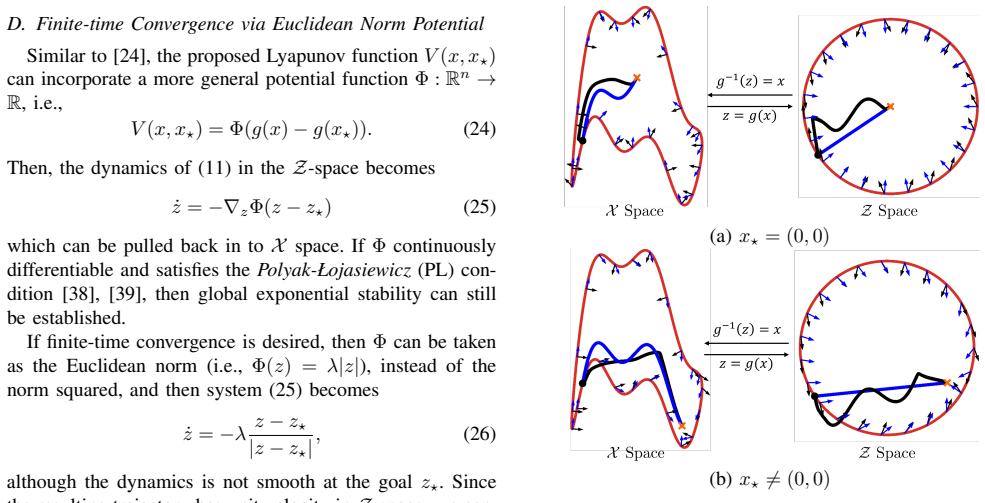
This paper presents a learning-based approach for all-pairs motion planning, where the initial and goal states are allowed to be arbitrary points in a safe set. We construct smooth goal-conditioned neural ordinary differential equations (neural ODEs) via bi-Lipschitz diffeomorphisms. Theoretical results show that the proposed model can provide guarantees of global exponential stability and safety (safe set forward invariance) regardless of goal location. Moreover, explicit bounds on convergence rate, tracking error, and vector field magnitude are established. Our approach admits a tractable learning implementation using bi-Lipschitz neural networks and can incorporate demonstration data. We illustrate the effectiveness of the proposed method on a 2D corridor navigation task.
Editorial analysis
A structured set of objections, weighed in public.
Referee Report
Summary. The manuscript presents a learning-based approach for all-pairs motion planning using goal-conditioned neural ODEs constructed through bi-Lipschitz diffeomorphisms. It claims to deliver theoretical guarantees of global exponential stability and safe set forward invariance independent of the goal location, along with explicit bounds on convergence rate, tracking error, and vector field magnitude. The method supports tractable training with bi-Lipschitz neural networks incorporating demonstration data and is illustrated on a 2D corridor navigation task.
Significance. If the theoretical results are rigorously established and the learned models reliably satisfy the bi-Lipschitz and invariance conditions for arbitrary goals, the work would offer a valuable contribution to safe and stable learning-based control in robotics. The provision of explicit bounds enhances its practical utility for motion planning applications.
major comments (2)
- [Learning implementation and theoretical results sections] The central theoretical claims of global exponential stability and safe-set forward invariance (regardless of goal location) rest on the learned goal-conditioned map being exactly bi-Lipschitz in the state variable for every goal inside the safe set. The learning implementation section provides no mechanism (regularization term, constraint, or post-training verification) that enforces this property uniformly on unseen goals, so any deviation in the learned Jacobian immediately voids the stability and invariance guarantees.
- [Experiments section] The 2-D corridor example is presented only as an illustration; no quantitative evaluation (e.g., measured convergence rates versus the derived bounds, or success rates over a dense sampling of unseen goals) is reported that would confirm the explicit bounds hold in practice.
minor comments (2)
- [Preliminaries] Notation for the safe set and its image under the diffeomorphism should be introduced earlier and used consistently when stating the invariance claim.
- [Experiments] Figure 1 (corridor trajectories) would be clearer if it overlaid the learned vector field and marked the safe-set boundary.
Simulated Author's Rebuttal
We thank the referee for the constructive comments on our manuscript. We address each major comment below and indicate the revisions planned for the next version.
read point-by-point responses
-
Referee: [Learning implementation and theoretical results sections] The central theoretical claims of global exponential stability and safe-set forward invariance (regardless of goal location) rest on the learned goal-conditioned map being exactly bi-Lipschitz in the state variable for every goal inside the safe set. The learning implementation section provides no mechanism (regularization term, constraint, or post-training verification) that enforces this property uniformly on unseen goals, so any deviation in the learned Jacobian immediately voids the stability and invariance guarantees.
Authors: The bi-Lipschitz property is guaranteed by construction through the choice of network architecture (bi-Lipschitz layers whose Lipschitz constants are independent of the goal input). This ensures the property holds for any goal, including unseen ones, without requiring goal-specific regularization. Nevertheless, to strengthen the presentation and address the concern directly, we will add an explicit discussion of the architecture's guarantees together with a post-training verification procedure on sampled unseen goals in the revised manuscript. revision: yes
-
Referee: [Experiments section] The 2-D corridor example is presented only as an illustration; no quantitative evaluation (e.g., measured convergence rates versus the derived bounds, or success rates over a dense sampling of unseen goals) is reported that would confirm the explicit bounds hold in practice.
Authors: We agree that quantitative evaluation would better demonstrate the practical validity of the bounds. In the revised manuscript we will augment the experiments section with measured convergence rates compared against the derived theoretical bounds, tracking-error statistics, and success rates evaluated over a dense sampling of unseen goal locations inside the safe set. revision: yes
Circularity Check
No significant circularity: guarantees derived from bi-Lipschitz properties, not from fitted data or self-citations.
full rationale
The paper constructs goal-conditioned neural ODEs via bi-Lipschitz diffeomorphisms and states that theoretical results then establish global exponential stability and safe-set invariance for arbitrary goals. These guarantees follow directly from the mathematical properties of bi-Lipschitz maps (pullback of a stable vector field and forward invariance) rather than from any data-fitted parameter or self-referential definition. No equations reduce a claimed prediction to an input by construction, no load-bearing self-citation chain is invoked for uniqueness, and the learning step is presented only as a tractable implementation that incorporates demonstrations while preserving the prior theoretical properties. The derivation chain is therefore self-contained against external mathematical benchmarks.
Axiom & Free-Parameter Ledger
axioms (2)
- standard math Bi-Lipschitz diffeomorphisms are smooth, invertible, and induce bounded distortion of distances and vector fields.
- domain assumption Bi-Lipschitz neural networks can be trained to approximate the vector field of a goal-conditioned dynamical system while retaining the bi-Lipschitz property.
Lean theorems connected to this paper
-
IndisputableMonolith/Foundation/RealityFromDistinction.leanreality_from_one_distinction unclear?
unclearRelation between the paper passage and the cited Recognition theorem.
We construct smooth goal-conditioned neural ordinary differential equations (neural ODEs) via bi-Lipschitz diffeomorphisms. ... natural gradient flow ... globally equilibrium-independent exponentially stable
-
IndisputableMonolith/Cost/FunctionalEquation.leanwashburn_uniqueness_aczel unclear?
unclearRelation between the paper passage and the cited Recognition theorem.
bi-Lipschitz neural networks ... explicit bounds on convergence rate, tracking error, and vector field magnitude
What do these tags mean?
- matches
- The paper's claim is directly supported by a theorem in the formal canon.
- supports
- The theorem supports part of the paper's argument, but the paper may add assumptions or extra steps.
- extends
- The paper goes beyond the formal theorem; the theorem is a base layer rather than the whole result.
- uses
- The paper appears to rely on the theorem as machinery.
- contradicts
- The paper's claim conflicts with a theorem or certificate in the canon.
- unclear
- Pith found a possible connection, but the passage is too broad, indirect, or ambiguous to say the theorem truly supports the claim.
Reference graph
Works this paper leans on
-
[1]
Prob- abilistic roadmaps for path planning in high-dimensional configuration spaces,
L. E. Kavraki, P. Svestka, J.-C. Latombe, and M. H. Overmars, “Prob- abilistic roadmaps for path planning in high-dimensional configuration spaces,”IEEE Transactions on Robotics and Automation, vol. 12, no. 4, pp. 566–580, 2002
work page 2002
-
[2]
Rapidly-exploring random trees : a new tool for path planning,
S. M. LaValle, “Rapidly-exploring random trees : a new tool for path planning,”The Annual Research Report, 1998
work page 1998
-
[3]
S. M. LaValle,Planning Algorithms. Cambridge university press, 2006
work page 2006
-
[4]
Recent advances in robot learning from demonstration,
H. Ravichandar, A. S. Polydoros, S. Chernova, and A. Billard, “Recent advances in robot learning from demonstration,”Annual Review of Control, Robotics, and Autonomous Systems, vol. 3, no. 1, pp. 297– 330, 2020
work page 2020
-
[5]
Learning stable nonlinear dynamical systems with Gaussian mixture models,
S. M. Khansari-Zadeh and A. Billard, “Learning stable nonlinear dynamical systems with Gaussian mixture models,”IEEE Transactions on Robotics, vol. 27, no. 5, pp. 943–957, 2011
work page 2011
-
[6]
A. Billard, S. S. Mirrazavi Salehian, and N. Figueroa,Learning for Adaptive and Reactive Robot Control: A Dynamical Systems Approach. Cambridge, USA: MIT Press, 2022
work page 2022
-
[7]
Learning efficient and robust ordinary differential equations via invertible neural networks,
W. Zhi, T. Lai, L. Ott, E. V . Bonilla, and F. Ramos, “Learning efficient and robust ordinary differential equations via invertible neural networks,” inIEEE International Conference on Machine Learning, 2022
work page 2022
-
[8]
Z. Jin, W. Si, A. Liu, W.-A. Zhang, L. Yu, and C. Yang, “Learning a flexible neural energy function with a unique minimum for globally stable and accurate demonstration learning,”IEEE Transactions on Robotics, vol. 39, no. 6, pp. 4520–4538, 2023
work page 2023
-
[9]
Compact oneshot modelling of high dimensional demonstrations using Laplacian eigenmaps,
S. Gupta, A. Nayak, and A. Billard, “Compact oneshot modelling of high dimensional demonstrations using Laplacian eigenmaps,”IEEE Transactions on Robotics, pp. 1–18, 2026
work page 2026
-
[10]
Real-time obstacle avoidance for manipulators and mobile robots,
O. Khatib, “Real-time obstacle avoidance for manipulators and mobile robots,” inIEEE International Conference on Robotics and Automa- tion, vol. 2, pp. 500–505, 1985
work page 1985
-
[11]
Local obstacle avoidance for mobile robots based on the method of artificial potentials,
R. Tilove, “Local obstacle avoidance for mobile robots based on the method of artificial potentials,” inIEEE International Conference on Robotics and Automation, pp. 566–571 vol.1, 1990
work page 1990
-
[12]
Potential field methods and their inher- ent limitations for mobile robot navigation,
Y . Koren and J. Borenstein, “Potential field methods and their inher- ent limitations for mobile robot navigation,” inIEEE International Conference on Robotics and Automation, pp. 1398–1404 vol.2, 1991
work page 1991
-
[13]
Avoidance of concave obsta- cles through rotation of nonlinear dynamics,
L. Huber, J.-J. Slotine, and A. Billard, “Avoidance of concave obsta- cles through rotation of nonlinear dynamics,”IEEE Transactions on Robotics, vol. 40, pp. 1983–2002, 2024
work page 1983
-
[14]
Robot navigation functions on manifolds with boundary,
D. E. Koditschek and E. Rimon, “Robot navigation functions on manifolds with boundary,”Advances in Applied Mathematics, vol. 11, no. 4, pp. 412–442, 1990
work page 1990
-
[15]
The structure of the level surfaces of a Lyapunov function,
F. W. Wilson, “The structure of the level surfaces of a Lyapunov function,”Journal of Differential Equations, vol. 3, no. 3, pp. 323– 329, 1967
work page 1967
-
[16]
Geometrization of 3-manifolds via the Ricci flow,
M. T. Anderson, “Geometrization of 3-manifolds via the Ricci flow,” Notices of the American Mathematical Society, vol. 51, pp. 184–193, 2004
work page 2004
-
[17]
Global linearization of asymptoti- cally stable systems without hyperbolicity,
M. D. Kvalheim and E. D. Sontag, “Global linearization of asymptoti- cally stable systems without hyperbolicity,”Systems & Control Letters, vol. 203, p. 106163, 2025
work page 2025
-
[18]
Monotone, bi- lipschitz, and Polyak-Lojasiewicz networks,
R. Wang, K. D. Dvijotham, and I. Manchester, “Monotone, bi- lipschitz, and Polyak-Lojasiewicz networks,” inIEEE International Conference on Machine Learning, 2024
work page 2024
-
[19]
Learning stable and passive neural differential equations,
J. Cheng, R. Wang, and I. R. Manchester, “Learning stable and passive neural differential equations,”2024 IEEE Conference on Decision and Control, pp. 7859–7864, 2024
work page 2024
-
[20]
Convex optimization in identification of stable non-linear state space models,
M. M. Tobenkin, I. R. Manchester, J. Wang, A. Megretski, and R. Tedrake, “Convex optimization in identification of stable non-linear state space models,” inIEEE Conference on Decision and Control, pp. 7232–7237, IEEE, 2010
work page 2010
-
[21]
M. M. Tobenkin, I. R. Manchester, and A. Megretski, “Convex parameterizations and fidelity bounds for nonlinear identification and reduced-order modelling,”IEEE Transactions on Automatic Control, vol. 62, no. 7, pp. 3679–3686, 2017
work page 2017
-
[22]
Learning robot motions with stable dynamical systems under diffeomorphic transformations,
K. Neumann and J. J. Steil, “Learning robot motions with stable dynamical systems under diffeomorphic transformations,”Robotics and Autonomous Systems, vol. 70, pp. 1–15, 2015
work page 2015
-
[23]
Fast diffeomorphic matching to learn globally asymptotically stable nonlinear dynamical systems,
N. Perrin and P. Schlehuber-Caissier, “Fast diffeomorphic matching to learn globally asymptotically stable nonlinear dynamical systems,” Systems & Control Letters, vol. 96, pp. 51–59, 2016
work page 2016
-
[24]
Euclideanizing flows: Diffeomorphic reduction for learning stable dynamical systems,
M. A. Rana, A. Li, D. Fox, B. Boots, F. Ramos, and N. Ratliff, “Euclideanizing flows: Diffeomorphic reduction for learning stable dynamical systems,” inLearning for Dynamics and Control, pp. 630– 639, PMLR, 2020
work page 2020
-
[25]
Diffeomorphic transforms for generalised imitation learning,
W. Zhi, T. Lai, L. Ott, and F. Ramos, “Diffeomorphic transforms for generalised imitation learning,” inLearning for Dynamics and Control, vol. 168, pp. 508–519, PMLR, 2022
work page 2022
-
[26]
Safe learning in robotics: From learning-based control to safe reinforcement learning,
L. Brunke, M. Greeff, A. W. Hall, Z. Yuan, S. Zhou, J. Panerati, and A. P. Schoellig, “Safe learning in robotics: From learning-based control to safe reinforcement learning,”Annual Review of Control, Robotics, and Autonomous Systems, vol. 5, no. 1, pp. 411–444, 2022
work page 2022
-
[27]
Neural networks in the loop: Learning with stability and robustness guarantees,
I. R. Manchester, R. Wang, and N. H. Barbara, “Neural networks in the loop: Learning with stability and robustness guarantees,”Annual Review of Control, Robotics, and Autonomous Systems, vol. 9, 2026
work page 2026
-
[28]
Learning complex motion plans using neural odes with safety and stability guarantees,
F. Nawaz, T. Li, N. Matni, and N. Figueroa, “Learning complex motion plans using neural odes with safety and stability guarantees,” inIEEE International Conference on Robotics and Automation, pp. 17216– 17222, IEEE, 2024
work page 2024
-
[29]
Converse theorems for certificates of safety and stability,
P. Mestres and J. Cort ´es, “Converse theorems for certificates of safety and stability,”IEEE Transactions on Automatic Control, 2025
work page 2025
-
[30]
Equilibrium-independent passivity: A new definition and numerical certification,
G. H. Hines, M. Arcak, and A. K. Packard, “Equilibrium-independent passivity: A new definition and numerical certification,”Automatica, vol. 47, no. 9, pp. 1949–1956, 2011
work page 1949
-
[31]
W. M. Boothby,An introduction to differentiable manifolds and Riemannian geometry, Revised, vol. 120. Gulf Professional Publishing, 2003
work page 2003
-
[32]
On contraction analysis for non- linear systems,
W. Lohmiller and J. J. E. Slotine, “On contraction analysis for non- linear systems,”Automatica, vol. 34, pp. 683–696, 6 1998
work page 1998
-
[33]
On the equivalence of contraction and koopman approaches for nonlinear stability and control,
B. Yi and I. R. Manchester, “On the equivalence of contraction and koopman approaches for nonlinear stability and control,”IEEE Transactions on Automatic Control, vol. 69, no. 7, pp. 4336–4351, 2023
work page 2023
-
[34]
Beyond convexity—contraction and global convergence of gradient descent,
P. M. Wensing and J.-J. Slotine, “Beyond convexity—contraction and global convergence of gradient descent,”Plos one, vol. 15, no. 8, p. e0236661, 2020
work page 2020
-
[35]
Exact robot navigation in ge- ometrically complicated but topologically simple spaces,
E. Romon and D. E. Koditschek, “Exact robot navigation in ge- ometrically complicated but topologically simple spaces,” inIEEE International Conference on Robotics and Automation, pp. 1937–1942, IEEE, 1990
work page 1937
-
[36]
Control barrier function based quadratic programs for safety critical systems,
A. Ames, X. Xu, J. W. Grizzle, and P. Tabuada, “Control barrier function based quadratic programs for safety critical systems,”IEEE Transactions on Automatic Control, vol. 62, pp. 3861–3876, 2016
work page 2016
-
[37]
¨Uber die lage der integralkurven gew ¨ohnlicher differen- tialgleichungen,
M. Nagumo, “ ¨Uber die lage der integralkurven gew ¨ohnlicher differen- tialgleichungen,”Proceedings of the physico-mathematical society of Japan. 3rd Series, vol. 24, pp. 551–559, 1942
work page 1942
-
[38]
Gradient methods for minimizing functionals (in russian),
B. Polyak, “Gradient methods for minimizing functionals (in russian),” USSR Computational Mathematics and Mathematical Physics, vol. 3, no. 4, pp. 643–653, 1963
work page 1963
-
[39]
A topological property of real analytic subsets,
S. Lojasiewicz, “A topological property of real analytic subsets,”Coll. du CNRS, Les ´equations aux d ´eriv´ees partielles, vol. 117, no. 87-89, p. 2, 1963
work page 1963
-
[40]
Direct parameterization of lipschitz- bounded deep networks,
R. Wang and I. Manchester, “Direct parameterization of lipschitz- bounded deep networks,” inIEEE International Conference on Ma- chine Learning, pp. 36093–36110, PMLR, 2023
work page 2023
-
[41]
Adam: A method for stochastic optimiza- tion,
D. P. Kingma and J. Ba, “Adam: A method for stochastic optimiza- tion,” inIEEE International Conference on Learning Representations, 2015
work page 2015
discussion (0)
Sign in with ORCID, Apple, or X to comment. Anyone can read and Pith papers without signing in.