Mott-Derived Local Moments and Kondo Hybridization in a d-electron Kagome lattice
Pith reviewed 2026-05-13 17:50 UTC · model grok-4.3
The pith
In CsCr6Sb6, Mott splitting of the kagome flat band creates local moments that hybridize with conduction electrons at low temperature, shown by temperature-dependent STS Fano lineshapes near EF and ARPES quasiparticle peaks that vanish together while high-energy humps persist.
A machine-rendered reading of the paper's core claim, the machinery that carries it, and where it could break.
Core claim
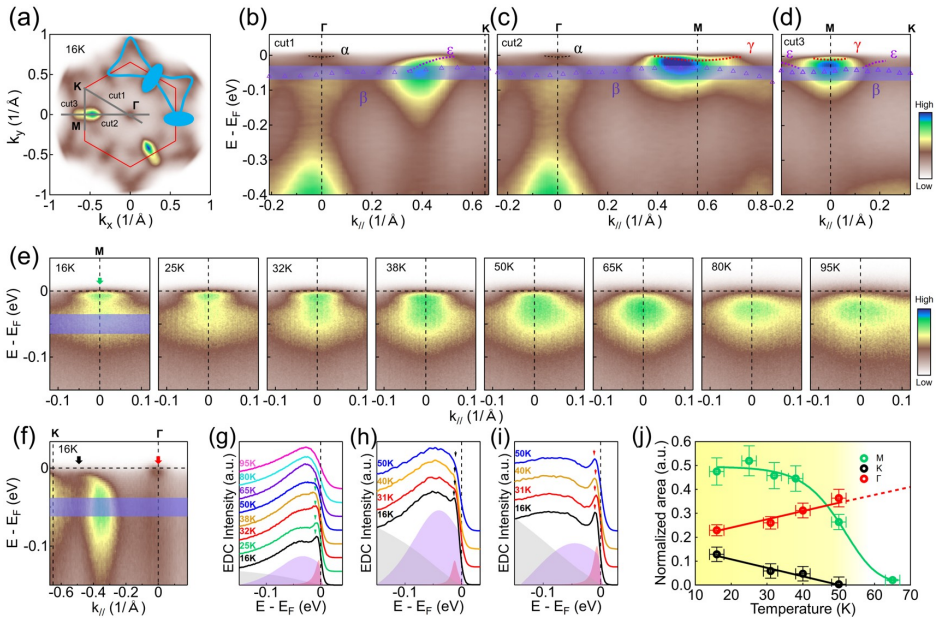
This separation of energy and temperature scales supports a two-stage picture in which a kagome flat band first undergoes correlation-driven splitting into lower and upper Hubbard bands, and the occupied lower Hubbard band supplies the local moments that later hybridize with itinerant electrons at lower temperature.
Load-bearing premise
That the symmetric high-energy humps at ±50 mV are the upper and lower Hubbard bands arising from Mott splitting of the flat band, and that the low-energy asymmetric suppression and quasiparticle peak are produced by Kondo hybridization rather than other many-body or band-structure effects.
Figures



read the original abstract
Unlike canonical Kondo lattices in f-electron systems, where localized f orbitalsnaturally provide local moments, d-electron Kondo lattices require a distinct mechanism for local-moment formation. However, the study of d-electron Kondo lattices in bulk materials remains far from settled, particularly with regard to the microscopic origin of the local moments. Here, we report a microscopic mechanism for this process in the bilayer kagome metal CsCr6Sb6, where strong correlations drive a Mott splitting of the kagome flat band to supply the requisite local moments. By combining STM/STS and ARPES, we resolve a spectroscopic hierarchy between high-energy correlation effects and low temperature hybridization. Low-temperature STS reveals a robust asymmetric suppression of the density of states near EF that is well captured phenomenologically by a Fano-type lineshape, while ARPES detects a sharp quasiparticlepeak near EF. These low-energy signatures evolveon the same temperature scale and disappear upon warming, consistent with the onset of Kondo hybridization. At the same time, STS resolves symmetric humps at approximately +-50 mV and ARPES identifies a weakly dispersive feature around 50 meV below EF; unlike the near-EF hybridization signatures, these features persist to substantially higher temperatures. This separation of energy and temperature scales supports a two-stage picture in which a kagome flat band first undergoes correlation-driven splitting into lower and upper Hubbard bands, and the occupied lower Hubbard band supplies the local moments that later hybridize with itinerant electrons at lower temperature. Our results therefore move beyond the phenomenology of a kagome Kondo lattice candidate and instead provide a microscopic spectroscopic picture linking Mottness to Kondo hybridization in a frustrated d-electron system.
Editorial analysis
A structured set of objections, weighed in public.
Circularity Check
No circularity: experimental spectroscopy interpreted via observed scales
full rationale
The manuscript is an experimental study using STM/STS and ARPES on CsCr6Sb6. It reports measured spectral features (symmetric humps at ±50 mV, low-energy Fano suppression, quasiparticle peak, weakly dispersive ARPES band) and their distinct temperature dependences. The two-stage Mott-then-Kondo interpretation is offered as a consistent reading of the hierarchy of energy and temperature scales, but no equation, fit, or derivation reduces any claimed result to a quantity defined by the same result. No self-citation supplies a load-bearing uniqueness theorem or ansatz; no parameter is fitted to a subset and then relabeled a prediction. The central claim therefore remains an interpretive model open to external theoretical checks rather than a self-referential construction.
Axiom & Free-Parameter Ledger
free parameters (1)
- Fano asymmetry and width parameters
axioms (2)
- domain assumption Symmetric humps at approximately ±50 mV are the upper and lower Hubbard bands from Mott splitting of the kagome flat band.
- domain assumption The low-energy asymmetric suppression and quasiparticle peak arise from Kondo hybridization of the local moments with itinerant electrons.
Lean theorems connected to this paper
-
IndisputableMonolith/Cost/FunctionalEquation.leanwashburn_uniqueness_aczel unclear?
unclearRelation between the paper passage and the cited Recognition theorem.
This separation of energy and temperature scales supports a two-stage picture in which a kagome flat band first undergoes correlation-driven splitting into lower and upper Hubbard bands, and the occupied lower Hubbard band supplies the local moments that later hybridize with itinerant electrons at lower temperature.
-
IndisputableMonolith/Foundation/AlphaCoordinateFixation.leanJ_uniquely_calibrated_via_higher_derivative unclear?
unclearRelation between the paper passage and the cited Recognition theorem.
the robust and ubiquitous temperature-independent ±50 mV humps... with the ARPES data, the hump located at approximately –50 mV can be naturally associated with the β band, which we identify as the LHB
What do these tags mean?
- matches
- The paper's claim is directly supported by a theorem in the formal canon.
- supports
- The theorem supports part of the paper's argument, but the paper may add assumptions or extra steps.
- extends
- The paper goes beyond the formal theorem; the theorem is a base layer rather than the whole result.
- uses
- The paper appears to rely on the theorem as machinery.
- contradicts
- The paper's claim conflicts with a theorem or certificate in the canon.
- unclear
- Pith found a possible connection, but the passage is too broad, indirect, or ambiguous to say the theorem truly supports the claim.
Reference graph
Works this paper leans on
-
[1]
Heavy fermions and the kondo lattice: a 21st century perspective,
P. Coleman, “Heavy fermions and the kondo lattice: a 21st century perspective,” (2015), arXiv:1509.05769 [cond-mat.str-el]
-
[2]
S. Kirchner, S. Paschen, Q. Chen, S. Wirth, D. Feng, J. D. Thompson, and Q. Si, Rev. Mod. Phys. 92, 011002 (2020)
work page 2020
-
[3]
W. Xie, B. Shen, Y. Zhang, C. Guo, J. Xu, X. Lu, and H. Yuan, Acta Physica Sinica 68, 177101 (2019)
work page 2019
-
[4]
S. Raj, Y. Iida, S. Souma, T. Sato, T. Takahashi, H. Ding, S. Ohara, T. Hayakawa, G. F. Chen, I. Sakamoto, and H. Harima, Phys. Rev. B 71, 224516 (2005)
work page 2005
-
[5]
S. Fujimori, A. Fujimori, K. Shimada, T. Narimura, K. Kobayashi, H. Namatame, M. Taniguchi, H. Harima, H. Shishido, S. Ikeda, D. Aoki, Y. Tokiwa, Y. Haga, and Y. Ōnuki, Phys. Rev. B 73, 224517 (2006)
work page 2006
-
[6]
K. Kummer, S. Patil, A. Chikina, M. Güttler, M. Höppner, A. Generalov, S. Danzenbächer, S. Seiro, A. Hannaske, C. Krellner, Y. Kucherenko, M. Shi, M. Radovic, E. Rienks, G. Zwick- nagl, K. Matho, J. W. Allen, C. Laubschat, C. Geibel, and D. V. Vyalikh, Phys. Rev. X 5, 011028 (2015)
work page 2015
-
[7]
W. K. Park, P. H. Tobash, F. Ronning, E. D. Bauer, J. L. Sarrao, J. D. Thompson, and L. H. Greene, Phys. Rev. Lett. 108, 246403 (2012)
work page 2012
-
[8]
W. Zhao, B. Shen, Z. Tao, Z. Han, K. Kang, K. Watanabe, T. Taniguchi, K. F. Mak, and J. Shan, Nature 616, 61 (2023)
work page 2023
-
[9]
K. Fan, H. Jin, B. Huang, G. Duan, R. Yu, Z.-Y. Liu, H.-N. Xia, L.-S. Liu, Y. Zhang, T. Xie, Q.-Y. Tang, G. Chen, W.-H. Zhang, F. C. Chen, X. Luo, W. J. Lu, Y. P. Sun, and Y.-S. Fu, Nature Communications 15, 8797 (2024)
work page 2024
-
[10]
V. Vaňo, M. Amini, S. C. Ganguli, G. Chen, J. L. Lado, S. Kezilebieke, and P. Liljeroth, Nature 599, 582 (2021)
work page 2021
- [11]
-
[12]
Y. Shimizu, H. Takeda, M. Tanaka, M. Itoh, S. Niitaka, and H. Takagi, Nature Communica- tions 3, 981 (2012)
work page 2012
-
[13]
L. Ye, S. Fang, M. Kang, J. Kaufmann, Y. Lee, C. John, P. M. Neves, S. Y. F. Zhao, J. Den- 16 linger, C. Jozwiak, A. Bostwick, E. Rotenberg, E. Kaxiras, D. C. Bell, O. Janson, R. Comin, and J. G. Checkelsky, Nature Physics 20, 610 (2024)
work page 2024
-
[14]
S. S. Zhang, J. Yin, M. Ikhlas, H.-J. Tien, R. Wang, N. Shumiya, G. Chang, S. S. Tsirkin, Y. Shi, C. Yi, Z. Guguchia, H. Li, W. Wang, T. Chang, Z. Wang, Y. Yang, T. Neupert, S. Nakatsuji, and M. Z. Hasan, Phys. Rev. Lett. 125, 046401 (2020)
work page 2020
-
[15]
J. G. Checkelsky, B. A. Bernevig, P. Coleman, Q. Si, and S. Paschen, Nature Reviews Materials 9, 509 (2024)
work page 2024
- [16]
-
[17]
Syôzi, Progress of Theoretical Physics 6, 306 (1951)
I. Syôzi, Progress of Theoretical Physics 6, 306 (1951)
work page 1951
-
[18]
J. Yin, B. Lian, and M. Z. Hasan, Nature 612, 647 (2022)
work page 2022
-
[19]
Y. Wang, H. Wu, G. T. McCandless, J. Y. Chan, and M. N. Ali, Nature Reviews Physics 5, 635 (2023)
work page 2023
-
[20]
B. Song, Y. Xie, W.-J. Li, H. Liu, J. Chen, S. Tian, X. Zhang, Q. Wang, X. Li, H. Lei, Q. Zhang, J.-g. Guo, L. Zhao, S.-L. Yu, X. Zhou, X. Chen, and T. Ying, Nature Communi- cations 16, 5643 (2025)
work page 2025
-
[21]
X. Liu, X. Zhang, J. Jiao, R. Zhang, K. Chen, Y. Wang, Y. Ye, Z. Yu, C. Jiang, X. Wang, L. Shu, B. Lv, G. Li, and Y. Guo, “Emergent dynamical kondo coherence and competing magnetic order in a correlated kagome flat-band metal CsCr 6Sb6,” (2025)
work page 2025
-
[22]
Z. Wang, Y.-X. Jiang, J.-X. Yin, Y. Li, G.-Y. Wang, H.-L. Huang, S. Shao, J. Liu, P. Zhu, N. Shumiya, M. S. Hossain, H. Liu, Y. Shi, J. Duan, X. Li, G. Chang, P. Dai, Z. Ye, G. Xu, Y. Wang, H. Zheng, J. Jia, M. Z. Hasan, and Y. Yao, Phys. Rev. B 104, 075148 (2021)
work page 2021
-
[23]
H. Chen, H. Yang, B. Hu, Z. Zhao, J. Yuan, Y. Xing, G. Qian, Z. Huang, G. Li, Y. Ye, S. Ma, S. Ni, H. Zhang, Q. Yin, C. Gong, Z. Tu, H. Lei, H. Tan, S. Zhou, C. Shen, X. Dong, B. Yan, Z. Wang, and H.-J. Gao, Nature 599, 222 (2021)
work page 2021
- [24]
-
[25]
A. K. Kundu, X. Huang, E. Seewald, E. Ritz, S. Pakhira, S. Zhang, D. Sun, S. Turkel, S. Shabani, T. Yilmaz, E. Vescovo, C. R. Dean, D. C. Johnston, T. Valla, T. Birol, D. N. Basov, R. M. Fernandes, and A. N. Pasupathy, Nature Communications 15, 5008 (2024)
work page 2024
-
[26]
J. Yu, Z. Xu, K. Xiao, Y. Yuan, Q. Yin, Z. Hu, C. Gong, Y. Guo, Z. Tu, P. Tang, H. Lei, Q.-K. Xue, and W. Li, Nano Letters 22, 918 (2022) . 17
work page 2022
- [27]
-
[28]
V. Madhavan, W. Chen, T. Jamneala, M. F. Crommie, N. S. Wingreen, and N. S. Wingreen, Science 280, 567 (1998)
work page 1998
- [29]
-
[30]
A. R. Schmidt, M. H. Hamidian, P. Wahl, F. Meier, A. V. Balatsky, J. D. Garrett, T. J. Williams, G. M. Luke, and J. C. Davis, Nature 465, 570 (2010)
work page 2010
-
[31]
W. Ruan, C. Ye, M. Guo, F. Chen, X. Chen, G.-M. Zhang, and Y. Wang, Phys. Rev. Lett. 112, 136401 (2014)
work page 2014
- [32]
- [33]
- [34]
-
[35]
P. Aynajian, E. H. da Silva Neto, A. Gyenis, R. E. Baumbach, J. D. Thompson, Z. Fisk, and A. Bauer, Eric D. Yazdani, Nature 486, 201 (2012)
work page 2012
-
[36]
K. Nagaoka, T. Jamneala, M. Grobis, and M. F. Crommie, Phys. Rev. Lett. 88, 077205 (2002)
work page 2002
-
[37]
C. Chen, J. Zheng, Y. He, X. Ying, S. Sankar, L. Li, Y. Wei, X. Dai, H. C. Po, and B. Jäck, arXiv preprint arXiv:2409.06933 (2024), 10.48550/arXiv.2409.06933 , arXiv:2409.06933 [cond- mat.str-el]
-
[38]
T. Qin, X. Wang, J. Wang, X. Li, S. You, Z. Wang, J. Zhu, F. Liu, L. Chi, and M. Pan, National Science Review , nwaf574 (2025) , https://academic.oup.com/nsr/advance-article- pdf/doi/10.1093/nsr/nwaf574/65883440/nwaf574.pdf
-
[39]
Y. Hu, X. X. Wu, B. R. Ortiz, S. L. Ju, X. L. Han, J. Z. Ma, N. C. Plumb, M. Radovic, R. Thomale, S. D. Wilson, A. P. Schnyder, and M. Shi, Nature Communications 13, 2220 (2022)
work page 2022
-
[40]
Y. Hu, A. P. Wu, Xianxin Schnyder, and M. Shi, npj Quantum Materials 8, 37 (2023)
work page 2023
-
[41]
A. C. Hewson, The Kondo Problem to Heavy Fermions , Cambridge Studies in Magnetism (Cambridge University Press, 1993). 18
work page 1993
-
[42]
Q. C. Yun Zhang, Shiyong Tan, Physics 49, 611 (2020)
work page 2020
- [43]
-
[44]
Q. Y. Chen, D. F. Xu, X. H. Niu, J. Jiang, R. Peng, H. C. Xu, C. H. P. Wen, Z. F. Ding, K. Huang, L. Shu, Y. J. Zhang, H. Lee, V. N. Strocov, M. Shi, F. Bisti, T. Schmitt, Y. B. Huang, P. Dudin, X. C. Lai, S. Kirchner, H. Q. Yuan, and D. L. Feng, Phys. Rev. B 96, 045107 (2017)
work page 2017
-
[45]
Q. Y. Chen, X. B. Luo, D. H. Xie, M. L. Li, X. Y. Ji, R. Zhou, Y. B. Huang, W. Zhang, W. Feng, Y. Zhang, L. Huang, Q. Q. Hao, Q. Liu, X. G. Zhu, Y. Liu, P. Zhang, X. C. Lai, Q. Si, and S. Y. Tan, Phys. Rev. Lett. 123, 106402 (2019)
work page 2019
- [46]
-
[47]
Q. Y. Chen, D. F. Xu, X. H. Niu, R. Peng, H. C. Xu, C. H. P. Wen, X. Liu, L. Shu, S. Y. Tan, X. C. Lai, Y. J. Zhang, H. Lee, V. N. Strocov, F. Bisti, P. Dudin, J.-X. Zhu, H. Q. Yuan, S. Kirchner, and D. L. Feng, Phys. Rev. Lett. 120, 066403 (2018)
work page 2018
-
[48]
A. Damascelli, Z. Hussain, and Z.-X. Shen, Rev. Mod. Phys. 75, 473 (2003)
work page 2003
-
[49]
S. Gao, S. Zhang, C. Wang, S. Yan, X. Han, X. Ji, W. Tao, J. Liu, T. Wang, S. Yuan, G. Qu, Z. Chen, Y. Zhang, J. Huang, M. Pan, S. Peng, Y. Hu, H. Li, Y. Huang, H. Zhou, S. Meng, L. Yang, Z. Wang, Y. Yao, Z. Chen, M. Shi, H. Ding, H. Yang, K. Jiang, Y. Li, H. Lei, Y. Shi, H. Weng, and T. Qian, Phys. Rev. X 13, 041049 (2023)
work page 2023
-
[50]
Brandow, Advances in Physics 26, 651 (1977), https://doi.org/10.1080/00018737700101443
B. Brandow, Advances in Physics 26, 651 (1977), https://doi.org/10.1080/00018737700101443
- [51]
-
[52]
A. O. Fumega and J. L. Lado, Nano Letters 24, 4272 (2024)
work page 2024
-
[53]
I. Giannakis, J. Leshen, M. Kavai, S. Ran, C. J. Kang, S. R. Saha, Y. Zhao, Z. Xu, J. W. Lynn, L. Miao, L. A. Wray, G. Kotliar, N. P. Butch, and P. Aynajian, Science Advances 5, eaaw9061 (2019)
work page 2019
-
[54]
G. Liu, G. Wang, Y. Zhu, H. Zhang, G. Zhang, X. Wang, Y. Zhou, W. Zhang, H. Liu, L. Zhao, J. Meng, X. Dong, C. Chen, Z. Xu, and X. J. Zhou, Review of Scientific Instruments 79, 023105 (2008)
work page 2008
-
[55]
T. Miao, Y. Xu, B. Liang, W. Zhu, N. Cai, M. Xu, D. Wu, H. Gu, W. Mao, S. Zhang, F. Zhang, F. Yang, Z. Wang, Q. Peng, Z. Xu, Z. Zhu, X. Li, H. Mao, L. Zhao, G. Liu, and 19 X. J. Zhou, Review of Scientific Instruments 97, 033908 (2026). 20 FIG. 1. Crystal structure and transport properties of CsCr 6Sb6. (a) Side view of the crystal structure. The green and...
work page 2026
-
[56]
Ubiquity of the gap feature and ±50 mV humps in CsCr 6Sb6 single crystals To verify the reproducibility of the gap feature and the ±50 mV humps, we performed STM/STS measurements using different instruments and tip calibration procedures (see Methods). As shown in Fig. S1, sample 1 was measured with a PtIr tip calibrated on an Ag(111) with a Unisoku USM-1...
-
[57]
Temperature-evolution of the electronic structure probed by STS and ARPES Key manifestations of Kondo hybridization in this system are reflected in the tempera- ture evolution of the electronic structure, which are consistently observed across independent experiments, as illustrated in Fig. S7 and Fig. S9. As shown in Fig. S7, the tunneling spec- tra on S...
discussion (0)
Sign in with ORCID, Apple, or X to comment. Anyone can read and Pith papers without signing in.