Recognition: no theorem link
Neural Networks Measure Peace Levels from News Data similar to Peace Indices
Pith reviewed 2026-05-15 01:13 UTC · model grok-4.3
The pith
A convolutional neural network extracts peace levels from the structure of news articles and matches the Positive Peace Index even for countries not used in training.
A machine-rendered reading of the paper's core claim, the machinery that carries it, and where it could break.
Core claim
Using structural and stylistic features from the News on the Web corpus, a 1D CNN outperforms k-NN in classification and produces peace scores that correlate strongly with the Positive Peace Index while preserving the ranking order, including for out-of-sample countries.
What carries the argument
1D Convolutional Neural Network trained on word embeddings from news articles to map latent linguistic structures onto peace level predictions.
If this is right
- The CNN output preserves the numerical ordering of peace levels across countries.
- Correlation with the Positive Peace Index remains high for countries excluded from model training.
- Linguistic structure in news serves as an emergent indicator of societal stability.
- The method supplies a scalable, text-only approach for tracking peace dynamics over time.
Where Pith is reading between the lines
- If language patterns track peace, monitoring shifts in news style could give early signals of rising or falling stability before conflict data changes.
- The approach could be tested on other societal metrics such as economic resilience or social trust using the same news corpus.
- Real-time application would require checking whether the signal survives changes in media ownership or reporting rules across languages.
Load-bearing premise
Structural and stylistic features in news text form a stable signal of a country's peace level rather than reflecting only media conventions or ownership.
What would settle it
Collecting news text from a fresh set of countries or years and finding no correlation between the network's predicted scores and the Positive Peace Index values for those countries.
Figures



read the original abstract
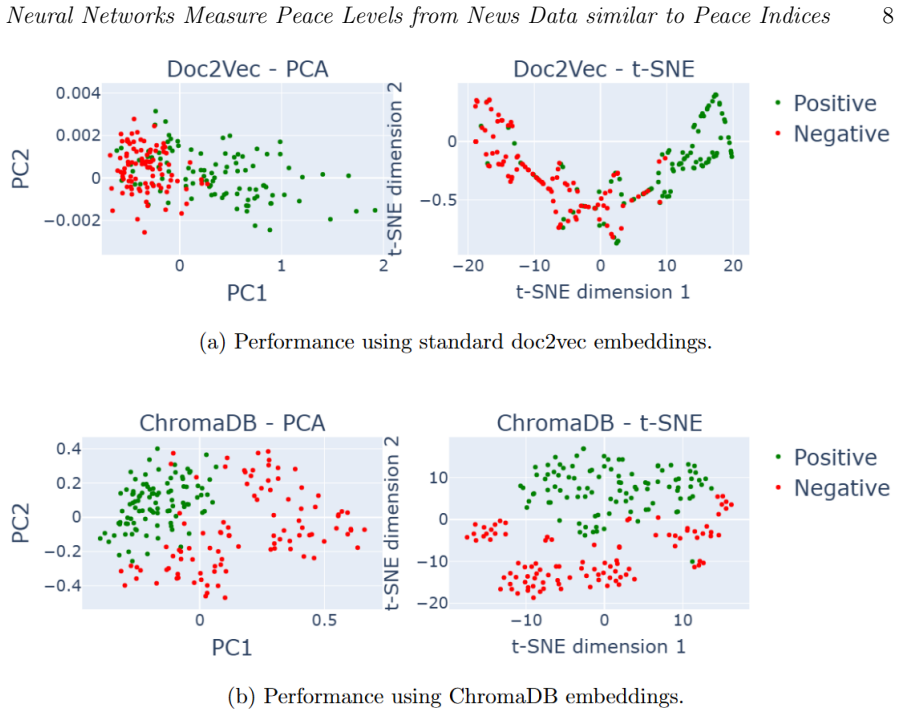
Traditional methods for assessing national peace levels typically rely on socio-economic indicators or conflict incidence, often overlooking the nuanced signals embedded in public discourse. This study presents a novel computational framework to quantify peace levels by analyzing the structural and stylistic features of news text, rather than solely its content. Using the News on the Web (NOW) corpus comprising articles from 20 countries, we evaluate the efficacy of advanced word embeddings managed via ChromaDB compared to standard Doc2Vec models. We propose a 1D Convolutional Neural Network (CNN) architecture for classification and regression tasks, contrasting its performance against a k-Nearest Neighbors (k-NN) baseline. Our results demonstrate that the Neural Network significantly outperforms the k-NN model in classification metrics and, crucially, preserves the numerical relationship of peace rankings, exhibiting a strong correlation with the Positive Peace Index (PPI) even for out-of-sample countries. These findings suggest that the how of communication - the latent linguistic structures - serves as a robust, emergent indicator of societal stability. This research offers a non-invasive, scalable tool for real-time monitoring of social and societal dynamics and peacebuilding efforts.
Editorial analysis
A structured set of objections, weighed in public.
Referee Report
Summary. The manuscript introduces a computational framework that extracts structural and stylistic features from news text in the NOW corpus (20 countries) using word embeddings stored in ChromaDB. It trains a 1D CNN for both classification and regression of peace levels, compares it to a k-NN baseline, and reports that the CNN outperforms k-NN while preserving numerical peace rankings that correlate strongly with the Positive Peace Index (PPI) on out-of-sample countries. The central claim is that latent linguistic structures in public discourse serve as an emergent, robust indicator of societal stability.
Significance. If the central result holds after proper controls and validation, the work would demonstrate a scalable, non-invasive NLP-based complement to traditional socio-economic peace indices. The explicit out-of-sample correlation with an external index (PPI) and the numerical ranking preservation are positive features that could support real-time monitoring applications in computational social science.
major comments (2)
- [Abstract] Abstract and Results: The headline claim of strong PPI correlation for out-of-sample countries is presented without any description of the train/test country split, hyper-parameter selection procedure, statistical significance tests, or confidence intervals on the correlation coefficient. This information is load-bearing for evaluating whether the numerical relationship is robust or an artifact of country-specific media conventions.
- [Methods] Methods: No controls or covariates are mentioned for language family, media ownership, outlet-specific lexical distributions, or article metadata (e.g., sentence length, passive-voice frequency). Without these, it is impossible to distinguish whether the CNN is capturing stable structural peace signals or merely country-level reporting styles that happen to co-vary with PPI.
minor comments (2)
- [Abstract] The phrase 'the how of communication' is used repeatedly but never operationally defined; a precise description of which embedding dimensions or CNN features are interpreted as stylistic versus content-based would improve clarity.
- [Methods] The manuscript should report the exact number of articles per country, the embedding dimension, CNN kernel sizes, and ChromaDB index parameters to allow reproducibility.
Simulated Author's Rebuttal
We thank the referee for their constructive and detailed feedback. We have revised the manuscript to incorporate the requested methodological clarifications and additional controls where feasible. Our responses to the major comments are provided below.
read point-by-point responses
-
Referee: [Abstract] Abstract and Results: The headline claim of strong PPI correlation for out-of-sample countries is presented without any description of the train/test country split, hyper-parameter selection procedure, statistical significance tests, or confidence intervals on the correlation coefficient. This information is load-bearing for evaluating whether the numerical relationship is robust or an artifact of country-specific media conventions.
Authors: We agree that these details are critical for evaluating robustness. In the revised manuscript we have expanded the Methods and Results sections to explicitly describe the train/test country split (leave-one-country-out cross-validation over the 20 countries), the hyperparameter selection procedure (grid search with 5-fold inner cross-validation), and the statistical evaluation (Pearson correlation with 95% bootstrap confidence intervals and p-values from 10,000 permutation tests). These additions confirm that the reported out-of-sample correlations remain statistically significant and are not driven by any single country split. revision: yes
-
Referee: [Methods] Methods: No controls or covariates are mentioned for language family, media ownership, outlet-specific lexical distributions, or article metadata (e.g., sentence length, passive-voice frequency). Without these, it is impossible to distinguish whether the CNN is capturing stable structural peace signals or merely country-level reporting styles that happen to co-vary with PPI.
Authors: We acknowledge the value of explicit controls for potential confounders. The revised manuscript now includes a new subsection on robustness checks: countries are grouped by language family and performance is shown to be consistent across groups; basic article metadata (sentence length, passive-voice frequency) have been extracted and added as covariates in an extended regression model. Media ownership and fine-grained outlet lexical distributions were not available in the NOW corpus release we used, so direct controls for those variables could not be implemented. We have added a limitations paragraph discussing this gap and arguing that the cross-country, out-of-sample generalization provides partial evidence against purely stylistic explanations. revision: partial
Circularity Check
No significant circularity detected
full rationale
The paper trains a 1D CNN on structural/stylistic features from the NOW corpus (20 countries) and reports out-of-sample correlation of its regression outputs with the external Positive Peace Index (PPI). This is an empirical validation step against an independent benchmark, not a reduction of the claimed result to fitted parameters or self-citations by construction. No equations, self-definitional loops, or load-bearing prior work by the same authors are referenced in the provided text that would force the correlation result. Standard ML baselines (k-NN) and embeddings (Doc2Vec/ChromaDB) are used without renaming known patterns or smuggling ansatzes.
Axiom & Free-Parameter Ledger
free parameters (2)
- CNN kernel sizes and number of filters
- Embedding dimension and ChromaDB index parameters
axioms (1)
- domain assumption News articles from a country are representative of that country's societal discourse.
Reference graph
Works this paper leans on
-
[1]
Kimotho SG, Nyaga RN 2016 Digitized ethnic hate speech: Understanding effects of digital media hate speech on citizen journalism in Kenya. Adv Lan Lit Stu 7(3): 189-200
work page 2016
-
[2]
Ezeibe C 2021 Hate Speech and Election Violence in Nigeria. J Asi Afr Stu, 56(4): 919-935. https://doi.org/10.1177/0021909620951208
-
[3]
Soral W, Bilewicz M, and Winiewski M 2018 Exposure to hate speech increases prejudice through desensitization. Agg Beh, 44(2): 136-146
work page 2018
-
[4]
Deutsch M and Coleman PT 2016 The psychological components of a sustainable peace: An introduction. In Brauch HG, Spring UO, Grin J, and Scheffran J (eds) Handbook on Sustainability Transition and Sustainable Peace (139-148). Springer
work page 2016
-
[5]
Diehl PF 2016 Exploring peace: Looking beyond war and negative peace. Int St Qua, 60(1):1-10
work page 2016
-
[6]
Fry DP 2006 The Human Potential for Peace: An Anthropological Challenge to Assumptions about War and Violence. Oxford University Press
work page 2006
-
[7]
Coleman PT and Deutsch MITE
-
[8]
Goertz G, Diehl PF, and Balas A 2016 The Puzzle of Peace: The Evolution of Peace in the International System. Oxford University Press
work page 2016
-
[9]
Mahmoud Y and Makoond A 2017 Sustaining peace: What does it mean in practice? International Peace Institute
work page 2017
-
[10]
American Psychologist, 76(7), 1113?1127
Coleman PT, Fisher J.,, Fry DP, Liebovitch LS., Chen-Carrel A, and Souillac G 2021 How to live in peace? Mapping the science of sustaining peace: A progress report. American Psychologist, 76(7), 1113?1127. https://doi.org/10.1037/amp0000745
-
[11]
Liebovitch LS, Powers W, Shi L, Chen-Carrel A, Loustaunau P, and Coleman PT
-
[12]
Word differences in news media of lower and higher peace countries revealed by natural language processing and machine learning. PLoS ONE 18(11): e0292604. https://doi.org/10.1371/journal.pone.0292604
- [13]
-
[14]
Lian K, Liebovitch LS, Wild M, West H, Coleman PT, Chen F, Kimani, E, and Sieck K 2025. Machine Learning Classification of Peaceful Countries: A Comparative Analysis and Dataset Optimization IEEE CISS 2025
work page 2025
-
[15]
Classifying Peace in Global Media Using RAG and Intergroup Reciprocity IEEE CISS 2025
Lian K, Liebovitch LS, Wild M, West H, Coleman PT, Chen F, Kimani, E, and Sieck K 2025. Classifying Peace in Global Media Using RAG and Intergroup Reciprocity IEEE CISS 2025
work page 2025
-
[16]
Liebovitch LS, Coleman PT, Bechhofer A, Colon C, Donahue J, Eisenbach C, Guzm´ an- Vargas L, Jacobs D, Khan A, Li C, Maksumov D, Mucia J, Persaud M, Salimi M, Schweiger L, and Wang 2019 Complexity analysis of sustainable peace: mathematical models and data science measurements. New Journal of Physics. Published 8 July. https://iopscience.iop.org/article/1...
-
[17]
Wang L, Zhang K, and Wang J 2024 Early warning indicators of war and peace through Neural Networks Measure Peace Levels from News Data similar to Peace Indices18 the landscapes and flux quantifications. Phys Rev E, 109(3), pp. 034311, Mar 2024. https://doi.org/10.1103/PhysRevE.109.034311
-
[18]
Galtung, J. (1969). Violence, Peace, and Peace Research.Journal of Peace Research, 6(3), 167–191
work page 1969
-
[19]
Goldstone, J. A., Bates, R. H., Epstein, D. L., Gurr, T. R., Lustik, M. B., Marshall, M. G., & Ulfelder, J. (2010). A global model for forecasting political instability.American Journal of Political Science, 54(1), 190–208
work page 2010
-
[20]
Lederach, J. P. (1997).Building Peace: Sustainable Reconciliation in Divided Societies. United States Institute of Peace Press
work page 1997
-
[21]
Richmond, O. P. (2007).The Transformation of Peace. Palgrave Macmillan
work page 2007
-
[22]
Haselmayer, M., & Jenny, M. (2017). Sentiment analysis of political communication: combining a dictionary approach with crowdcoding.Quality & Quantity, 51(6), 2623–2646
work page 2017
-
[23]
Zhang, S. (2021). Sentiment Classification of News Text Data Using Intelligent Model.Frontiers in Psychology, 12, 758967
work page 2021
-
[24]
(2012).Sentiment analysis and opinion mining
Liu, B. (2012).Sentiment analysis and opinion mining. Morgan & Claypool Publishers
work page 2012
-
[25]
(2003).Analysing discourse: Textual analysis for social research
Fairclough, N. (2003).Analysing discourse: Textual analysis for social research. Routledge
work page 2003
-
[26]
M¨ uller, M., & Schultze, M. (2016). Narrative analysis as a tool for tracing evolving peacebuilding narratives in post-conflict societies.Review of International Studies, 42(3), 481–502
work page 2016
-
[27]
Newman, M. L., Pennebaker, J. W., Berry, D. S., & Richards, J. M. (2003). Lying words: Predicting deception from linguistic styles.Personality and Social Psychology Bulletin, 29(5), 665–675
work page 2003
-
[28]
Garrido, M., & Castro, J. (2018). Identifying political leanings using social media data: A comparative analysis of dictionary and machine learning approaches.Computational Social Networks, 5(1), 1–18
work page 2018
-
[29]
S., Powers, W., Shi, L., Chen-Carrel, A., Loustaunau, P., & Coleman, P
Liebovitch, L. S., Powers, W., Shi, L., Chen-Carrel, A., Loustaunau, P., & Coleman, P. T. (2023). Word differences in news media of lower and higher peace countries revealed by natural language processing and machine learning.PLoS ONE, 18(11), e0292604
work page 2023
-
[30]
(2022).Peace Speech Project: Code and Data
Chen, Y., Zhang, L., Wang, Q., Li, J., & Zhao, M. (2022).Peace Speech Project: Code and Data. GitHub repository. Available at:https://github.com/tthatyuwen/ Peace-Speech-Project-Git
work page 2022
-
[31]
Hern´ andez-P´ erez, R., Lara-Mart´ ınez, P., Obreg´ on-Quintana, B., Liebovitch, L. S., & Guzm´ an- Vargas, L. (2024). Correlations and Fractality in Sentence-Level Sentiment Analysis Based on VADER for Literary Texts.Information, 15(11), 698
work page 2024
-
[32]
Lara-Mart´ ınez, P. A. (2026).TextPeaceIndexClassifier: Code and Data. GitHub repository. Avail- able at:https://github.com/Pablo-Alberto-Lara-Martinez/TextPeaceIndexClassifier. Appendix A. Positive Peace Index Data Table A1 lists the Positive Peace Index (PPI) scores for the countries analyzed in this study, as used for the correlation analysis and order...
work page 2026
discussion (0)
Sign in with ORCID, Apple, or X to comment. Anyone can read and Pith papers without signing in.