A critical analysis of main-sequence fitting in open clusters to derive the helium-to-metal enrichment ratio Delta Y/Delta Z
Pith reviewed 2026-05-10 20:15 UTC · model grok-4.3
The pith
Stellar model differences introduce large biases when deriving the helium-to-metal enrichment ratio from open cluster photometry.
A machine-rendered reading of the paper's core claim, the machinery that carries it, and where it could break.
Core claim
Synthetic clusters generated from PARSEC, BASTI, and MIST isochrones and fitted with FRANEC models yield recovered ΔY/ΔZ values that deviate from truth by up to 1.5, with underestimation for PARSEC targets and overestimation for BASTI and MIST; using identical FRANEC models but alternate bolometric corrections still produces biases up to 0.6, while only perfectly matching codes for generation and fitting return unbiased results.
What carries the argument
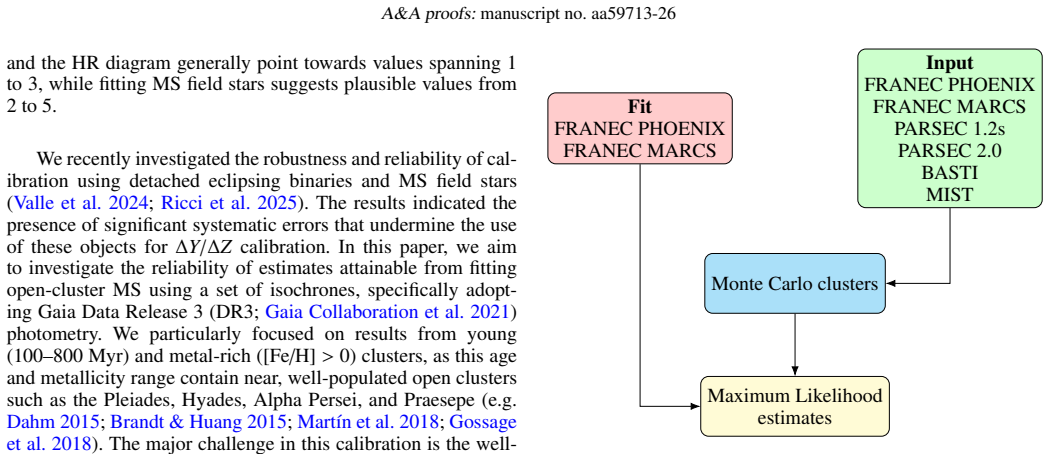
Monte Carlo experiments that generate mock photometric data from multiple stellar evolution codes and recover ΔY/ΔZ by main-sequence fitting in a restricted magnitude window chosen to limit the influence of uncertain physics.
If this is right
- The photometric calibration of ΔY/ΔZ using open clusters is not reliably robust.
- Recovered values depend strongly on which stellar evolution code generates the data and which fits it.
- Unbiased recovery occurs only when the same models are used for both steps.
- Even restricting the fit to a narrow, well-constrained magnitude range does not eliminate the biases.
Where Pith is reading between the lines
- Existing literature values of ΔY/ΔZ derived from cluster photometry may carry unrecognized systematic offsets.
- Models of galactic chemical evolution that adopt cluster-calibrated ratios may require re-examination with independent methods.
- Greater consistency among stellar evolution codes would be needed before photometric fitting can deliver accurate ΔY/ΔZ.
Load-bearing premise
That the differences among the five tested stellar evolution codes adequately sample the full range of possible modeling uncertainties that would affect real open-cluster data.
What would settle it
Independent spectroscopic or asteroseismic measurements of ΔY/ΔZ in the same open clusters that would show whether the photometric fitting results match or exhibit the predicted code-dependent offsets.
Figures


read the original abstract
We aim to investigate the feasibility of accurately determining the helium-to-metal enrichment ratio $\Delta Y/\Delta Z$ for open clusters using Gaia DR3 photometry. To test the reliability of this calibration, we performed a theoretical investigation using mock open clusters. We generated synthetic photometric data from isochrones calculated by five different stellar evolution codes (FRANEC, PARSEC 1.2s, PARSEC 2.0, BASTI, and MIST), for which the true $\Delta Y/\Delta Z$ is known. We then fitted these mock clusters with two sets of isochrones calculated with the FRANEC code, differing only in the implementation of bolometric corrections (BCs). The analysis focused on the G-band absolute magnitude range (4.3 to 6.5 mag) to minimise the impact of poorly constrained physics. Synthetic clusters were generated at [Fe/H] values from 0.0 to 0.15 dex, for different numbers of populating stars and different levels of photometric uncertainties. The Monte Carlo experiments revealed significant and code-dependent biases. Unbiased results were achieved only when the stellar models used for synthetic-cluster generation and fitting were identical. Using identical FRANEC stellar models but different BCs introduced a significant bias of up to 0.6. Furthermore, using different stellar models for synthetic cluster generations resulted in even larger biases: $\Delta Y/\Delta Z$ was underestimated by up to 0.8 for PARSEC target isochrones, while it was overestimated for BASTI and MIST isochrones by up to 0.6 and 1.5, respectively. The magnitude and the inconsistency of these biases strongly suggest that the photometric calibration of $\Delta Y/\Delta Z$ using open clusters is not reliably robust.
Editorial analysis
A structured set of objections, weighed in public.
Referee Report
Summary. The manuscript conducts Monte Carlo experiments on synthetic open clusters generated from isochrones of five stellar evolution codes (FRANEC, PARSEC 1.2s, PARSEC 2.0, BASTI, MIST) with known true ΔY/ΔZ. These mocks, populated at [Fe/H] = 0.0–0.15 dex with varying star counts and photometric errors, are fitted in the G = 4.3–6.5 mag range using FRANEC isochrones (two bolometric-correction variants) to recover ΔY/ΔZ. The study finds unbiased recovery only for identical generating and fitting models; different BC implementations introduce biases up to 0.6, while inter-code mismatches produce biases of −0.8 (PARSEC) to +1.5 (MIST). The authors conclude that these code-dependent biases indicate the photometric calibration of ΔY/ΔZ from open clusters is not reliably robust.
Significance. If the reported inter-code biases are representative of systematic uncertainties in real Gaia DR3 data, the work demonstrates that model choice can dominate the recovered ΔY/ΔZ, limiting the reliability of open-cluster calibrations for helium enrichment and chemical-evolution studies. The controlled forward-simulation design with known truth values and explicit focus on a narrow magnitude range where physics is better constrained provides a clear, falsifiable test of robustness.
major comments (2)
- [Abstract and Results] Abstract and Results section: the claim that the observed biases 'strongly suggest that the photometric calibration of ΔY/ΔZ using open clusters is not reliably robust' is load-bearing for the paper's central conclusion, yet rests on the untested premise that the specific differences among the five chosen codes (FRANEC, PARSEC 1.2s/2.0, BASTI, MIST) adequately proxy the full range of modeling uncertainties (e.g., variations in overshooting, diffusion, or atmospheric boundary conditions) that would appear when fitting actual Gaia DR3 photometry. The manuscript does not demonstrate that other plausible model variations produce similarly large and inconsistent biases.
- [Methods] Methods (mock generation and fitting procedure): all synthetic clusters are fitted exclusively with FRANEC isochrones, so the experiment quantifies only the bias incurred when the fitting code differs from the generating code. It does not test the symmetric case or the bias that would arise if a different code (e.g., PARSEC or MIST) were used for fitting real data, which is the situation encountered in the literature.
minor comments (2)
- [Methods] The manuscript should clarify in the text (not only in the abstract) the exact number of Monte Carlo realizations per configuration and the precise definition of the photometric uncertainty levels applied.
- [Figures] Figure captions and axis labels should explicitly state the bolometric-correction variants used for the FRANEC fitting grid.
Simulated Author's Rebuttal
We thank the referee for the thorough review and constructive comments on our manuscript. We address each major comment below in a point-by-point manner, agreeing where the critique identifies genuine limitations and outlining specific revisions to strengthen the paper.
read point-by-point responses
-
Referee: [Abstract and Results] Abstract and Results section: the claim that the observed biases 'strongly suggest that the photometric calibration of ΔY/ΔZ using open clusters is not reliably robust' is load-bearing for the paper's central conclusion, yet rests on the untested premise that the specific differences among the five chosen codes (FRANEC, PARSEC 1.2s/2.0, BASTI, MIST) adequately proxy the full range of modeling uncertainties (e.g., variations in overshooting, diffusion, or atmospheric boundary conditions) that would appear when fitting actual Gaia DR3 photometry. The manuscript does not demonstrate that other plausible model variations produce similarly large and inconsistent biases.
Authors: We acknowledge that the five codes tested do not exhaustively cover every possible modeling variation, such as arbitrary changes to overshooting efficiency or diffusion coefficients beyond those already implemented differently across the codes. These particular codes were selected because they are among the most commonly employed in the recent literature on open-cluster photometry and provide publicly available isochrones spanning a range of ΔY/ΔZ values. The observed biases of up to 1.5 nevertheless illustrate that even modest differences in the treatment of convection, opacities, and boundary conditions can propagate into large systematic offsets in the recovered enrichment ratio. In the revised manuscript we will qualify the abstract and results language to state that the biases are representative of differences among widely used current models rather than claiming they bound all conceivable uncertainties, and we will add a short discussion paragraph noting specific additional variations (e.g., altered overshooting) that future work could explore. revision: partial
-
Referee: [Methods] Methods (mock generation and fitting procedure): all synthetic clusters are fitted exclusively with FRANEC isochrones, so the experiment quantifies only the bias incurred when the fitting code differs from the generating code. It does not test the symmetric case or the bias that would arise if a different code (e.g., PARSEC or MIST) were used for fitting real data, which is the situation encountered in the literature.
Authors: The referee is correct that the fitting procedure is fixed to FRANEC isochrones (with two BC variants). This design isolates the effect of model mismatch under the realistic scenario in which an observer adopts one fitting grid. The key result—that unbiased recovery occurs only when generating and fitting models are identical—directly implies that any mismatch, regardless of which code is chosen for fitting, will introduce bias. We did not perform the computationally heavier symmetric experiment of fitting each mock set with every other code. In the revised Methods section we will explicitly justify the single-fitting-code choice and add a paragraph discussing how the reported biases would affect literature analyses that employ PARSEC, MIST or BASTI for fitting real Gaia data. revision: partial
Circularity Check
No significant circularity in forward simulation bias test
full rationale
The paper conducts a Monte Carlo simulation study: synthetic clusters are generated from five independent stellar evolution codes (FRANEC, PARSEC, BASTI, MIST) with known true ΔY/ΔZ, then fitted exclusively with FRANEC isochrones (two BC variants) over a restricted magnitude range. Recovered ΔY/ΔZ values are compared directly to the input true values, exposing code-dependent biases only when generation and fitting models differ. This is a forward test against external model outputs with no fitted parameter renamed as prediction, no self-definitional loop, and no load-bearing self-citation chain. The central claim follows from the observed mismatches rather than reducing to the inputs by construction.
Axiom & Free-Parameter Ledger
axioms (1)
- domain assumption Differences among FRANEC, PARSEC 1.2s, PARSEC 2.0, BASTI, and MIST adequately represent the range of stellar-model uncertainties relevant to main-sequence fitting.
Reference graph
Works this paper leans on
-
[1]
2007, Encyclopedia of Measurement and Statistics, ed
Abdi, H. 2007, Encyclopedia of Measurement and Statistics, ed. C. S. N. Salkind (Sage, Thousand Oaks, CA), 103–107
work page 2007
-
[2]
2011, in Astronomical Society of the Pa- cific Conference Series, V ol
Allard, F., Homeier, D., & Freytag, B. 2011, in Astronomical Society of the Pa- cific Conference Series, V ol. 448, 16th Cambridge Workshop on Cool Stars, Stellar Systems, and the Sun, ed. C. Johns-Krull, M. K. Browning, & A. A. West, 91
work page 2011
-
[3]
Allard, F., Homeier, D., Freytag, B., & Sharp, C. M. 2012, in EAS Publications
work page 2012
-
[4]
An, D., Terndrup, D. M., Pinsonneault, M. H., et al. 2007, ApJ, 655, 233
work page 2007
-
[5]
Asplund, M., Grevesse, N., Sauval, A. J., & Scott, P. 2009, ARA&A, 47, 481
work page 2009
-
[6]
Bahcall, J. N., Pinsonneault, M. H., & Wasserburg, G. J. 1995, Reviews of Mod- ern Physics, 67, 781
work page 1995
-
[7]
Brandner, W., Sorg, A., Röser, S., & Schilbach, E. 2024, AJ, 168, 282
work page 2024
-
[8]
Brandt, T. D. & Huang, C. X. 2015, ApJ, 807, 24
work page 2015
-
[9]
Bressan, A., Marigo, P., Girardi, L., et al. 2012, MNRAS, 427, 127
work page 2012
- [10]
- [11]
-
[12]
Casagrande, L., Flynn, C., Portinari, L., Girardi, L., & Jimenez, R. 2007, MN- RAS, 382, 1516
work page 2007
-
[13]
Castellani, V ., degl’Innocenti, S., & Marconi, M. 1999, A&A, 349, 834
work page 1999
-
[14]
Castelli, F. & Kurucz, R. L. 2003, in IAU Symposium, V ol. 210, Modelling of Stellar Atmospheres, ed. N. Piskunov, W. W. Weiss, & D. F. Gray, A20
work page 2003
-
[15]
Chaboyer, B., Fenton, W. H., Nelan, J. E., Patnaude, D. J., & Simon, F. E. 2001, ApJ, 562, 521
work page 2001
- [16]
- [17]
- [18]
-
[19]
Conroy, C., Villaume, A., van Dokkum, P. G., & Lind, K. 2018, ApJ, 854, 139
work page 2018
-
[20]
Dahm, S. E. 2015, ApJ, 813, 108 de Marchi, G. & Pulone, L. 2007, A&A, 467, 107 Dell’Omodarme, M., Valle, G., Degl’Innocenti, S., & Prada Moroni, P. G. 2012, A&A, 540, A26 D’Odorico, S., Peimbert, M., & Sabbadin, F. 1976, A&A, 47, 341
work page 2015
-
[21]
Fernandes, J., Vaz, A. I. F., & Vicente, L. N. 2012, MNRAS, 425, 3104
work page 2012
-
[22]
Fukugita, M. & Kawasaki, M. 2006, ApJ, 646, 691 Gaia Collaboration, Brown, A. G. A., Vallenari, A., et al. 2021, A&A, 649, A1
work page 2006
-
[23]
Gennaro, M., Prada Moroni, P. G., & Degl’Innocenti, S. 2010, A&A, 518, A13+
work page 2010
- [24]
-
[25]
Gustafsson, B., Edvardsson, B., Eriksson, K., et al. 2008, A&A, 486, 951
work page 2008
-
[26]
L., Pietrinferni, A., Cassisi, S., et al
Hidalgo, S. L., Pietrinferni, A., Cassisi, S., et al. 2018, ApJ, 856, 125
work page 2018
-
[27]
Jimenez, R., Flynn, C., MacDonald, J., & Gibson, B. K. 2003, Science, 299, 1552
work page 2003
-
[28]
Jimenez, R., MacDonald, J., Dunlop, J. S., Padoan, P., & Peacock, J. A. 2004, MNRAS, 349, 240
work page 2004
-
[29]
Kurichin, O. A., Kislitsyn, P. A., & Ivanchik, A. V . 2021, Astronomy Letters, 47, 674
work page 2021
- [30]
-
[31]
Lebreton, Y ., Perrin, M.-N., Cayrel, R., Baglin, A., & Fernandes, J. 1999, A&A, 350, 587
work page 1999
-
[32]
Maciel, W. J. 2001, Ap&SS, 277, 545
work page 2001
-
[33]
Magg, E., Bergemann, M., Serenelli, A., et al. 2022, A&A, 661, A140
work page 2022
-
[34]
Marino, A. F., Milone, A. P., Przybilla, N., et al. 2014, MNRAS, 437, 1609 Martín, E. L., Lodieu, N., Pavlenko, Y ., & Béjar, V . J. S. 2018, ApJ, 856, 40 Méndez-Delgado, J. E., Esteban, C., García-Rojas, J., Arellano-Córdova, K. Z., & Valerdi, M. 2020, MNRAS, 496, 2726
work page 2014
-
[35]
Moedas, N., Deal, M., Bossini, D., & Campilho, B. 2022, A&A, 666, A43
work page 2022
-
[36]
T., Costa, G., Bressan, A., et al
Nguyen, C. T., Costa, G., Bressan, A., et al. 2025, A&A, 701, A258
work page 2025
- [37]
-
[38]
Pagel, B. E. J. & Portinari, L. 1998, MNRAS, 298, 747
work page 1998
-
[39]
Pagel, B. E. J., Simonson, E. A., Terlevich, R. J., & Edmunds, M. G. 1992, MNRAS, 255, 325
work page 1992
-
[40]
Peimbert, M., Peimbert, A., & Ruiz, M. T. 2000, ApJ, 541, 688
work page 2000
- [41]
- [42]
-
[43]
Pinsonneault, M. H., Terndrup, D. M., Hanson, R. B., & Stauffer, J. R. 2003, ApJ, 598, 588 Planck Collaboration, Aghanim, N., Akrami, Y ., et al. 2020, A&A, 641, A6
work page 2003
- [44]
- [45]
-
[46]
Ricci, N., Valle, G., Dell’Omodarme, M., Prada Moroni, P. G., & Degl’Innocenti, S. 2025, A&A, 702, A194
work page 2025
- [47]
-
[48]
Salaris, M., Cassisi, S., Schiavon, R. P., & Pietrinferni, A. 2018, A&A, 612, A68
work page 2018
-
[49]
Serenelli, A. M. 2010, Ap&SS, 328, 13 Silva Aguirre, V ., Lund, M. N., Antia, H. M., et al. 2017, ApJ, 835, 173
work page 2010
-
[50]
J., Fossati, L., Passy, J.-C., & Schneider, F
Stancliffe, R. J., Fossati, L., Passy, J.-C., & Schneider, F. R. N. 2016, A&A, 586, A119
work page 2016
- [51]
-
[52]
Tognelli, E., Dell’Omodarme, M., Valle, G., Prada Moroni, P. G., & Degl’Innocenti, S. 2021, MNRAS, 501, 383
work page 2021
- [53]
-
[54]
Valcarce, A. A. R., Catelan, M., & De Medeiros, J. R. 2013, A&A, 553, A62
work page 2013
-
[55]
Valcarce, A. A. R., Catelan, M., & Sweigart, A. V . 2012, A&A, 547, A5
work page 2012
-
[56]
Valle, G., Dell’Omodarme, M., Prada Moroni, P. G., & Degl’Innocenti, S. 2013, A&A, 549, A50
work page 2013
-
[57]
Valle, G., Dell’Omodarme, M., Prada Moroni, P. G., & Degl’Innocenti, S. 2024, A&A, 687, A294
work page 2024
-
[58]
Valle, G., Dell’Omodarme, M., & Tognelli, E. 2021, A&A, 649, A127
work page 2021
-
[59]
Verma, K., Raodeo, K., Basu, S., et al. 2019, MNRAS, 483, 4678
work page 2019
- [60]
-
[61]
Viallet, M., Meakin, C., Prat, V ., & Arnett, D. 2015, A&A, 580, A61
work page 2015
-
[62]
Vinyoles, N., Serenelli, A. M., Villante, F. L., et al. 2017, ApJ, 835, 202
work page 2017
-
[63]
2025, ApJ, 979, 92 Article number, page 8 of 8
Wang, F., Fang, M., Fu, X., et al. 2025, ApJ, 979, 92 Article number, page 8 of 8
work page 2025
discussion (0)
Sign in with ORCID, Apple, or X to comment. Anyone can read and Pith papers without signing in.