Dominating Set with Quotas: Balancing Coverage and Constraints
Pith reviewed 2026-05-10 19:20 UTC · model grok-4.3
The pith
Adding quotas to dominating set makes it W[1]-hard on degeneracy-2 graphs, where the classical version is FPT.
A machine-rendered reading of the paper's core claim, the machinery that carries it, and where it could break.
Core claim
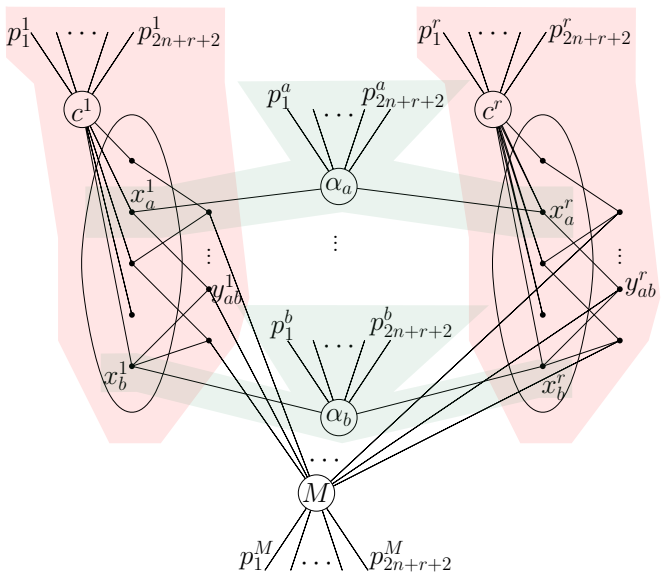
DSQ is W[1]-hard even on graphs with degeneracy 2 or excluding K_{3,3} as a subgraph, yet DSQ is FPT when parameterized by solution size and treewidth, FPT on nowhere dense classes, and has a subexponential-time algorithm on apex-minor-free graphs.
What carries the argument
The per-vertex lower and upper quota bounds on the coverage count |N[v] ∩ S| for each vertex v, enforced simultaneously with the global size bound |S| ≤ k.
Load-bearing premise
The hardness reductions can introduce the quota numbers into the input without increasing the degeneracy or creating forbidden minors in the target graph classes.
What would settle it
A fixed-parameter algorithm running in f(k) n^c time on all degeneracy-2 graphs would falsify the W[1]-hardness result for that class.
Figures


read the original abstract
We study a natural generalization of the classical \textsc{Dominating Set} problem, called \textsc{Dominating Set with Quotas} (DSQ). In this problem, we are given a graph \( G \), an integer \( k \), and for each vertex \( v \in V(G) \), a lower quota \( \mathrm{lo}_v \) and an upper quota \( \mathrm{up}_v \). The goal is to determine whether there exists a set \( S \subseteq V(G) \) of size at most \( k \) such that for every vertex \( v \in V(G) \), the number of vertices in its closed neighborhood that belong to \( S \), i.e., \( |N[v] \cap S| \), lies within the range \( [\mathrm{lo}_v, \mathrm{up}_v] \). This richer model captures a variety of practical settings where both under- and over-coverage must be avoided -- such as in fault-tolerant infrastructure, load-balanced facility placement, or constrained communication networks. While DS is already known to be computationally hard, we show that the added expressiveness of per-vertex quotas in DSQ introduces additional algorithmic challenges. In particular, we prove that DSQ becomes \W[1]-hard even on structurally sparse graphs -- such as those with degeneracy 2, or excluding \( K_{3,3} \) as a subgraph -- despite these classes admitting FPT algorithms for DS. On the positive side, we show that DSQ is fixed-parameter tractable when parameterized by solution size and treewidth, and more generally, on nowhere dense graph classes. Furthermore, we design a subexponential-time algorithm for DSQ on apex-minor-free graphs using the bidimensionality framework. These results collectively offer a refined view of the algorithmic landscape of DSQ, revealing a sharp contrast with the classical DS problem and identifying the key structural properties that govern tractability.
Editorial analysis
A structured set of objections, weighed in public.
Referee Report
Summary. The paper introduces Dominating Set with Quotas (DSQ), a generalization of Dominating Set in which each vertex v is equipped with lower and upper quotas lo_v and up_v; the task is to decide whether there exists a set S of size at most k such that for every v the value |N[v] ∩ S| lies in [lo_v, up_v]. The authors prove that DSQ is W[1]-hard even on degeneracy-2 graphs and on K_{3,3}-free graphs (classes on which ordinary Dominating Set is FPT), while showing that DSQ is FPT when parameterized by solution size plus treewidth, FPT on nowhere-dense classes, and solvable in subexponential time on apex-minor-free graphs via bidimensionality.
Significance. If the stated hardness and algorithmic results hold, the work supplies a precise delineation of how the addition of per-vertex coverage quotas alters the parameterized complexity of domination problems on sparse graphs. The contrast with classical DS on degeneracy-2 and K_{3,3}-free graphs is the most striking contribution, and the positive results correctly reuse standard tools (treewidth DP, nowhere-dense algorithms, bidimensionality) without introducing new ad-hoc parameters.
minor comments (2)
- [Abstract] The abstract and introduction would benefit from an explicit statement of the range of the quota values (e.g., whether they are bounded by a function of k or can be arbitrary integers up to n).
- [Introduction] A short comparison table contrasting the complexity of DS versus DSQ on the same graph classes would improve readability.
Simulated Author's Rebuttal
We thank the referee for their careful summary of our work and for highlighting the significance of the contrast between DSQ and classical Dominating Set on degeneracy-2 and K_{3,3}-free graphs. We are pleased that the positive results are viewed as correctly reusing standard tools. No specific major comments were provided in the report, so we have no individual points to address.
Circularity Check
No significant circularity; results via new reductions and standard techniques
full rationale
The paper establishes W[1]-hardness for DSQ via explicit reductions on degeneracy-2 and K_{3,3}-free graphs, then shows FPT membership by k+tw, on nowhere-dense classes, and subexponential time on apex-minor-free graphs via bidimensionality. These steps rely on new constructions and applications of existing parameterized machinery rather than any self-definitional loop, fitted parameter renamed as prediction, or load-bearing self-citation chain. The derivation chain is self-contained against external benchmarks in parameterized complexity.
Axiom & Free-Parameter Ledger
axioms (1)
- standard math Standard definitions of W[1]-hardness, FPT, treewidth, degeneracy, nowhere dense classes, and apex-minor-free graphs.
Reference graph
Works this paper leans on
-
[1]
Algorithmica54(4), 544–556 (2009)
Alon, N., Gutner, S.: Linear time algorithms for finding a dominating set of fixed size in degenerated graphs. Algorithmica54(4), 544–556 (2009). https://doi.org/10.1007/s00453- 008-9204-0
-
[2]
Alon, N., Yuster, R., Zwick, U.: Color-coding. Journal of the ACM (JACM)42(4), 844–856 (1995). https://doi.org/10.1145/210332.210337
-
[3]
Arnborg, S., Proskurowski, A.: Linear time algorithms for np-hard problems restricted to partial k-trees. Discret. Appl. Math.23(1), 11–24 (1989). https://doi.org/10.1016/0166- 218X(89)90031-0
-
[4]
In: Proceedings of the 24th ACM Conference on Economics and Computation (EC)
Banerjee, S., Eichhorn, M., Kempe, D.: Allocating with priorities and quotas: Algorithms, complexity , and dynamics. In: Proceedings of the 24th ACM Conference on Economics and Computation (EC). pp. 209–240 (2023). https://doi.org/10.1145/3580507.3597733
-
[5]
Cull, P., Nelson, I.: Perfect codes, Np-completeness, and towers of Hanoi graphs. Tech. rep., Oregon State University (1998)
work page 1998
-
[7]
Dawar, A., Kreutzer, S.: Domination problems in nowhere-dense classes. In: Proceedings of the IARCS Annual Conference on Foundations of Software Technology and Theoretical Computer Science (FSTTCS). LIPIcs, vol. 4, pp. 157–168. Schloss Dagstuhl - Leibniz-Zentrum für Informatik (2009). https://doi.org/10.4230/LIPICS.FSTTCS.2009.2315
-
[8]
Demaine, E.D., Hajiaghayi, M.: The bidimensionality theory and its algorithmic applications. Comput. J.51(3), 292–302 (2008). https://doi.org/10.1093/COMJNL/BXM033
-
[9]
Downey , R.G., Fellows, M.R.: Fixed-parameter tractability and completeness I: basic results. SIAM J. Comput.24(4), 873–921 (1995). https://doi.org/10.1137/S0097539792228228
-
[10]
Drange, P.G., Dregi, M.S., Fomin, F.V., Kreutzer, S., Lokshtanov, D., Pilipczuk, M., Pilipczuk, M., Reidl, F., Villaamil, F.S., Saurabh, S., Siebertz, S., Sikdar, S.: Kernelization and sparseness: the case of dominating set. In: Ollinger, N., Vollmer, H. (eds.) 33rd Symposium on Theoretical Aspects of Computer Science, STACS 2016. LIPIcs, vol. 47, pp. 31:...
-
[11]
Dreier, J., Eleftheriadis, I., Mählmann, N., McCarty , R., Pilipczuk, M., Torunczyk, S.: First-order model checking on monadically stable graph classes. In: 65th IEEE Annual Symposium on Foundations of Computer Science, FOCS 2024. pp. 21–30. IEEE (2024). https://doi.org/10.1109/FOCS61266.2024.00012 21
-
[12]
Einarson, C., Reidl, F.: A general kernelization technique for domination and indepen- dence problems in sparse classes. In: Cao, Y., Pilipczuk, M. (eds.) 15th International Sym- posium on Parameterized and Exact Computation, IPEC 2020, December 14-18, 2020. LIPIcs, vol. 180, pp. 11:1–11:15. Schloss Dagstuhl - Leibniz-Zentrum für Informatik (2020). https:...
-
[13]
Fabianski, G., Pilipczuk, M., Siebertz, S., Torunczyk, S.: Progressive algorithms for domination and independence. In: Niedermeier, R., Paul, C. (eds.) 36th Interna- tional Symposium on Theoretical Aspects of Computer Science, STACS 2019. LIPIcs, vol. 126, pp. 27:1–27:16. Schloss Dagstuhl - Leibniz-Zentrum für Informatik (2019). https://doi.org/10.4230/LI...
-
[14]
Fellows, M.R., Fomin, F.V., Lokshtanov, D., Rosamond, F.A., Saurabh, S., Szeider, S., Thomassen, C.: On the complexity of some colorful problems parameterized by treewidth. Inf. Comput.209(2), 143–153 (2011). https://doi.org/10.1016/J.IC.2010.11.026
-
[15]
Focke, J., Marx, D., Inerney , F.M., Neuen, D., Sankar, G.S., Schepper, P., Well- nitz, P.: Tight complexity bounds for counting generalized dominating sets in bounded-treewidth graphs part I: algorithmic results. CoRRabs/2211.04278(2022). https://doi.org/10.48550/ARXIV.2211.04278
-
[16]
In: Proceedings of the 2023 ACM-SIAM Symposium on Discrete Algorithms (SODA)
Focke, J., Marx, D., Inerney , F.M., Neuen, D., Sankar, G.S., Schepper, P., Wellnitz, P.: Tight complexity bounds for counting generalized dominating sets in bounded-treewidth graphs. In: Proceedings of the 2023 ACM-SIAM Symposium on Discrete Algorithms (SODA). pp. 3664–3683. SIAM (2023). https://doi.org/10.1137/1.9781611977554.CH140
-
[17]
In: Algorithms - ESA 2009, 17th Annual European Symposium
Fomin, F.V., Golovach, P.A., Thilikos, D.M.: Contraction bidimensionality: The accu- rate picture. In: Algorithms - ESA 2009, 17th Annual European Symposium. Proceed- ings. Lecture Notes in Computer Science, vol. 5757, pp. 706–717. Springer (2009). https://doi.org/10.1007/978-3-642-04128-0_63
-
[18]
Fomin, F.V., Lokshtanov, D., Saurabh, S., Thilikos, D.M.: Linear kernels for (connected) dom- inating set onH-minor-free graphs. In: Rabani, Y. (ed.) Proceedings of the Twenty-Third An- nual ACM-SIAM Symposium on Discrete Algorithms, SODA 2012. pp. 82–93. SIAM (2012). https://doi.org/10.1137/1.9781611973099.7
-
[19]
Fomin, F.V., Lokshtanov, D., Saurabh, S., Thilikos, D.M.: Linear kernels for (connected) dominating set on graphs with excluded topological subgraphs. In: Portier, N., Wilke, T. (eds.) 30th International Symposium on Theoretical Aspects of Computer Science, STACS
-
[20]
LIPIcs, vol. 20, pp. 92–103. Schloss Dagstuhl - Leibniz-Zentrum für Informatik (2013). https://doi.org/10.4230/LIPICS.STACS.2013.92
-
[21]
Fomin, F.V., Lokshtanov, D., Saurabh, S., Thilikos, D.M.: Bidimensionality and kernels. SIAM J. Comput.49(6), 1397–1422 (2020). https://doi.org/10.1137/16M1080264
-
[22]
Fomin, F.V., Thilikos, D.M.: Dominating sets in planar graphs: Branch- width and exponential speed-up. SIAM J. Comput.36(2), 281–309 (2006). https://doi.org/10.1137/S0097539702419649
-
[23]
Gajarský, J., Hlinený, P., Obdrzálek, J., Ordyniak, S., Reidl, F., Rossmanith, P., Villaamil, F.S., Sikdar, S.: Kernelization using structural parameters on sparse graph classes. J. Comput. Syst. Sci.84, 219–242 (2017). https://doi.org/10.1016/J.JCSS.2016.09.002 22
-
[24]
Garey , M.R., Johnson, D.S.: Computers and Intractability: A Guide to the Theory of NP- Completeness. W. H. Freeman (1979)
work page 1979
-
[25]
Golovach, P.A., Kratochvíl, J., Suchý, O.: Parameterized complexity of gen- eralized domination problems. Discret. Appl. Math.160(6), 780–792 (2012). https://doi.org/10.1016/J.DAM.2010.11.012
-
[26]
In: Graph-Theoretic Concepts in Computer Science
Golovach, P.A., Villanger, Y.: Parameterized complexity for domination problems on degen- erate graphs. In: Graph-Theoretic Concepts in Computer Science. pp. 195–205. Springer (2008). https://doi.org/10.1007/978-3-540-92248-3_18
-
[27]
Grohe, M., Kreutzer, S., Siebertz, S.: Deciding first-order properties of nowhere dense graphs. Journal of the ACM (JACM)64(3), 17:1–17:32 (2017). https://doi.org/10.1145/3051095
-
[28]
In: Proceed- ings of the 4ths Annual European Symposium on Algorithms (ESA)
Guha, S., Khuller, S.: Approximation algorithms for connected dominating sets. In: Proceed- ings of the 4ths Annual European Symposium on Algorithms (ESA). LNCS, vol. 1136, pp. 179–193 (1996). https://doi.org/10.1007/3-540-61680-2_55
-
[29]
Guha, S., Khuller, S.: Improved methods for approximating node weighted steiner trees and connected dominating sets. In: Proceedings of the 18th Conference on the Foundations of Software Technology and Theoretical Computer Science (FSTTCS). LNCS, vol. 1530, pp. 54–
-
[30]
https://doi.org/10.1007/978-3-540-49382-2_6
Springer (1998). https://doi.org/10.1007/978-3-540-49382-2_6
-
[31]
Gupta, S., Jain, P., Petety , A., Singh, S.: Parameterized complexity of d-hitting set with quo- tas. In: Bures, T., Dondi, R., Gamper, J., Guerrini, G., Jurdzinski, T., Pahl, C., Sikora, F., Wong, P.W.H. (eds.) SOFSEM 2021: Theory and Practice of Computer Science - 47th Inter- national Conference on Current Trends in Theory and Practice of Computer Scien...
-
[32]
Impagliazzo, R., Paturi, R.: On the complexity of k-sat. J. Comput. Syst. Sci.62(2), 367–375 (2001). https://doi.org/10.1006/JCSS.2000.1727
-
[33]
InAdvances in Cryptology – EUROCRYPT 2011 (Lecture Notes in Computer Science, Vol
Iwata, Y.: A faster algorithm for dominating set analyzed by the potential method. In: Proceedings of the 6th International Symposium of Parameterized and Exact Computation (IPEC). LNCS, vol. 7112, pp. 41–54. Springer (2011). https://doi.org/10.1007/978-3-642- 28050-4_4
-
[34]
Johnson, D.S.: Approximation algorithms for combinatorial problems. vol. 9, pp. 256–278 (1974). https://doi.org/10.1016/S0022-0000(74)80044-9
-
[35]
Karthik C. S., Laekhanukit, B., Manurangsi, P.: On the parameterized com- plexity of approximating dominating set. In: Proceedings of the 50th Annual ACM Symposium on Theory of Computing (STOC). pp. 1283–1296. ACM (2018). https://doi.org/10.1145/3188745.3188896
-
[36]
Knop, D., Koutecký, M., Masarík, T., Toufar, T.: Simplified algorithmic metatheorems be- yond MSO: treewidth and neighborhood diversity . Log. Methods Comput. Sci.15(4) (2019). https://doi.org/10.23638/LMCS-15(4:12)2019 23
-
[37]
Knop, D., Masarík, T., Toufar, T.: Parameterized complexity of fair vertex evaluation problems. In: Proceedings of the 44th International Symposium on Mathematical Foundations of Com- puter Science (MFCS). LIPIcs, vol. 138, pp. 33:1–33:16. Schloss Dagstuhl - Leibniz-Zentrum für Informatik (2019). https://doi.org/10.4230/LIPICS.MFCS.2019.33
-
[38]
ACM Transaction of Algorithms14(2), 13:1–13:30 (2018)
Lokshtanov, D., Marx, D., Saurabh, S.: Known algorithms on graphs of bounded treewidth are probably optimal. ACM Transaction of Algorithms14(2), 13:1–13:30 (2018). https://doi.org/10.1145/3170442
-
[39]
Lokshtanov, D., Mnich, M., Saurabh, S.: A linear kernel for planar con- nected dominating set. Theor. Comput. Sci.412(23), 2536–2543 (2011). https://doi.org/10.1016/J.TCS.2010.10.045
-
[40]
Discrete Applied Maths278, 51–61 (2020)
Masarík, T., Toufar, T.: Parameterized complexity of fair deletion problems. Discrete Applied Maths278, 51–61 (2020). https://doi.org/10.1016/J.DAM.2019.06.001
-
[41]
Theoretical Computer Sciences (TCS)804, 207–218 (2020)
Meybodi, M.A., Fomin, F.V., Mouawad, A.E., Panolan, F.: On the parameterized complexity of [1,j]-domination problems. Theoretical Computer Sciences (TCS)804, 207–218 (2020). https://doi.org/10.1016/J.TCS.2019.11.032
-
[42]
Schulman and Aravind Srinivasan , booktitle =
Naor, M., Schulman, L.J., Srinivasan, A.: Splitters and near-optimal derandomization. In: 36th Annual Symposium on Foundations of Computer Science (FOCS). pp. 182–191. IEEE Computer Society (1995). https://doi.org/10.1109/SFCS.1995.492475
-
[43]
van Rooij, J.M.M.: A generic convolution algorithm for join operations on tree decompo- sitions. In: Proceedings of the 16th International Computer Science Symposium in Russia (CSR). LNCS, vol. 12730, pp. 435–459. Springer (2021). https://doi.org/10.1007/978-3- 030-79416-3_27
-
[44]
In: Proceedings of the 17th Annual European Symposium Algorithms (ESA)
van Rooij, J.M.M., Bodlaender, H.L., Rossmanith, P.: Dynamic programming on tree de- compositions using generalised fast subset convolution. In: Proceedings of the 17th Annual European Symposium Algorithms (ESA). LNCS, vol. 5757, pp. 566–577. Springer (2009). https://doi.org/10.1007/978-3-642-04128-0_51
-
[45]
Nordic Journal of Computing (NJC)1(1), 157–171 (1994)
Telle, J.A.: Complexity of domination-type problems in graphs. Nordic Journal of Computing (NJC)1(1), 157–171 (1994)
work page 1994
-
[46]
In: Proceed- ings of the 20th Annual European Symposium on Algorithms (ESA)
Telle, J.A., Villanger, Y.: FPT algorithms for domination in biclique-free graphs. In: Proceed- ings of the 20th Annual European Symposium on Algorithms (ESA). LNCS, vol. 7501, pp. 802–812. Springer (2012). https://doi.org/10.1007/978-3-642-33090-2_69 24
discussion (0)
Sign in with ORCID, Apple, or X to comment. Anyone can read and Pith papers without signing in.