Sample entropy for graph signals: An approach to nonlinear dynamic analysis of data on networks
Pith reviewed 2026-05-10 18:45 UTC · model grok-4.3
The pith
Sample entropy can be defined for graph signals to analyze nonlinear dynamics on networks.
A machine-rendered reading of the paper's core claim, the machinery that carries it, and where it could break.
Core claim
We introduce sample entropy for graph signals (SampEnG), a unified framework that generalises classical sample entropy from uni- and bi-dimensional signals, including time series and images, by building on topology-aware embeddings using multi-hop neighbourhoods and computing finite scale of correlation sums in the continuous embedding state space.
What carries the argument
SampEnG framework, which uses multi-hop neighbourhood embeddings on the graph plus correlation-sum counting in the continuous state space to compute a conditional-entropy-style measure for graph signals.
If this is right
- SampEnG recovers known nonlinear dynamical features on synthetic paths and grids.
- On directed traffic networks it detects transitions between free-flow and congestion states.
- It supplies information complementary to existing Shannon-entropy methods on the same data.
- The approach applies to real systems including weather stations, wireless sensors, and traffic monitoring.
Where Pith is reading between the lines
- The same embedding approach could be tested on biological or social networks to track emerging collective behaviors.
- Direct comparison with graph permutation entropy on identical datasets would clarify which better isolates nonlinear structure.
- Extending the method to time-varying graphs would test whether it can follow evolving network dynamics.
Load-bearing premise
That multi-hop neighborhood embeddings plus correlation-sum counting preserve the original conditional-entropy interpretation without introducing topology-dependent biases.
What would settle it
An experiment on a graph dataset with a documented nonlinear phase change where SampEnG values show no statistically significant shift while classical measures do.
Figures
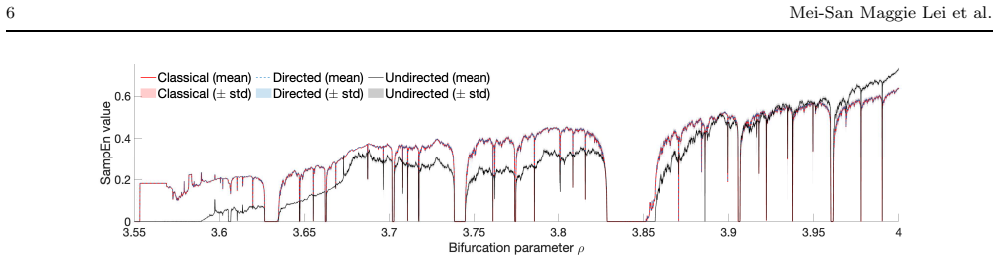
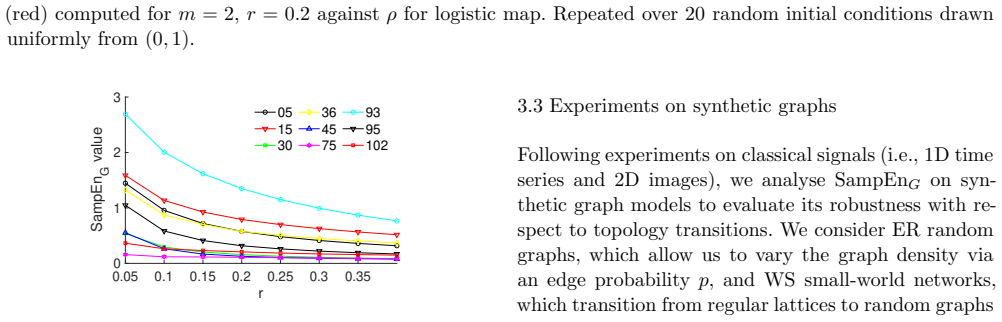
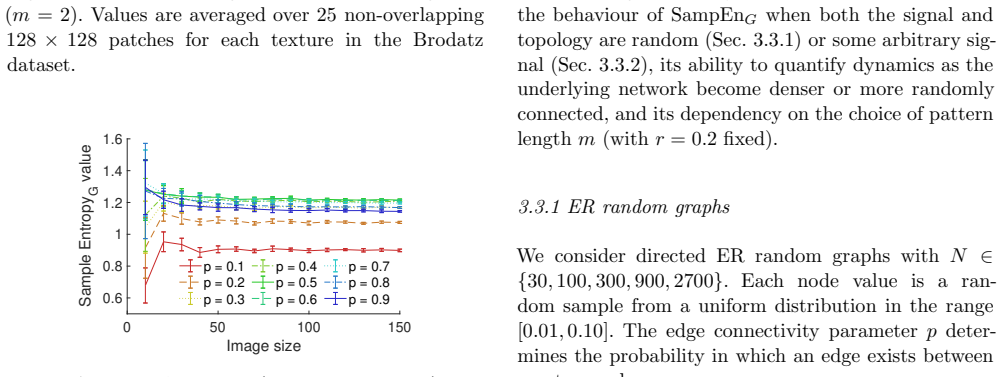
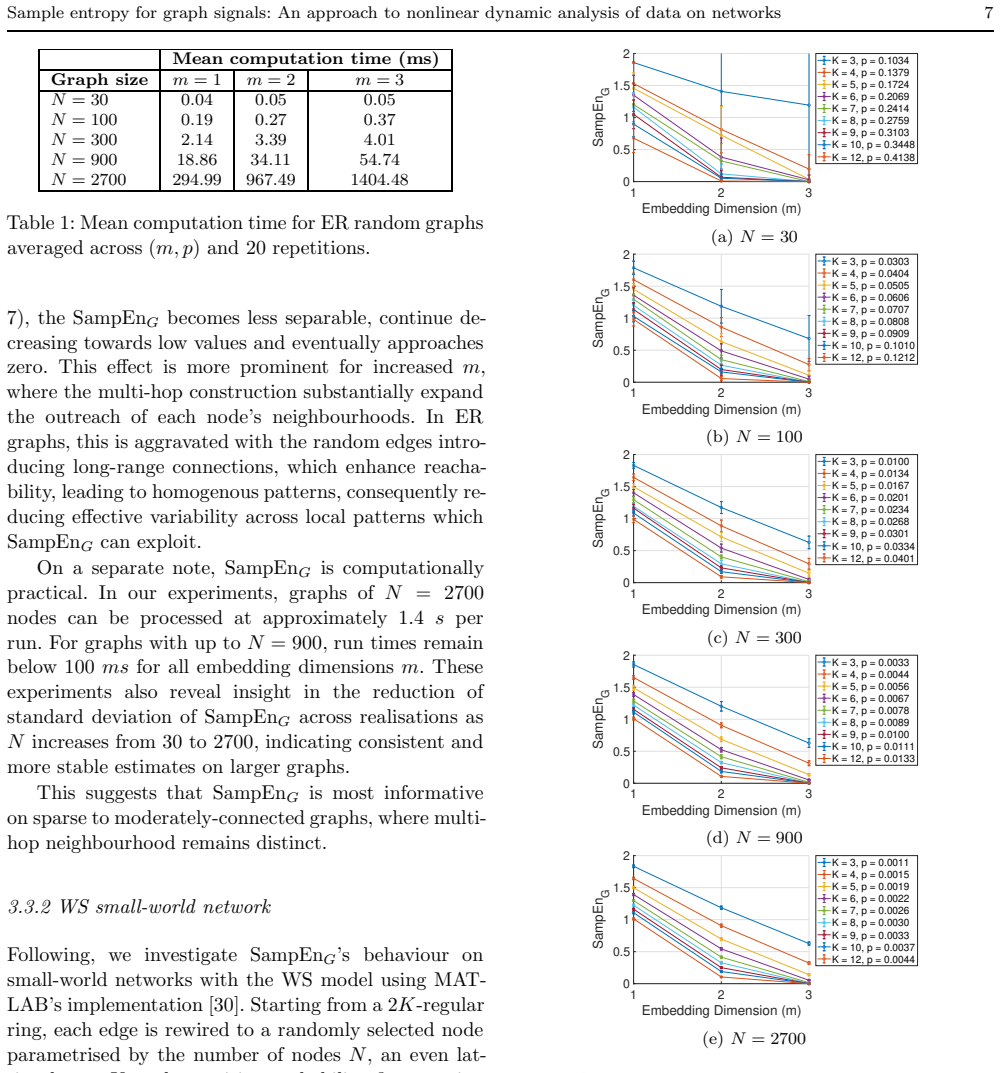
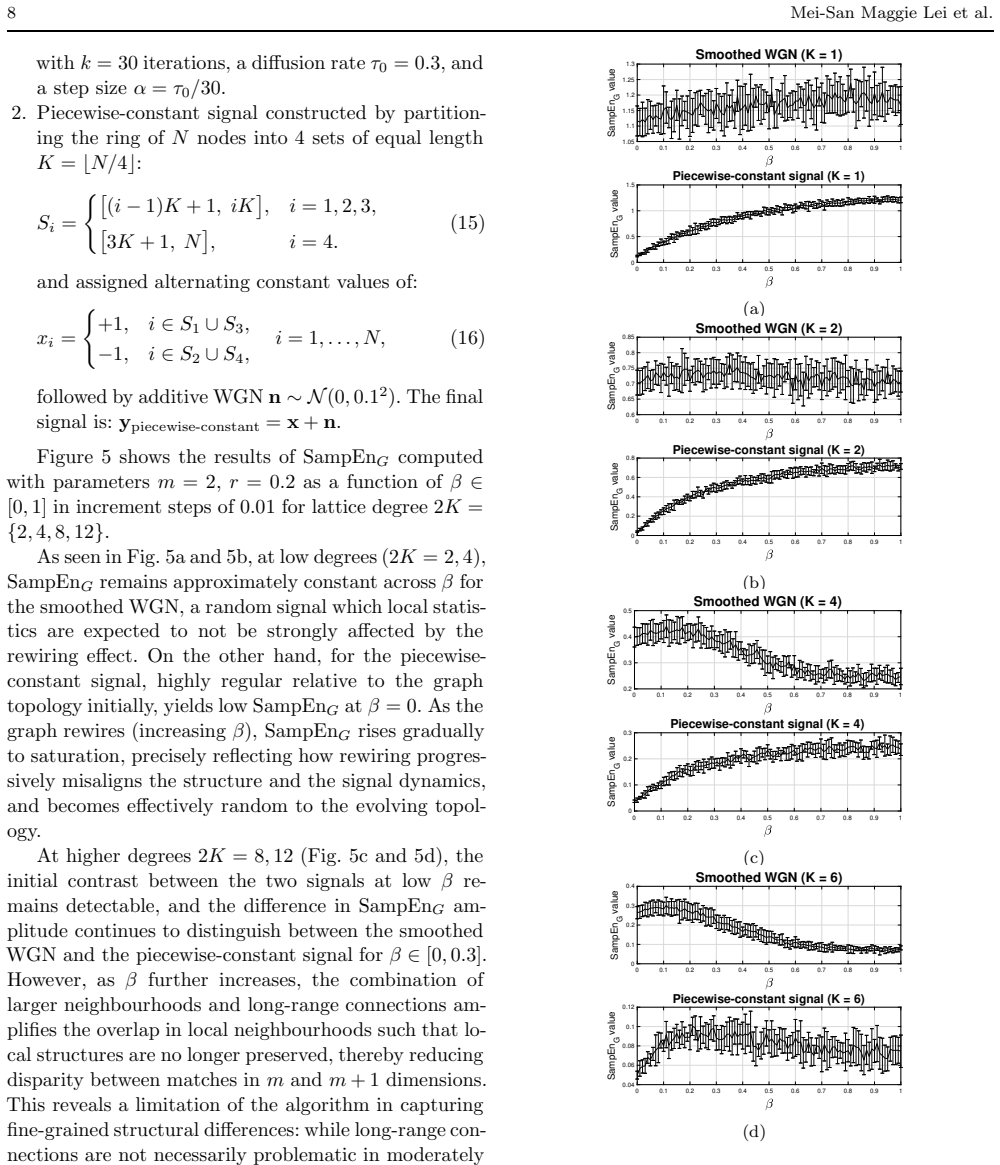
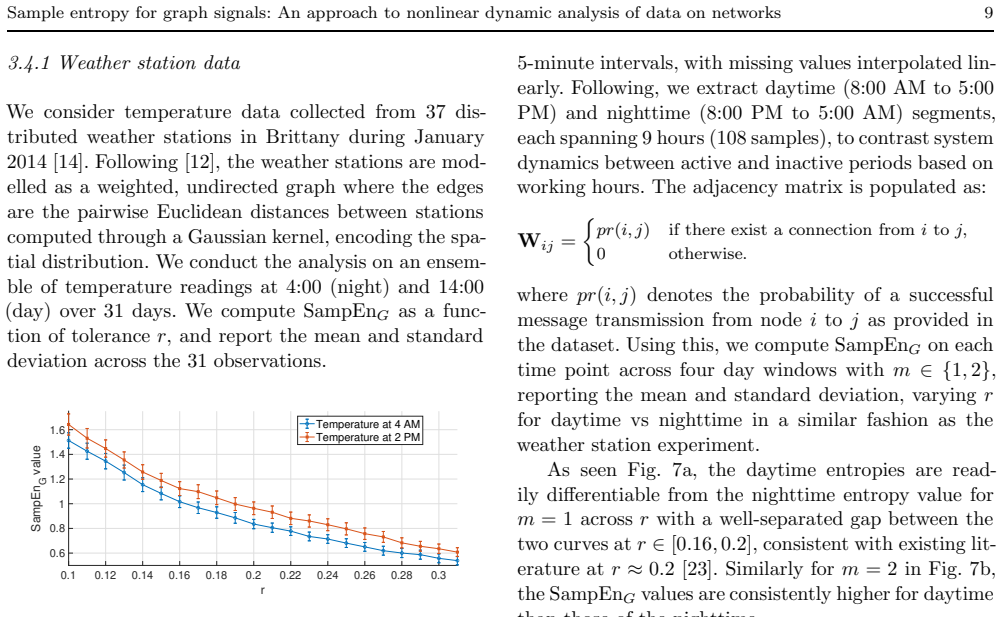
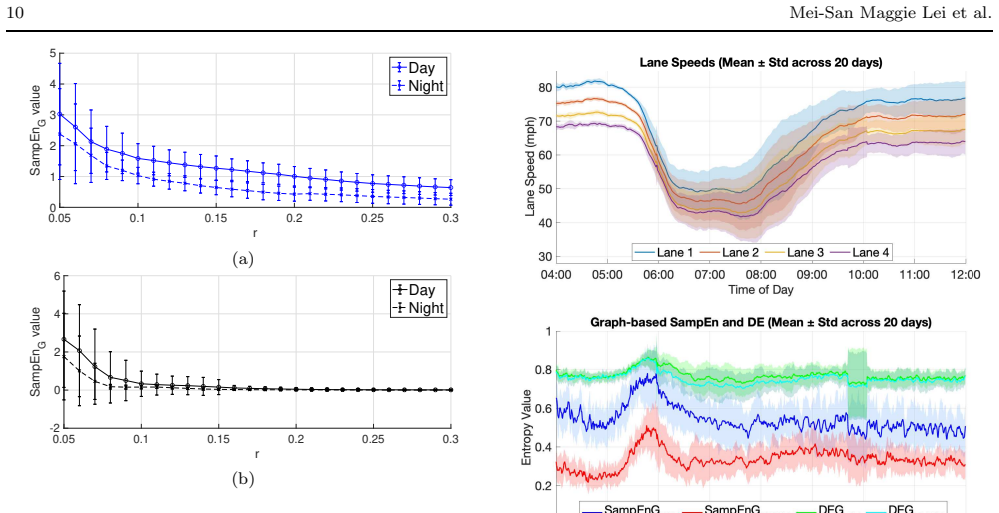
read the original abstract
The recent extension of permutation entropy and its derivatives to graph signals has opened up new horizons for the analysis of complex, high-dimensional systems evolving on networks. However, these measures are all fundamentally rooted in Shannon entropy and symbol dynamics. In this paper, we explore, for the first time, whether and how a popular conditional-entropy based measure --Sample Entropy (SampEn)-- can be effectively defined for graph signals and used to characterise the nonlinear dynamics of data on complex networks. We introduce sample entropy for graph signals (SampEnG), a unified framework that generalises classical sample entropy from uni- and bi-dimensional signals, including time series and images, by building on topology-aware embeddings using multi-hop neighbourhoods and computing finite scale of correlation sums in the continuous embedding state space. Experiments on synthetic and real-world datasets, including weather station, wireless sensor monitoring, and traffic systems, verify that SampEnG recovers known nonlinear dynamical features on paths and grids. In the traffic-flow analysis, SampEnG on a directed topology (encoding causal flow constraint) is particularly sensitive to phase transitions between free-flow and congestion, offering information that is complementary to existing Shannon-entropy based approaches. We expect SampEnG to open up new ways to analyse graph signals, generalising sample entropy and the concept of conditional entropy to extending nonlinear analysis to a wide variety of network data.
Editorial analysis
A structured set of objections, weighed in public.
Referee Report
Summary. The manuscript introduces sample entropy for graph signals (SampEnG) as a generalization of classical SampEn to signals defined on graphs. It constructs topology-aware embeddings via multi-hop neighborhoods and computes correlation sums in the continuous embedding space to quantify nonlinear dynamics, claiming this extends the conditional-entropy interpretation beyond uni- and bi-dimensional cases. Experiments on synthetic data, weather station networks, wireless sensor data, and traffic systems are presented to show recovery of known dynamical features on paths/grids and sensitivity to free-flow/congestion transitions when using directed topologies.
Significance. If the construction preserves the conditional-entropy meaning of SampEn and reduces exactly to the classical formula on path and grid graphs without topology-induced bias, the work would supply a missing conditional-entropy tool for graph signal processing, complementing recent Shannon- and permutation-entropy extensions. This could enable new nonlinear analyses in network applications such as traffic monitoring and sensor networks.
major comments (2)
- [Definition of SampEnG (Section 3)] The central generalization claim requires that the multi-hop neighborhood embedding plus correlation-sum counting recovers the standard time-delay embedding and SampEn formula exactly when the graph is a path (1D) or grid (2D). No derivation or explicit reduction is provided in the definition or methods, leaving open the possibility that neighborhood cardinality normalization or radius choice mixes topological scale with dynamical scale in a graph-dependent manner.
- [Experiments (Section 4)] The experimental verification that SampEnG recovers known nonlinear features and detects phase transitions relies on finite-scale correlation sums, yet the manuscript provides no details on the choice of multi-hop radius, any normalization of neighborhood size, number of Monte Carlo realizations, or statistical error bars. This makes it impossible to assess robustness against post-hoc parameter selection or degree-distribution bias.
minor comments (2)
- Clarify the phrase 'finite scale of correlation sums' in the abstract and methods; it is ambiguous whether this refers to a fixed embedding dimension, a specific tolerance parameter r, or a finite-sample approximation.
- The traffic-flow results on directed graphs are presented as complementary to Shannon-based measures, but a direct side-by-side comparison table (e.g., SampEnG vs. graph permutation entropy) would strengthen the claim of added value.
Simulated Author's Rebuttal
We thank the referee for their constructive and detailed review. The comments highlight important aspects of the generalization claim and experimental reproducibility that we will address to strengthen the manuscript.
read point-by-point responses
-
Referee: [Definition of SampEnG (Section 3)] The central generalization claim requires that the multi-hop neighborhood embedding plus correlation-sum counting recovers the standard time-delay embedding and SampEn formula exactly when the graph is a path (1D) or grid (2D). No derivation or explicit reduction is provided in the definition or methods, leaving open the possibility that neighborhood cardinality normalization or radius choice mixes topological scale with dynamical scale in a graph-dependent manner.
Authors: We agree that an explicit derivation is necessary to fully substantiate the claim that SampEnG reduces exactly to classical SampEn on path and grid graphs. In the revised manuscript we will add a dedicated derivation in Section 3. For a path graph the multi-hop neighborhood embedding with radius chosen to match the embedding dimension recovers the standard time-delay vectors, and the correlation-sum counting reduces to the original SampEn formula without additional normalization factors that would introduce graph-dependent bias. An analogous reduction holds for grid graphs. We will also clarify the radius selection rule and neighborhood-size handling to ensure topological and dynamical scales remain separated. revision: yes
-
Referee: [Experiments (Section 4)] The experimental verification that SampEnG recovers known nonlinear features and detects phase transitions relies on finite-scale correlation sums, yet the manuscript provides no details on the choice of multi-hop radius, any normalization of neighborhood size, number of Monte Carlo realizations, or statistical error bars. This makes it impossible to assess robustness against post-hoc parameter selection or degree-distribution bias.
Authors: We acknowledge that the current version omits these implementation details. In the revision we will add a new subsection (or appendix) that specifies, for every experiment: the exact multi-hop radius employed, the neighborhood-size normalization procedure, the number of Monte Carlo realizations, and the statistical error bars or confidence intervals computed. These additions will enable readers to reproduce the results and evaluate robustness to parameter choice and potential degree-distribution effects. revision: yes
Circularity Check
No circularity: SampEnG is an explicit definitional generalization of classical sample entropy
full rationale
The paper defines SampEnG directly via topology-aware multi-hop neighborhood embeddings and finite-scale correlation sums in the continuous state space, explicitly generalizing the classical SampEn construction for time series and images. No load-bearing step reduces the output to a fitted parameter renamed as prediction, a self-citation chain, or an ansatz smuggled from prior work by the same authors. The abstract and description present the measure as a construction that recovers known features on paths/grids by design, without claiming an independent derivation that collapses to its inputs. This is a standard definitional extension rather than a circular one; the conditional-entropy interpretation is preserved by the explicit embedding choice, not asserted tautologically.
Axiom & Free-Parameter Ledger
Lean theorems connected to this paper
-
IndisputableMonolith/Cost/FunctionalEquationwashburn_uniqueness_aczel unclear?
unclearRelation between the paper passage and the cited Recognition theorem.
We introduce sample entropy for graph signals (SampEnG), a unified framework that generalises classical sample entropy ... by building on topology-aware embeddings using multi-hop neighbourhoods and computing finite scale of correlation sums in the continuous embedding state space.
-
IndisputableMonolith/Foundation/RealityFromDistinctionreality_from_one_distinction unclear?
unclearRelation between the paper passage and the cited Recognition theorem.
SampEnG reduces to 1D SampEn on a path graph ... On directed path graphs, SampEnG reduces to the classical SampEn
What do these tags mean?
- matches
- The paper's claim is directly supported by a theorem in the formal canon.
- supports
- The theorem supports part of the paper's argument, but the paper may add assumptions or extra steps.
- extends
- The paper goes beyond the formal theorem; the theorem is a base layer rather than the whole result.
- uses
- The paper appears to rely on the theorem as machinery.
- contradicts
- The paper's claim conflicts with a theorem or certificate in the canon.
- unclear
- Pith found a possible connection, but the passage is too broad, indirect, or ambiguous to say the theorem truly supports the claim.
Reference graph
Works this paper leans on
-
[1]
Resource Letter CS–1: Complex Systems | Ameri- can Journal of Physics | AIP Publishing
-
[2]
Searching Towards Class-Aware Generators for Conditional Generative Adversarial Networks
Ahmed, M.U., Mandic, D.P.: Multivariate Multi- scale Entropy Analysis. IEEE Signal Processing Letters 19(2), 91–94 (2012). DOI 10.1109/LSP. 2011.2180713
work page doi:10.1109/lsp 2012
-
[3]
Biomedical Signal Processing and Control 5(1), 1–14 (2010)
Alcaraz, R., Rieta, J.J.: A review on sample entropy applications for the non-invasive analysis of atrial fibrillation electrocardiograms. Biomedical Signal Processing and Control 5(1), 1–14 (2010). DOI 10.1016/j.bspc.2009.11.001
-
[4]
IEEE Signal Processing Letters 24(9), 1338–1342 (2017)
Azami, H., Escudero, J., Humeau-Heurtier, A.: Bidimensional Distribution Entropy to Analyze the Irregularity of Small-Sized Textures. IEEE Signal Processing Letters 24(9), 1338–1342 (2017). DOI 10.1109/LSP.2017.2723505
-
[5]
In: Contemporary Mathematics and Its Applica- tions: Monographs, Expositions and Lecture Notes, vol
Azami, H., Faes, L., Escudero, J., Humeau- Heurtier, A., Silva, L.E.: ENTROPY ANALY- SIS OF UNIV ARIATE BIOMEDICAL SIGNALS: REVIEW AND COMPARISON OF METHODS. In: Contemporary Mathematics and Its Applica- tions: Monographs, Expositions and Lecture Notes, vol. 04, pp. 233–286. WORLD SCIENTIFIC (2022). DOI 10.1142/9789811259401 0009
-
[6]
URL http://db.csail.mit.edu/labdata/labdata.html
Bodik, P., Hong, W., Guestrin, C., Madden, S., Paskin, M., Thibaux, R., Polastre, J., Szewczyk, R.: Intel berkeley research lab sensor data (2004). URL http://db.csail.mit.edu/labdata/labdata.html
work page 2004
-
[7]
Christakis, N., Patel, M.K., Cross, M., T¨ uz¨ un, U.: On the Modelling of Complex Systems - Methodolo- gies and Applications. In: 2010 Ninth International Symposium on Distributed Computing and Appli- cations to Business, Engineering and Science, pp. 40–45 (2010). DOI 10.1109/DCABES.2010.15
-
[8]
Advances in Neural Information Processing Systems 37, 15526–15549 (2024)
Coursey, A., Ji, J., Quinones-Grueiro, M., Barbour, W., Zhang, Y., Derr, T., Biswas, G., Work, D.B.: Ft-aed: Benchmark dataset for early freeway traf- fic anomalous event detection. Advances in Neural Information Processing Systems 37, 15526–15549 (2024)
work page 2024
-
[9]
Delgado-Bonal, A., Marshak, A.: Approximate En- tropy and Sample Entropy: A Comprehensive Tu- torial. Entropy 21(6), 541 (2019). DOI 10.3390/ e21060541. Number: 6 Publisher: Multidisciplinary Digital Publishing Institute
work page 2019
-
[10]
Fluctuation and Noise Letters 23(05), 2450052 (2024)
Dong, K., Li, D.: An Information-Theoretic Ap- proach to Analyze Irregularity of Graph Signals and Network Topological Changes Based on Bub- ble Entropy. Fluctuation and Noise Letters 23(05), 2450052 (2024). DOI 10.1142/S0219477524500524. Publisher: World Scientific Publishing Co
-
[11]
Chaos, Solitons & Fractals 175, 113977 (2023)
Fabila-Carrasco, J., Tan, C., Escudero, J.: Disper- sion entropy for graph signals. Chaos, Solitons & Fractals 175, 113977 (2023). DOI https://doi.org/ 10.1016/j.chaos.2023.113977
-
[12]
IEEE Trans- actions on Signal and Information Processing over Networks 8, 288–300 (2022)
Fabila-Carrasco, J.S., Tan, C., Escudero, J.: Per- mutation Entropy for Graph Signals. IEEE Trans- actions on Signal and Information Processing over Networks 8, 288–300 (2022). DOI 10.1109/TSIPN. 2022.3167333
-
[13]
DOI 10.13140/RG.2.2.33612.46722
Fekri-Ershad, S.: A New Benchmark Dataset for Texture Image Analysis and Surface Defect De- tection (2019). DOI 10.13140/RG.2.2.33612.46722. ArXiv:1906.11561 [cs]
-
[14]
In: 2015 23rd Euro- pean Signal Processing Conference (EUSIPCO), pp
Girault, B.: Stationary graph signals using an iso- metric graph translation. In: 2015 23rd Euro- pean Signal Processing Conference (EUSIPCO), pp. 1516–1520 (2015). DOI 10.1109/EUSIPCO.2015. 7362637
-
[15]
Physical Review Letters 50(5), 346–349 (1983)
Grassberger, P., Procaccia, I.: Characterization of Strange Attractors. Physical Review Letters 50(5), 346–349 (1983). DOI 10.1103/PhysRevLett.50.346
-
[16]
IEEE Signal Processing Letters 22(12), 2364–2367 (2015)
Humeau-Heurtier, A., Wu, C.W., Wu, S.D.: Refined Composite Multiscale Permutation Entropy to Overcome Multiscale Permutation Entropy Length Dependence. IEEE Signal Processing Letters 22(12), 2364–2367 (2015). DOI 10.1109/LSP.2015. 2482603
-
[17]
IEEE Access 11, 71905– 71924 (2023)
Jui, S.J.J., Deo, R.C., Barua, P.D., Devi, A., Soar, J., Acharya, U.R.: Application of Entropy for Au- tomated Detection of Neurological Disorders With Electroencephalogram Signals: A Review of the Last Decade (2012–2022). IEEE Access 11, 71905– 71924 (2023). DOI 10.1109/ACCESS.2023.3294473
-
[18]
DOI 10.1007/ s13194-012-0056-8
Ladyman, J., Lambert, J., Wiesner, K.: What is a complex system? European Journal for Philoso- phy of Science 3(1), 33–67 (2013). DOI 10.1007/ s13194-012-0056-8
work page 2013
-
[19]
MathWorks File Exchange (2018)
Mart ´ ınez-Cagigal, V.: Sample entropy. MathWorks File Exchange (2018). URL https://uk.mathworks.com/matlabcentral/fileexchange/693 Version 1.1.0
work page 2018
-
[20]
Meng, X., Li, J., Di, X., Sheng, Y., Jiang, D.: An Encryption Algorithm for Region of Interest in Medical DICOM Based on One-Dimensional e λ- cos-cot Map. Entropy 24(7), 901 (2022). DOI 10.3390/e24070901. Number: 7 Publisher: Multi- disciplinary Digital Publishing Institute
-
[21]
Pro- ceedings of the IEEE 106(5), 808–828 (2018)
Ortega, A., Frossard, P., Kovaˇ cevi´ c, J., Moura, J.M.F., Vandergheynst, P.: Graph Signal Process- ing: Overview, Challenges, and Applications. Pro- ceedings of the IEEE 106(5), 808–828 (2018). DOI 10.1109/JPROC.2018.2820126 Sample entropy for graph signals: An approach to nonlinear d ynamic analysis of data on networks 13
-
[22]
Annals of the New York Academy of Sciences 954(1), 245–267 (2001)
Pincus, S.M.: Assessing Serial Irregularity and Its Implications for Health. Annals of the New York Academy of Sciences 954(1), 245–267 (2001). DOI 10.1111/j.1749-6632.2001.tb02755.x
-
[23]
In: Methods in Enzymology, Nu- merical Computer Methods, Part E , vol
Richman, J.S., Lake, D.E., Moorman, J.R.: Sam- ple Entropy. In: Methods in Enzymology, Nu- merical Computer Methods, Part E , vol. 384, pp. 172–184. Academic Press (2004). DOI 10.1016/ S0076-6879(04)84011-4
work page 2004
-
[24]
American Journal of Physiology
Richman, J.S., Moorman, J.R.: Physiological time- series analysis using approximate entropy and sam- ple entropy. American Journal of Physiology. Heart and Circulatory Physiology 278(6), H2039–2049 (2000). DOI 10.1152/ajpheart.2000.278.6.H2039
-
[25]
IEEE Signal Processing Letters 23(5), 610–614 (2016)
Rostaghi, M., Azami, H.: Dispersion Entropy: A Measure for Time-Series Analysis. IEEE Signal Processing Letters 23(5), 610–614 (2016). DOI 10.1109/LSP.2016.2542881
-
[26]
IEEE Signal Processing Magazine 31(5), 80–90 (2014)
Sandryhaila, A., Moura, J.M.: Big Data Analysis with Signal Processing on Graphs: Representation and processing of massive data sets with irregular structure. IEEE Signal Processing Magazine 31(5), 80–90 (2014). DOI 10.1109/MSP.2014.2329213
-
[27]
Biomedical Physics & Engineering Express 2(4), 045002 (2016)
Silva, L.E.V., Filho, A.C.S.S., Fazan, V.P.S., Fe- lipe, J.C., Junior, L.O.M.: Two-dimensional sam- ple entropy: assessing image texture through irreg- ularity. Biomedical Physics & Engineering Express 2(4), 045002 (2016). DOI 10.1088/2057-1976/2/4/ 045002
-
[28]
Frontiers in Neuroin- formatics 8 (2014)
Sokunbi, M.O.: Sample entropy reveals high dis- criminative power between young and elderly adults in short fMRI data sets. Frontiers in Neuroin- formatics 8 (2014). DOI 10.3389/fninf.2014.00069. Publisher: Frontiers
-
[29]
IEEE Transac- tions on Signal and Information Processing over Networks 3(3), 484–499 (2017)
Thanou, D., Dong, X., Kressner, D., Frossard, P.: Learning Heat Diffusion Graphs. IEEE Transac- tions on Signal and Information Processing over Networks 3(3), 484–499 (2017). DOI 10.1109/ TSIPN.2017.2731164
-
[30]
MATLAB & Simulink Example (2015)
The MathWorks, I.: Build watts-strogatz small world graph model. MATLAB & Simulink Example (2015). URL https://uk.mathworks.com/help/matlab/math/build-wat ts-strogatz-small-world-graph-model.html
work page 2015
-
[31]
In: 2011 International Conference on Electric Technol- ogy and Civil Engineering (ICETCE), pp
Zhao, J.: Road traffic safety evaluation index sys- tem based on complex system-entropy theory. In: 2011 International Conference on Electric Technol- ogy and Civil Engineering (ICETCE), pp. 1521– 1524 (2011). DOI 10.1109/ICETCE.2011.5776393
discussion (0)
Sign in with ORCID, Apple, or X to comment. Anyone can read and Pith papers without signing in.