Recognition: no theorem link
SN2023ixf: Radiative-transfer modeling of the photospheric phase evolution from the ultraviolet to the infrared
Pith reviewed 2026-05-10 19:00 UTC · model grok-4.3
The pith
Prolonged interaction with decreasing circumstellar material density is required to match the multi-wavelength evolution of SN2023ixf.
A machine-rendered reading of the paper's core claim, the machinery that carries it, and where it could break.
Core claim
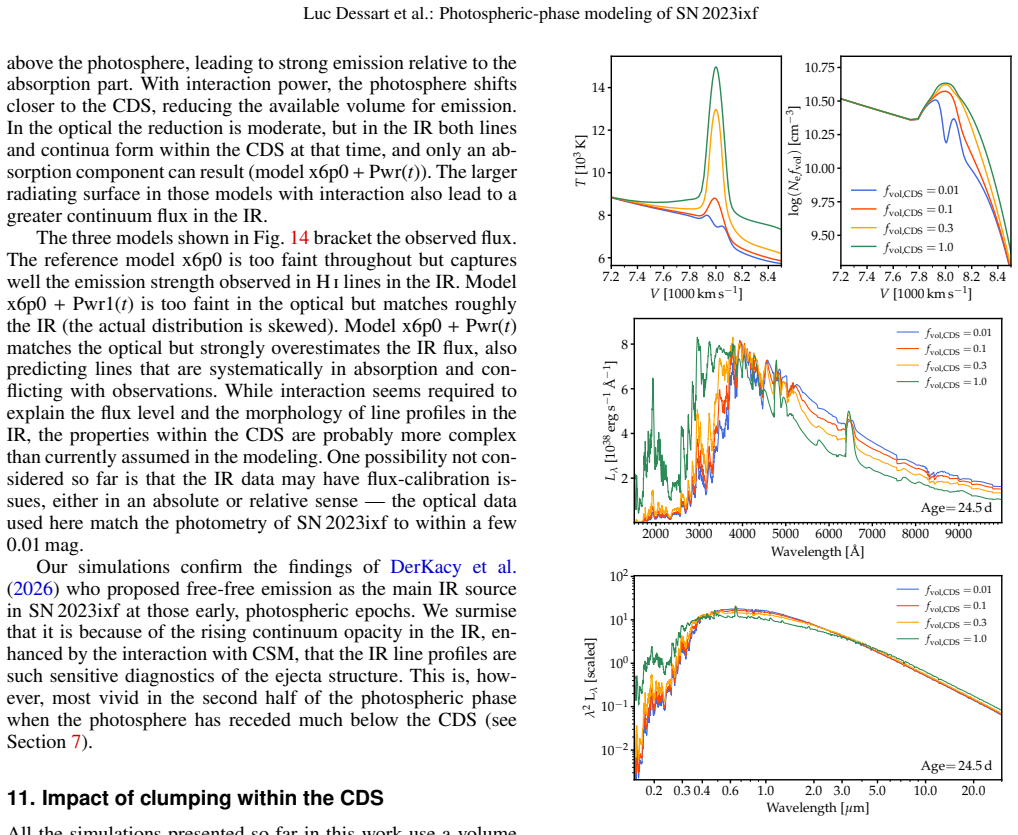
The radiative transfer modeling shows that the photospheric phase of SN2023ixf is best reproduced by the explosion of a 15 solar mass progenitor with an ejecta of 7-8 solar masses, kinetic energy of 1.2 x 10^51 erg, and 0.05 solar masses of nickel-56, but only when including prolonged interaction with a decreasing density circumstellar medium. This interaction sustains the UV continuum and lines, boosts the optical brightness and specific line shapes, and enhances the infrared flux through free-free emission. No faster material than the cold dense shell at around 8000 km/s is needed or found.
What carries the argument
Non-local thermodynamic equilibrium time-dependent radiative-transfer calculations incorporating ejecta-CSM interaction and the resulting cold dense shell.
If this is right
- The UV spectra show complexity from metal line blanketing.
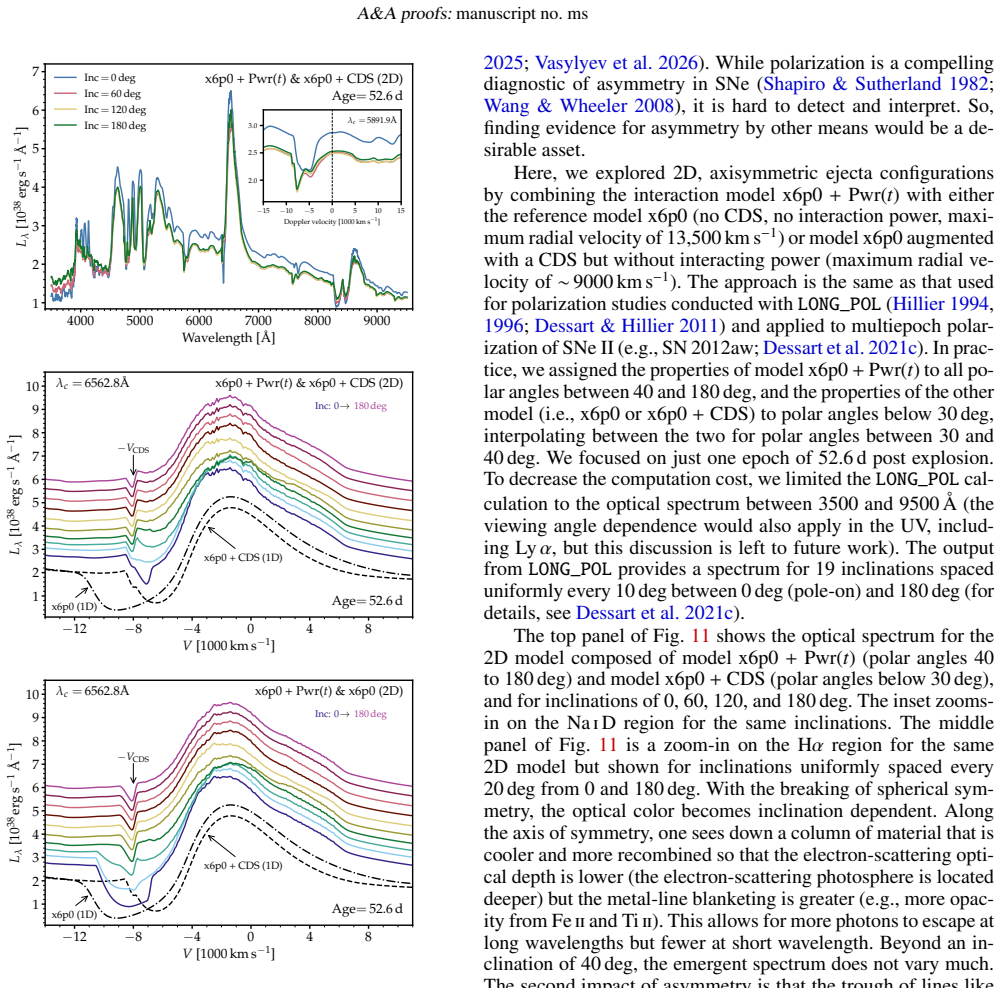
- Two-dimensional models with asymmetry produce varied absorption profiles with flat bottoms or notches.
- The cold dense shell becomes more apparent at later times, especially in infrared observations.
- Clumping in the cold dense shell influences the results, though smooth cases show larger discrepancies.
Where Pith is reading between the lines
- Similar modeling could help interpret other supernovae with early interaction signatures to map progenitor mass-loss rates.
- Later-time infrared observations might provide stronger constraints on the cold dense shell properties.
- Accounting for asymmetry in future models could explain variations in line profiles seen in different supernovae.
Load-bearing premise
The calculations rely on a specific 15 solar mass progenitor model with enhanced red-supergiant mass loss that produces a decreasing circumstellar density profile allowing interaction to persist without requiring material faster than 8000 km/s.
What would settle it
Observing spectral signatures of material expanding faster than 8000 km/s during the late photospheric phase or failing to detect the expected infrared flux boost from the interaction.
Figures





read the original abstract
SN2023ixf, a Type II supernova (SN) showing early signs of interaction with circumstellar material (CSM), has been observed with unprecedented detail across the electromagnetic spectrum since shock breakout. Here, we present nonlocal thermodynamic equilibrium time-dependent radiative-transfer calculations of its photospheric-phase evolution (i.e., ~20 to ~120d), and for the first time encompassing from the ultraviolet (UV) to the infrared (IR). The explosion of a 15Msun progenitor star, evolved with enhanced mass loss during the red-supergiant phase, yielding an ejecta of 7-8Msun, a kinetic energy of 1.2x10^51 erg, and a 56Ni mass of 0.05Msun, yields a satisfactory match to the photospheric-phase duration and brightness. Prolonged interaction with a decreasing CSM density is required to match a number of salient features of SN2023ixf during the photospheric phase, including the persistent UV continuum and line fluxes, the optical brightness and line profiles (in particular Halpha), as well as the IR flux (interaction boosts the free-free emission at long wavelengths). The presence of a cold dense shell (CDS), which is hard to infer at early times when the CDS and photosphere lie at similar velocities, becomes evident at later times and more so in the IR - we find no evidence for material faster than the CDS at ~8000km/s. Exploratory two-dimensional radiative-transfer calculations based on axially symmetric CSM or ejecta suggest that asymmetry can produce a diversity of profile shapes, with absorption troughs exhibiting a flat bottom or notches at any Doppler velocity. We emphasize the complexity of UV spectra influenced by complex metal-line blanketing at these phases. We document the sensitivity of model results to the adopted clumping in the CDS, though the largest offset is obtained here in the unlikely case of a smooth CDS.
Editorial analysis
A structured set of objections, weighed in public.
Referee Report
Summary. The manuscript presents nonlocal thermodynamic equilibrium time-dependent radiative-transfer calculations for the photospheric phase (~20-120 d) of SN2023ixf from UV to IR. A 15 M⊙ progenitor with enhanced RSG mass loss yields 7-8 M⊙ ejecta, 1.2×10^51 erg kinetic energy, and 0.05 M⊙ of 56Ni that matches photospheric duration and brightness; prolonged interaction with a decreasing CSM density is required to match persistent UV continuum/line fluxes, optical brightness and Hα profiles, and IR free-free flux. The cold dense shell (CDS) becomes evident later (no material faster than ~8000 km/s), exploratory 2D axially symmetric models suggest asymmetry can produce diverse line-profile shapes, and results are sensitive to CDS clumping.
Significance. If the central claim holds, the work demonstrates the necessity of prolonged CSM interaction for explaining multi-wavelength features in a well-observed Type II supernova, with implications for progenitor mass-loss rates and the challenges of UV metal-line blanketing. The inclusion of IR diagnostics and the CDS velocity constraint adds value, though the exploratory 2D calculations and noted parameter sensitivities limit the robustness of some conclusions.
major comments (3)
- [Abstract and modeling description] Abstract and modeling description: The claim that the baseline explosion parameters already give a satisfactory match to duration and brightness while the decreasing-CSM model is required for UV continuum, Hα, optical evolution, and IR flux is load-bearing, yet no spectra or light curves from the identical radiative-transfer setup with zero CSM density are shown. Without this explicit no-interaction control, it remains possible that adjustments to 56Ni mixing, ionization, or clumping could close the gap.
- [Exploratory 2D calculations] Exploratory 2D calculations: The axially symmetric 2D radiative-transfer models are presented as exploratory and suggest diversity in absorption-trough shapes, but they do not quantitatively test whether asymmetry can reproduce the observed mismatches in the 1D baseline without the specific decreasing CSM profile. This leaves the necessity argument dependent on the unshown 1D zero-CSM case.
- [CDS clumping and velocity constraint] CDS clumping and velocity constraint: Sensitivity to CDS clumping is documented (largest offset in the smooth case), but the impact on the IR flux boost and the inference of no material faster than the CDS at ~8000 km/s is not quantified in detail; this affects the robustness of the prolonged-interaction scenario.
minor comments (2)
- A summary table of all adopted parameters (progenitor mass, ejecta mass, kinetic energy, 56Ni mass, CSM density profile, clumping factors) with their ranges would improve clarity and reproducibility.
- Notation for velocities (e.g., the CDS at ~8000 km/s) and the distinction between 1D and 2D results could be made more consistent across text and figures.
Simulated Author's Rebuttal
We thank the referee for their detailed and constructive report. We address each major comment point by point below with the strongest honest defense possible, without misrepresenting the manuscript. Revisions will be made where they strengthen the work.
read point-by-point responses
-
Referee: [Abstract and modeling description] Abstract and modeling description: The claim that the baseline explosion parameters already give a satisfactory match to duration and brightness while the decreasing-CSM model is required for UV continuum, Hα, optical evolution, and IR flux is load-bearing, yet no spectra or light curves from the identical radiative-transfer setup with zero CSM density are shown. Without this explicit no-interaction control, it remains possible that adjustments to 56Ni mixing, ionization, or clumping could close the gap.
Authors: We appreciate the referee's emphasis on this point. The baseline model uses the stated explosion parameters (15 M⊙ progenitor, 7-8 M⊙ ejecta, 1.2×10^51 erg, 0.05 M⊙ 56Ni) in the identical radiative-transfer setup but with zero CSM density; these runs match the photospheric duration and brightness as claimed. Variations in 56Ni mixing, ionization, and clumping were tested in the baseline and do not reproduce the persistent UV continuum, Hα evolution, or IR free-free excess. To make the control explicit, we will add a direct comparison figure of no-CSM versus interacting light curves and spectra in the revised manuscript. revision: yes
-
Referee: [Exploratory 2D calculations] Exploratory 2D calculations: The axially symmetric 2D radiative-transfer models are presented as exploratory and suggest diversity in absorption-trough shapes, but they do not quantitatively test whether asymmetry can reproduce the observed mismatches in the 1D baseline without the specific decreasing CSM profile. This leaves the necessity argument dependent on the unshown 1D zero-CSM case.
Authors: The 2D models are labeled exploratory and serve only to illustrate that axial symmetry produces diverse absorption-trough shapes (flat bottoms or notches). They do not claim to quantitatively replace the 1D necessity argument for the decreasing CSM profile. The core support for prolonged interaction comes from the 1D models simultaneously fitting UV, optical, and IR data. We will revise the text to clarify this scope and note that asymmetry alone is unlikely to produce the IR flux boost. With the explicit 1D zero-CSM comparison added per the first comment, the necessity argument will stand on firmer ground. revision: partial
-
Referee: [CDS clumping and velocity constraint] CDS clumping and velocity constraint: Sensitivity to CDS clumping is documented (largest offset in the smooth case), but the impact on the IR flux boost and the inference of no material faster than the CDS at ~8000 km/s is not quantified in detail; this affects the robustness of the prolonged-interaction scenario.
Authors: We agree that more detailed quantification of clumping effects would improve robustness. The manuscript already states the largest offset occurs for a smooth CDS. In revision we will add quantitative estimates of IR flux variation across clumping factors and confirm that the CDS velocity constraint (no material faster than ~8000 km/s) remains consistent, as it derives from the absence of high-velocity absorption features in the data. This will be supported by additional model outputs or a summary table. revision: yes
Circularity Check
No circularity: standard parameter-tuned radiative-transfer modeling with no self-referential reduction
full rationale
The paper selects a 15 Msun progenitor, ejecta mass, energy, and Ni mass, then adds a decreasing CSM density profile, and reports that the combined setup reproduces photospheric duration, brightness, UV continuum, Halpha, and IR free-free flux. This is ordinary forward modeling in which parameters are adjusted until the synthetic observables match data; the 'requirement' for CSM interaction is asserted by contrasting the baseline (no-CSM) match to duration/brightness against the improved match when CSM is included. No equation, ansatz, or uniqueness theorem is shown to reduce to its own input by construction, no self-citation carries the central claim, and no fitted quantity is relabeled as an independent prediction. The derivation therefore remains self-contained and does not meet the criteria for any enumerated circularity pattern.
Axiom & Free-Parameter Ledger
free parameters (4)
- progenitor mass =
15 Msun
- kinetic energy =
1.2e51 erg
- 56Ni mass =
0.05 Msun
- CSM density profile =
decreasing
axioms (2)
- standard math Non-local thermodynamic equilibrium time-dependent radiative transfer applies to the photospheric phase
- domain assumption Progenitor evolved with enhanced mass loss during red-supergiant phase
invented entities (1)
-
cold dense shell (CDS)
no independent evidence
Forward citations
Cited by 1 Pith paper
-
SN2023ixf: ultraviolet-to-infrared radiative-transfer modeling of the nebular-phase evolution until 1000 days
Radiative-transfer models of SN2023ixf require a 0.2 solar-mass cold dense shell plus rising dust mass to match its nebular-phase UV-optical-IR evolution to 1000 days.
Reference graph
Works this paper leans on
-
[1]
H., et al
Baron, E., Branch, D., Hauschildt, P. H., et al. 2000, ApJ, 545, 444
2000
-
[2]
C., Orellana, M., Folatelli, G., et al
Bersten, M. C., Orellana, M., Folatelli, G., et al. 2024, A&A, 681, L18
2024
-
[3]
J., Ramsbottom, C
Blondin, S., Dessart, L., Hillier, D. J., Ramsbottom, C. A., & Storey, P. J. 2023, A&A, 678, A170
2023
-
[4]
A., Sand, D
Bostroem, K. A., Sand, D. J., Dessart, L., et al. 2024, ApJ, 973, L47
2024
-
[5]
Bostroem, K. A., Valenti, S., Sand, D. J., et al. 2025, submitted to ApJ, arXiv:2508.11756
-
[6]
A., Laplace, E., Schneider, F
Bronner, V . A., Laplace, E., Schneider, F. R. N., & Podsiadlowski, P. 2025, A&A, 703, A61
2025
-
[7]
A., Maeda, K., Ray, A
Chandra, P., Chevalier, R. A., Maeda, K., Ray, A. K., & Nayana, A. J. 2024, ApJ, 963, L4
2024
-
[8]
& Blondin, J
Chevalier, R. & Blondin, J. M. 1995, ApJ, 444, 312
1995
-
[9]
A., Blondin, J
Chevalier, R. A., Blondin, J. M., & Emmering, R. T. 1992, ApJ, 392, 118
1992
-
[10]
Chevalier, R. A. & Fransson, C. 1994, ApJ, 420, 268
1994
-
[11]
N., Chevalier, R
Chugai, N. N., Chevalier, R. A., & Utrobin, V . P. 2007, ApJ, 662, 1136
2007
-
[12]
M., Ashall, C., Baron, E., et al
DerKacy, J. M., Ashall, C., Baron, E., et al. 2026, ApJ, 997, 179
2026
-
[13]
2026, in Encyclopedia of Astrophysics, V ol
Dessart, L. 2026, in Encyclopedia of Astrophysics, V ol. 2, 706–719
2026
-
[14]
& Audit, E
Dessart, L. & Audit, E. 2019, A&A, 629, A17
2019
-
[15]
Dessart, L., Audit, E., & Hillier, D. J. 2015, MNRAS, 449, 4304
2015
-
[16]
J., et al
Dessart, L., Blondin, S., Brown, P. J., et al. 2008, ApJ, 675, 644
2008
-
[17]
P., Kuncarayakti, H., Fox, O
Dessart, L., Gutiérrez, C. P., Kuncarayakti, H., Fox, O. D., & Filippenko, A. V . 2023, A&A, 675, A33
2023
-
[18]
& Hillier, D
Dessart, L. & Hillier, D. J. 2005, A&A, 437, 667
2005
-
[19]
& Hillier, D
Dessart, L. & Hillier, D. J. 2006, A&A, 447, 691
2006
-
[20]
& Hillier, D
Dessart, L. & Hillier, D. J. 2011, MNRAS, 415, 3497
2011
-
[21]
& Hillier, D
Dessart, L. & Hillier, D. J. 2019, A&A, 625, A9
2019
-
[22]
& Hillier, D
Dessart, L. & Hillier, D. J. 2022, A&A, 660, L9
2022
-
[23]
J., Waldman, R., & Livne, E
Dessart, L., Hillier, D. J., Waldman, R., & Livne, E. 2013, MNRAS, 433, 1745
2013
-
[24]
J., & Wilk, K
Dessart, L., Hillier, D. J., & Wilk, K. D. 2018, A&A, 619, A30
2018
-
[25]
2010, MNRAS, 405, 2113
Dessart, L., Livne, E., & Waldman, R. 2010, MNRAS, 405, 2113
2010
-
[26]
2025, ApJ, 984, 71
Dickinson, D., Milisavljevic, D., Garretson, B., et al. 2025, ApJ, 984, 71
2025
-
[27]
J., Valenti, S., et al
Dong, Y ., Sand, D. J., Valenti, S., et al. 2023, ApJ, 957, 28
2023
-
[28]
J., Ferrari, L., et al
Fang, Q., Moriya, T. J., Ferrari, L., et al. 2025, ApJ, 978, 36
2025
-
[29]
Ferrari, L., Folatelli, G., Ertini, K., Kuncarayakti, H., & Andrews, J. E. 2024, A&A, 687, L20
2024
-
[30]
2025, A&A, 698, A213
Folatelli, G., Ferrari, L., Ertini, K., Kuncarayakti, H., & Maeda, K. 2025, A&A, 698, A213
2025
-
[31]
& Goldberg, J
Forde, S. & Goldberg, J. A. 2025, Research Notes of the American Astronomical Society, 9, 135
2025
-
[32]
Fransson, C., Lundqvist, P., & Chevalier, R. A. 1996, ApJ, 461, 993
1996
-
[33]
A., Bildsten, L., & Paxton, B
Goldberg, J. A., Bildsten, L., & Paxton, B. 2019, ApJ, 879, 3
2019
-
[34]
W., Brightman, M., Earnshaw, H
Grefenstette, B. W., Brightman, M., Earnshaw, H. P., Harrison, F. A., & Margutti, R. 2023, ApJ, 952, L3 Gutiérrez, C. P., Anderson, J. P., Hamuy, M., et al. 2014, ApJ, 786, L15
2023
-
[35]
Hillier, D. J. 1994, A&A, 289, 492
1994
-
[36]
Hillier, D. J. 1996, A&A, 308, 521
1996
-
[37]
Hillier, D. J. & Dessart, L. 2012, MNRAS, 424, 252
2012
-
[38]
Hillier, D. J. & Dessart, L. 2019, A&A, 631, A8
2019
-
[39]
Hillier, D. J. & Miller, D. L. 1998, ApJ, 496, 407
1998
-
[40]
A., et al
Hsu, B., Smith, N., Goldberg, J. A., et al. 2025, ApJ, 990, 148
2025
-
[41]
2023, Transient Name Server Discovery Report, 2023-1158, 1
Itagaki, K. 2023, Transient Name Server Discovery Report, 2023-1158, 1
2023
-
[42]
2025, ApJ, 978, 138 Jacobson-Galán, W
Iwata, Y ., Akimoto, M., Matsuoka, T., et al. 2025, ApJ, 978, 138 Jacobson-Galán, W. V ., Dessart, L., Davis, K. W., et al. 2025a, ApJ, 992, 100 Jacobson-Galán, W. V ., Dessart, L., Kilpatrick, C. D., et al. 2025b, ApJ, 994, L14 Jacobson-Galán, W. V ., Dessart, L., Margutti, R., et al. 2023, ApJ, 954, L42
2025
-
[43]
E., Pearson, J., Beasor, E
Jencson, J. E., Pearson, J., Beasor, E. R., et al. 2023, ApJ, 952, L30
2023
-
[44]
D., Foley, R
Kilpatrick, C. D., Foley, R. J., Jacobson-Galán, W. V ., et al. 2023, ApJ, 952, L23
2023
-
[45]
2025, A&A, 694, A319
Kozyreva, A., Caputo, A., Baklanov, P., Mironov, A., & Janka, H.-T. 2025, A&A, 694, A319
2025
-
[46]
R., Singleton, A
Kumar, A., Dastidar, R., Maund, J. R., Singleton, A. J., & Sun, N.-C. 2025, MNRAS, 538, 659
2025
-
[47]
A., Schneider, F
Laplace, E., Bronner, V . A., Schneider, F. R. N., & Podsiadlowski, P. 2026, ApJ, 998, L40
2026
-
[48]
2024, Nature, 627, 754
Li, G., Hu, M., Li, W., et al. 2024, Nature, 627, 754
2024
-
[49]
2025, A&A, 703, A168
Li, G., Wang, X., Yang, Y ., et al. 2025, A&A, 703, A168
2025
-
[50]
2025, submitted to ApJL, arXiv:2510.14875
Ma, J.-Z., Justham, S., Pakmor, R., et al. 2025, submitted to ApJL, arXiv:2510.14875
-
[51]
Moriya, T. J. & Singh, A. 2024, PASJ, 76, 1050
2024
-
[52]
J., Margutti, R., Wiston, E., et al
Nayana, A. J., Margutti, R., Wiston, E., et al. 2025, ApJ, 985, 51
2025
-
[53]
Neustadt, J. M. M., Kochanek, C. S., & Smith, M. R. 2024, MNRAS, 527, 5366
2024
-
[54]
R., et al
Niu, Z., Sun, N.-C., Maund, J. R., et al. 2023, ApJ, 955, L15
2023
-
[55]
H., Rho, J., Yoon, S.-C., et al
Park, S. H., Rho, J., Yoon, S.-C., et al. 2025, A&A, 703, A227
2025
-
[56]
2009, MNRAS, 394, 2266
Pastorello, A., Valenti, S., Zampieri, L., et al. 2009, MNRAS, 394, 2266
2009
-
[57]
2011, ApJS, 192, 3
Paxton, B., Bildsten, L., Dotter, A., et al. 2011, ApJS, 192, 3
2011
-
[58]
2013, ApJS, 208, 4
Paxton, B., Cantiello, M., Arras, P., et al. 2013, ApJS, 208, 4
2013
-
[59]
A., Gal-Yam, A., Irani, I., & Zimmerman, E
Perley, D. A., Gal-Yam, A., Irani, I., & Zimmerman, E. 2023, Transient Name Server AstroNote, 119, 1
2023
-
[60]
2024, MNRAS, 534, 271
Qin, Y .-J., Zhang, K., Bloom, J., et al. 2024, MNRAS, 534, 271
2024
-
[61]
L., Villar, V
Ransome, C. L., Villar, V . A., Tartaglia, A., et al. 2024, ApJ, 965, 93
2024
-
[62]
G., Yuan, W., Macri, L
Riess, A. G., Yuan, W., Macri, L. M., et al. 2022, ApJ, 934, L7
2022
-
[63]
Shapiro, P. R. & Sutherland, P. G. 1982, ApJ, 263, 902
1982
-
[64]
J., et al
Shrestha, M., DeSoto, S., Sand, D. J., et al. 2025, ApJ, 982, L32
2025
-
[65]
S., Moriya, T
Singh, A., Teja, R. S., Moriya, T. J., et al. 2024, ApJ, 975, 132
2024
-
[66]
J., et al
Smith, N., Pearson, J., Sand, D. J., et al. 2023, ApJ, 956, 46
2023
-
[67]
D., Szalai, T., Van Dyk, S
Soraisam, M. D., Szalai, T., Van Dyk, S. D., et al. 2023, ApJ, 957, 64
2023
-
[68]
E., Brown, J
Sukhbold, T., Ertl, T., Woosley, S. E., Brown, J. M., & Janka, H.-T. 2016, ApJ, 821, 38
2016
-
[69]
S., Singh, A., Basu, J., et al
Teja, R. S., Singh, A., Basu, J., et al. 2023, ApJ, 954, L12
2023
-
[70]
P., Wongwathanarat, A., Janka, H.-T., & Müller, E
Utrobin, V . P., Wongwathanarat, A., Janka, H.-T., & Müller, E. 2017, ApJ, 846, 37 Van Dyk, S. D., Srinivasan, S., Andrews, J. E., et al. 2024a, ApJ, 968, 27 Van Dyk, S. D., Szalai, T., Cutri, R. M., et al. 2024b, ApJ, 977, 98
2017
-
[71]
S., Dessart, L., Yang, Y ., et al
Vasylyev, S. S., Dessart, L., Yang, Y ., et al. 2026, ApJ, 1000, 18
2026
-
[72]
S., Yang, Y ., Filippenko, A
Vasylyev, S. S., Yang, Y ., Filippenko, A. V ., et al. 2023, ApJ, 955, L37 Vinkó, J., Bodola, Z. R., G˝odény, Á., et al. 2025, ApJ, 993, 39
2023
-
[73]
& Wheeler, J
Wang, L. & Wheeler, J. C. 2008, ARA&A, 46, 433
2008
-
[74]
V ., et al
Zheng, W., Dessart, L., Filippenko, A. V ., et al. 2025, ApJ, 988, 61
2025
-
[75]
A., Irani, I., Chen, P., et al
Zimmerman, E. A., Irani, I., Chen, P., et al. 2024, Nature, 627, 759 Article number, page 17 of 18 A&A proofs:manuscript no. ms Appendix A: Additional comparisons with observations Figure A.1 complements the results presented in Section 4 by showing comparisons at additional epochs and specifically at 31.5, 38.5, 71.9, and 97.4 d (for the last epoch, shuf...
2024
discussion (0)
Sign in with ORCID, Apple, or X to comment. Anyone can read and Pith papers without signing in.