Semantic analysis of behavior in a DNA-functionalized molecular swarm
Pith reviewed 2026-05-10 20:03 UTC · model grok-4.3
The pith
Semantic embedding extracts atoms from microtubule swarm simulations that match expected DNA-controlled behaviors.
A machine-rendered reading of the paper's core claim, the machinery that carries it, and where it could break.
Core claim
Extending a microtubule model to incorporate DNA-functionalized interactions and then applying semantic embedding yields semantic atoms whose extracted patterns match the expected behaviors; moreover, the decomposition of individual simulation frames accurately reflects the influence of the external control values.
What carries the argument
Semantic embedding applied to simulation trajectories of DNA-functionalized microtubule swarms, which decomposes the data into semantic atoms representing basic behaviors.
If this is right
- The extracted atoms supply a compact, interpretable feature set for optimizing swarm parameters such as motor density or DNA sequence.
- Frame-by-frame decomposition can quantify the instantaneous effect of each external control input on the collective pattern.
- The same pipeline can be used to compare simulation output against experimental video of the physical system.
- Explainable atoms reduce reliance on black-box optimization when tuning in-vitro molecular devices.
Where Pith is reading between the lines
- If the atoms prove stable across different simulation engines, they could serve as a common language for comparing microtubule-based swarms built in separate laboratories.
- The approach might extend to other motor-filament systems once their interaction rules are encoded similarly.
- A natural next measurement is whether the same atoms appear when the embedding is trained on experimental microscopy footage instead of simulation.
Load-bearing premise
The semantic embedding procedure recovers the same behaviors regardless of the particular modeling choices or parameter settings used to generate the simulation data.
What would settle it
A direct test would be to run the same embedding on new simulation runs that deliberately alter the DNA interaction rules while keeping visible swarm motion identical; if the extracted atoms change, the method is sensitive to model details rather than to observable behavior.
Figures
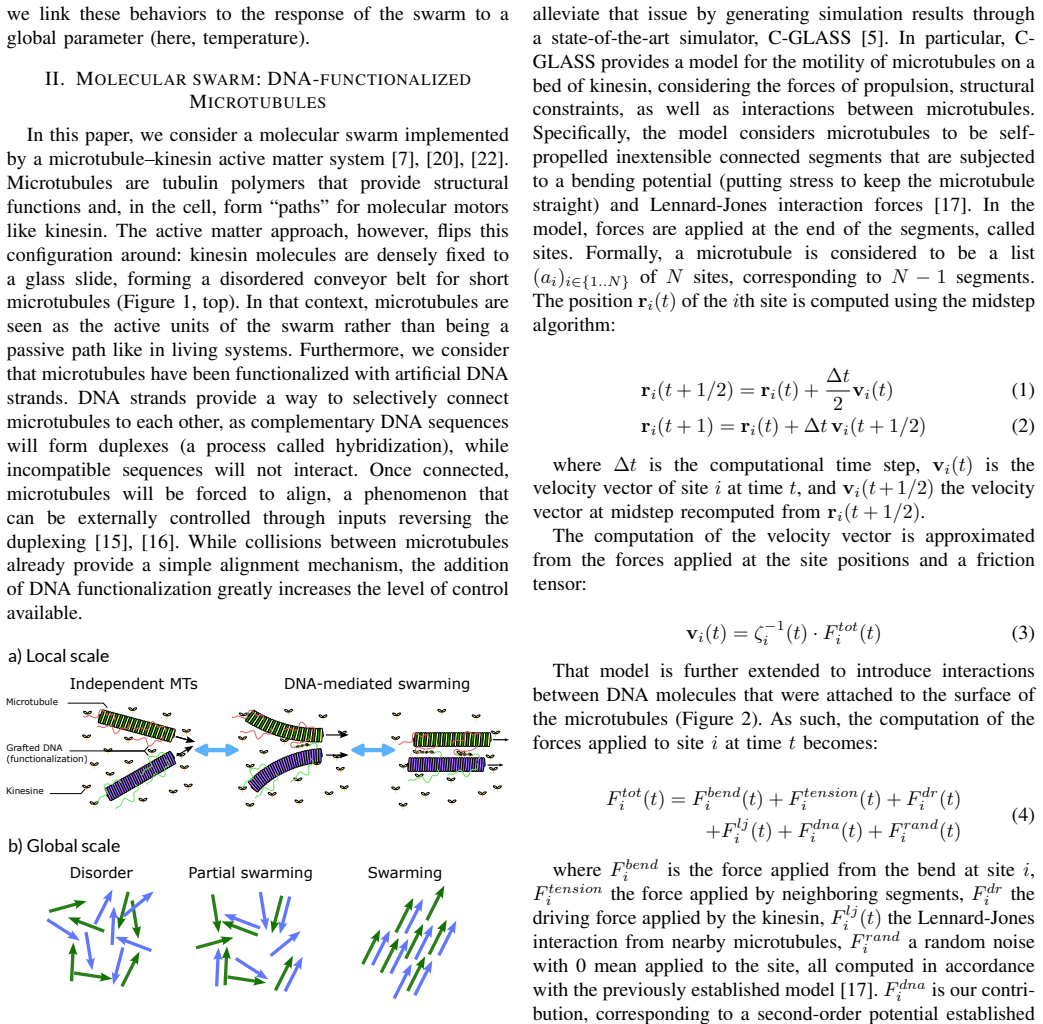



read the original abstract
In this paper, we propose applying semantic embedding to learn the range of behaviors exhibited by molecular swarms, thereby providing a richer set of features to optimize such systems. Specifically, we consider a standard molecular swarm where the individuals are cytoskeletal filaments (called microtubules) propelled by surface-adhered kinesin motors, with the addition of DNA functionalization for further control. We extend a microtubule model with that additional interaction and show that the extracted semantic atoms from simulation results match the expected behaviors. Moreover, the decomposition of each frame in the simulations accurately describes the expected impact of the external control values. Those results provide relevant leads towards the explainability of simulated experiments, making them more reliable for designing and optimizing in-vitro systems.
Editorial analysis
A structured set of objections, weighed in public.
Referee Report
Summary. The paper proposes applying semantic embedding to analyze and learn the range of behaviors in a DNA-functionalized molecular swarm of cytoskeletal microtubules propelled by surface-adhered kinesin motors. It extends an existing microtubule model to incorporate DNA interactions, extracts semantic atoms from simulation results that are claimed to match expected behaviors, and shows that per-frame decompositions accurately reflect the impact of external control values. The work positions this as a step toward improved explainability of simulated experiments to support design and optimization of in-vitro systems.
Significance. If the central claims are substantiated with rigorous validation, the approach could provide a useful bridge between semantic analysis techniques and physical molecular swarm modeling, offering interpretable features for optimization in molecular robotics. This would be a modest but relevant contribution to explainable simulation in bio-inspired systems, particularly if the semantic atoms prove robust across different control regimes.
major comments (3)
- [Results] The abstract and results sections assert that extracted semantic atoms match expected behaviors and that frame decompositions accurately describe control impacts, but no quantitative validation metrics (e.g., similarity scores, reconstruction error, or statistical tests) are reported to support these matches; this is load-bearing for the central claim.
- [Methods] The embedding method and simulation setup are insufficiently specified (no details on how semantic atoms are derived, how 'expected behaviors' are independently defined versus derived from the same control parameters, or the microtubule model extensions), preventing assessment of potential circularity or sensitivity to model assumptions.
- [Model] §3 (model extension): the additional DNA interaction is introduced without equations or parameter values, making it impossible to verify that the semantic decomposition is independent of the simulation parameters used to generate the data.
minor comments (2)
- [Abstract] The abstract would be strengthened by including at least one concrete quantitative result (e.g., number of semantic atoms, average reconstruction accuracy) rather than purely qualitative statements.
- [Notation] Notation for the semantic atoms and control variables should be defined consistently in the main text and any figures.
Simulated Author's Rebuttal
We thank the referee for their constructive and detailed feedback. The comments identify important areas for clarification and strengthening, particularly around quantitative support for claims, methodological transparency, and model specification. We have revised the manuscript accordingly and provide point-by-point responses below.
read point-by-point responses
-
Referee: [Results] The abstract and results sections assert that extracted semantic atoms match expected behaviors and that frame decompositions accurately describe control impacts, but no quantitative validation metrics (e.g., similarity scores, reconstruction error, or statistical tests) are reported to support these matches; this is load-bearing for the central claim.
Authors: We agree that the absence of quantitative metrics weakens the presentation of the central claims. In the revised manuscript we have added cosine similarity scores between the extracted semantic atoms and independently defined expected behavior templates, mean squared reconstruction error for the per-frame decompositions, and paired statistical tests (Wilcoxon signed-rank) on decomposition coefficients across control regimes. These results are reported in a new subsection of Results and in an expanded Figure 4. revision: yes
-
Referee: [Methods] The embedding method and simulation setup are insufficiently specified (no details on how semantic atoms are derived, how 'expected behaviors' are independently defined versus derived from the same control parameters, or the microtubule model extensions), preventing assessment of potential circularity or sensitivity to model assumptions.
Authors: We have substantially expanded the Methods section. We now provide the full algorithmic description of the semantic embedding procedure (including the non-negative matrix factorization step and atom extraction threshold), the a-priori definition of expected behaviors from the DNA hybridization rules and motor density parameters (derived before any embedding was performed), and the precise extensions made to the base microtubule model. These additions allow readers to evaluate independence between the control-parameter definitions and the subsequent embedding. revision: yes
-
Referee: [Model] §3 (model extension): the additional DNA interaction is introduced without equations or parameter values, making it impossible to verify that the semantic decomposition is independent of the simulation parameters used to generate the data.
Authors: We accept this criticism. The revised Section 3 now includes the explicit force equations for the DNA-mediated interactions (both attractive and repulsive terms) together with the numerical parameter values and their literature sources. We also added a short sensitivity analysis showing that the extracted semantic atoms remain stable under modest parameter perturbations, confirming that the decomposition is not an artifact of the specific simulation settings. revision: yes
Circularity Check
No significant circularity identified
full rationale
The paper extends an existing microtubule model by adding DNA-functionalized interactions, runs simulations, and extracts semantic atoms via embedding that are then compared to independently anticipated behaviors and control impacts. No equations, parameter-fitting steps, or self-citations are shown that define the target 'expected behaviors' in terms of the same fitted quantities or simulation outputs, nor does any step reduce a claimed prediction to a tautological renaming or input-derived quantity by construction. The central claims rest on simulation results and semantic decomposition whose validity is presented as externally checkable against the control values rather than forced by the embedding method itself.
Axiom & Free-Parameter Ledger
Reference graph
Works this paper leans on
-
[1]
Evolutionary optimization of self-assembly in a swarm of bio-micro-robots
Nathanael Aubert-Kato, Charles Fosseprez, Guillaume Gines, Ibuki Kawamata, Huy Dinh, Leo Cazenille, Andre Estevez-Tores, Masami Hagiya, Yan-Nick Rondelez, and Nicolas Bredeche. Evolutionary optimization of self-assembly in a swarm of bio-micro-robots. In Proceedings of the Genetic and Evolutionary Computation Conference, volume 8, pages 59–66, New York, N...
work page 2017
-
[2]
Alexandre Baccouche, Shu Okumura, Remi Sieskind, Elia Henry, Nathanael Aubert-Kato, Nicolas Bredeche, Jean-Francois Bartolo, Va- lerie Taly, Yannick Rondelez, Teruo Fujii, et al. Massively parallel and multiparameter titration of biochemical assays with droplet microflu- idics.Nature Protocols, 12(9):1912–1932, 2017
work page 1912
-
[3]
Can image compression rely on clip?IEEE Access, 12:78922–78938, 2024
Tom Bachard and Thomas Maugey. Can image compression rely on clip?IEEE Access, 12:78922–78938, 2024
work page 2024
-
[4]
Smic: Semantic multi-item com- pression based on clip dictionary, 2024
Tom Bachard and Thomas Maugey. Smic: Semantic multi-item com- pression based on clip dictionary, 2024
work page 2024
-
[5]
C-glass: Coarse-grained living active system simulator, May 2024
Betterton-Lab. C-glass: Coarse-grained living active system simulator, May 2024
work page 2024
-
[6]
Leo Cazenille, Nicolas Bredeche, and Nathanael Aubert-Kato. Explor- ing self-assembling behaviors in a swarm of bio-micro-robots using surrogate-assisted map-elites. In2019 IEEE Symposium Series on Computational Intelligence (SSCI), pages 238–246. IEEE, 2019
work page 2019
-
[7]
Active matter.Nature Reviews Physics, 1:1–15, 2019
Zvonimir Dogic et al. Active matter.Nature Reviews Physics, 1:1–15, 2019
work page 2019
-
[8]
Reflections on the future of swarm robotics.Science Robotics, 5(49):eabe4385, 2020
M Dorigo, G Theraulaz, and V Trianni. Reflections on the future of swarm robotics.Science Robotics, 5(49):eabe4385, 2020
work page 2020
-
[9]
From individual robots to robot societies, 2021
Dario Floreano and Hod Lipson. From individual robots to robot societies, 2021
work page 2021
-
[10]
AJ Genot, A Baccouche, R Sieskind, N Aubert-Kato, Nicolas Bred `eche, JF Bartolo, V Taly, T Fujii, and Y Rondelez. High-resolution mapping of bifurcations in nonlinear biochemical circuits.Nature chemistry, 8(8):760–767, 2016
work page 2016
-
[11]
Evolution of oil droplets in a chemorobotic platform.Nature Communications, 5(1):5571, 2014
Juan Manuel Parrilla Gutierrez, Trevor Hinkley, James Ward Taylor, Kliment Yanev, and Leroy Cronin. Evolution of oil droplets in a chemorobotic platform.Nature Communications, 5(1):5571, 2014
work page 2014
-
[12]
Molecular Robots with Sensors and Intelligence
Masami Hagiya, Akihiko Konagaya, Satoshi Kobayashi, Hirohide Saito, and Satoshi Murata. Molecular Robots with Sensors and Intelligence. Accounts of Chemical Research, 47(6):1681–1690, jun 2014
work page 2014
-
[13]
Alon Henson, Juan Manuel Parrilla Gutierrez, Trevor Hinkley, Soichiro Tsuda, and Leroy Cronin. Towards heterotic computing with droplets in a fully automated droplet-maker platform.Philosophical Transactions of the Royal Society A: Mathematical, Physical and Engineering Sciences, 373(2046), 2015
work page 2046
-
[14]
Arif Md Rashedul Kabir, Daisuke Inoue, and Akira Kakugo. Molecular swarm robots: recent progress and future challenges.Science and technology of advanced materials, 21(1):323–332, 2020
work page 2020
-
[15]
Ibuki Kawamata, Kohei Nishiyama, Daiki Matsumoto, Shosei Ichiseki, Jakia J Keya, Kohei Okuyama, Masatoshi Ichikawa, Arif Md Rashedul Kabir, Yusuke Sato, Daisuke Inoue, et al. Autonomous assembly and disassembly of gliding molecular robots regulated by a dna-based molecular controller.Science advances, 10(22):eadn4490, 2024
work page 2024
-
[16]
J. Keya and et al. DNA-assisted swarm control in a biomolecular motor system.Nature Communications, 9(1):4–11, 2018
work page 2018
-
[17]
Jeffrey M Moore, Tyler N Thompson, Matthew A Glaser, and Mered- ith D Betterton. Collective motion of driven semiflexible filaments tuned by soft repulsion and stiffness.Soft Matter, 16(41):9436–9442, 2020
work page 2020
-
[18]
Learning transferable visual models from natural language supervision, 2021
Alec Radford, Jong Wook Kim, Chris Hallacy, Aditya Ramesh, Gabriel Goh, Sandhini Agarwal, Girish Sastry, Amanda Askell, Pamela Mishkin, Jack Clark, Gretchen Krueger, and Ilya Sutskever. Learning transferable visual models from natural language supervision, 2021
work page 2021
-
[19]
Hierarchical text-conditional image generation with clip latents, 2022
Aditya Ramesh, Prafulla Dhariwal, Alex Nichol, Casey Chu, and Mark Chen. Hierarchical text-conditional image generation with clip latents, 2022
work page 2022
-
[20]
Spontaneous motion in hierarchically assembled active matter.Nature, 491:431–434, 2012
Tim Sanchez et al. Spontaneous motion in hierarchically assembled active matter.Nature, 491:431–434, 2012
work page 2012
-
[21]
Laion-5b: An open large-scale dataset for training next generation image-text models, 2022
Christoph Schuhmann, Romain Beaumont, Richard Vencu, Cade Gor- don, Ross Wightman, Mehdi Cherti, Theo Coombes, Aarush Katta, Clayton Mullis, Mitchell Wortsman, Patrick Schramowski, Srivatsa Kundurthy, Katherine Crowson, Ludwig Schmidt, Robert Kaczmarczyk, and Jenia Jitsev. Laion-5b: An open large-scale dataset for training next generation image-text models, 2022
work page 2022
-
[22]
Thomas Surrey et al. Physical properties determining self-organization of motors and microtubules.Science, 292:1167–1171, 2001
work page 2001
-
[23]
Olaf Witkowski and Takashi Ikegami. How to make swarms open- ended? evolving collective intelligence through a constricted exploration of adjacent possibles.Artificial life, 25(2):178–197, 2019
work page 2019
-
[24]
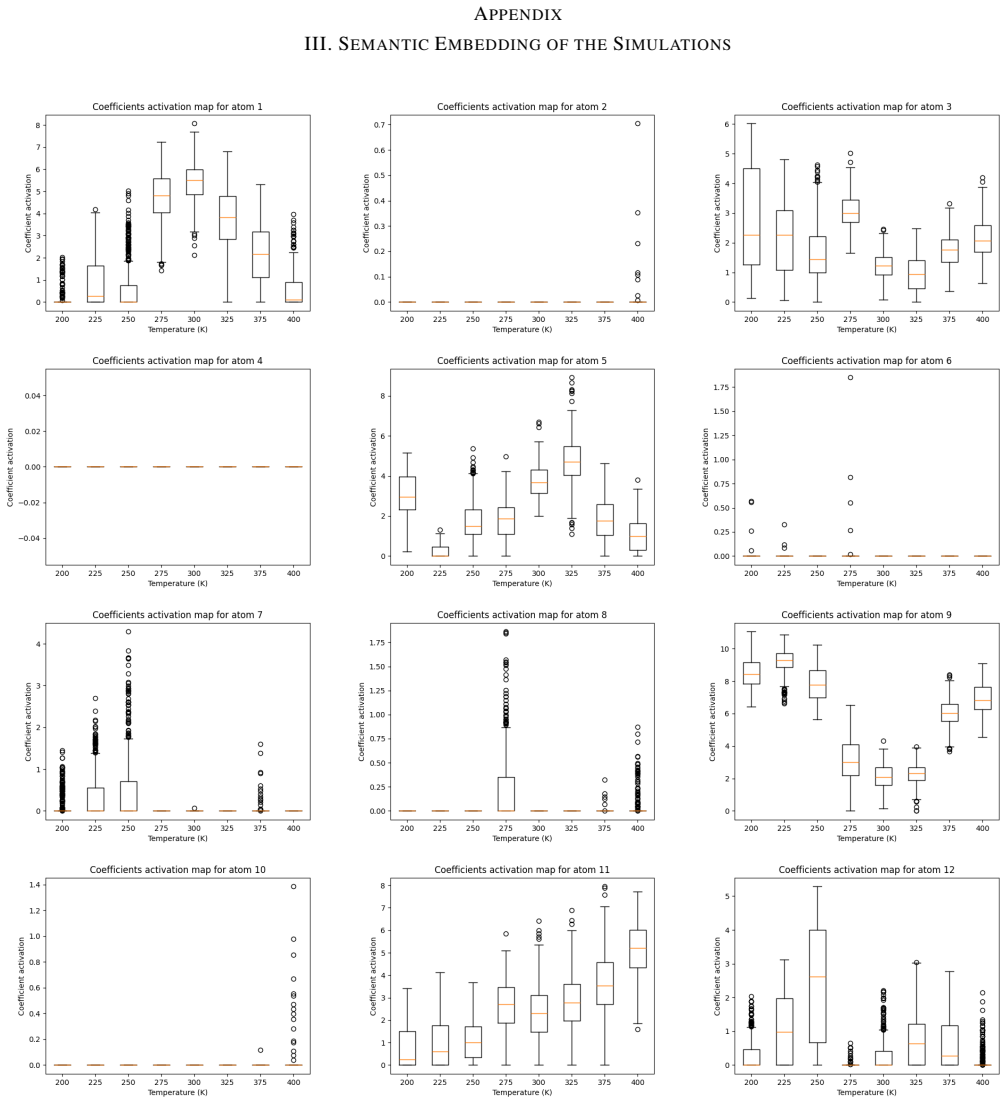
Anton S Zadorin, Yannick Rondelez, Guillaume Gines, Vadim Dilhas, Georg Urtel, Adrian Zambrano, Jean-Christophe Galas, and Andr ´e Estevez-Torres. Synthesis and materialization of a reaction–diffusion french flag pattern.Nature chemistry, 9(10):990–996, 2017. APPENDIX III. SEMANTICEMBEDDING OF THESIMULATIONS Fig. 10. Box plot activations for all the12atom...
work page 2017
discussion (0)
Sign in with ORCID, Apple, or X to comment. Anyone can read and Pith papers without signing in.