Quasi-stationary Slice Detection-Based Robust Respiration Rate Estimation under Large-scale Random Body Movement
Pith reviewed 2026-05-10 20:14 UTC · model grok-4.3
The pith
Detecting quasi-stationary slices in radar signals allows accurate respiration rate estimation even with large random body movements.
A machine-rendered reading of the paper's core claim, the machinery that carries it, and where it could break.
Core claim
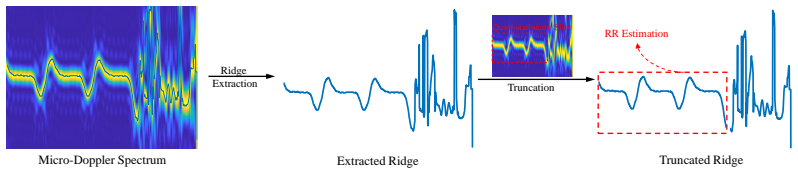
The proposed scheme uses an enhanced deep neural network with dynamic snake convolution to detect quasi-stationary slices in micro-Doppler spectra, then restricts respiration rate estimation to the ridges consistent with those slices, thereby mitigating large-scale random body movement interferences and reducing estimation error.
What carries the argument
Quasi-stationary slice detection in micro-Doppler spectra using dynamic snake convolution-enhanced neural network, followed by selective ridge-based estimation.
Load-bearing premise
The identified quasi-stationary slices contain unbiased respiration information that represents the true breathing rate without systematic distortion or omission.
What would settle it
An experiment showing that RR estimates from the detected slices consistently differ from simultaneous ground-truth measurements obtained by a contact sensor in the presence of controlled large body movements.
Figures




read the original abstract
Radar-based non-contact respiration rate (RR) measurement has become increasingly popular due to its convenience, non-intrusiveness, and low cost. However, it is still quite challenging to accurately acquire vital signs estimation in complex measurement scenarios with large-scale random body movements (RBM), particularly for RR estimation due to strong low-frequency interferences. To cope with the RBM challenge in RR estimation, we propose a novel two-stage RR estimation scheme involving detecting the portion of signals, called as quasi-stationary slices, exhibiting the quasi-stationary pattern. At the detection stage, an enhanced deep neural network framework incorporating the dynamic snake convolution is exploited to detect the quasi-stationary slices in the micro-Doppler spectra. At the estimation stage, we mitigate RBM interferences and achieve accurate RR estimation by only using the portion of ridges consistent with the location of detected quasi-stationary slice. Extensive experimental results demonstrate that our proposed scheme can accurately detect quasi-stationary slices under normal scenarios with large-scale RBM, thereby reducing the error of subsequent RR estimation.
Editorial analysis
A structured set of objections, weighed in public.
Referee Report
Summary. The manuscript proposes a two-stage radar-based respiration rate (RR) estimation pipeline to address large-scale random body movements (RBM). In the detection stage, an enhanced DNN incorporating dynamic snake convolution identifies quasi-stationary slices within micro-Doppler spectra. In the estimation stage, RR is computed exclusively from ridges whose locations align with the detected slices, thereby suppressing low-frequency RBM interference. The authors claim that extensive experiments confirm accurate slice detection under normal scenarios with large-scale RBM and a consequent reduction in RR estimation error.
Significance. If the experimental claims and the unbiased-slice assumption hold, the work could meaningfully advance non-contact vital-signs monitoring by providing a practical way to isolate respiration information amid strong motion artifacts. The targeted adaptation of dynamic snake convolution to micro-Doppler slice detection is a concrete technical contribution that integrates recent convolutional advances with established radar signal-processing pipelines.
major comments (3)
- [Abstract] Abstract: The headline claim that the scheme 'reducing the error of subsequent RR estimation' rests entirely on 'extensive experimental results,' yet the manuscript supplies no quantitative metrics (MAE, RMSE, error bars), dataset descriptions, subject counts, baseline comparisons, or statistical tests. This absence is load-bearing because the central contribution is the asserted error reduction rather than the algorithmic novelty alone.
- [Estimation stage] Estimation-stage description: The method implicitly assumes that the local periodicity inside detected quasi-stationary slices equals the long-term average breathing rate even when RBM is present. No analysis, simulation, or experiment is shown to verify that the slice-selection criterion does not systematically bias the ridge locations relative to the true average RR (e.g., by preferentially capturing momentary stable intervals while the overall rate drifts).
- [Experimental results] Experimental protocol: No information is given on how the DNN is trained (loss function, data augmentation, ground-truth labeling of quasi-stationary slices), what performance metrics are used for detection accuracy, or how the 'consistent ridges' are extracted and aggregated into a final RR value. These omissions prevent independent assessment of reproducibility and robustness.
minor comments (3)
- The term 'quasi-stationary pattern' is introduced without a precise mathematical definition or threshold (e.g., maximum frequency deviation or phase-stability criterion) that would allow readers to reproduce the slice-labeling process.
- Missing reference to the original dynamic snake convolution paper and to prior micro-Doppler RR estimation methods that also attempt to mitigate body motion.
- Figure captions and axis labels for the micro-Doppler spectra and detected slices should be expanded to indicate the time-frequency resolution and the exact meaning of the color scale.
Simulated Author's Rebuttal
We thank the referee for the constructive and detailed comments, which have helped us identify areas for improvement. We address each major comment below and will revise the manuscript to enhance its clarity, completeness, and rigor.
read point-by-point responses
-
Referee: [Abstract] Abstract: The headline claim that the scheme 'reducing the error of subsequent RR estimation' rests entirely on 'extensive experimental results,' yet the manuscript supplies no quantitative metrics (MAE, RMSE, error bars), dataset descriptions, subject counts, baseline comparisons, or statistical tests. This absence is load-bearing because the central contribution is the asserted error reduction rather than the algorithmic novelty alone.
Authors: We agree that the abstract would be strengthened by including quantitative support. In the revised manuscript, we will update the abstract to explicitly state key metrics such as MAE and RMSE reductions achieved, along with brief references to the experimental setup (e.g., subject counts and baseline methods). We will also ensure the experimental results section clearly presents all supporting data, including error bars, dataset descriptions, and statistical tests. revision: yes
-
Referee: [Estimation stage] Estimation-stage description: The method implicitly assumes that the local periodicity inside detected quasi-stationary slices equals the long-term average breathing rate even when RBM is present. No analysis, simulation, or experiment is shown to verify that the slice-selection criterion does not systematically bias the ridge locations relative to the true average RR (e.g., by preferentially capturing momentary stable intervals while the overall rate drifts).
Authors: This concern about potential selection bias is well-taken. The quasi-stationary slices are intended to isolate intervals free of large-scale RBM, allowing ridge-based RR extraction to reflect respiration without low-frequency interference. To verify the assumption, we will add a dedicated analysis subsection (including simulations or targeted experiments) in the revised manuscript demonstrating that the selected ridges align with the ground-truth average RR without systematic drift-induced bias. revision: yes
-
Referee: [Experimental results] Experimental protocol: No information is given on how the DNN is trained (loss function, data augmentation, ground-truth labeling of quasi-stationary slices), what performance metrics are used for detection accuracy, or how the 'consistent ridges' are extracted and aggregated into a final RR value. These omissions prevent independent assessment of reproducibility and robustness.
Authors: We apologize for the insufficient detail on the experimental protocol. The revised manuscript will expand the relevant sections to fully describe the DNN training (including loss function, data augmentation techniques, and ground-truth labeling procedure for quasi-stationary slices), the detection performance metrics employed, and the exact method for extracting consistent ridges and aggregating them into the final RR estimate. This will facilitate reproducibility. revision: yes
Circularity Check
No significant circularity in the two-stage detection-plus-estimation pipeline
full rationale
The paper describes a detection stage that applies an enhanced DNN with dynamic snake convolution to micro-Doppler spectra in order to locate quasi-stationary slices, followed by an estimation stage that restricts ridge-based RR calculation to those detected locations. No equations, fitted parameters, or self-citations are shown that would make the RR estimate equivalent to the detection criterion by construction. The central claim rests on experimental results that the selected slices reduce estimation error, which is presented as an independent empirical outcome rather than a definitional or fitted tautology. This is a standard methodological pipeline whose validity can be assessed against external ground-truth RR measurements without internal reduction to its own inputs.
Axiom & Free-Parameter Ledger
Lean theorems connected to this paper
-
IndisputableMonolith/Foundation/RealityFromDistinction.leanreality_from_one_distinction unclear?
unclearRelation between the paper passage and the cited Recognition theorem.
two-stage RR estimation scheme involving detecting the portion of signals, called as quasi-stationary slices... enhanced deep neural network framework incorporating the dynamic snake convolution... truncate the ridges according to the detected quasi-stationary slices
-
IndisputableMonolith/Cost/FunctionalEquation.leanwashburn_uniqueness_aczel unclear?
unclearRelation between the paper passage and the cited Recognition theorem.
R(n) = max_k STFT(n,k)... RR of the quasi-stationary slices can be estimated by calculating the frequency of the truncated ridges
What do these tags mean?
- matches
- The paper's claim is directly supported by a theorem in the formal canon.
- supports
- The theorem supports part of the paper's argument, but the paper may add assumptions or extra steps.
- extends
- The paper goes beyond the formal theorem; the theorem is a base layer rather than the whole result.
- uses
- The paper appears to rely on the theorem as machinery.
- contradicts
- The paper's claim conflicts with a theorem or certificate in the canon.
- unclear
- Pith found a possible connection, but the passage is too broad, indirect, or ambiguous to say the theorem truly supports the claim.
Reference graph
Works this paper leans on
-
[1]
Vital Signs: Core Metrics for Health and Health Care Progress,
D. Blumenthal, E. Malphrus, and J. M. McGinnis, “Vital Signs: Core Metrics for Health and Health Care Progress,” National Academies,
-
[2]
Remote respi- ratory monitoring in the time of covid-19,
C. Massaroni, A. Nicol `o, E. Schena, and M. Sacchetti, “Remote respi- ratory monitoring in the time of covid-19,” Frontiers in physiology, vol. 11, pp. 635, 2020
work page 2020
-
[3]
Dopplesleep: A contactless unobtrusive sleep sensing system using short-range doppler radar,
T. Rahman, A. T. Adams, R. V . Ravichandran, M. Zhang, S. N. Patel, J. A. Kientz, and T. Choudhury, “Dopplesleep: A contactless unobtrusive sleep sensing system using short-range doppler radar,” in Proceedings of the 2015 ACM international joint conference on pervasive and ubiquitous computing, 2015, pp. 39–50
work page 2015
-
[4]
Random body movement cancellation method for FMCW radar vital sign detection,
H. Shang, X. Zhang, Y . Ma, Z. Li, and C. Jin, “Random body movement cancellation method for FMCW radar vital sign detection,” in 2019 IEEE international conference on signal, information and data processing, 2019, pp. 1-4
work page 2019
-
[5]
Advances in Nonlinear Blind Source Separation,
C. Jutten and J. Karhunen, “Advances in Nonlinear Blind Source Separation,” in Proceedings of the 4th international symposium on Independent Component Analysis and Blind Signal Separation, 2003, pp.245–256
work page 2003
-
[6]
J. Tu, T. Hwang, and J. Lin, “Respiration rate measurement under 1-D body motion using single continuous-wave Doppler radar vital sign detection system,” IEEE Transactions on Microwave Theory and Techniques, vol. 64, no. 6, pp. 1937–1946, 2016
work page 1937
-
[7]
A non-contact vital signs detection in a multi-channel 77GHz LFMCW radar system,
Q. Wu, Z. Mei, Z. Lai, D. Li, and D. Zhao, “A non-contact vital signs detection in a multi-channel 77GHz LFMCW radar system,” IEEE Access, vol. 9, pp. 49614-49628, 2021
work page 2021
-
[8]
Z. Xie, B. Zhou, and F. Ye. ”Signal quality detection towards practical non-touch vital sign monitoring.” in Proceedings of the 12th ACM Conference on Bioinformatics, Computational Biology, and Health In- formatics, 2021, pp. 1-9
work page 2021
-
[9]
Z. Xie, H. Wang, S. Han, E. Schoenfeld, and F. Ye. ”DeepVS: a deep learning approach for RF-based vital signs sensing.” in Proceedings of the 13th ACM international conference on bioinformatics, computational biology and health informatics, 2022, pp. 1-5
work page 2022
-
[10]
Random body movement cancellation in Doppler radar vital sign detection,
C. Li and J. Lin, “Random body movement cancellation in Doppler radar vital sign detection,” IEEE Transactions on Microwave Theory and Techniques, vol. 56, no. 12, pp. 3143–3152, 2008
work page 2008
-
[11]
F. K. Wang, T. S. Horng, K. C. Peng, J. K. Jau, J. Y . Li, and C. C. Chen, “Single-antenna Doppler radars using self and mutual injection locking for vital sign detection with random body movement cancellation,” IEEE Transactions on Microwave Theory and Techniques, vol. 59, no. 12, pp. 3577–3587, 2011
work page 2011
-
[12]
C. Gu, G. Wang, Y . Li, T. Inoue, and C. Li, “A hybrid radar-camera sensing system with phase compensation for random body movement cancellation in Doppler vital sign detection,” IEEE Transactions on Microwave Theory and Techniques, vol. 61, no. 12, pp. 4678–4688, 2013
work page 2013
-
[13]
Z. Xie, B. Zhou, X. Cheng, E. Schoenfeld, and F. Ye. ”Vitalhub: Robust, non-touch multi-user vital signs monitoring using depth camera- aided uwb.” in 2021 IEEE 9th International Conference on Healthcare Informatics (ICHI), 2021, pp. 320-329
work page 2021
-
[14]
J. Glenn, ”Ultralytics YOLOv8. https://github.com/ultralytics/ultralytics,” 2023
work page 2023
-
[15]
Y . Qi, Y . He, X. Qi, Y . Zhang, G. Yang, “Dynamic Snake Convolution based on Topological Geometric Constraints for Tubular Structure Seg- mentation,” in Proceedings of the IEEE/CVF International Conference on Computer Vision, 2023, pp. 6070-6079
work page 2023
-
[16]
Multitarget Respiration Monitoring Based on Cumulative Phase Gradient Approach,
Q. Wu, X. Huang, Y . Chen, J. Li, and W. Zhu, “Multitarget Respiration Monitoring Based on Cumulative Phase Gradient Approach,” IEEE Geoscience and Remote Sensing Letters, vol. 20, pp. 1-5, 2023
work page 2023
-
[17]
Harmonic Suppres- sion Phase Gradient Demodulation for Vital Sign Monitoring,
J. Li, Y . Chen, S. Yao, P. Li, K. Yin, and Q. Wu, “Harmonic Suppres- sion Phase Gradient Demodulation for Vital Sign Monitoring,” IEEE Transactions on Instrumentation and Measurement, 2023, in press
work page 2023
-
[18]
Revisiting the sibling head in object detector,
G. Song, L. Yu, and X Wang, “Revisiting the sibling head in object detector,” in Proceedings of the IEEE/CVF conference on computer vision and pattern recognition, 2020, pp. 11563-11572
work page 2020
-
[19]
H. Liu, A. N. Cartwright, C. Basaran, “Moire interferogram phase ex- traction: a ridge detection algorithm for continuous wavelet transforms,” Applied optics, vol. 43, no. 4, pp. 850–857, 2004
work page 2004
discussion (0)
Sign in with ORCID, Apple, or X to comment. Anyone can read and Pith papers without signing in.