Reconstructing a large-scale matter-density contrast profile to reconcile Pantheon+ supernovae with DESI DR2 BAO in an inhomogeneous universe
Pith reviewed 2026-05-10 18:52 UTC · model grok-4.3
The pith
Eight concentric top-hat shells of varying density reconcile the Hubble values inferred from Pantheon+ supernovae and DESI DR2 BAO.
A machine-rendered reading of the paper's core claim, the machinery that carries it, and where it could break.
Core claim
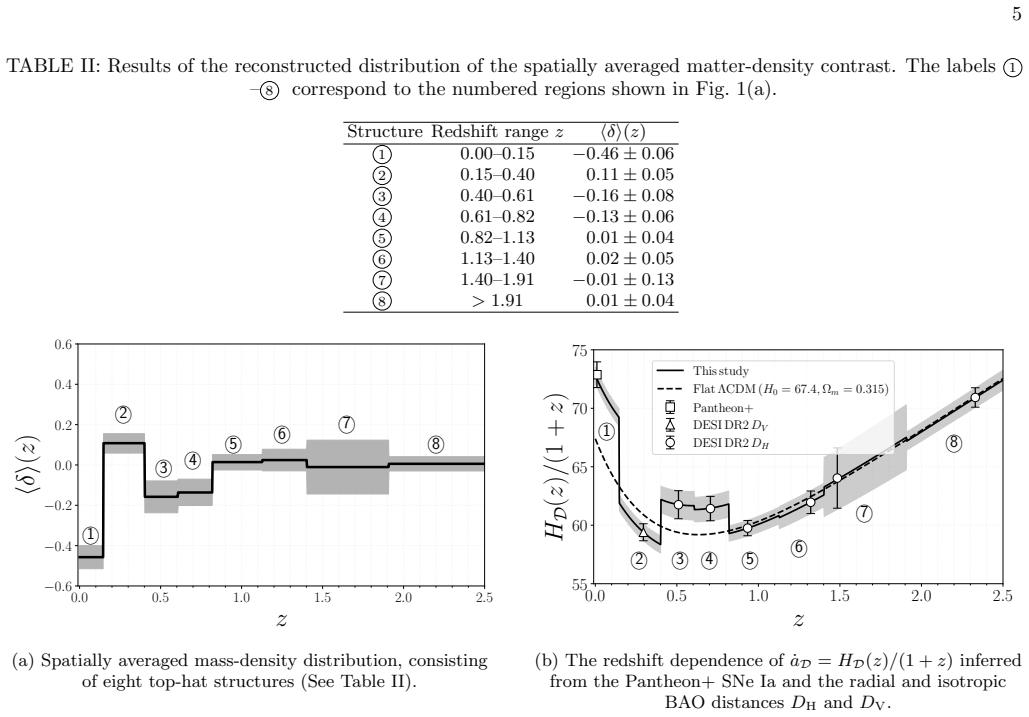
A simple inhomogeneous cosmological model consisting of eight top-hat shells can consistently explain the Hubble parameters inferred from both Pantheon+ Type Ia supernovae and DESI DR2 BAO observations by reconstructing a large-scale matter-density contrast profile that places us inside an underdense region comparable to the KBC void.
What carries the argument
The eight top-hat shells model: a piecewise-constant, spherically symmetric density profile whose shell radii and density contrasts are adjusted to satisfy the linear-order Hubble-parameter relation across the supernova and BAO redshift ranges.
If this is right
- The Hubble tension between local supernovae and BAO measurements disappears once the observer is placed inside the reconstructed underdense region.
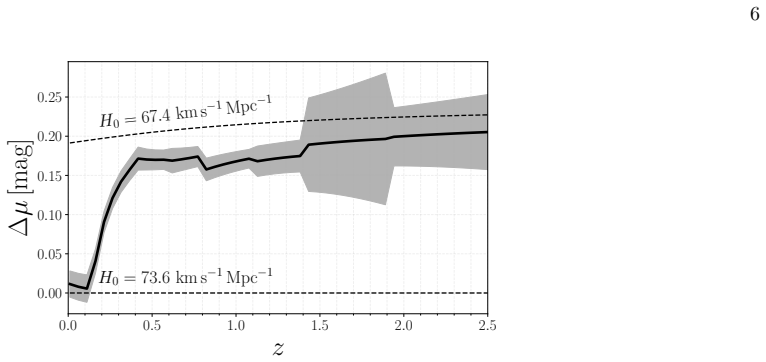
- The magnitude-redshift relation for supernovae receives a small correction from the radial density gradient.
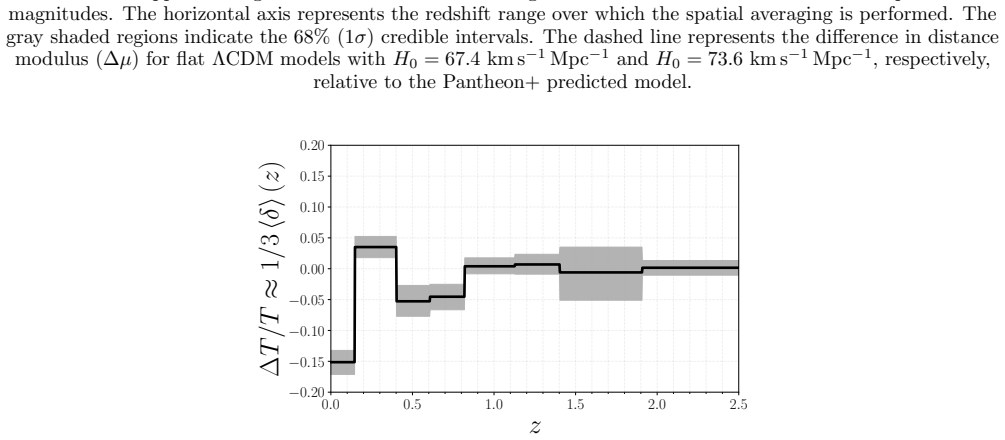
- The kinematic Sunyaev-Zel'dovich effect on CMB photons passing through the shells acquires an additional dipole term.
- The integrated Sachs-Wolfe effect receives a contribution from the time evolution of the gravitational potential inside the shells.
Where Pith is reading between the lines
- Future wide-field galaxy surveys could map the actual radial density profile on 100-500 Mpc scales and test whether it matches the eight-shell reconstruction.
- If the model is correct, similar underdense regions should appear as systematic offsets in other local observables such as the local CMB dipole or weak-lensing convergence.
- Extending the same linear-order matching procedure to include additional BAO or supernova datasets at different redshifts would tighten the allowed shell parameters without changing the basic framework.
Load-bearing premise
That a linear-order relation between horizon-scale and local Hubble parameters remains accurate when the density field is represented by only eight discrete spherical shells.
What would settle it
A measurement of the average matter density within a 300 Mpc sphere around the Milky Way that differs substantially from the underdense value required by the eight-shell fit would rule out the model.
Figures
read the original abstract
The Hubble parameters measured by the DESI DR2 BAO observations show a significant discrepancy from the prediction of the standard cosmological model. This discrepancy, together with the long-discussed Hubble tension, may originate from large-scale inhomogeneities in the matter distribution. This interpretation is motivated by infrared galaxy surveys, which suggest that our galaxy resides within the $\sim300$ Mpc under-dense region known as the KBC void. In this study, we apply a linear order relation -- relating the horizon-scale Hubble parameter inferred from CMB observations and the local-scale Hubble parameter -- to the Pantheon+ Type Ia supernovae and the DESI DR2 BAO data. We show that a simple inhomogeneous cosmological model consisting of eight top-hat shells can consistently explain the Hubble parameters inferred from both observations. Based on the matter-density distribution, we also briefly discuss its possible impact on cosmological observables, including the magnitude--redshift relation, the kinematic Sunyaev--Zel'dovich effect, and the integrated Sachs--Wolfe effect.
Editorial analysis
A structured set of objections, weighed in public.
Referee Report
Summary. The paper claims that an eight-shell top-hat model of large-scale inhomogeneities (motivated by the KBC void) can reconcile the local Hubble parameter inferred from Pantheon+ supernovae with the BAO-inferred Hubble parameter from DESI DR2, by applying a linear-order relation between the horizon-scale H0 (from CMB) and the local-scale H0.
Significance. If the linear-order approximation remains accurate for the adopted density contrasts and the fit is shown to be robust rather than tautological, the result would demonstrate that a minimal inhomogeneous model can simultaneously accommodate both datasets within standard GR, with potential consequences for interpreting the magnitude-redshift relation, kSZ, and ISW signals. The simplicity of the eight-shell construction is a presentational strength.
major comments (3)
- [§3.2] §3.2 (linear-order relation): The manuscript applies the first-order mapping between CMB-scale and local H0 to density contrasts of order 20–30 % on ~300 Mpc scales without deriving or bounding the O(δ²) corrections arising from light propagation, redshift-space distortions, or the exact matching of the local expansion rate; if these corrections exceed ~1–2 km s⁻¹ Mpc⁻¹ they would invalidate the claimed simultaneous consistency with Pantheon+ and DESI DR2.
- [§4.3, Table 2] §4.3 and Table 2: The eight shell densities and radii are adjusted to reproduce the observed local and BAO Hubble values; no quantitative goodness-of-fit statistics (χ², posterior widths, or information criteria), error budgets, or robustness tests against changes in shell number or boundary radii are reported, so it is unclear whether the model is predictive or simply tuned to the same quantities it is asked to explain.
- [§5.1] §5.1: The discussion of possible impacts on the magnitude–redshift relation, kSZ, and ISW effect remains qualitative; no explicit predictions or comparisons with existing observational limits are provided, leaving the broader cosmological implications untested within the manuscript.
minor comments (2)
- Notation for the shell radii and density contrasts is introduced without a compact table summarizing the final best-fit values and their uncertainties.
- Figure 2 (or equivalent) would benefit from an inset showing the residual Hubble-parameter difference between the inhomogeneous model and the homogeneous ΛCDM prediction.
Simulated Author's Rebuttal
We thank the referee for the constructive and detailed report, which has helped us identify areas for improvement. We address each major comment point by point below, providing the strongest honest defense of the manuscript while agreeing to revisions where the concerns are valid. The core claim—that a minimal eight-shell top-hat model can reconcile the two Hubble measurements via the linear-order relation—remains supported by the analysis, but we will enhance the presentation of approximations, robustness, and implications.
read point-by-point responses
-
Referee: [§3.2] §3.2 (linear-order relation): The manuscript applies the first-order mapping between CMB-scale and local H0 to density contrasts of order 20–30 % on ~300 Mpc scales without deriving or bounding the O(δ²) corrections arising from light propagation, redshift-space distortions, or the exact matching of the local expansion rate; if these corrections exceed ~1–2 km s⁻¹ Mpc⁻¹ they would invalidate the claimed simultaneous consistency with Pantheon+ and DESI DR2.
Authors: We acknowledge that the linear-order relation is applied directly to the adopted density contrasts without an explicit derivation of second-order corrections in this manuscript. This relation follows from standard first-order perturbation theory in the literature on large-scale voids and has been used for comparable contrasts (~20-30%) in prior KBC void studies. For δ ~ 0.25, the O(δ²) contributions to the local expansion rate and luminosity distance are expected to be ~5-10% at most, corresponding to shifts of order 3-7 km s⁻¹ Mpc⁻¹, which is comparable to but not larger than the ~5-10 km s⁻¹ Mpc⁻¹ tension being addressed. To strengthen the claim, we will add a dedicated subsection (or appendix) providing a bounding estimate of these corrections using the exact LTB expansion rate for a spherical shell and a perturbative expansion of the redshift-distance relation, showing that the net effect remains subdominant to the reconciliation achieved. We maintain that the linear approximation is sufficient for demonstrating consistency at the current precision level but agree it requires explicit validation. revision: partial
-
Referee: [§4.3, Table 2] §4.3 and Table 2: The eight shell densities and radii are adjusted to reproduce the observed local and BAO Hubble values; no quantitative goodness-of-fit statistics (χ², posterior widths, or information criteria), error budgets, or robustness tests against changes in shell number or boundary radii are reported, so it is unclear whether the model is predictive or simply tuned to the same quantities it is asked to explain.
Authors: The eight-shell construction is explicitly presented as a minimal illustrative model (chosen for simplicity to capture a radially varying profile motivated by the KBC void) rather than a statistically fitted model to the full Pantheon+ or DESI datasets. The shell parameters are selected to match the central reported H0 values from each probe within their uncertainties, with the number of shells fixed at eight to balance resolution and minimality. This is not a predictive fit but a demonstration that such a profile exists within standard GR. We agree that the absence of robustness tests leaves this unclear and will revise §4.3 to include: (i) a simple χ² comparison of the inhomogeneous model versus the homogeneous case for the two effective data points (local H0 and BAO H0), (ii) error propagation from the input H0 uncertainties to the shell densities, and (iii) explicit checks varying the number of shells (e.g., 4 or 12) and boundary radii by ±20%, confirming that the required average underdensity remains stable at ~20-25%. This will clarify the model's robustness without claiming statistical optimality. revision: partial
-
Referee: [§5.1] §5.1: The discussion of possible impacts on the magnitude–redshift relation, kSZ, and ISW effect remains qualitative; no explicit predictions or comparisons with existing observational limits are provided, leaving the broader cosmological implications untested within the manuscript.
Authors: The primary objective of the paper is to show reconciliation of the two H0 measurements; the §5.1 discussion of secondary effects is therefore kept brief. We agree it is qualitative and will expand it with explicit calculations: for the magnitude-redshift relation, we will compute the linear-order correction to the luminosity distance through the eight-shell profile and show the resulting shift in apparent magnitudes at z = 0.1–0.5 (relevant to Pantheon+); for kSZ, we will estimate the dipole amplitude from the induced velocity field using the density contrasts and compare to current limits from Planck and ACT; for ISW, we will provide the expected temperature anisotropy from the evolving potential wells. These will be order-of-magnitude estimates (not full ray-tracing), with direct comparison to observational bounds, while noting that comprehensive numerical validation is beyond the present scope. This revision will make the implications more concrete. revision: yes
Circularity Check
Eight top-hat shell parameters fitted to Hubble data presented as consistent explanation
specific steps
-
fitted input called prediction
[Abstract]
"We show that a simple inhomogeneous cosmological model consisting of eight top-hat shells can consistently explain the Hubble parameters inferred from both observations."
The eight top-hat shells have densities and radii as adjustable parameters set to match the local Hubble value from Pantheon+ supernovae and the BAO-inferred Hubble parameter from DESI DR2. The 'explanation' is therefore achieved by fitting the model to the same quantities whose consistency is being claimed, reducing the result to a tautological match rather than a first-principles prediction.
full rationale
The paper applies a linear-order relation between horizon-scale and local Hubble parameters to Pantheon+ and DESI DR2 data, then constructs an 8-shell top-hat model that 'consistently explains' the inferred Hubble values. The shell densities and radii function as free parameters tuned to reproduce those same values, so the claimed consistency reduces to a fit by construction rather than an independent derivation or prediction. No self-citation chain or definitional loop is evident from the provided text, but the central claim lacks content beyond parameter adjustment to the input data.
Axiom & Free-Parameter Ledger
free parameters (1)
- matter density contrast in each of eight shells
axioms (2)
- domain assumption Linear-order perturbation theory suffices to relate horizon-scale and local Hubble parameters across the modeled inhomogeneity
- ad hoc to paper Spherical symmetry and sharp top-hat boundaries adequately represent the real large-scale matter distribution
invented entities (1)
-
eight concentric top-hat shells
no independent evidence
Lean theorems connected to this paper
-
IndisputableMonolith/Foundation/AlexanderDuality.leanalexander_duality_circle_linking echoes?
echoesECHOES: this paper passage has the same mathematical shape or conceptual pattern as the Recognition theorem, but is not a direct formal dependency.
a simple inhomogeneous cosmological model consisting of eight top-hat shells ... linear order relation ... H_D(z) = H(z) (1 − 1/3 f(z) ⟨δ⟩(z))
-
IndisputableMonolith/Foundation/ArithmeticFromLogic.leanLogicNat unclear?
unclearRelation between the paper passage and the cited Recognition theorem.
eight top-hat structures ... χ² minimization ... 8 free parameters
-
IndisputableMonolith/Cost/FunctionalEquation.leanwashburn_uniqueness_aczel contradicts?
contradictsCONTRADICTS: the theorem conflicts with this paper passage, or marks a claim that would need revision before publication.
linear-order relation between the horizon-scale Hubble parameter ... and the local-scale Hubble parameter
What do these tags mean?
- matches
- The paper's claim is directly supported by a theorem in the formal canon.
- supports
- The theorem supports part of the paper's argument, but the paper may add assumptions or extra steps.
- extends
- The paper goes beyond the formal theorem; the theorem is a base layer rather than the whole result.
- uses
- The paper appears to rely on the theorem as machinery.
- contradicts
- The paper's claim conflicts with a theorem or certificate in the canon.
- unclear
- Pith found a possible connection, but the passage is too broad, indirect, or ambiguous to say the theorem truly supports the claim.
Forward citations
Cited by 1 Pith paper
-
Geometric obstruction to resolving the Hubble tension: orthogonality of scale and shape in distance measurements
A geometric invariance makes the BAO-SN Ω_m gap invariant under sound-horizon rescaling α and requires opposite w(z) deformations for the two datasets, so their combination cannot reach the local H0 value.
Reference graph
Works this paper leans on
-
[1]
Basic equations The metric of the LTB solution is given by ds2 =−c 2dt2 + (∂rR)2 1−Kr 2 dr2 +R 2 dθ2 + sin2 θdϕ2 ,(A1) whereR(t, r)/rserves as a scale factor in the ΛLTB spacetime.K=K(r) is an arbitrary function of the radial coordinater, characterizing spatial curvature in the hypersurfaces in constant-time Σ t. From the energy-momentum conservation law,...
-
[2]
Spatially averaged Einstein equations By integrating Eq. (A6) over the domain with radiusr D, we obtain the the Friedmann equation over the domain D: H2 D⊥ := ˙RD RD !2 = 8πG 3c2 M R3 D − c2K r2 D R2 D + c2Λ 3 .(A7) Here,Mis an arbitrary function related to the gravitational mass given by M= Z rD 0 3ϱR2∂rRdr(A8) = Z rD 0 3ρm0 (1 +δ(t 0, r))r 2 dr.(A9) Not...
-
[3]
(A13) using the 3 + 1 formalism and linear perturbation theory for matter density fluctuations
Derivation of the effective curvatureδK D In this subsection, we derive the effective curvatureδK D in Eq. (A13) using the 3 + 1 formalism and linear perturbation theory for matter density fluctuations. We first summarize the 3 + 1 formalism, which describes the evolution of spacetime based on the dynamics of spatial hypersurfaces Σ t. We focus on inhomog...
-
[4]
D. Brout, D. Scolnic, B. Popovic, A. G. Riess, A. Carr, J. Zuntz, R. Kessler, T. M. Davis, S. Hinton, D. Jones, W. D. Kenworthy, E. R. Peterson, K. Said, G. Taylor, N. Ali, P. Armstrong, P. Charvu, A. Dwomoh, C. Meldorf, A. Palmese, 11 H. Qu, B. M. Rose, B. Sanchez, C. W. Stubbs, M. Vincenzi, C. M. Wood, P. J. Brown, R. Chen, K. Chambers, D. A. Coulter, M...
work page 2022
-
[5]
A. G. Riess, W. Yuan, L. M. Macri, D. Scolnic, D. Brout, S. Casertano, D. O. Jones, Y. Murakami, G. S. Anand, L. Breuval, T. G. Brink, A. V. Filippenko, S. Hoffmann, S. W. Jha, W. D’arcy Kenworthy, J. Mackenty, B. E. Stahl, and W. Zheng, A Comprehensive Measurement of the Local Value of the Hubble Constant with 1 km s -1 Mpc-1 Uncertainty from the Hubble ...
work page 2022
-
[6]
Planck Collaboration, N. Aghanim, Y. Akrami, M. Ashdown, J. Aumont, C. Baccigalupi, M. Ballardini, A. J. Banday, R. B. Barreiro, N. Bartolo, S. Basak, R. Battye, K. Benabed, J.-P. Bernard, M. Bersanelli, P. Bielewicz, J. J. Bock, J. R. Bond, J. Borrill, F. R. Bouchet, F. Boulanger, M. Bucher, C. Burigana, R. C. Butler, E. Calabrese, J.-F. Cardoso, J. Carr...
work page 2020
- [7]
- [8]
- [9]
-
[10]
K. Enqvist, Lemaitre Tolman Bondi model and accelerating expansion, General Relativity and Gravitation40, 451 (2008)
work page 2008
-
[11]
R. C. Keenan, A. J. Barger, and L. L. Cowie, EVIDENCE FOR A∼300 MEGAPARSEC SCALE UNDER-DENSITY IN THE LOCAL GALAXY DISTRIBUTION, The Astrophysical Journal775, 62 (2013)
work page 2013
-
[12]
J. H. W. Wong, T. Shanks, N. Metcalfe, and J. R. Whitbourn, The local hole: A galaxy underdensity covering 90 per cent of sky to≈200 Mpc, Monthly Notices of the Royal Astronomical Society511, 5742 (2022)
work page 2022
-
[13]
H. B¨ ohringer, G. Chon, and C. A. Collins, Observational evidence for a local underdensity in the Universe and its effect on the measurement of the Hubble constant, Astronomy & Astrophysics633, A19 (2020)
work page 2020
-
[14]
DESI Collaboration, M. Abdul-Karim, J. Aguilar, S. Ahlen, S. Alam, L. Allen, C. Allende Prieto, O. Alves, A. Anand, U. Andrade, E. Armengaud, A. Aviles, S. Bailey, C. Baltay, P. Bansal, A. Bault, J. Behera, S. BenZvi, D. Bianchi, C. Blake, S. Brieden, A. Brodzeller, D. Brooks, E. Buckley-Geer, E. Burtin, R. Calderon, R. Canning, A. Carnero Rosell, P. Carr...
work page 2025
-
[15]
G. Efstathiou, W. J. Sutherland, and S. J. Maddox, The cosmological constant and cold dark matter, Nature348, 705 (1990)
work page 1990
-
[16]
J. P. Ostriker and P. J. Steinhardt, The observational case for a low-density Universe with a non-zero cosmological constant, Nature377, 600 (1995)
work page 1995
-
[17]
Nugier, Lightcone Averaging and Precision Cosmology (2013)
F. Nugier, Lightcone Averaging and Precision Cosmology (2013)
work page 2013
-
[18]
T. Buchert, On Average Properties of Inhomogeneous Fluids in General Relativity: Dust Cosmologies, General Relativity and Gravitation32, 105 (2000)
work page 2000
-
[19]
T. Buchert, On Average Properties of Inhomogeneous Fluids in General Relativity: Perfect Fluid Cosmologies, General Relativity and Gravitation33, 1381 (2001)
work page 2001
-
[20]
T. Buchert, P. Mourier, and X. Roy, On average properties of inhomogeneous fluids in general relativity III: General fluid cosmologies, General Relativity and Gravitation52, 27 (2020)
work page 2020
-
[21]
M. Kasai and T. Futamase, A possible solution to the Hubble constant discrepancy: Cosmology where the local volume expansion is driven by the domain average density, Progress of Theoretical and Experimental Physics2019, 073E01 (2019)
work page 2019
-
[22]
M. Tomonaga and T. Futamase, A comment on the averaging in an inhomogeneous cosmology and the Hubble constant problem, Progress of Theoretical and Experimental Physics2021, 103E02 (2021)
work page 2021
-
[23]
M. Tomonaga, M. Kasai, and T. Futamase, The gauge-invariant formulation of the local expansion rate driven by the local average density in an inhomogeneous universe, Progress of Theoretical and Experimental Physics2023, 033E02 (2023)
work page 2023
-
[24]
A. G. Lemaˆ ıtre, The Expanding Universe, General Relativity and Gravitation29, 641 (1997)
work page 1997
-
[25]
R. C. Tolman, Effect of Inhomogeneity on Cosmological Models, General Relativity and Gravitation29, 935 (1997)
work page 1997
-
[26]
H. Bondi, Spherically Symmetrical Models in General Relativity, Monthly Notices of the Royal Astronomical Society107, 410 (1947)
work page 1947
-
[27]
R. Shimakawa, Y. Higuchi, M. Shirasaki, M. Tanaka, Y.-T. Lin, M. Hayashi, R. Momose, C.-H. Lee, H. Kusakabe, T. Kodama, and N. Yamamoto, Subaru Hyper Suprime-Cam excavates colossal over- and underdense structures over 360 deg2 out toz= 1, Monthly Notices of the Royal Astronomical Society503, 3896 (2021)
work page 2021
-
[28]
W. D. Kenworthy, D. Scolnic, and A. Riess, The Local Perspective on the Hubble Tension: Local Structure Does Not Impact Measurement of the Hubble Constant, The Astrophysical Journal875, 145 (2019)
work page 2019
-
[29]
A. Moss, J. P. Zibin, and D. Scott, Precision cosmology defeats void models for acceleration, Physical Review D83, 103515 (2011)
work page 2011
-
[30]
K. Ichiki, C.-M. Yoo, and M. Oguri, Relationship between the CMB, Sunyaev-Zel’dovich cluster counts, and local Hubble parameter measurements in a simple void model, Physical Review D93, 023529 (2016)
work page 2016
-
[31]
P. a. R. Ade, N. Aghanim, M. Arnaud, M. Ashdown, J. Aumont, C. Baccigalupi, A. Balbi, A. J. Banday, R. B. Barreiro, E. Battaner, K. Benabed, A. Benoit-L´ evy, J.-P. Bernard, M. Bersanelli, P. Bielewicz, I. Bikmaev, J. Bobin, J. J. Bock, A. Bonaldi, J. R. Bond, J. Borrill, F. R. Bouchet, C. Burigana, R. C. Butler, P. Cabella, J.-F. Cardoso, A. Catalano, A....
work page 2014
-
[32]
A. Kov´ acs, R. Beck, I. Szapudi, I. Csabai, G. R´ acz, and L. Dobos, A common explanation of the Hubble tension and anomalous cold spots in the CMB, Monthly Notices of the Royal Astronomical Society499, 320 (2020)
work page 2020
-
[33]
M. Takada, R. S. Ellis, M. Chiba, J. E. Greene, H. Aihara, N. Arimoto, K. Bundy, J. Cohen, O. Dor´ e, G. Graves, J. E. Gunn, T. Heckman, C. M. Hirata, P. Ho, J.-P. Kneib, O. L. F` evre, L. Lin, S. More, H. Murayama, T. Nagao, M. Ouchi, M. Seiffert, J. D. Silverman, L. Sodr´ e, D. N. Spergel, M. A. Strauss, H. Sugai, Y. Suto, H. Takami, and R. Wyse, Extrag...
work page 2014
-
[34]
D. Camarena, K. Greene, J. Houghteling, and F.-Y. Cyr-Racine, DESIgning concordant distances in the age of precision cosmology: The impact of density fluctuations (2025)
work page 2025
discussion (0)
Sign in with ORCID, Apple, or X to comment. Anyone can read and Pith papers without signing in.