An Additional Resonance Damping Control for Grey-Box D-PMSG Wind Farm Integrated Weak Grid
Pith reviewed 2026-05-10 19:23 UTC · model grok-4.3
The pith
An added control loop can reshape the impedance of hidden D-PMSG wind turbines to damp resonance in weak grids.
A machine-rendered reading of the paper's core claim, the machinery that carries it, and where it could break.
Core claim
The central claim is that incorporating an additional control loop outside the D-PMSG controller allows online reshaping of the external impedance of the grey-box system to increase the magnitude stability margin once resonance occurs, thereby providing effective resonance damping for wind farms integrated with weak grids.
What carries the argument
The Additional Resonance Damping Control (ARDC) loop that uses pre-determined impedance data and Bode-based tuning to modify the system's impedance response in real time.
Load-bearing premise
The frequency sweeping technique accurately obtains the external impedance characteristics of the grey-box D-PMSG, and the Bode-diagram-based method correctly determines the key parameter for the worst stability scenario without full system knowledge.
What would settle it
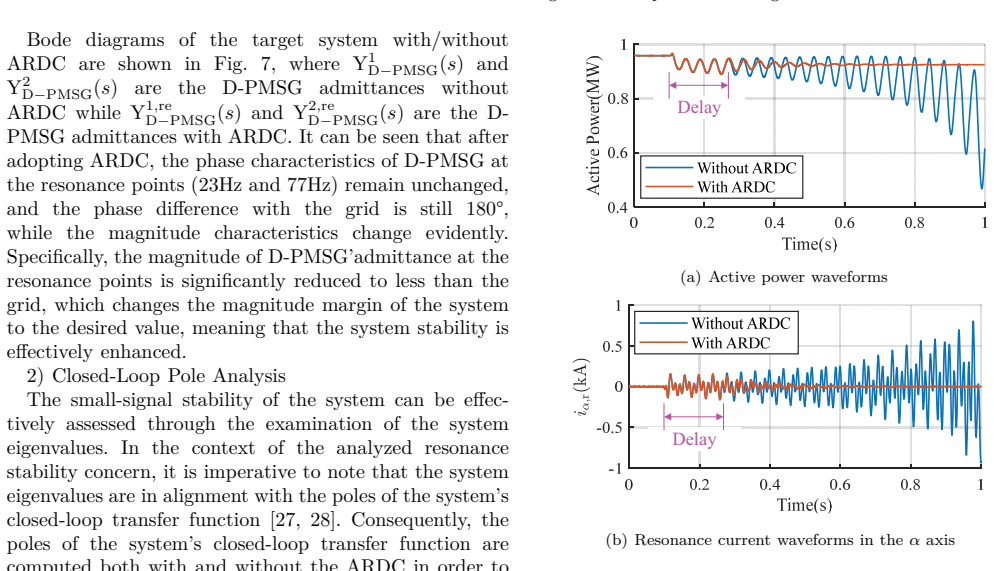
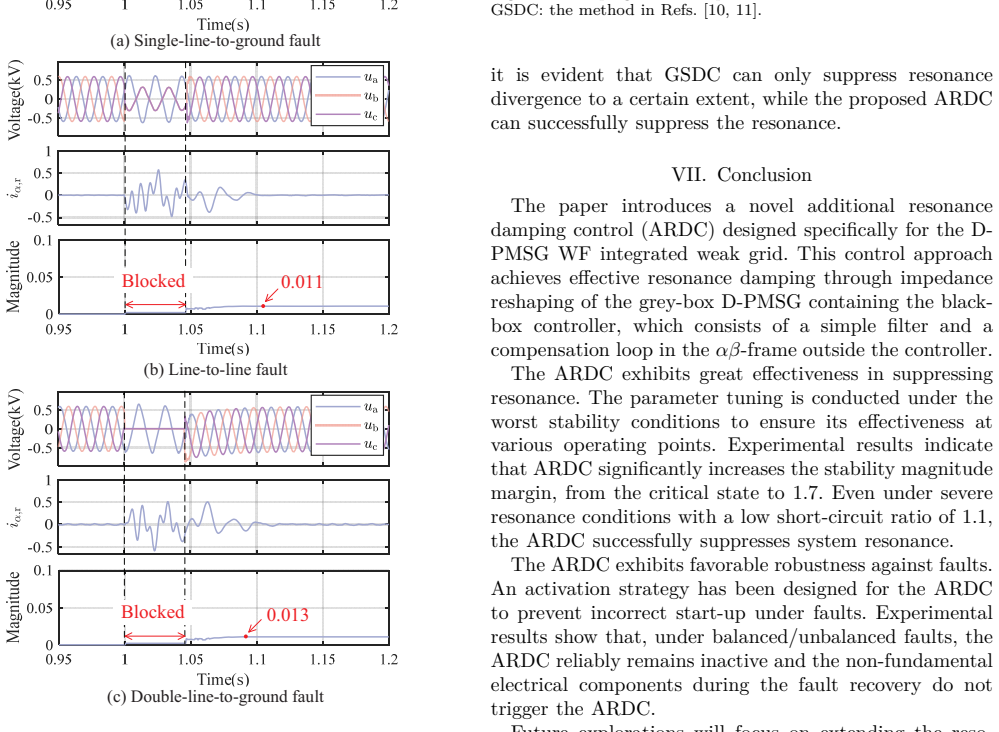
A simulation or experiment where resonance persists or the stability margin does not increase after applying the ARDC under the tested conditions would disprove the effectiveness of the damping method.
Figures




read the original abstract
Considerable efforts have been made to address the resonance issue of the Direct-drive Permanent Magnet Synchronous Generator (D-PMSG) wind farm integrated power systems. However, the D-PMSG controller structure and parameters are concealed because of commercial secrecy, thus the target system exhibits grey-box characteristics. The existing resonance damping methods are either unavailable for grey-box systems or economically infeasible, which makes resonance damping of grey-box systems extremely challenging. To address this issue, this paper proposes an Additional Resonance Damping Control (ARDC) specfically for the grey-box D-PMSG system. This strategy is achieved by incorporating an additional control loop outside the D-PMSG controller. Firstly, the external impedance characteristics are obtained by the frequency sweeping technique ofline and then the key parameter of the additional control loop is determined by the Bode-diagram-based method under the worst stability scenario. Once the resonance occurs, the external impedance of the black-box D-PMSG is reshaped online to increase the magnitude stability margin of the system, thus providing effective resonance damping. The ARDC's effectiveness is finally verfied in the simulation and controller-hardware-in-the-loop experiment under various operating conditions.
Editorial analysis
A structured set of objections, weighed in public.
Referee Report
Summary. The paper proposes an Additional Resonance Damping Control (ARDC) for grey-box D-PMSG wind farms integrated into weak grids. The strategy adds an external control loop whose key parameter is tuned offline: external impedance is obtained via frequency sweeping, then a Bode-diagram analysis under a presumed worst-case stability scenario selects the parameter. Once resonance is detected, the loop is activated to reshape the D-PMSG terminal impedance and thereby increase the system's magnitude stability margin. Effectiveness is asserted via simulation and controller-hardware-in-the-loop (CHIL) experiments under various operating conditions.
Significance. If the offline-tuned reshaping reliably guarantees positive margin under grey-box uncertainty, the method would offer a practical, non-intrusive damping solution for commercial wind farms where controller internals are proprietary. The use of standard frequency-sweeping and Bode techniques plus CHIL verification under multiple conditions is a strength; however, the absence of an analytical robustness bound limits the claimed generality.
major comments (2)
- [ARDC parameter tuning and activation description] In the ARDC design procedure (offline frequency sweeping followed by Bode-diagram parameter selection under the 'worst stability scenario'), no sensitivity analysis or analytical bound is supplied to show that the fixed key parameter maintains a positive magnitude margin when actual grid impedance, other turbines, or operating points deviate from the assumed worst case. Because the full plant is unknown by construction, this assumption is load-bearing for the central claim that online reshaping 'increases the magnitude stability margin' and provides effective damping.
- [Mechanism of impedance reshaping] The abstract asserts that activation of the additional loop 'reshapes the external impedance of the black-box D-PMSG' to raise the stability margin, yet the provided description contains no small-signal model, transfer-function derivation, or explicit expression for the modified terminal impedance Z_out(s) after the loop is closed. Without this, it is impossible to verify that the reshaping direction is always stabilizing rather than potentially destabilizing under unmodeled dynamics.
minor comments (2)
- [Abstract] Abstract contains multiple typos: 'specfically' (specifically), 'verfied' (verified), 'ofline' (offline).
- [Abstract] The abstract states that effectiveness is 'finally verfied in the simulation and controller-hardware-in-the-loop experiment' but supplies no quantitative metrics (e.g., margin improvement, resonance peak reduction, or comparison against baseline).
Simulated Author's Rebuttal
We thank the referee for the thorough and constructive review of our manuscript on the Additional Resonance Damping Control (ARDC) strategy. The comments highlight important aspects of robustness and modeling that we will address in the revision to strengthen the paper's claims for grey-box systems. Our point-by-point responses follow.
read point-by-point responses
-
Referee: In the ARDC design procedure (offline frequency sweeping followed by Bode-diagram parameter selection under the 'worst stability scenario'), no sensitivity analysis or analytical bound is supplied to show that the fixed key parameter maintains a positive magnitude margin when actual grid impedance, other turbines, or operating points deviate from the assumed worst case. Because the full plant is unknown by construction, this assumption is load-bearing for the central claim that online reshaping 'increases the magnitude stability margin' and provides effective damping.
Authors: We agree that the manuscript would be improved by including sensitivity analysis for the offline-tuned parameter. In the revised version, we will add a new subsection with simulation results that vary grid impedance (within practical weak-grid ranges), number of turbines, and operating points (active/reactive power levels) around the worst-case scenario used for tuning. These results will demonstrate that the selected parameter maintains positive magnitude margins in the tested deviations. While a general analytical robustness bound is difficult to derive without internal plant knowledge, the conservative worst-case Bode selection combined with this expanded empirical validation supports the practical effectiveness of the method. We will also explicitly note the limitations of relying on offline tuning in grey-box settings. revision: yes
-
Referee: The abstract asserts that activation of the additional loop 'reshapes the external impedance of the black-box D-PMSG' to raise the stability margin, yet the provided description contains no small-signal model, transfer-function derivation, or explicit expression for the modified terminal impedance Z_out(s) after the loop is closed. Without this, it is impossible to verify that the reshaping direction is always stabilizing rather than potentially destabilizing under unmodeled dynamics.
Authors: We acknowledge the need for a more explicit description of the impedance reshaping. Although the grey-box nature precludes derivation from proprietary internal controller parameters, the additional loop is external and its effect on terminal impedance can be modeled using the measured external impedance characteristics. In the revised manuscript, we will insert a dedicated small-signal modeling section that derives the closed-loop terminal impedance expression Z_out(s) incorporating the ARDC loop, showing analytically how it modifies the magnitude to increase the stability margin at the resonant frequency. This will be based on the frequency-swept impedance data and the loop structure, allowing verification that the reshaping is stabilizing under the modeled conditions. revision: yes
- Deriving a general closed-form analytical robustness bound that guarantees positive margin for arbitrary untested deviations in grid impedance or operating conditions without any internal plant knowledge.
Circularity Check
No circularity in ARDC derivation chain
full rationale
The paper presents a control strategy that obtains D-PMSG external impedance via standard offline frequency sweeping, selects a fixed key parameter via Bode-diagram analysis under an assumed worst-case stability scenario, and then activates an additional loop to reshape terminal impedance for damping. No step reduces by construction to its own inputs: the parameter choice is an engineering assumption rather than a fitted prediction renamed as output, there are no self-citations invoked as load-bearing uniqueness theorems, and the impedance-reshaping claim follows from standard small-signal stability principles without self-definition or ansatz smuggling. The method is therefore self-contained against external benchmarks.
Axiom & Free-Parameter Ledger
free parameters (1)
- key parameter of the additional control loop
axioms (1)
- domain assumption The frequency sweeping technique accurately captures the external impedance characteristics of the grey-box system.
Reference graph
Works this paper leans on
-
[1]
Subsynchronous Interaction Between Direct-Drive PMSG Based Wind Farms and Weak AC Networks,
H. Liu, X. Xie, J. He, T. Xu, Z. Yu, C. Wang, and C. Zhang, “Subsynchronous Interaction Between Direct-Drive PMSG Based Wind Farms and Weak AC Networks,” IEEE Trans. Power Syst., vol. 32, no. 6, pp. 4708–4720, 2017
work page 2017
-
[2]
Y. Li, L. Fan, and Z. Miao, “Wind in Weak Grids: Low-Frequency Oscillations, Subsynchronous Oscil- lations, and Torsional Interactions,” IEEE Trans. Power Syst., vol. 35, no. 1, pp. 109–118, 2020. 14
work page 2020
-
[3]
Harmonic Stability and Resonance Analysis in Large PMSG-Based Wind Power Plants,
E. Ebrahimzadeh, F. Blaabjerg, X. Wang, and C. L. Bak, “Harmonic Stability and Resonance Analysis in Large PMSG-Based Wind Power Plants,” IEEE Trans. Sustain. Energy, vol. 9, no. 1, pp. 12–23, 2018
work page 2018
-
[4]
Wind in Weak Grids: 4 Hz or 30 Hz Oscillations?
L. Fan and Z. Miao, “Wind in Weak Grids: 4 Hz or 30 Hz Oscillations?” IEEE Trans. Power Syst., vol. 33, no. 5, pp. 5803–5804, 2018
work page 2018
-
[5]
Oscillatory Stability Region Analysis of Black-Box CIGs,
W. Liu, J. Shair, S. Wu, and X. Xie, “Oscillatory Stability Region Analysis of Black-Box CIGs,” IEEE Trans. Power Electron., vol. 37, no. 8, pp. 8780–8784, 2022
work page 2022
-
[6]
M. Amin and M. Molinas, “A Gray-Box Method for Stability and Controller Parameter Estimation in HVDC-Connected Wind Farms Based on Non- parametric Impedance,” IEEE Trans. Ind. Electron., vol. 66, no. 3, pp. 1872–1882, 2019
work page 2019
-
[7]
SSR Damping in Fixed-Speed Wind Farms Using Series F ACTS Controllers,
H. A. Mohammadpour, M. M. Islam, E. Santi, and Y.- J. Shin, “SSR Damping in Fixed-Speed Wind Farms Using Series F ACTS Controllers,” IEEE Trans. Power Deliv., vol. 31, no. 1, pp. 76–86, 2016
work page 2016
-
[8]
G. Li, Y. Chen, A. Luo, and X. Liu, “Wideband Harmonic Voltage Feedforward Control Strategy of STATCOM for Mitigating Subsynchronous Reso- nance in Wind Farm Connected to Weak Grid and LCC HVDC,” IEEE J. Emerging Sel. Top. Power Electron., vol. 9, no. 4, pp. 4546–4557, 2021
work page 2021
-
[9]
G. Li, Y. Chen, A. Luo, and H. Wang, “An Enhancing Grid Stiffness Control Strategy of STATCOM/BESS for Damping Sub-Synchronous Resonance in Wind Farm Connected to Weak Grid,” IEEE Trans. Ind. Inf., vol. 16, no. 9, pp. 5835–5845, 2020
work page 2020
-
[10]
J. Shair, X. Xie, H. Li, W. Zhao, and W. Liu, “A Grid-side Multi-modal Adaptive Damping Control of Super-/Sub-synchronous Oscillations in Type-4 Wind Farms Connected to Weak AC Grid,” Electr. Power Syst. Res., vol. 215, p. 108963, 2023
work page 2023
-
[11]
X. Zhang, X. Xie, J. Shair, H. Liu, Y. Li, and Y. Li, “A Grid-Side Subsynchronous Damping Controller to Mitigate Unstable SSCI and Its Hardware-in-the-loop Tests,” IEEE Trans. Sustain. Energy, vol. 11, no. 3, pp. 1548–1558, 2020
work page 2020
-
[12]
G. Li, W. Wang, C. Liu, Y. Jin, H. Nian, and G. He, “ Mechanism Analysis and Suppression Method of Wideband Oscillation of PMSG Wind Farms Con- nected to Weak Grid (Part II): Suppression Method of Wideband Oscillation Based on Impedance Re- shaping,” Proc CSEE, vol. 39, no. 6908-6920+7104, 2019
work page 2019
-
[13]
H. Jiang, C. Yi, C. Shi, H. Yang, M. Li, and X. Zhang, “Suppression of Sub-synchronous Oscilla- tion in Direct-drive Permanent Magnet Wind Turbine Based on Generator-side Converter Compensation Control,” in Asia Conf. Energy Electr. Eng. 2022, 2022, pp. 113–117
work page 2022
-
[14]
X. Zhang, M. Li, and D. Xu, “PCC Voltage Pertur- bation Path Analysis and Compensation for Grid- Connected Voltage-Source Converter Under Weak Grid,” IEEE Trans. Ind. Electron., vol. 68, no. 12, pp. 12 331–12 339, 2021
work page 2021
-
[15]
M. Li, X. Zhang, Z. Guo, J. Wang, Y. Wang, F. Li, and W. Zhao, “The Control Strategy for the Grid- Connected Inverter Through Impedance Reshaping in q-Axis and its Stability Analysis Under a Weak Grid,” IEEE J. Emerging Sel. Top. Power Electron., vol. 9, no. 3, pp. 3229–3242, 2021
work page 2021
-
[16]
S. Yang, R. Shen, J. Shu, T. Zhang, Y. Li, B. Zhang, and Z. Hao, “PLL Based Sub-/Super-Synchronous Resonance Damping Controller for D-PMSG Wind Farm Integrated Power Systems,” IEEE Trans. En- ergy Convers., vol. 37, no. 4, pp. 2370–2384, 2022
work page 2022
-
[17]
G. Li, Y. Chen, A. Luo, and Y. Wang, “An Inertia Phase Locked Loop for Suppressing Sub-Synchronous Resonance of Renewable Energy Generation System Under Weak Grid,” IEEE Trans. Power Syst., vol. 36, no. 5, pp. 4621–4631, 2021
work page 2021
-
[18]
Mitigating Subsynchronous Oscillation Using Model-Free Adaptive Control of DFIGs,
X. Wu, S. Xu, X. Shi, M. Shahidehpour, M. Wang, and Z. Li, “Mitigating Subsynchronous Oscillation Using Model-Free Adaptive Control of DFIGs,” IEEE Trans. Sustain. Energy, vol. 14, no. 1, pp. 242–253, 2023
work page 2023
-
[19]
Black-Box Impedance-Based Stability Assessment of Dynamic Interactions Between Converters and Grid,
N. Cifuentes, M. Sun, R. Gupta, and B. C. Pal, “Black-Box Impedance-Based Stability Assessment of Dynamic Interactions Between Converters and Grid,” IEEE Trans. Power Syst., vol. 37, no. 4, pp. 2976– 2987, 2022
work page 2022
-
[20]
An Argument-Principle Based Stability Assessment Method for Grey-Box DFIG Systems,
T. Zhang, Z. Hao, S. Yang, H. Ma, and B. Zhang, “An Argument-Principle Based Stability Assessment Method for Grey-Box DFIG Systems,” IEEE Trans. Energy Convers., vol. 38, no. 4, pp. 2499–2513, 2023
work page 2023
-
[21]
A Gray-Box Impedance Reshaping Method of Grid- Connected Inverter for Resonance Damping,
W. Zhou, Y. Wang, P. Cai, and Z. Chen, “A Gray-Box Impedance Reshaping Method of Grid- Connected Inverter for Resonance Damping,” in Int. Conf. Power Electron. 2019 - ECCE Asia, 2019, pp. 2660–2667
work page 2019
-
[22]
Small-Signal Modeling and Analysis of DC-Link Dynamics in Type-IV Wind Turbine System,
Y. Xu, H. Nian, and L. Chen, “Small-Signal Modeling and Analysis of DC-Link Dynamics in Type-IV Wind Turbine System,” IEEE Trans. Ind. Electron., vol. 68, no. 2, pp. 1423–1433, 2021
work page 2021
-
[23]
H. Nian, L. Chen, Y. Xu, H. Huang, and J. Ma, “Sequences Domain Impedance Modeling of Three- Phase Grid-Connected Converter Using Harmonic Transfer Matrices,” IEEE Trans. Energy Convers., vol. 33, no. 2, pp. 627–638, 2018
work page 2018
-
[24]
Impedance Modeling and Controllers Shaping Effect Analysis of PMSG Wind Turbines,
B. Liu, Z. Li, X. Dong, S. S. Yu, X. Chen, A. M. T. Oo, X. Lian, Z. Shan, and X. Liu, “Impedance Modeling and Controllers Shaping Effect Analysis of PMSG Wind Turbines,” IEEE J. Emerging Sel. Top. Power Electron., vol. 9, no. 2, pp. 1465–1478, 2021
work page 2021
-
[25]
C. Zhang, X. Cai, A. Rygg, and M. Molinas, “Se- quence Domain SISO Equivalent Models of a Grid- Tied Voltage Source Converter System for Small- Signal Stability Analysis,” IEEE Trans. Energy Con- vers., vol. 33, no. 2, pp. 741–749, 2018
work page 2018
-
[26]
S. Kamala, N. B. Y. Gorla, and S. K. Panda, “Small- Signal Stability Improvement of Microgrid With Bat- tery Energy Storage System Based on Real-Time Grid 15 Impedance Measurement,” IEEE Trans. Ind. Appl., vol. 58, no. 2, pp. 2537–2546, 2022
work page 2022
-
[27]
L. H. Bezerra and N. Martins, “Eigenvalue Meth- ods for Calculating Dominant Poles of a Transfer Function and Their Applications in Small-Signal Stability,” Appl. Math. Comput., vol. 347, pp. 113– 121, 2019
work page 2019
-
[28]
Dominant Mode Identification for Grey-box Grid- tied Converters,
T. Zhang, Z. Hao, H. Ma, S. Yang, and C. Li, “Dominant Mode Identification for Grey-box Grid- tied Converters,” Electr. Power Syst. Res., vol. 228, p. 110038, 2024
work page 2024
-
[29]
L. Chen, W. Zhao, F. Wang, Q. Wang, and S. Huang, “An Interharmonic Phasor and Frequency Estimator for Subsynchronous Oscillation Identification and Monitoring,” IEEE Trans. Instrum. Meas., vol. 68, no. 6, pp. 1714–1723, 2019
work page 2019
-
[30]
J. Shair, X. Xie, L. Yuan, Y. Wang, and Y. Luo, “Monitoring of subsynchronous oscillation in a series- compensated wind power system using an adaptive extended Kalman filter,” IET Renew. Power Gener., vol. 14, no. 5, 2021
work page 2021
-
[31]
A. Sharma, S. C. Srivastava, and S. Chakrabarti, “Testing and Validation of Power System Dynamic State Estimators Using Real Time Digital Simulator (RTDS),” IEEE Trans. Power Syst., vol. 31, no. 3, pp. 2338–2347, 2016. Tao Zhang (S’20) received the B.S. degree in electrical engineering from Xi’an Jiaotong University, Xi’an, China in 2017. And he is curren...
work page 2016
discussion (0)
Sign in with ORCID, Apple, or X to comment. Anyone can read and Pith papers without signing in.