Minimal Generating Sets of Singular Reidemeister Moves and Their Classification
Pith reviewed 2026-05-10 19:15 UTC · model grok-4.3
The pith
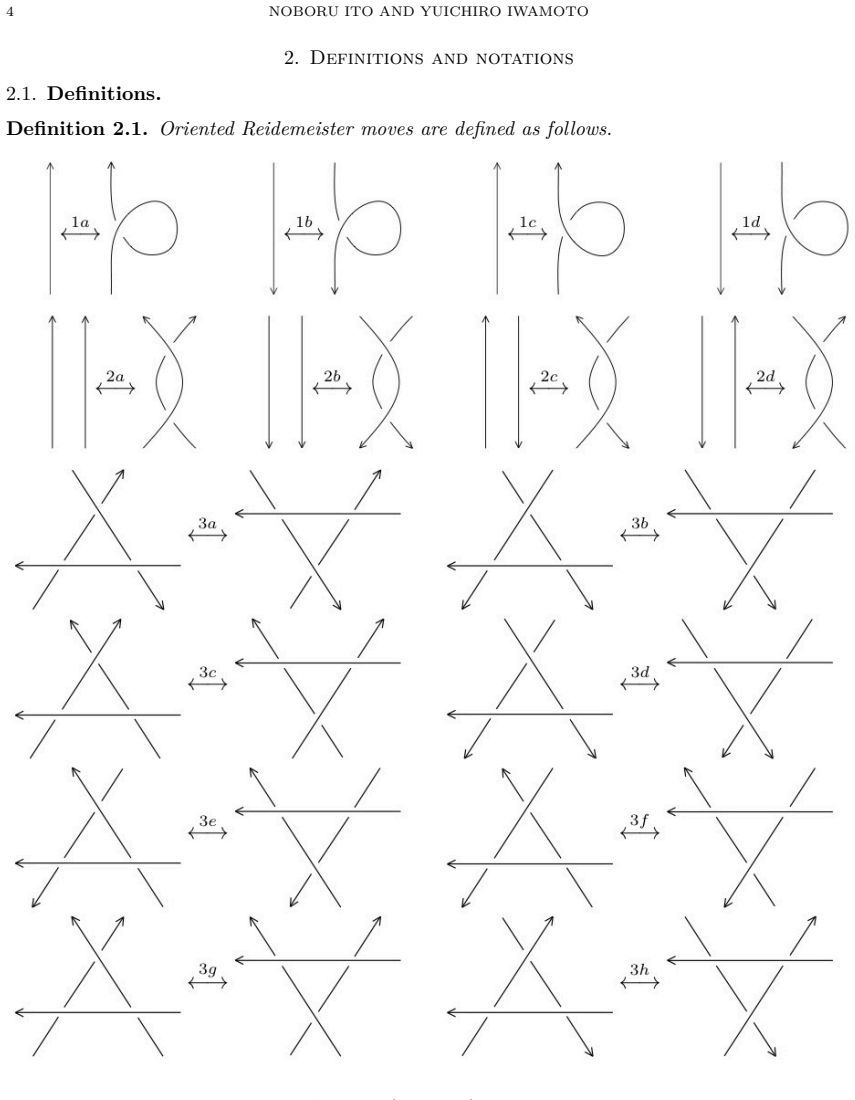
Singular Reidemeister moves admit exactly 96 distinct inclusion-minimal generating sets once classical moves are fixed.
A machine-rendered reading of the paper's core claim, the machinery that carries it, and where it could break.
Core claim
Starting from a minimal generating set of ordinary Reidemeister moves of types I--III, the singular moves admit exactly 96 distinct inclusion-minimal generating sets, and these exhaust all possibilities. The proof introduces a new invariant for singular links, constructed via a projection to self-singular links, which detects the distinction between the two families of type IV moves and provides an obstruction for generating type V moves from types I--IV. Independence of type III from types I, II, IV, and V is established, and the unoriented case is shown to have exactly 8 minimal generating sets.
What carries the argument
The projection invariant to self-singular links, which distinguishes the two families of type IV moves and obstructs generation of type V from types I-IV.
If this is right
- Type III moves remain independent of types I, II, IV, and V even after singular moves are adjoined.
- The 96 sets are exhaustive, so every minimal generating set for the singular moves belongs to this list.
- The same invariant supplies explicit lower bounds and obstructions for any proposed generating set of singular moves.
- In the unoriented case the classification reduces to exactly eight minimal generating sets.
Where Pith is reading between the lines
- Algorithms that enumerate or simplify singular knot diagrams could be restricted to any one of the 96 sets without loss of generality.
- The projection technique that produces the distinguishing invariant may apply directly to virtual or welded knot diagrams.
- Explicit enumeration of the 96 sets would allow direct comparison of their computational cost on sample singular links.
Load-bearing premise
The newly introduced invariant, constructed via projection to self-singular links, correctly distinguishes the two families of type IV moves and supplies a genuine obstruction to generating type V from types I--IV.
What would settle it
A concrete falsifier is a sequence of singular Reidemeister moves of types I-IV that produces the effect of a type V move on some diagram, or a pair of diagrams related only by one family of type IV moves whose projected self-singular invariants nevertheless coincide.
Figures


read the original abstract
Singular knot theory extends classical knot theory by allowing transverse double points without over/under information, together with singular Reidemeister moves of types IV and V. A central open problem in this theory is to determine the minimal generating sets of oriented singular Reidemeister moves. In this paper, we completely solve this problem. In addition, we establish independence results for singular Reidemeister moves by introducing an invariant that provides obstructions and lower bounds for generating sets, including the independence of type III from types I, II, IV, and V. More precisely, starting from a minimal generating set of ordinary Reidemeister moves of types I--III, we prove that the singular moves admit exactly $96$ distinct inclusion-minimal generating sets, and that these exhaust all possibilities. Our proof introduces a new invariant for singular links, constructed via a projection to self-singular links, which detects the distinction between the two families of type IV moves and provides an obstruction for generating type V moves from types I--IV. We also determine the unoriented case, where the classification collapses to exactly $8$ minimal generating sets.
Editorial analysis
A structured set of objections, weighed in public.
Referee Report
Summary. The paper claims to completely solve the open problem of minimal generating sets for oriented singular Reidemeister moves. Starting from any minimal generating set of ordinary Reidemeister moves (types I--III), it proves that the singular moves admit exactly 96 distinct inclusion-minimal generating sets and that these exhaust all possibilities. A new invariant, obtained by projection to self-singular links, is introduced to distinguish the two families of type IV moves and to obstruct generation of type V moves from any combination of types I--IV; this invariant also yields independence results such as the independence of type III from I, II, IV, and V. The unoriented case is shown to collapse to exactly 8 minimal generating sets.
Significance. If the central claims hold, the result is a foundational contribution to singular knot theory: it resolves the classification of minimal generating sets for singular Reidemeister moves and supplies an explicit invariant that furnishes obstructions and lower bounds. The exhaustive enumeration (96 oriented, 8 unoriented) together with the independence statements would be a strong, concrete advance. The projection-based invariant is a potentially reusable tool if its invariance and separating properties are fully established.
major comments (2)
- [Section introducing the invariant and the obstruction argument] The classification into precisely 96 inclusion-minimal generating sets (stated in the abstract and proved in the main theorem) rests entirely on the new projection invariant distinguishing the two type-IV families and obstructing type V from I--IV. The manuscript must supply explicit, case-by-case verification that the invariant is unchanged by every move appearing in the candidate generating sets and that its value differs precisely on the diagrams that would require a type-V move.
- [Section containing the enumeration and classification theorem] The enumeration argument that exactly 96 sets are minimal and exhaustive requires a complete accounting of all possible combinations of singular moves together with the ordinary I--III moves. The proof must demonstrate that every combination ruled out by the invariant is indeed incapable of generating the full set of singular moves, and that each of the 96 listed sets does generate everything; without these explicit checks the count of 96 cannot be confirmed.
minor comments (2)
- Notation for the two families of type IV moves should be introduced earlier and used consistently throughout the classification tables or lists.
- The unoriented case is stated to collapse to 8 sets; a brief comparison table or diagram showing how the oriented 96 reduce under forgetting orientation would improve readability.
Simulated Author's Rebuttal
We thank the referee for the careful reading and for highlighting the need for greater explicitness in the verification steps. The core claims of the paper rest on the projection invariant and the exhaustive case analysis; we will revise the manuscript to make the case-by-case checks fully transparent while preserving the existing arguments.
read point-by-point responses
-
Referee: [Section introducing the invariant and the obstruction argument] The classification into precisely 96 inclusion-minimal generating sets (stated in the abstract and proved in the main theorem) rests entirely on the new projection invariant distinguishing the two type-IV families and obstructing type V from I--IV. The manuscript must supply explicit, case-by-case verification that the invariant is unchanged by every move appearing in the candidate generating sets and that its value differs precisely on the diagrams that would require a type-V move.
Authors: The invariance of the projection invariant under ordinary Reidemeister moves I--III is proved in Proposition 3.2 by direct local computation on all possible diagrams. Invariance under each of the two type-IV families is established separately in Propositions 4.1 and 4.2, again by exhaustive local checks. The obstruction to generating type V from any combination of I--IV is given in Lemma 5.3, which exhibits a concrete pair of diagrams related by a type-V move on which the invariant differs, together with the observation that all I--IV moves preserve the invariant. To satisfy the request for fully explicit case-by-case verification across all candidate generating sets, we will add an appendix containing a table that lists, for each of the 96 sets, the precise moves included and the corresponding invariance computation (or reference to the relevant proposition). revision: yes
-
Referee: [Section containing the enumeration and classification theorem] The enumeration argument that exactly 96 sets are minimal and exhaustive requires a complete accounting of all possible combinations of singular moves together with the ordinary I--III moves. The proof must demonstrate that every combination ruled out by the invariant is indeed incapable of generating the full set of singular moves, and that each of the 96 listed sets does generate everything; without these explicit checks the count of 96 cannot be confirmed.
Authors: The classification begins from any minimal ordinary set of types I--III and then enumerates the admissible inclusions of the two type-IV families and the type-V move. The invariant immediately rules out any set that selects the wrong type-IV family or omits type V; for each such ruled-out combination we exhibit a target diagram whose invariant value cannot be reached, proving non-generation. For each of the 96 admissible combinations we supply, in the proof of the main theorem, an explicit sequence of moves showing how the remaining singular moves are generated from the chosen set. To make this accounting completely explicit, the revised version will include a summary table of all 96 sets together with a pointer to the specific generating sequence used for each. revision: yes
Circularity Check
No circularity: new projection invariant and ordinary-move base case are independent inputs
full rationale
The derivation begins from a known minimal generating set of ordinary Reidemeister moves (types I-III) and introduces a fresh invariant defined by projection onto self-singular links. This invariant is shown to be unchanged under the relevant moves and to separate the two families of type-IV moves while obstructing type V; nothing in the abstract or described proof reduces the invariant's value or the enumeration of the 96 sets back to a fit, a self-definition, or a self-citation chain whose own justification is the present paper. The count of inclusion-minimal singular generating sets is therefore obtained by exhaustive case analysis against an externally supplied obstruction rather than by construction from the sets themselves.
Axiom & Free-Parameter Ledger
axioms (1)
- standard math Reidemeister moves generate the equivalence relation on (singular) knot diagrams
invented entities (1)
-
Invariant obtained by projection to self-singular links
no independent evidence
Reference graph
Works this paper leans on
-
[1]
Knot theory for proteins: Gauss codes, quandles and bondles
Colin Adams, Judah Devadoss, Mohamed Elhamdadi, and Alireza Mashaghi. Knot theory for proteins: Gauss codes, quandles and bondles. J. Math. Chem. , 58(8):1711–1736, 2020
work page 2020
-
[2]
Generating sets of Reidemeister moves of oriented singular links and quandles
Khaled Bataineh, Mohamed Elhamdadi, Mustafa Hajij, and William Youmans. Generating sets of Reidemeister moves of oriented singular links and quandles. J. Knot Theory Ramifications , 27(14):1850064, 15, 2018
work page 2018
-
[3]
Tobias J. Hagge. Every Reidemeister move is needed for each knot type. Proc. Amer. Math. Soc., 134(1):295–301, 2006
work page 2006
-
[4]
Strong and weak (1, 3) homotopies on knot projections
Noboru Ito, Yusuke Takimura, and Kouki Taniyama. Strong and weak (1, 3) homotopies on knot projections. Osaka J. Math. , 52(3):617–646, 2015
work page 2015
- [5]
-
[6]
Invariants of knot diagrams and diagrammatic knot invariants
Olof-Petter Ostlund. Invariants of knot diagrams and diagrammatic knot invariants . ProQuest LLC, Ann Arbor, MI, 2001. Thesis (Ph.D.)–Uppsala Universitet (Sweden)
work page 2001
-
[7]
Vladimir Turaev. Knots and words. Int. Math. Res. Not. , pages Art. ID 84098, 23, 2006
work page 2006
-
[8]
On elementary moves of singular Legendrian knots
Sara Yamaguchi and Noboru Ito. On elementary moves of singular Legendrian knots. JP J. Geom. Topol. , 27:1–9, 2022. Department of Mathematics, F aculty of Engineering, Shinshu University, W akasato 4-17-1, Nagano, Nagano 380-8553, Japan Email address : nito@shinshu-u.ac.jp Department of Science and Technology, Graduate School of Medicine, Science and Tech...
work page 2022
discussion (0)
Sign in with ORCID, Apple, or X to comment. Anyone can read and Pith papers without signing in.