Elasto-inertial transitions in viscoelastic flows through cylinder arrays
Pith reviewed 2026-05-10 18:41 UTC · model grok-4.3
The pith
Viscoelastic flows through cylinder arrays reach elasto-inertial turbulence via a subcritical saddle-node bifurcation followed by supercritical bifurcations in a Ruelle-Takens-Newhouse route to chaos.
A machine-rendered reading of the paper's core claim, the machinery that carries it, and where it could break.
Core claim
With increasing elasticity, EIT is reached via an initial sub-critical saddle-node bifurcation from the Newtonian state and then follows a series of supercritical bifurcations, in a Ruelle-Takens-Newhouse route to chaos. This transition is driven by the interaction between vortex shedding in cylinder wakes, and the bulk flow between cylinders. Within the EIT regime, slow dynamics in cylinder wakes interact with fast dynamics in channels between cylinders, leading to two distinct slopes in the energy spectra. At low Reynolds numbers arrowhead structures are present, but these are suppressed at higher inertia. In the present configuration, there is no direct connection between EIT and purely弹性
What carries the argument
The interaction between vortex shedding in cylinder wakes and the bulk flow between cylinders, which initiates the saddle-node bifurcation and sustains the subsequent supercritical cascade to chaos.
If this is right
- EIT appears at Reynolds numbers below the threshold for inertial turbulence in Newtonian fluids.
- Energy spectra inside the EIT regime exhibit two power-law slopes arising from slow wake dynamics and fast inter-cylinder channel dynamics.
- Arrowhead flow structures form only at low Reynolds numbers and vanish once inertia increases.
- The EIT state develops without requiring or connecting to purely elastic instabilities.
Where Pith is reading between the lines
- The same wake-channel coupling may set the transition threshold in other periodic porous geometries, allowing reduced-order models to predict onset without full three-dimensional simulations.
- Varying polymer relaxation time in experiments should shift the saddle-node bifurcation point in a measurable way that tests the elasticity dependence found here.
- The suppression of arrowhead structures with rising inertia suggests that mixing patterns in porous media will change qualitatively once Reynolds number exceeds a modest value.
Load-bearing premise
The chosen viscoelastic constitutive model and numerical discretization faithfully reproduce the bifurcation sequence of real dilute polymer solutions without introducing artifacts that would change the observed transition path.
What would settle it
Experimental observation of a direct link between EIT and purely elastic instabilities, or of a transition sequence lacking the initial saddle-node bifurcation, would falsify the claimed route.
Figures




read the original abstract
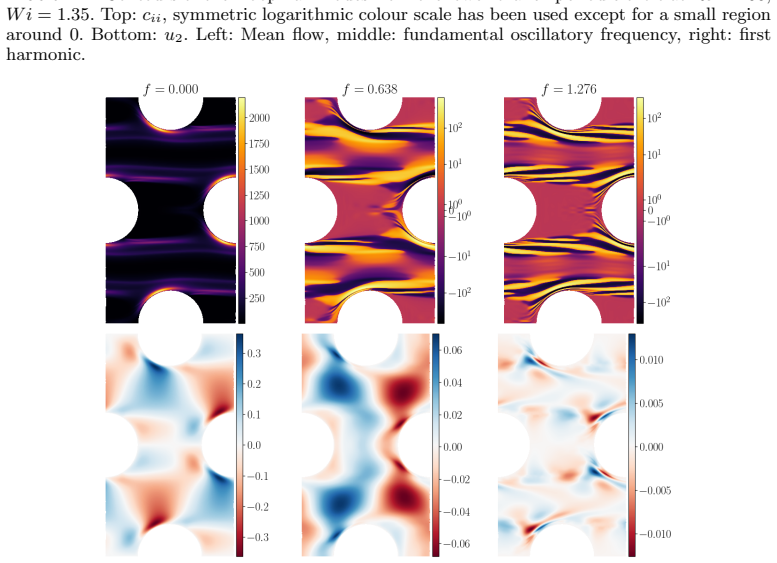
For dilute solutions of polymers, chaotic flow states can occur at lower Reynolds numbers than required for inertial turbulence in Newtonian fluids, offering the potential for increased mixing efficiency. These states may be promoted by the flow geometry, and in recent years, porous media have gained attention as a promising setting in which viscoelastic instabilities may be exploited, although studies have primarily been in the creeping flow regime. Cylinder arrays serve as a prototypical porous media, giving a controlled setting in which to investigate flow dynamics. Here we explore the transition to elasto-inertial turbulence (EIT) in cylinder arrays via detailed numerical simulations. With increasing elasticity, EIT is reached via an initial sub-critical saddle-node bifurcation from the Newtonian state and then follows a series of supercritical bifurcations, in a Ruelle-Takens-Newhouse route to chaos. This transition is driven by the interaction between vortex shedding in cylinder wakes, and the bulk flow between cylinders. Within the EIT regime, we observe an interaction between slow dynamics in cylinder wakes, and fast dynamics in channels between cylinders, leading to two distinct slopes in the energy spectra. At low Reynolds numbers arrowhead structures are present, but these are suppressed at higher inertia. In the present configuration, we find no direct connection between EIT and purely elastic instabilities.
Editorial analysis
A structured set of objections, weighed in public.
Referee Report
Summary. The manuscript uses time-dependent numerical simulations to study viscoelastic flows through cylinder arrays as a model porous medium. It claims that elasto-inertial turbulence (EIT) is reached from the Newtonian base state via an initial sub-critical saddle-node bifurcation as elasticity increases, followed by a sequence of supercritical bifurcations that produce a Ruelle-Takens-Newhouse route to chaos. The transition is driven by the interaction of vortex shedding in cylinder wakes with the bulk inter-cylinder flow. In the EIT regime, slow wake dynamics couple to fast channel dynamics, producing two distinct slopes in the energy spectra; arrowhead structures appear at low Reynolds number but are suppressed at higher inertia, and EIT is found to have no direct connection to purely elastic instabilities.
Significance. If the reported bifurcation sequence and driving mechanism hold, the work provides a concrete mechanistic picture of how inertia and elasticity interact to produce chaos in a controlled geometry relevant to porous-media flows. The separation of slow wake and fast channel timescales, together with the explicit distinction from purely elastic instabilities, adds useful insight for low-Re mixing applications. The use of direct numerical simulation to trace the full transition path is a clear strength.
major comments (2)
- [results section on bifurcation sequence] The classification of the initial transition as a sub-critical saddle-node bifurcation (abstract and results section on the bifurcation sequence) is not accompanied by explicit evidence of hysteresis or a discontinuous jump in an order parameter such as kinetic energy or drag coefficient when the Weissenberg number is varied. This evidence is load-bearing for the claimed route to chaos.
- [numerical methods section] The numerical methods section provides no mesh-convergence data, wake-region resolution details, or error estimates for the reported bifurcation points and frequencies. Because the identification of the sub-critical saddle-node and the subsequent frequency-locking steps in the Ruelle-Takens-Newhouse route is known to be sensitive to numerical diffusion and stress boundary-layer resolution, this information is required to substantiate the central claim.
minor comments (2)
- [abstract] The abstract states that 'detailed numerical simulations support' the claims but does not indicate the constitutive model (Oldroyd-B, FENE-P, etc.) or the range of Reynolds and Weissenberg numbers examined; these details should appear in the abstract or be cross-referenced to the methods section.
- [figure captions] Figure captions for time series and spectra should explicitly label the (Re, Wi) values and the identified dynamical regime (periodic, quasi-periodic, chaotic) to allow readers to connect the plots directly to the bifurcation diagram.
Simulated Author's Rebuttal
We thank the referee for their careful reading and constructive comments on our manuscript. The points raised regarding evidence for the sub-critical bifurcation and numerical validation are well taken, and we will strengthen the paper accordingly. We address each major comment below.
read point-by-point responses
-
Referee: [results section on bifurcation sequence] The classification of the initial transition as a sub-critical saddle-node bifurcation (abstract and results section on the bifurcation sequence) is not accompanied by explicit evidence of hysteresis or a discontinuous jump in an order parameter such as kinetic energy or drag coefficient when the Weissenberg number is varied. This evidence is load-bearing for the claimed route to chaos.
Authors: We agree that explicit evidence of hysteresis or a discontinuous jump in an order parameter is important to substantiate the sub-critical saddle-node classification. Our identification of this bifurcation rests on the abrupt onset of finite-amplitude chaotic states directly from the Newtonian base flow as the Weissenberg number increases, without intervening stable periodic regimes. To address the referee's concern, we will add in the revised manuscript additional simulations demonstrating hysteresis loops in both kinetic energy and drag coefficient, obtained by sweeping the Weissenberg number upward and downward across the transition point. revision: yes
-
Referee: [numerical methods section] The numerical methods section provides no mesh-convergence data, wake-region resolution details, or error estimates for the reported bifurcation points and frequencies. Because the identification of the sub-critical saddle-node and the subsequent frequency-locking steps in the Ruelle-Takens-Newhouse route is known to be sensitive to numerical diffusion and stress boundary-layer resolution, this information is required to substantiate the central claim.
Authors: We acknowledge that the numerical methods section lacks explicit mesh-convergence data, wake-region resolution details, and error estimates, which are necessary given the sensitivity of bifurcation identification to numerical diffusion. In the revised manuscript we will expand this section to include systematic mesh-convergence studies, quantitative details on grid resolution within cylinder wakes and stress boundary layers, and error estimates for the reported critical Weissenberg numbers and frequencies. These additions will confirm that the identified sub-critical transition and subsequent Ruelle-Takens-Newhouse sequence are robust. revision: yes
Circularity Check
No circularity: bifurcation sequence and transition route obtained directly from time-dependent viscoelastic DNS
full rationale
The paper reports the elasto-inertial transition sequence (sub-critical saddle-node followed by supercritical bifurcations in a Ruelle-Takens-Newhouse route) as the observed outcome of direct numerical integration of the incompressible Navier-Stokes equations coupled to a viscoelastic constitutive model. No quantity is defined in terms of another that is later 'predicted'; no parameters are fitted to a data subset and then re-used as a forecast; no uniqueness theorem or ansatz is imported via self-citation to force the reported route; and the driving mechanism (wake vortex shedding interacting with inter-cylinder bulk flow) is identified from the computed fields rather than imposed by construction. The derivation chain therefore remains self-contained against the governing PDEs and the numerical discretization.
Axiom & Free-Parameter Ledger
axioms (2)
- domain assumption The flow obeys the incompressible Navier-Stokes equations augmented by a viscoelastic constitutive relation.
- domain assumption Cylinder-array geometry with appropriate boundary conditions represents prototypical porous media.
Reference graph
Works this paper leans on
-
[1]
Abed, W. M., Whalley, R. D., Dennis, D. J.C. & Poole, R. J.2016 Experimental investigation of the impact of elastic turbulence on heat transfer in a serpentine channel. Journal of Non-Newtonian Fluid Mechanics231, 68–78. Alcocer, F. J. & Singh, P.2002 Permeability of periodic arrays of cylinders for viscoelastic flows.Physics of Fluids14(7), 2578–2581. Ba...
work page 2016
-
[2]
Broomhead, D. S. & King, G. P.1986 Extracting qualitative dynamics from experimental data.Physica D: Nonlinear Phenomena20(2-3), 217–236. Browne, C. A. & Datta, S. S.2021 Elastic turbulence generates anomalous flow resistance in porous media.Science Advances7(45), eabj2619. Browne, C. A. & Datta, S. S.2024 Harnessing elastic instabilities for enhanced mix...
work page 1986
-
[3]
22 Galindo-Rosales, F. J., Campo-Dea ˜no, L., Sousa, P. C., Ribeiro, V. M., Oliveira, M. S.N., Alves, M. A. & Pinho, F. T.2014 Viscoelastic instabilities in micro-scale flows.Experimental Thermal and Fluid Science59, 128–139. Garg, P. & Rosti, M. E.2025 Elastic turbulence hides in the small scales of inertial polymeric turbulence.Phys. Rev. Lett.135, 0740...
discussion (0)
Sign in with ORCID, Apple, or X to comment. Anyone can read and Pith papers without signing in.