A boundary integral equation method for Steklov eigenvalue problems for smooth planar domains
Pith reviewed 2026-05-10 18:22 UTC · model grok-4.3
The pith
The Steklov spectrum of smooth simply connected planar domains can be computed accurately from boundary data alone using a generalized conjugation operator.
A machine-rendered reading of the paper's core claim, the machinery that carries it, and where it could break.
Core claim
The Steklov spectrum of smooth simply connected planar domains can be approximated accurately by a boundary-only formulation based on harmonic conjugation through the generalized conjugation operator defined via the boundary integral equation with the generalized Neumann kernel, combined with Fourier differentiation on an equidistant boundary grid. This produces a dense algebraic eigenvalue problem for the boundary traces of the eigenfunctions, uses only boundary data, treats interior and exterior problems in a unified way, and reconstructs eigenfunctions in the domain by harmonic extension.
What carries the argument
The generalized conjugation operator obtained from the boundary integral equation with the generalized Neumann kernel, which extends the classical conjugation operator of the unit disk and, together with Fourier differentiation, converts the Steklov problem into a boundary algebraic eigenvalue problem.
If this is right
- The method yields high-accuracy Steklov eigenvalues for ellipses, star-like curves, and other smooth parameter-dependent families without interior meshing.
- Interior and exterior Steklov problems are treated by the same boundary formulation.
- Boundary traces of eigenfunctions are obtained directly and can be extended harmonically to the whole domain.
- The dependence of the spectrum on geometric parameters can be tracked continuously across families of smooth domains.
Where Pith is reading between the lines
- The same boundary-integral conjugation idea may apply to other boundary-value eigenvalue problems whose operators can be reduced to the Dirichlet-to-Neumann map.
- For domains with corners or lower regularity the equidistant Fourier grid would need replacement by a more adaptive quadrature or basis.
- The approach could be embedded in shape-optimization loops that seek domains realizing prescribed Steklov spectra.
Load-bearing premise
The generalized conjugation operator defined via the boundary integral equation with the generalized Neumann kernel correctly extends harmonic conjugation to arbitrary smooth simply connected domains, and Fourier differentiation on an equidistant grid introduces negligible error for the targeted smooth boundaries.
What would settle it
Apply the method to the unit disk, where the exact Steklov eigenvalues are known to be the nonnegative integers with multiplicity two for each positive integer; if the computed spectrum deviates from these exact values by more than discretization tolerance, the extension or grid accuracy fails.
Figures




read the original abstract
In this paper, we study the computational question of whether the Steklov spectrum of smooth simply connected planar domains can be approximated accurately by a boundary-only formulation based on harmonic conjugation. For the unit disk, the Dirichlet-to-Neumann operator can be written explicitly in terms of the classical conjugation operator. We show how this viewpoint extends to general bounded and unbounded simply connected domains through the generalized conjugation operator defined through the boundary integral equation with the generalized Neumann kernel. Combined with Fourier differentiation on an equidistant boundary grid, this leads to a dense algebraic eigenvalue problem for the boundary traces of Steklov eigenfunctions. The resulting method uses only boundary data, treats interior and exterior problems in a unified way, and reconstructs eigenfunctions in the domain by harmonic extension. Numerical experiments on benchmark domains and on parameter-dependent smooth families, including ellipses and star-like curves, show high accuracy for smooth boundaries and illustrate how the Steklov spectrum changes with geometry.
Editorial analysis
A structured set of objections, weighed in public.
Referee Report
Summary. The paper develops a boundary integral equation method to approximate the Steklov spectrum of smooth simply connected planar domains. It extends the explicit Dirichlet-to-Neumann operator from the unit disk to general domains via the generalized conjugation operator defined by the boundary integral equation with the generalized Neumann kernel. Discretization combines this operator with Fourier differentiation on an equidistant boundary grid to produce a dense algebraic eigenvalue problem for the boundary traces of eigenfunctions; eigenfunctions are recovered by harmonic extension. The method treats interior and exterior problems uniformly and is tested numerically on ellipses, star-like curves, and parameter-dependent families, reporting high accuracy for smooth boundaries.
Significance. If the discretization achieves the claimed accuracy, the approach supplies an efficient, boundary-only scheme that unifies interior/exterior Steklov problems and leverages standard integral operators plus harmonic extension. This could be valuable for shape optimization or spectral geometry computations on planar domains. The absence of free parameters in the core derivation and the use of established kernels are positive features.
major comments (2)
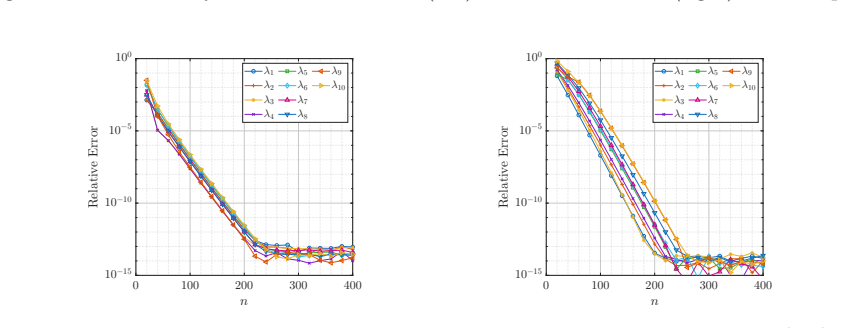
- [§3 and §4] §3 (discretization of the generalized conjugation operator) and §4 (numerical experiments): Fourier differentiation is applied on an equidistant parameter grid for non-circular domains (ellipses, star-like curves). For parametrizations that are not arc-length uniform, this grid is non-uniform in physical arc length; without explicit Jacobian weights or re-parametrization, the discrete differentiation operator approximates the continuous operator only to O(h) or O(h^2) rather than spectrally. This directly affects the accuracy of the resulting Steklov eigenvalues, especially higher modes, and is the least-secured step in the high-accuracy claim. The manuscript should supply a convergence analysis or numerical comparison against arc-length parametrization to confirm spectral accuracy.
- [Table 1, Figure 3] Table 1 and Figure 3 (ellipse and star-like results): reported eigenvalue errors decrease rapidly with N, but without a clear statement of the underlying parametrization (polar angle vs. arc length) or quadrature corrections, it is unclear whether the observed rates are consistent with the equidistant-grid Fourier scheme or require hidden re-weighting. This needs explicit clarification because it bears on whether the method truly extends the unit-disk case without loss of spectral accuracy.
minor comments (2)
- [§2] Notation for the generalized Neumann kernel and conjugation operator should be introduced with a brief reminder of its integral-equation definition in §2 to improve readability for readers unfamiliar with the kernel.
- [Abstract, §1] The abstract and introduction claim 'high accuracy' without specifying the norm or reference solution used; a short sentence defining the error measure would help.
Simulated Author's Rebuttal
We thank the referee for the thorough review and valuable suggestions. We address the major comments below and will incorporate the necessary clarifications and additions in the revised manuscript.
read point-by-point responses
-
Referee: [§3 and §4] Fourier differentiation is applied on an equidistant parameter grid for non-circular domains (ellipses, star-like curves). For parametrizations that are not arc-length uniform, this grid is non-uniform in physical arc length; without explicit Jacobian weights or re-parametrization, the discrete differentiation operator approximates the continuous operator only to O(h) or O(h^2) rather than spectrally. This directly affects the accuracy of the resulting Steklov eigenvalues, especially higher modes, and is the least-secured step in the high-accuracy claim. The manuscript should supply a convergence analysis or numerical comparison against arc-length parametrization to confirm spectral accuracy.
Authors: We agree that the discretization details in Section 3 require more explicit treatment to confirm spectral accuracy for general parametrizations. In the revised version, we will expand the description of the discrete generalized conjugation operator to include the explicit incorporation of the parametrization speed |γ'(θ)| when recovering the arc-length derivative from the Fourier differentiation in the parameter θ. We will also add a brief theoretical note on the spectral convergence for smooth periodic parametrizations and include numerical comparisons using arc-length reparametrization in Section 4 to verify the rates. revision: yes
-
Referee: [Table 1, Figure 3] reported eigenvalue errors decrease rapidly with N, but without a clear statement of the underlying parametrization (polar angle vs. arc length) or quadrature corrections, it is unclear whether the observed rates are consistent with the equidistant-grid Fourier scheme or require hidden re-weighting. This needs explicit clarification because it bears on whether the method truly extends the unit-disk case without loss of spectral accuracy.
Authors: We will revise the presentation of the numerical results in Section 4, including the captions for Table 1 and Figure 3, to explicitly describe the parametrizations employed (polar angle for the ellipse and star-like examples) and confirm that the differentiation and quadrature steps include the appropriate metric factors derived from the boundary parametrization. This clarification will demonstrate that the observed convergence rates are consistent with the spectral method without hidden adjustments. revision: yes
Circularity Check
No circularity: derivation extends standard harmonic conjugation independently of target eigenvalues
full rationale
The paper's chain begins with the explicit Dirichlet-to-Neumann operator on the unit disk, then defines the generalized conjugation operator via the boundary integral equation with the generalized Neumann kernel for general smooth simply connected domains. This definition rests on established properties of harmonic functions and integral operators, not on the Steklov eigenvalues or spectrum being computed. Fourier differentiation on the equidistant boundary grid is introduced as a standard discretization step to form the algebraic eigenvalue problem. No equation or claim reduces a prediction to a fitted parameter, self-referential definition, or load-bearing self-citation chain; the numerical validation on benchmarks is external to the derivation itself. The approach is self-contained against external benchmarks for smooth domains.
Axiom & Free-Parameter Ledger
axioms (2)
- standard math The Dirichlet-to-Neumann operator on the unit disk can be expressed explicitly using the classical conjugation operator.
- domain assumption The generalized conjugation operator defined by the boundary integral equation with the generalized Neumann kernel correctly reproduces the Dirichlet-to-Neumann map for arbitrary smooth simply connected domains.
Reference graph
Works this paper leans on
-
[1]
W. Alhejaili & C. Kao, Numerical studies of the Steklov eigenvalue problem via conformal mappings,Appl. Math. Comput.347 (2019) 785-802
work page 2019
-
[2]
K.E. Atkinson, The numerical solution of integral equations of the second kind, Cambridge university press, Cambridge, 1997
work page 1997
-
[3]
P. Auscher & M. Egert, Boundary Value Problems and Hardy Spaces for Elliptic Systems with Block Structure, Birkh¨ auser, Cham, 2023
work page 2023
-
[4]
I. Babuˇ ska & J. Osborn, Eigenvalue problems, In: Handbook of Numerical Analysis, Vol. 2, Elsevier, pp. 641–787, 1991
work page 1991
-
[5]
L. Bundrock, A. Girouard, D.S. Grebenkov, M. Levitin, & I. Polterovich, The exterior Steklov problem for Euclidean domains,arXiv:2511.09490(2025)
-
[6]
B. Dittmar, Eigenvalue Problems and Conformal Mapping, In: Handbook of Complex Analysis: Geometric Functional Theory, Vol. 2, Elsevier B.V, pp. 669–686, 2005
work page 2005
-
[7]
Duren, Theory ofH p Spaces, Academic Press, New York, 1970
P. Duren, Theory ofH p Spaces, Academic Press, New York, 1970
work page 1970
-
[8]
Gaier, Konstruktive Methoden der konformen Abbildung, Springer, Berlin, 1964
D. Gaier, Konstruktive Methoden der konformen Abbildung, Springer, Berlin, 1964
work page 1964
-
[9]
A. Girouard & I. Polterovich, Spectral geometry of the Steklov problem (survey article), J. Spectral Theory 7 (2017) 321–359
work page 2017
-
[10]
Henrici, Applied and Computational Complex Analysis, Vol
P. Henrici, Applied and Computational Complex Analysis, Vol. 3, John Wiley & Sons, New York, 1986
work page 1986
-
[11]
Henrot, Extremum Problems for Eigenvalues of Elliptic Operators, Birkh¨ auser, Basel, 2006
A. Henrot, Extremum Problems for Eigenvalues of Elliptic Operators, Birkh¨ auser, Basel, 2006
work page 2006
- [12]
-
[13]
N. Kuznetsov, T. Kulczycki, M. Kwasnicki, A. Nazarov, S. Poborchi, I. Polterovich & B. Siudeja, The legacy of Vladimir Andreevich Steklov,Notices Amer. Math. Soc.61 (2014) 9–23
work page 2014
-
[14]
J.M. Lee & G. Uhlmann, Determining anisotropic real-analytic conductivities by boundary measurements,Comm. Pure Appl. Math.42 (1989) 1097–1112
work page 1989
-
[15]
M. Levitin, D. Mangoubi & I. Polterovich, Topics in spectral geometry, AMS, Providence, 2023
work page 2023
-
[16]
Nasser, A nonlinear integral equation for numerical conformal mapping,Adv
M.M.S. Nasser, A nonlinear integral equation for numerical conformal mapping,Adv. Pure Appl. Math.1 (2010) 47–63
work page 2010
-
[17]
M.M.S. Nasser, Convergence of numerical solution of generalized Theodorsen’s nonlinear integral equation,Abstr. Appl. Anal.2014 (2014) 213296
work page 2014
-
[18]
Nasser, Fast solution of boundary integral equations with the generalized Neumann kernel,Electron
M.M.S. Nasser, Fast solution of boundary integral equations with the generalized Neumann kernel,Electron. Trans. Numer. Anal.44 (2015) 189–229
work page 2015
-
[19]
M.M.S. Nasser, A.H.M. Murid, M. Ismail & E.M.A. Alejaily, Boundary integral equations with generalized Neumann kernel for Laplace’s equation in multiply connected regions,Appl. Math. Comput.217 (2011) 4710–4727
work page 2011
-
[20]
S. Naqos, A.H.M. Murid, M.M.S. Nasser & S.H. Yeak, Computing the Dirichlet-to-Neumann map via an integral equation with the adjoint generalized Neumann kernel,Partial Differ. Equ. Appl. Math.12 (2024) 100967
work page 2024
- [21]
-
[22]
Schwab,p- andhp-Finite Element Methods, Oxford University Press, Oxford, 1998
C. Schwab,p- andhp-Finite Element Methods, Oxford University Press, Oxford, 1998
work page 1998
-
[23]
B. Szab´ o & I. Babuˇ ska, Finite Element Analysis, Wiley, New York, 1991
work page 1991
-
[24]
Taylor, Partial Differential Equations II: Qualitative Studies of Linear Equations, Springer, 2011
M.E. Taylor, Partial Differential Equations II: Qualitative Studies of Linear Equations, Springer, 2011
work page 2011
-
[25]
L.N. Trefethen & J.A.C. Weideman, The exponentially convergent trapezoidal rule,SIAM Rev. 56 (2014) 385–458
work page 2014
-
[26]
Wegmann, Methods for numerical conformal mapping
R. Wegmann, Methods for numerical conformal mapping. In: Handbook of Complex Analysis: Geometric Function Theory, Vol. 2, Elsevier B. V., pp. 351–477, 2005
work page 2005
-
[27]
R. Wegmann, A.H.M. Murid & M.M.S. Nasser, The Riemann-Hilbert problem and the general- ized Neumann kernel,J. Comput. Appl. Math.182 (2005) 388–415
work page 2005
-
[28]
Weinstock, Inequalities for a classical eigenvalue problem,J
R. Weinstock, Inequalities for a classical eigenvalue problem,J. Ration. Mech. Anal.3 (1954) 745–753. 28
work page 1954
discussion (0)
Sign in with ORCID, Apple, or X to comment. Anyone can read and Pith papers without signing in.