Contextual Chain: Single-State Ledger Design for Mobile/IoT Networks with Frequent Partitions
Pith reviewed 2026-05-10 18:41 UTC · model grok-4.3
The pith
Adaptive synchronization improves ledger agreement and recovery after partitions more than quarantine signals alone.
A machine-rendered reading of the paper's core claim, the machinery that carries it, and where it could break.
Core claim
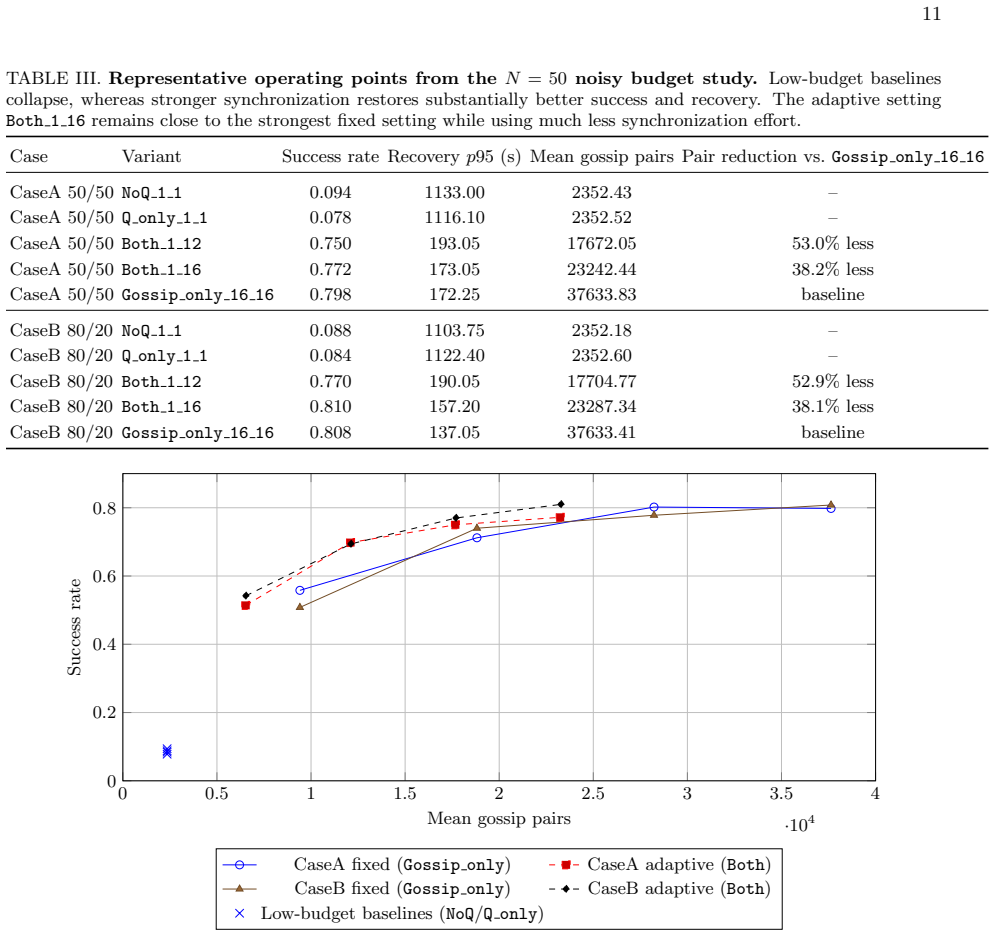
The protocol uses contextual authentication—checkpoint-first fork choice, local branch scoring from proposer behavior, and inconsistency-driven quarantine—together with adaptive synchronization that increases gossip only when inconsistency is prevalent. Discrete-event simulations under controlled partitions show that synchronization strategies raise final agreement probability and improve recovery-time tails after rejoin, whereas quarantine alone does not, indicating that recovery is limited by information availability.
What carries the argument
Contextual authentication rule combined with adaptive synchronization that triggers higher gossip on detected inconsistency.
If this is right
- Quarantine signals alone do not materially raise agreement or shorten recovery under noisy partition conditions.
- Increasing synchronization effort when inconsistency appears raises both final agreement probability and the distribution of recovery times.
- Low-synchronization failures remain even when nodes are allowed longer waiting periods.
- Parameter sets effective at N=20 do not automatically transfer to N=50 or N=100.
Where Pith is reading between the lines
- Designers of intermittent ledgers should treat inconsistency detection as a trigger for extra information exchange rather than a signal for local rejection only.
- The same adaptive-gossip principle could be tested in other partition-heavy settings such as vehicular networks or drone swarms.
- Energy and bandwidth costs of the extra gossip phase would need separate measurement on real hardware.
Load-bearing premise
The discrete-event simulator reproduces the partition frequency, noise characteristics, and rejoin behavior of actual mobile and IoT networks.
What would settle it
Deploy the protocol on physical IoT devices in a lab network with controlled partitions, measure agreement rates and recovery times after rejoin, and compare those values directly to the simulation outputs.
Figures




read the original abstract
We study a lightweight ledger protocol for intermittent and noisy networks, motivated by IoT and mobile settings in which partitions are common and full-history verification is impractical. Our design centers on an \emph{operational} notion of \textbf{contextual authentication}: each node decides whether a chain extension is acceptable in its current local context, using checkpoint-first fork choice, a local branch score derived from recent proposer behavior, and an inconsistency-driven \emph{quarantine} signal. To improve recovery after partitions, we combine this acceptance rule with \textbf{adaptive synchronization}, which increases gossip effort only when inconsistency becomes prevalent. We evaluate the protocol with a discrete-event simulator under controlled partitions and two network regimes (clean and noisy). Across 500 seeds at $N=20$, the main result is that quarantine alone does not materially improve agreement or recovery under noisy conditions, whereas increased synchronization (\texttt{Gossip\_only} and \texttt{Both}) substantially improves both final agreement probability and recovery-time tails after partition rejoin. Longer-horizon experiments show that low-synchronization failures are not removed simply by waiting longer, and scaling experiments at $N=50$ and $N=100$ show that parameters that work at small scale do not automatically generalize. These results indicate that, under noisy partition/rejoin dynamics, recovery in the current design is limited primarily by information availability, making synchronization policy a first-class design problem.
Editorial analysis
A structured set of objections, weighed in public.
Referee Report
Summary. The manuscript proposes Contextual Chain, a single-state ledger for mobile/IoT networks with frequent partitions. It centers on contextual authentication via checkpoint-first fork choice, a local branch score from recent proposer behavior, and inconsistency-driven quarantine, combined with adaptive synchronization that increases gossip effort when inconsistency is detected. Discrete-event simulations under controlled partitions compare clean and noisy regimes; across 500 seeds at N=20, quarantine alone yields little improvement in agreement or recovery, while Gossip_only and Both substantially improve final agreement probability and recovery-time tails. Longer-horizon runs show low-synchronization failures persist, and scaling tests at N=50/100 indicate small-scale parameters do not generalize. The authors conclude that recovery is limited primarily by information availability, making synchronization policy a first-class design problem.
Significance. If the simulation outcomes prove robust, the work provides actionable insight for ledger design in partitioned environments by showing that synchronization policy dominates recovery behavior over quarantine mechanisms. The concrete demonstration that waiting longer does not resolve low-sync failures and that parameters fail to scale are useful empirical observations for intermittent-network protocols.
major comments (1)
- The central claim—that recovery under noisy partition/rejoin dynamics is limited primarily by information availability—depends entirely on the discrete-event simulator faithfully reproducing real mobile/IoT partition frequency, noise characteristics, rejoin behavior, and inconsistency signals. No validation against empirical traces, sensitivity analysis to alternative generative models, or exact parameter values for the controlled partitions are referenced, so the reported superiority of Gossip_only and Both over quarantine alone risks being an artifact of the chosen simulation model rather than a general property of the design.
minor comments (1)
- The abstract and results summary reference 'longer-horizon experiments' and scaling at N=50/100 but provide no quantitative details, figure references, or statistical tests (e.g., confidence intervals on recovery tails) to support the claim that low-synchronization failures are not removed by waiting longer.
Simulated Author's Rebuttal
We thank the referee for highlighting the importance of simulation fidelity. We address this concern by providing additional details and analysis in the revised manuscript.
read point-by-point responses
-
Referee: The central claim—that recovery under noisy partition/rejoin dynamics is limited primarily by information availability—depends entirely on the discrete-event simulator faithfully reproducing real mobile/IoT partition frequency, noise characteristics, rejoin behavior, and inconsistency signals. No validation against empirical traces, sensitivity analysis to alternative generative models, or exact parameter values for the controlled partitions are referenced, so the reported superiority of Gossip_only and Both over quarantine alone risks being an artifact of the chosen simulation model rather than a general property of the design.
Authors: We acknowledge that our conclusions are based on simulation and that greater transparency is needed. In the revised version, we have included the exact parameter values for the controlled partitions (e.g., partition durations, frequencies, noise levels, and rejoin probabilities) in a new appendix. We have also performed and reported a sensitivity analysis varying the generative model parameters for partitions and noise, confirming that the relative advantage of adaptive synchronization over quarantine persists across a range of settings. While we do not have access to proprietary empirical traces from specific IoT deployments, the model parameters are drawn from literature on mobile and intermittent networks. We agree that this limits generalizability and have toned down the claim to emphasize that it holds under the modeled conditions, making synchronization policy important in such settings. revision: partial
Circularity Check
No circularity: empirical simulation study with independent results
full rationale
The paper describes a protocol design and evaluates it via discrete-event simulations across multiple regimes, seeds, and scales. No equations, fitted parameters, or self-citations are presented that reduce any reported outcome to a quantity defined by the inputs themselves. The central claims follow directly from the simulation outputs rather than from any self-referential derivation or renaming of known results.
Axiom & Free-Parameter Ledger
free parameters (2)
- branch-score threshold
- gossip-increase multiplier
axioms (1)
- domain assumption The discrete-event simulator accurately models intermittent and noisy network partitions and rejoin events.
Lean theorems connected to this paper
-
IndisputableMonolith/Cost/FunctionalEquation.leanwashburn_uniqueness_aczel echoes?
echoesECHOES: this paper passage has the same mathematical shape or conceptual pattern as the Recognition theorem, but is not a direct formal dependency.
each node decides whether a chain extension is acceptable in its current local context, using checkpoint-first fork choice, a local branch score derived from recent proposer behavior, and an inconsistency-driven quarantine signal
-
IndisputableMonolith/Foundation/ArithmeticFromLogic.leanembed_injective unclear?
unclearRelation between the paper passage and the cited Recognition theorem.
recovery in the current design is limited primarily by information availability, making synchronization policy a first-class design problem
What do these tags mean?
- matches
- The paper's claim is directly supported by a theorem in the formal canon.
- supports
- The theorem supports part of the paper's argument, but the paper may add assumptions or extra steps.
- extends
- The paper goes beyond the formal theorem; the theorem is a base layer rather than the whole result.
- uses
- The paper appears to rely on the theorem as machinery.
- contradicts
- The paper's claim conflicts with a theorem or certificate in the canon.
- unclear
- Pith found a possible connection, but the passage is too broad, indirect, or ambiguous to say the theorem truly supports the claim.
Reference graph
Works this paper leans on
-
[1]
Receive blockbwith parent pointerb.prev
-
[2]
Ifbis already known, return
-
[3]
Ifb.prev is unknown, storebas an orphan and return
-
[4]
Detect equivocation for (b.proposer, b.height)
-
[5]
Update local reputation and recent equivoca- tion statistics
-
[6]
Insertbinto the local block graph
-
[7]
Compute the inconsistency snapshotI t and up- date the EMA I t
-
[8]
Update the quarantine flag by hysteresis
-
[9]
Compute the candidate headh ⋆ using checkpoint-first fork choice
-
[10]
If quarantine is active, apply the conservative head-switch rule; otherwise seth←h ⋆
-
[11]
If the head changed, record the reorg magnitude in the recent window
-
[12]
Apply a small proposer reward if no equivoca- tion penalty was triggered. FIG. 2. Contextual authentication on block acceptance. Inside quarantine, switching is more conservative: •switch immediately if the candidate has higher checkpoint level; •if checkpoint levels match, switch when the candidate improves height by at least 1; •if heights also match, s...
-
[13]
Bitcoin: A peer-to-peer elec- tronic cash system
Satoshi Nakamoto. Bitcoin: A peer-to-peer elec- tronic cash system. White paper, 2008
work page 2008
-
[14]
The honey badger of BFT pro- tocols
Andrew Miller, Yu Xia, Kyle Croman, Elaine Shi, and Dawn Song. The honey badger of BFT pro- tocols. InProceedings of the 2016 ACM SIGSAC Conference on Computer and Communications Se- curity, pages 31–42. ACM, 2016
work page 2016
-
[15]
Flyclient: Super-light clients for cryptocurrencies
Benedikt B”unz, Lucianna Kiffer, Loi Luu, and Mahdi Zamani. Flyclient: Super-light clients for cryptocurrencies. In2020 IEEE Symposium on Security and Privacy (SP), pages 928–946. IEEE, 2020
work page 2020
-
[16]
Utreexo: A dynamic hash-based accumulator optimized for the bitcoin UTXO set
Thaddeus Dryja. Utreexo: A dynamic hash-based accumulator optimized for the bitcoin UTXO set. Cryptology ePrint Archive, Paper 2019/611, 2019
work page 2019
- [17]
-
[18]
Contextuality as an External Bookkeeping Cost under Fixed Shared-State Semantics
Song-Ju Kim. Contextuality as an external book- keeping cost under fixed shared-state semantics. arXiv preprint arXiv:2601.20167, 2026
work page internal anchor Pith review Pith/arXiv arXiv 2026
-
[19]
Contextuality from Single-State Ontological Models: An Information-Theoretic Obstruction
Song-Ju Kim. Contextuality from single-state onto- logical models: An information-theoretic no-go the- orem.arXiv preprint arXiv:2602.16716, 2026
work page internal anchor Pith review Pith/arXiv arXiv 2026
-
[20]
Contextual Control without Memory Growth in a Context-Switching Task
Song-Ju Kim. Contextual control without memory growth in a context-switching task.arXiv preprint arXiv:2604.03479, 2026
work page internal anchor Pith review Pith/arXiv arXiv 2026
-
[21]
Practical byzantine fault tolerance
Miguel Castro and Barbara Liskov. Practical byzantine fault tolerance. InProceedings of the Third Symposium on Operating Systems Design and Implementation (OSDI), pages 173–186. USENIX, 1999
work page 1999
-
[22]
Algorand: Scaling byzantine agreements for cryptocurrencies
Yossi Gilad, Rotem Hemo, Silvio Micali, Georgios Vlachos, and Nickolai Zeldovich. Algorand: Scaling byzantine agreements for cryptocurrencies. InPro- ceedings of the 26th Symposium on Operating Sys- tems Principles, pages 51–68. ACM, 2017
work page 2017
-
[23]
Snowflake to avalanche: A novel metastable consensus protocol family for cryptocur- rencies
Team Rocket. Snowflake to avalanche: A novel metastable consensus protocol family for cryptocur- rencies. Technical report / white paper, 2019
work page 2019
-
[24]
Non-interactive proofs of proof-of-work
Aggelos Kiayias, Andrew Miller, and Dionysis Zin- dros. Non-interactive proofs of proof-of-work. InFi- nancial Cryptography and Data Security (FC 2020), volume 12059 ofLecture Notes in Computer Science, pages 505–522. Springer, 2020
work page 2020
-
[25]
Yixin Li, Bin Cao, Mugen Peng, Long Zhang, Lei Zhang, Daquan Feng, and Jihong Yu. Direct acyclic graph-based ledger for internet of things: Perfor- mance and security analysis.IEEE/ACM Transac- tions on Networking, 28(4):1643–1656, 2020
work page 2020
-
[26]
DESYNC: Self-organizing desynchroniza- tion and TDMA on wireless sensor networks
Julius Degesys, Ian Rose, Ankit Patel, and Radhika Nagpal. DESYNC: Self-organizing desynchroniza- tion and TDMA on wireless sensor networks. In Proceedings of the 6th International Symposium on Information Processing in Sensor Networks, pages 11–20. ACM/IEEE, 2007
work page 2007
-
[27]
Ueon-Sang Yu, Hyung-Ho Choi, and Jung-Ryun Lee. Kuramoto-desynch: Distributed and fair re- source allocation in a wireless network.IEEE Ac- cess, 7:104769–104776, 2019
work page 2019
-
[28]
Hiroyuki Yasuda, Takahito Mitsui, Aohan Li, Kazuyuki Aihara, and Mikio Hasegawa. Decentral- ized TDMA for IoT networks based on synchroniza- tion theory with intermittent communication.Dis- cover Artificial Intelligence, 2026. in press
work page 2026
-
[29]
Song-Ju Kim, Hiroyuki Yasuda, Ryoma Kitagawa, and Mikio Hasegawa. Resource allocation method using tug-of-war-based synchronization.IEICE Communications Express, 10(12):1021–1025, 2021
work page 2021
discussion (0)
Sign in with ORCID, Apple, or X to comment. Anyone can read and Pith papers without signing in.