Shocks without shock capturing: Information geometric regularization of finite volume methods for Navier--Stokes-like problems
Pith reviewed 2026-05-10 18:27 UTC · model grok-4.3
The pith
Information geometric regularization embeds into finite volume methods to resolve shocks as smooth adjustable profiles without artificial viscosity or limiters.
A machine-rendered reading of the paper's core claim, the machinery that carries it, and where it could break.
Core claim
Embedding information geometric regularization into finite-volume schemes replaces shock singularities with smooth profiles of adjustable width without dissipating fine-scale features such as turbulence or acoustics, yielding solutions that recover the expected behavior on all canonical benchmarks while remaining competitive in accuracy with WENO and LAD schemes and requiring fewer memory accesses and arithmetic operations per time step.
What carries the argument
Information geometric regularization (IGR), which replaces shock singularities with smooth profiles of adjustable width without dissipating fine-scale features.
If this is right
- Existing finite volume codes can treat discontinuous flows without adding custom limiter or Riemann-solver logic.
- Turbulent or acoustic structures near shocks remain undamped, allowing direct simulation of mixed smooth-discontinuous regimes.
- Lower arithmetic and memory cost per step permits either larger grids or shorter run times for the same accuracy.
- The regularization width parameter can be chosen independently of mesh size, separating physical smoothing from numerical resolution.
Where Pith is reading between the lines
- The same regularization could be inserted into other conservation-law discretizations such as discontinuous Galerkin or spectral element methods.
- Because fine-scale features are preserved, the method may improve accuracy in multi-physics problems that couple fluid shocks to acoustics or chemistry.
- The underlying information-geometric construction might imply additional discrete invariance properties that help long-time conservation on unstructured meshes.
Load-bearing premise
That the IGR regularization term can be inserted into existing finite volume codes for Navier-Stokes-like equations and will maintain numerical stability and physical fidelity in every flow regime without further tuning or post-processing.
What would settle it
A high-Mach-number shock-tube or blast-wave simulation in which the IGR-regularized finite volume scheme develops growing oscillations or violates discrete conservation to a greater degree than a standard WENO scheme on the same mesh.
Figures


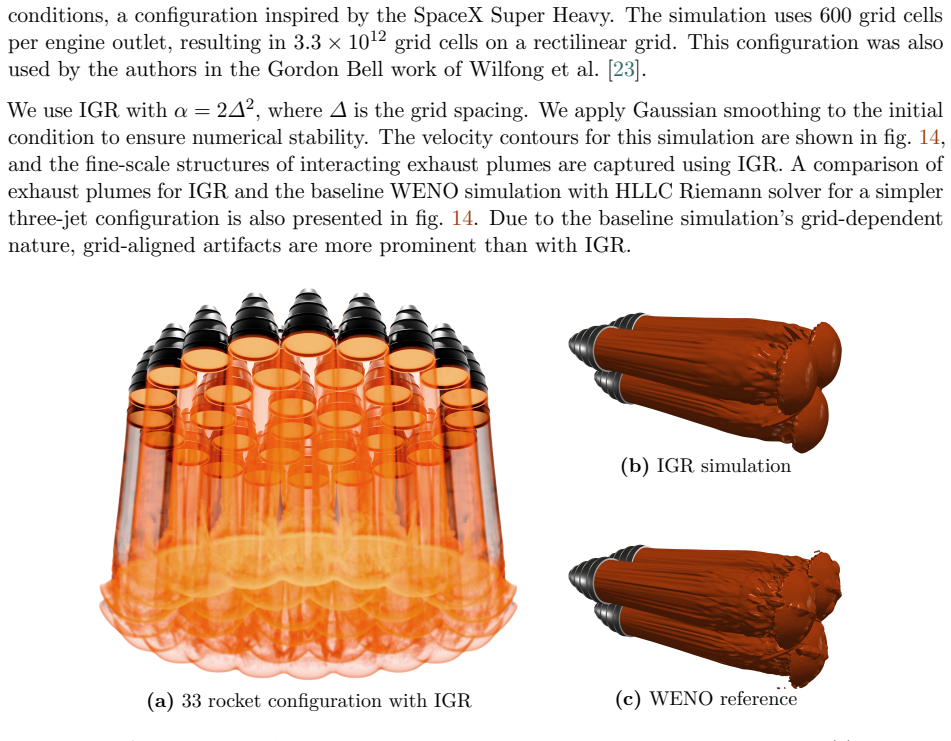
read the original abstract
Shock waves in high-speed fluid dynamics produce near-discontinuities in the fluid momentum, density, and energy. Most contemporary works use artificial viscosity or limiters as numerical mitigation of the Gibbs--Runge oscillations that result from traditional numerics. These approaches face a delicate balance in achieving sufficiently regular solutions without dissipating fine-scale features, such as turbulence or acoustics. Recent work by Cao and Sch\"afer introduces information geometric regularization (IGR), the first inviscid regularization method for fluid dynamics. IGR replaces shock singularities with smooth profiles of adjustable width, without dissipating fine-scale features. This work provides a strategy for the practical use of IGR in finite-volume-based numerical methods. We illustrate its performance on canonical test problems and compare it against established approaches based on limiters and Riemann solvers. Results show that the finite volume IGR approach recovers the expected solutions in all cases. Across canonical benchmarks, IGR achieves accuracy competitive with WENO and LAD shock-capturing schemes in both smooth and discontinuous flow regimes. The IGR approach is computationally light, with meaningfully fewer memory accesses and arithmetic operations per time step.
Editorial analysis
A structured set of objections, weighed in public.
Referee Report
Summary. The manuscript proposes a strategy for embedding information geometric regularization (IGR) into standard finite-volume discretizations of Navier-Stokes-like systems. It replaces shock singularities with smooth profiles whose width is controlled by an information-geometric length scale, claims that this recovers expected solutions on canonical benchmarks without traditional shock-capturing, achieves accuracy competitive with WENO and LAD schemes in both smooth and discontinuous regimes, and incurs meaningfully lower memory-access and arithmetic cost per time step.
Significance. If the central claims hold, the work would be significant for high-speed flow simulation: it offers an inviscid regularization that avoids dissipating fine-scale features while simplifying the numerical treatment of discontinuities and reducing per-step cost relative to limiters or artificial-viscosity methods. The approach extends the prior IGR framework of Cao and Schäfer into a practical FV setting.
major comments (1)
- [Abstract] Abstract: the central claim that IGR can be directly embedded 'without additional tuning' and remains 'computationally light' is load-bearing, yet the regularization length scale is described as adjustable. Without explicit demonstration (e.g., a single fixed width that works across all reported benchmarks without per-problem adjustment or post-processing), the method risks reintroducing a tunable dissipation scale comparable to existing shock-capturing techniques, directly weakening the advertised advantage.
minor comments (1)
- [Abstract] Abstract: the performance assertions (recovery of expected solutions, competitive accuracy, reduced operation count) are stated without reference to specific test cases, error norms, or implementation details; these should be summarized concisely so readers can gauge the scope of the validation.
Simulated Author's Rebuttal
We thank the referee for the careful review and constructive feedback. We address the single major comment below.
read point-by-point responses
-
Referee: [Abstract] Abstract: the central claim that IGR can be directly embedded 'without additional tuning' and remains 'computationally light' is load-bearing, yet the regularization length scale is described as adjustable. Without explicit demonstration (e.g., a single fixed width that works across all reported benchmarks without per-problem adjustment or post-processing), the method risks reintroducing a tunable dissipation scale comparable to existing shock-capturing techniques, directly weakening the advertised advantage.
Authors: We agree that the regularization length scale is an adjustable parameter, as stated in the abstract. The manuscript's reference to embedding 'without additional tuning' is intended to contrast IGR with traditional approaches that require per-problem calibration of limiters, Riemann solvers, or artificial viscosity coefficients; the IGR length scale is instead chosen once relative to mesh size to set a target shock width and then held fixed for the entire benchmark suite. However, the referee correctly identifies that the current text does not explicitly demonstrate this consistency. We will therefore revise the abstract to remove any ambiguity around parameter selection and add a concise statement (with supporting detail in the results section) confirming that the same relative length scale was used without per-benchmark retuning or post-processing. revision: yes
Circularity Check
No significant circularity; central FV embedding and benchmark results are independent of prior IGR definition
full rationale
The paper's core contribution is a practical embedding strategy for IGR into standard finite-volume discretizations, with performance claims (accuracy competitive with WENO/LAD, fewer operations, recovery of expected solutions) resting on numerical experiments across canonical problems rather than any self-referential derivation. The abstract attributes the IGR concept itself to prior work by Cao and Schäfer, but this citation supplies the regularization mechanism as an external input; the present results do not reduce to it by construction, nor do any quoted equations or claims equate a 'prediction' to a fitted parameter or rename a known result. No load-bearing step collapses to self-definition, fitted-input-as-prediction, or an unverified self-citation chain. The derivation chain is therefore self-contained against external benchmarks.
Axiom & Free-Parameter Ledger
Forward citations
Cited by 1 Pith paper
-
Thermodynamically Constrained Information Geometric Regularization for Compressible Flows
A thermodynamic extension of information geometric regularization for compressible flows introduces an anisotropic stress tensor and an elliptic equation that mitigates cusp singularities in simulations while preservi...
Reference graph
Works this paper leans on
-
[1]
C.-W. Shu, Essentially non-oscillatory and weighted essentially non-oscillatory schemes for hyperbolic conservation laws, in: B. Cockburn, C. Johnson, C.-W. Shu, E. Tadmor (Eds.), Advanced Numerical Approximation of Nonlinear Hyperbolic Equations, volume 1697 of Lecture Notes in Mathematics, Springer, 1998, pp. 325–432
work page 1998
-
[2]
D. Gottlieb, C.-W. Shu, On the Gibbs phenomenon and its resolution, SIAM Review39(1997) 644–668
work page 1997
- [3]
-
[4]
J. VonNeumann, R. D. Richtmyer, A method for the numerical calculation of hydrodynamic shocks, Journal of Applied Physics21(1950) 232–237
work page 1950
-
[5]
G. Puppo, Numerical entropy production for central schemes, SIAM Journal on Scientific Computing25(2004) 1382–1415
work page 2004
-
[6]
A. W. Cook, W. H. Cabot, Hyperviscosity for shock-turbulence interactions, Journal of Computational Physics203(2005) 379–385
work page 2005
-
[7]
B. Fiorina, S. K. Lele, An artificial nonlinear diffusivity method for supersonic reacting flows with shocks, Journal of Computational Physics222(2007) 246–264
work page 2007
-
[8]
A. Mani, J. Larsson, P. Moin, Suitability of artificial bulk viscosity for large-eddy simulation of turbulent flows with shocks, Journal of Computational Physics228(2009) 7368–7374
work page 2009
-
[9]
G. E. Barter, D. L. Darmofal, Shock capturing with PDE-based artificial viscosity for DGFEM: Part I. formulation, Journal of Computational Physics229(2010) 1810–1827
work page 2010
-
[10]
J.-L. Guermond, R. Pasquetti, B. Popov, Entropy viscosity method for nonlinear conservation laws, Journal of Computational Physics230(2011) 4248–4267
work page 2011
-
[11]
O. P. Bruno, J. S. Hesthaven, D. V. Leibovici, FC-based shock-dynamics solver with neural- network localized artificial-viscosity assignment, Journal of Computational Physics: X15 (2022) 100110
work page 2022
-
[12]
V. Dolejˇ s´ ı, M. Feistauer, C. Schwab, On some aspects of the discontinuous Galerkin finite element method for conservation laws, Mathematics and Computers in Simulation61(2003) 333–346
work page 2003
-
[13]
J. Glaubitz, P. ¨Offner, H. Ranocha, T. Sonar, Smooth and compactly supported viscous sub-cell shock capturing for discontinuous Galerkin methods, Journal of Scientific Computing79(2019) 249–272
work page 2019
-
[14]
Van Leer, Towards the ultimate conservative difference scheme
B. Van Leer, Towards the ultimate conservative difference scheme. V. a second-order sequel to Godunov’s method, Journal of computational Physics32(1979) 101–136
work page 1979
-
[15]
D. Ray, J. S. Hesthaven, An artificial neural network as a troubled-cell indicator, Journal of computational physics367(2018) 166–191
work page 2018
-
[16]
X.-D. Liu, S. Osher, T. Chan, Weighted essentially non-oscillatory schemes, Journal of Computational Physics115(1994) 200–212
work page 1994
- [17]
-
[18]
J.-L. Guermond, M. Nazarov, B. Popov, I. Tomas, Second-order invariant domain preserving approximation of the euler equations using convex limiting, SIAM Journal on Scientific Computing40(2018) A3211–A3239
work page 2018
-
[19]
D. Kuzmin, Monolithic convex limiting for continuous finite element discretizations of hyperbolic conservation laws, Computer Methods in Applied Mechanics and Engineering361(2020) 112804. 25
work page 2020
-
[20]
C. Lozano, Watch your adjoints! Lack of mesh convergence in inviscid adjoint solutions, AIAA Journal57(2019) 3991–4006
work page 2019
- [21]
- [22]
-
[23]
B. Wilfong, A. Radhakrishnan, H. Le Berre, D. J. Vickers, T. Prathi, N. Tselepidis, B. Dorschner, R. Budiardja, B. Cornille, S. Abbott, F. Sch¨ afer, S. H. Bryngelson, Simulating many-engine spacecraft: Exceeding 1 quadrillion degrees of freedom via information geometric regularization, in: Proceedings of SC ’25: The International Conference for High Perf...
work page 2025
- [24]
-
[25]
arXiv preprint arXiv:2512.13948 (2025)
W. Barham, B. K. Tran, B. S. Southworth, F. Sch¨ afer, Hamiltonian information geometric regularization of the compressible euler equations, arXiv preprint arXiv:2512.13948 (2025)
-
[26]
B. Guelmame, D. Clamond, S. Junca, Hamiltonian regularisation of the unidimensional barotropic euler equations, Nonlinear Analysis: Real World Applications64(2022) 103455
work page 2022
-
[27]
J. Koreeda, H. Yanagisawa, K. Maeno, H. Honma, S. Bystrov, V. Ivanov, F. Shugaev, Front structures of strong shock waves in air, in: Shock Waves @ Marseille II: Physico-Chemical Processes and Nonequilibrium Flow, Springer, 1995, pp. 263–268
work page 1995
- [28]
-
[29]
van Leer, Towards the ultimate conservative difference scheme
B. van Leer, Towards the ultimate conservative difference scheme. V. A second-order sequel to Godunov’s method, Journal of Computational Physics32(1979) 101–136
work page 1979
-
[30]
van Leer, Towards the ultimate conservative difference scheme
B. van Leer, Towards the ultimate conservative difference scheme. I. The quest of monotonicity, Lecture Notes in Physics18(1973) 163–168
work page 1973
-
[31]
V. Arnold, Sur la g´ eom´ etrie diff´ erentielle des groupes de Lie de dimension infinie et ses applications ` a l’hydrodynamique des fluides parfaits, Annales de l’institut Fourier16(1966) 319–361
work page 1966
- [32]
- [33]
-
[34]
E. F. Toro, M. Spruce, W. Speares, Restoration of the contact surface in the HLL-Riemann solver, Shock Waves4(1994) 25–34
work page 1994
-
[35]
E. F. Toro, Riemann Solvers and Numerical Methods for Fluid Dynamics: A Practical Intro- duction, 3 ed., Springer, 2009. 26
work page 2009
-
[36]
Y. Chauvat, J.-M. Moschetta, J. Gressier, Shock wave numerical structure and the carbuncle phenomenon, International Journal for Numerical Methods in Fluids47(2005) 903–909
work page 2005
-
[37]
S. Gottlieb, C.-W. Shu, E. Tadmor, Strong stability-preserving high-order time discretization methods, SIAM Review43(2001) 89–112
work page 2001
-
[38]
P. S. Rawat, X. Zhong, On high-order shock-fitting and front-tracking schemes for numerical simulation of shock–disturbance interactions, Journal of Computational Physics229(2010) 6744–6780
work page 2010
-
[39]
C.-W. Shu, S. Osher, Efficient implementation of essentially non-oscillatory shock-capturing schemes, Journal of Computational Physics77(1988) 439–471
work page 1988
-
[40]
G. A. Sod, A survey of several finite difference methods for systems of nonlinear hyperbolic conservation laws, Journal of Computational Physics27(1978) 1–31
work page 1978
-
[41]
R. Loub` ere, M. J. Shashkov, A subcell remapping method on staggered polygonal grids for arbitrary Lagrangian–Eulerian methods, Journal of Computational Physics209(2005) 105–138
work page 2005
- [42]
-
[43]
P. Woodward, P. Colella, The numerical simulation of two-dimensional fluid flow with strong shocks, Journal of Computational Physics54(1984) 115–173
work page 1984
-
[44]
C.-W. Shu, Essentially non-oscillatory and weighted essentially non-oscillatory schemes for hyperbolic conservation laws, in: Advanced Numerical Approximation of Nonlinear Hyperbolic Equations: Lectures given at the 2nd Session of the Centro Internazionale Matematico Estivo (CIME) held in Cetraro, Italy, June 23–28, 1997, Springer, 2006, pp. 325–432
work page 1997
-
[45]
S. C. Spiegel, H. Huynh, J. R. DeBonis, A survey of the isentropic Euler vortex problem using high-order methods, in: 22nd AIAA computational fluid dynamics conference, 2015, p. 2444
work page 2015
-
[46]
M. E. Brachet, D. I. Meiron, S. A. Orszag, B. G. Nickel, R. H. Morf, U. Frisch, Small-scale structure of the Taylor–Green vortex, Journal of Fluid Mechanics130(1983) 411–452
work page 1983
-
[47]
D. J. Lusher, N. D. Sandham, Assessment of low-dissipative shock-capturing schemes for the compressible Taylor–Green vortex, AIAA Journal59(2021) 533–545
work page 2021
-
[48]
S. B. Pope, Turbulent Flows, Cambridge University Press, Cambridge, UK, 2000
work page 2000
- [49]
-
[50]
S. K. Godunov, A difference method for numerical calculation of discontinuous solutions of the equations of hydrodynamics, Matematicheskii Sbornik47(1959) 271–306
work page 1959
-
[51]
P. Colella, P. R. Woodward, The piecewise parabolic method (PPM) for gas-dynamical simulations, Journal of Computational Physics54(1984) 174–201
work page 1984
-
[52]
P. L. Roe, Approximate Riemann solvers, parameter vectors, and difference schemes, Journal of Computational Physics43(1981) 357–372. 27
work page 1981
-
[53]
M.-S. Liou, A sequel to AUSM, Part II: AUSM+-up for all speeds, Journal of Computational Physics214(2006) 137–170
work page 2006
-
[54]
J. P. Boris, D. L. Book, Flux-corrected transport. I. SHASTA, a fluid transport algorithm that works, Journal of Computational Physics11(1973) 38–69
work page 1973
-
[55]
S. T. Zalesak, Fully multidimensional flux-corrected transport algorithms for fluids, Journal of Computational Physics31(1979) 335–362
work page 1979
- [56]
-
[57]
Tadmor, The numerical viscosity of entropy stable schemes for systems of conservation laws
E. Tadmor, The numerical viscosity of entropy stable schemes for systems of conservation laws. I, Mathematics of Computation49(1987) 91–103
work page 1987
-
[58]
A. Kurganov, E. Tadmor, New high-resolution central schemes for nonlinear conservation laws and convection–diffusion equations, Journal of Computational Physics160(2000) 241–282
work page 2000
-
[59]
B. Cockburn, C.-W. Shu, The Runge–Kutta discontinuous Galerkin method for conservation laws V: Multidimensional systems, Journal of Computational Physics141(1998) 199–224
work page 1998
-
[60]
J. J. Quirk, A contribution to the great Riemann solver debate, International Journal for Numerical Methods in Fluids18(1994) 555–574
work page 1994
- [61]
-
[62]
S. K. Lele, Compact finite difference schemes with spectral-like resolution, Journal of computa- tional physics103(1992) 16–42. 28
work page 1992
discussion (0)
Sign in with ORCID, Apple, or X to comment. Anyone can read and Pith papers without signing in.