Newton polytopes of immanants of some combinatorial matrices
Pith reviewed 2026-05-14 22:15 UTC · model grok-4.3
The pith
The Newton polytopes of immanants of Giambelli matrices are saturated for every character.
A machine-rendered reading of the paper's core claim, the machinery that carries it, and where it could break.
Core claim
For Giambelli matrices the saturation property holds for all immanants. This follows from an explicit formula for the coefficient of the largest monomial, taken in the dominance order, inside the monomial expansion of any such immanant. The formula is obtained by counting lattice paths compatible with the Giambelli shape.
What carries the argument
The coefficient of the dominance-maximal monomial in the immanant expansion of a Giambelli matrix, extracted via a lattice-path enumeration.
If this is right
- Every lattice point inside the Newton polytope of a Giambelli immanant appears with nonzero coefficient.
- The explicit leading coefficient immediately determines the vertices and the full support of the polytope for any Giambelli matrix.
- Saturation supplies a geometric strengthening of the already-established m-positivity for these immanants.
- The same lattice-path counting that yields the leading coefficient can be reused to study further positivity questions for Giambelli immanants.
Where Pith is reading between the lines
- If saturation holds, the Newton polytope description may give a direct combinatorial route to proving Schur positivity for Giambelli immanants.
- The explicit coefficient formula could be tested on small matrices to see whether an analogous statement applies to other families of combinatorial matrices.
- Saturation of the polytope would imply that the immanant is a sum of monomials whose exponents form a normal semigroup.
Load-bearing premise
The lattice-path models give the exact set of monomials with nonzero coefficients in every immanant expansion.
What would settle it
A single Giambelli matrix together with an irreducible character for which some lattice point strictly inside the Newton polytope has coefficient zero in the immanant.
Figures


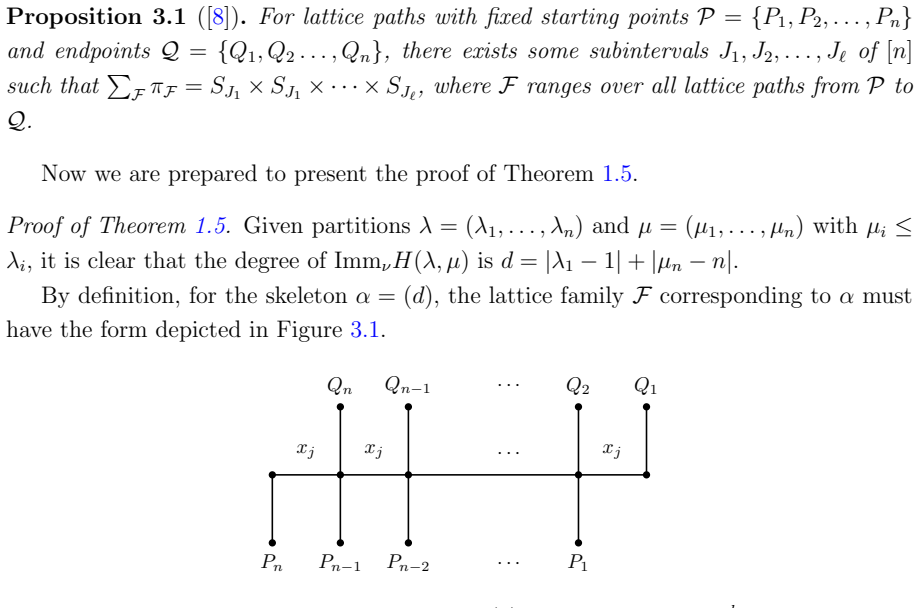

read the original abstract
The immanants of combinatorial matrices have many significant properties, including m-positivity and Schur positivity. While the immanants of Jacobi-Trudi matrices are known to be both m-positive and Schur positive, those of Giambelli matrices have only been proven to be m-positive, with Schur positivity remaining a conjecture. These positivity properties rely heavily on lattice path interpretations. In this paper, we study the Newton polytopes of immanants for these two classes of matrices. Using the lattice path method, we verify the saturation property for the Newton polytopes of Jacobi-Trudi matrices in special cases. For Giambelli matrices, we prove that this property holds for all immanants. To achieve this, we obtain the explicit coefficients of the largest monomial (in the dominance order) in the monomial expansion of the immanants of Giambelli matrices.
Editorial analysis
A structured set of objections, weighed in public.
Referee Report
Summary. The manuscript studies Newton polytopes of immanants of Jacobi-Trudi and Giambelli matrices. Using lattice-path interpretations of monomial expansions, it verifies the saturation property for special cases of Jacobi-Trudi immanants and proves saturation for every immanant of a Giambelli matrix by deriving an explicit formula for the coefficient of the dominance-maximal monomial.
Significance. If the lattice-path derivations are complete and accurate, the explicit coefficient formulas and saturation proofs would strengthen combinatorial tools for studying positivity properties of immanants, offering concrete progress toward the open Schur-positivity conjecture for Giambelli immanants and new information on the convex hulls of their support.
major comments (2)
- [Giambelli section / main theorem] The saturation proof for Giambelli immanants (central claim in the abstract and main theorem) rests entirely on the lattice-path model correctly identifying both the dominance-maximal monomial and its coefficient; the manuscript supplies no independent enumeration or direct expansion check for small partitions (e.g., (2,1) or (3,1)) that would confirm no omitted paths alter the convex hull.
- [lattice-path derivation for Giambelli] The explicit coefficient formula obtained via lattice paths is asserted to be the largest monomial in dominance order, yet the text provides no derivation steps showing why competing paths cannot produce a monomial that is larger or equal in dominance order, which is load-bearing for the saturation conclusion.
minor comments (1)
- [abstract] The abstract states that saturation is verified 'in special cases' for Jacobi-Trudi matrices but does not list the partitions or matrix sizes considered, making the scope of the verification unclear.
Simulated Author's Rebuttal
We thank the referee for the careful reading and for highlighting points where additional verification and derivation details would strengthen the manuscript. We agree that the saturation result for Giambelli immanants is the central claim and that the lattice-path argument must be made fully transparent. Below we respond point by point and indicate the revisions we will make.
read point-by-point responses
-
Referee: [Giambelli section / main theorem] The saturation proof for Giambelli immanants (central claim in the abstract and main theorem) rests entirely on the lattice-path model correctly identifying both the dominance-maximal monomial and its coefficient; the manuscript supplies no independent enumeration or direct expansion check for small partitions (e.g., (2,1) or (3,1)) that would confirm no omitted paths alter the convex hull.
Authors: We accept this observation. In the revised manuscript we will add a new subsection containing explicit lattice-path enumerations for the partitions (2,1) and (3,1). For each case we list all admissible paths, compute the resulting monomials, verify that the claimed monomial is dominance-maximal, and confirm that its coefficient matches the formula given in the main theorem. These checks will demonstrate that no additional paths contribute a monomial that could enlarge the Newton polytope. revision: yes
-
Referee: [lattice-path derivation for Giambelli] The explicit coefficient formula obtained via lattice paths is asserted to be the largest monomial in dominance order, yet the text provides no derivation steps showing why competing paths cannot produce a monomial that is larger or equal in dominance order, which is load-bearing for the saturation conclusion.
Authors: We agree that the current text is too terse on this point. In the revision we will insert a detailed argument immediately after the statement of the coefficient formula. The argument proceeds by showing that any lattice path other than the one corresponding to the dominance-maximal monomial must either (i) cross a forbidden region of the Giambelli matrix (producing a zero entry) or (ii) produce a monomial that is componentwise smaller in the dominance partial order. We will also prove that the coefficient of the maximal monomial is strictly positive by exhibiting a unique contributing path with weight 1. These steps will make the dominance-maximality claim self-contained. revision: yes
Circularity Check
No significant circularity; lattice-path derivations are externally grounded
full rationale
The paper applies the standard lattice-path interpretation of immanant monomial expansions (cited from the literature) to compute explicit coefficients of dominance-maximal monomials for Giambelli matrices and to verify saturation in special Jacobi-Trudi cases. No quantity is defined in terms of the target saturation property, no fitted parameter is relabeled as a prediction, and no load-bearing step reduces to a self-citation or self-derived uniqueness theorem. The central claims therefore rest on independent combinatorial enumeration rather than circular reduction.
Axiom & Free-Parameter Ledger
axioms (1)
- domain assumption Lattice path interpretations accurately and completely model the monomial expansions and positivity properties of immanants of Jacobi-Trudi and Giambelli matrices.
Reference graph
Works this paper leans on
-
[1]
W. Y. C. Chen, G.-G. Yan, and A. L. B. Yang. Transformations of border strips and Schur function determinants.J. Algebraic Combin., 21(4):379–394, 2005
work page 2005
-
[2]
C. W. Cryer. Some properties of totally positive matrices.Linear Algebra Appl., 15(1):1–25, 1976
work page 1976
-
[3]
¨O. N. E˘ gecio˘ glu and J. B. Remmel. A combinatorial proof of the Giambelli identity for Schur functions.Adv. in Math., 70(1):59–86, 1988
work page 1988
-
[4]
A. Fink, K. M´ esz´ aros, and A. St. Dizier. Schubert polynomials as integer point transforms of generalized permutahedra.Adv. Math., 332:465–475, 2018
work page 2018
-
[5]
Lattice path proofs for determinan- tal formulas for symplectic and orthogonal characters.J
Markus Fulmek and Christian Krattenthaler. Lattice path proofs for determinan- tal formulas for symplectic and orthogonal characters.J. Combin. Theory Ser. A, 77(1):3–50, 1997
work page 1997
-
[6]
W. Fulton and J. Harris.Representation theory, volume 129 ofGraduate Texts in Mathematics. Springer-Verlag, New York, 1991. A first course, Readings in Mathe- matics. 16
work page 1991
-
[7]
I. Gessel and G. Viennot. Binomial determinants, paths, and hook length formulae. Adv. in Math., 58(3):300–321, 1985
work page 1985
-
[8]
I. P. Goulden and D. M. Jackson. Immanants of combinatorial matrices.J. Algebra, 148(2):305–324, 1992
work page 1992
-
[9]
C. Greene. Proof of a conjecture on immanants of the Jacobi-Trudi matrix.Linear Algebra Appl., 171:65–79, 1992
work page 1992
-
[10]
M. Haiman. Hecke algebra characters and immanant conjectures.J. Amer. Math. Soc., 6(3):569–595, 1993
work page 1993
-
[11]
A. M. Hamel and I. P. Goulden. Planar decompositions of tableaux and Schur function determinants.European J. Combin., 16(5):461–477, 1995
work page 1995
-
[12]
A. Lascoux and P. Pragacz. Ribbon Schur functions.European J. Combin., 9(6):561– 574, 1988
work page 1988
-
[13]
N. R. T. Lesnevich. Hook-shape immanant characters from Stanley-Stembridge char- acters.Algebr. Comb., 7(1):137–157, 2024
work page 2024
-
[14]
Y. H. Li.Planar Networks and Immanant Positivity for Combinatorial Matrices
-
[15]
Thesis (Ph.D.)–Nankai University
-
[16]
C. Monical, N. Tokcan, and A. Yong. Newton polytopes in algebraic combinatorics. Selecta Math. (N.S.), 25(5):Paper No. 66, 37, 2019
work page 2019
-
[17]
Murota.Discrete convex analysis
K. Murota.Discrete convex analysis. SIAM Monographs on Discrete Mathematics and Applications. Society for Industrial and Applied Mathematics (SIAM), Philadel- phia, PA, 2003
work page 2003
- [18]
-
[19]
R. Rado. An inequality.J. London Math. Soc., 27:1–6, 1952
work page 1952
-
[20]
B. E. Sagan.The symmetric group, volume 203 ofGraduate Texts in Mathematics. Springer-Verlag, New York, second edition, 2001. Representations, combinatorial algorithms, and symmetric functions
work page 2001
-
[21]
A. J. St. Dizier.Combinatorics of Schubert Polynomials. ProQuest LLC, Ann Arbor, MI, 2020. Thesis (Ph.D.)–Cornell University. 17
work page 2020
-
[22]
R. P. Stanley.Enumerative combinatorics. Vol. 2, volume 208 ofCambridge Studies in Advanced Mathematics. Cambridge University Press, Cambridge, [2024]©2024. Second edition [of 1676282], With an appendix by Sergey Fomin
work page 2024
-
[23]
R. P. Stanley and J. R. Stembridge. On immanants of Jacobi-Trudi matrices and permutations with restricted position.J. Combin. Theory Ser. A, 62(2):261–279, 1993
work page 1993
-
[24]
J. R. Stembridge. Immanants of totally positive matrices are nonnegative.Bull. London Math. Soc., 23(5):422–428, 1991
work page 1991
-
[25]
J. R. Stembridge. Some conjectures for immanants.Canad. J. Math., 44(5):1079– 1099, 1992
work page 1992
-
[26]
The Sage Developers.SageMath, the Sage Mathematics Software System (Version 10.4), 2024.https://www.sagemath.org
work page 2024
-
[27]
B. Wang, C. X. T. Zhang, and Z.-X. Zhang. Newton polytopes of dualk-Schur polynomials.Adv. in Appl. Math., 162:Paper No. 102773, 21, 2025
work page 2025
-
[28]
H. L. Wolfgang.Two interactions between combinatorics and representation theory: Monomial immanants and Hochschild cohomology. ProQuest LLC, Ann Arbor, MI,
-
[29]
Thesis (Ph.D.)–Massachusetts Institute of Technology. 18
discussion (0)
Sign in with ORCID, Apple, or X to comment. Anyone can read and Pith papers without signing in.