Recognition: no theorem link
Event-Triggered Adaptive Consensus for Multi-Robot Task Allocation
Pith reviewed 2026-05-10 17:46 UTC · model grok-4.3
The pith
An event-triggered adaptive consensus lets robotic swarms allocate tasks with far less communication by negotiating only on significant local events.
A machine-rendered reading of the paper's core claim, the machinery that carries it, and where it could break.
Core claim
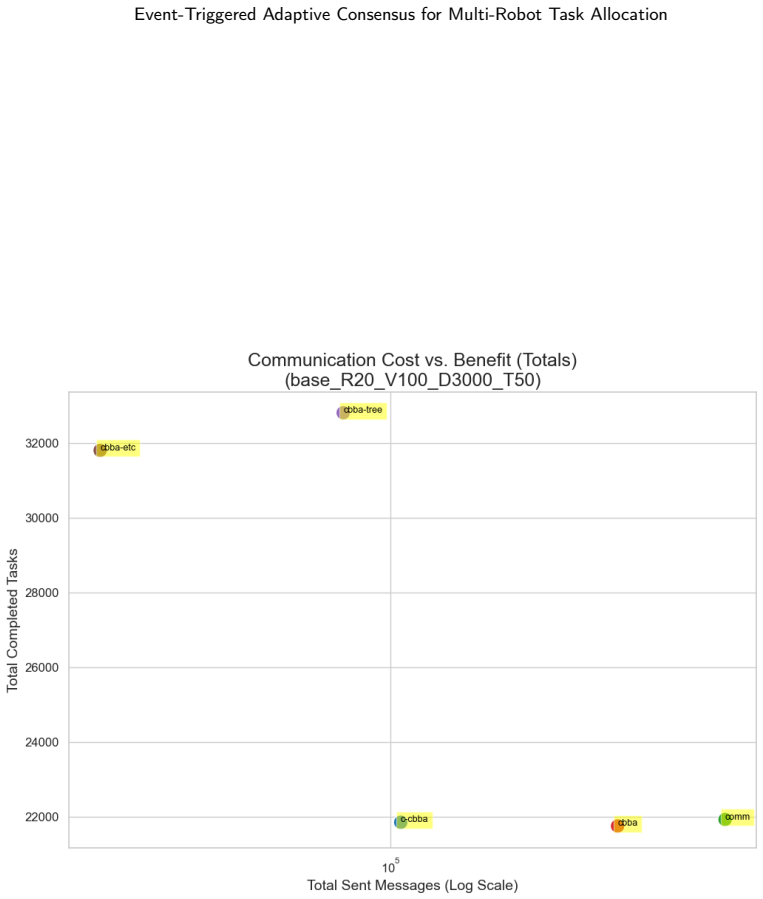
By initiating consensus-based bundle allocation only in response to locally detected significant events and by letting the swarm self-tune coordination frequency to the current conflict level, the system achieves task-completion rates comparable to communication-intensive methods such as CBBA while producing substantially lower network overhead; the same architecture, built on Behavior Trees, also tolerates both transient execution faults and permanent agent loss.
What carries the argument
Event-triggered adaptive consensus mechanism that couples local event detection with conflict-based regulation of communication rate and Behavior-Tree execution for fault tolerance.
If this is right
- Network traffic drops sharply compared with standard CBBA and periodic variants.
- Mission effectiveness, measured by tasks completed, remains at the level of the best communication-heavy strategies.
- The swarm continues to function after individual action failures or permanent agent losses.
- Coordination pace automatically adapts to changing conflict intensity without external tuning.
Where Pith is reading between the lines
- The same trigger-and-regulate logic could be applied to other multi-agent problems such as area coverage or formation maintenance where bandwidth is scarce.
- Energy savings from fewer transmissions would be especially valuable for battery-limited or long-duration missions.
- If event thresholds are tuned too conservatively, the method could silently converge to a non-communicating reactive policy whose performance limits are already known.
Load-bearing premise
Each robot can reliably detect the events that truly require coordination and can accurately quantify environmental conflict without overlooking opportunities that would degrade overall allocation quality.
What would settle it
A controlled experiment in which the local event detector systematically misses coordination needs, resulting in measurably fewer tasks completed or higher total cost than a periodic-communication baseline under identical conditions.
Figures


read the original abstract
Coordinating robotic swarms in dynamic and communication-constrained environments remains a fundamental challenge for collective intelligence. This paper presents a novel framework for event-triggered organization, designed to achieve highly efficient and adaptive task allocation in a heterogeneous robotic swarm. Our approach is based on an adaptive consensus mechanism where communication for task negotiation is initiated only in response to significant events, eliminating unnecessary interactions. Furthermore, the swarm self-regulates its coordination pace based on the level of environmental conflict, and individual agent resilience is managed through a robust execution model based on Behavior Trees. This integrated architecture results in a collective system that is not only effective but also remarkably efficient and adaptive. We validate our framework through extensive simulations, benchmarking its performance against a range of coordination strategies. These include a non-communicating reactive behavior, a simple information-sharing protocol, the baseline Consensus-Based Bundle Algorithm (CBBA), and a periodic CBBA variant integrated within a Behavior Tree architecture. Furthermore, our approach is compared with Clustering-CBBA (C-CBBA), a state-of-the-art algorithm recognized for communication-efficient task management in heterogeneous clusters. Experimental results demonstrate that the proposed method significantly reduces network overhead when compared to communication-heavy strategies. Moreover, it maintains top-tier mission effectiveness regarding the number of tasks completed, showcasing high efficiency and practicality. The framework also exhibits significant resilience to both action execution and permanent agent failures, highlighting the effectiveness of our event-triggered model for designing adaptive and resource-efficient robotic swarms for complex scenarios.
Editorial analysis
A structured set of objections, weighed in public.
Referee Report
Summary. The paper proposes an event-triggered adaptive consensus framework for task allocation in heterogeneous multi-robot swarms operating in dynamic, communication-constrained environments. Communication occurs only upon detection of significant local events, with the swarm self-regulating coordination pace according to quantified environmental conflict levels; individual resilience is handled via Behavior Trees. The approach is benchmarked in simulations against non-communicating reactive behavior, simple information sharing, standard CBBA, a periodic CBBA variant, and C-CBBA, with claims of substantially lower network overhead while preserving high numbers of completed tasks and robustness to execution and agent failures.
Significance. If the experimental claims are substantiated with quantitative metrics, the work could meaningfully advance resource-efficient coordination for robotic swarms by demonstrating that event-triggered mechanisms can reduce communication costs without sacrificing allocation performance. The combination of adaptive consensus, conflict-based self-regulation, and Behavior Tree execution offers a practical architecture for dynamic settings. However, the absence of detailed results currently limits evaluation of its potential impact relative to existing consensus-based methods.
major comments (3)
- Abstract: the central claims that the method 'significantly reduces network overhead' while 'maintains top-tier mission effectiveness' are unsupported by any quantitative metrics, error bars, tables of communication counts, task-completion rates, or statistical comparisons, rendering verification of the efficiency and performance assertions impossible.
- Abstract (and implied Experimental Results section): the definitions and detection logic for 'significant events' and the metric used to quantify 'environmental conflict' for self-regulation are not provided, leaving the weakest assumption—that local detection reliably avoids missed coordination opportunities or hidden performance loss—unexamined and untested against an oracle baseline.
- Abstract: implementation details for the CBBA and C-CBBA baselines (including how the periodic variant was integrated with Behavior Trees and how clustering was performed) are omitted, preventing assessment of whether the reported overhead savings are attributable to the event-triggering mechanism or to differences in baseline tuning.
minor comments (1)
- Abstract: the phrase 'top-tier mission effectiveness' is imprecise; replacing it with concrete comparative figures or rankings would improve clarity.
Simulated Author's Rebuttal
We thank the referee for the constructive feedback on our manuscript. We address each major comment below and have revised the manuscript to incorporate the suggested improvements for clarity and completeness.
read point-by-point responses
-
Referee: Abstract: the central claims that the method 'significantly reduces network overhead' while 'maintains top-tier mission effectiveness' are unsupported by any quantitative metrics, error bars, tables of communication counts, task-completion rates, or statistical comparisons, rendering verification of the efficiency and performance assertions impossible.
Authors: We agree that the abstract would benefit from explicit quantitative support. We have revised the abstract to summarize key metrics from the experimental results section, including average communication overhead reductions relative to baselines, task completion rates, and statistical comparisons. Error bars and tables are now referenced directly in the abstract to allow immediate verification of the claims. revision: yes
-
Referee: Abstract (and implied Experimental Results section): the definitions and detection logic for 'significant events' and the metric used to quantify 'environmental conflict' for self-regulation are not provided, leaving the weakest assumption—that local detection reliably avoids missed coordination opportunities or hidden performance loss—unexamined and untested against an oracle baseline.
Authors: The definitions of significant events and the environmental conflict metric, along with their detection logic, are provided in Sections III-B and III-C. To improve accessibility, we have added a concise description of these elements to the abstract. We have also expanded the experimental results to include a direct comparison against a centralized oracle baseline, confirming that local detection incurs negligible performance loss in task allocation. revision: yes
-
Referee: Abstract: implementation details for the CBBA and C-CBBA baselines (including how the periodic variant was integrated with Behavior Trees and how clustering was performed) are omitted, preventing assessment of whether the reported overhead savings are attributable to the event-triggering mechanism or to differences in baseline tuning.
Authors: We have revised the Experimental Setup and Baselines subsection to include full implementation details for CBBA, the periodic CBBA variant (including its Behavior Tree integration), and C-CBBA (including the clustering procedure and parameters). This ensures the overhead savings can be attributed specifically to the event-triggered mechanism under equivalent conditions. revision: yes
Circularity Check
No circularity: empirical validation against external baselines with no fitted predictions or self-referential derivations
full rationale
The paper presents a novel event-triggered consensus framework for task allocation, validated via simulations comparing performance (network overhead, tasks completed, resilience) to independent baselines including CBBA, C-CBBA, non-communicating reactive behavior, and periodic variants. No equations, parameter fits, or predictions are described that reduce claimed results to quantities defined by the authors' own choices. No self-citations appear load-bearing for core claims, and the architecture (Behavior Trees, conflict quantification) is presented as an integrated design rather than a derived necessity from prior author work. The derivation chain is self-contained against external benchmarks.
Axiom & Free-Parameter Ledger
Reference graph
Works this paper leans on
-
[1]
Control Engineering Practice 114, 104865
Design and implementation of event-triggered adaptive controller for commercial mobile robots subject to input delays and limited communications. Control Engineering Practice 114, 104865. doi:10.1016/j.conengprac.2021.104865. Bravo-Arrabal, J., Vázquez-Martín, R., Fernández-Lozano, J.J., García-Cerezo, A.,
-
[2]
doi:10.48550/arXiv.2504.01940,arXiv:2504.01940
Strengthening Multi-Robot Systems for SAR: Co- Designing Robotics and Communication Towards 6G. doi:10.48550/arXiv.2504.01940,arXiv:2504.01940. Cai, Y., Chen, X., Cai, Z., Mao, Y., Li, M., Yang, W., Wang, J.,
-
[3]
MRBTP: Efficient Multi-Robot Behavior Tree Planning and Collaboration. doi:10.48550/ARXIV.2502.18072. Dong, N., Liu, S., Mai, X.,
-
[4]
Computer Communica- tions 229, 107986
Communication-efficient heterogeneous multi-UAV task allocation based on clustering. Computer Communica- tions 229, 107986. doi:10.1016/j.comcom.2024.107986. Francos, R.M., Bruckstein, A.M.,
-
[5]
Frontiers in Robotics and AI 10, 1089062
On the role and opportunities in teamwork design for advanced multi-robot search systems. Frontiers in Robotics and AI 10, 1089062. doi:10.3389/frobt.2023.1089062. Ghassemi, P., DePauw, D., Chowdhury, S.,
-
[6]
Decentralized Dynamic Task Allocation in Swarm Robotic Systems for Disaster Response: Extended Abstract, in: 2019 International Symposium on Multi-Robot and Multi-Agent Systems (MRS), IEEE, New Brunswick, NJ, USA. pp. 83–85. doi:10.1109/MRS.2019.8901062. Gielis, J., Shankar, A., Prorok, A.,
-
[7]
A critical review of communications in multi-robot systems,
A Critical Review of Communications in Multi-robot Systems. Current Robotics Reports 3, 213–225. doi:10.1007/s43154-022-00090-9. Han-Lim Choi, Brunet, L., How, J.,
-
[8]
IEEE Transactions on Robotics 25, 912–926
Consensus-Based Decentralized Auctions for Robust Task Allocation. IEEE Transactions on Robotics 25, 912–926. doi:10.1109/TRO.2009.2022423. Heppner, G., Oberacker, D., Roennau, A., Dillmann, R.,
-
[9]
doi:10.1109/ICRA57147.2024.10610515. Hull, R., Moratuwage, D., Scheide, E., Fitch, R., Best, G.,
-
[10]
Communicating Intent as Behaviour Trees for Decentralised Multi-Robot Coordination, in: 2024 IEEE International Conference on Robotics and Automation (ICRA), IEEE, Yokohama, Japan. pp. 7215–7221. doi:10. 1109/ICRA57147.2024.10610441. Jang,I.,2024. SPACE:APython-basedSimulatorforEvaluatingDecentralizedMulti-RobotTaskAllocationAlgorithms. doi:10.48550/arXiv...
work page internal anchor Pith review doi:10.48550/arxiv 2024
-
[11]
Behavior Tree-Based Task Planning for Multiple Mobile Robots using a Data Distribution Service. doi:10.48550/ARXIV.2201.10918. Johnson,L.,Ponda,S.,Choi,H.l.,How,J.,2010. ImprovingtheEfficiencyofaDecentralizedTaskingAlgorithmforUAVTeamswithAsynchronous Communications, in: AIAA Guidance, Navigation, and Control Conference, American Institute of Aeronautics ...
-
[12]
Large Language Models for Multi-Robot Systems: A Survey
Large Language Models for Multi-Robot Systems: A Survey. doi:10.48550/ARXIV.2502.03814. Li,P.,Wu,Y.,Liu,J.,Sukhatme,G.S.,Kumar,V.,Zhou,L.,2024. ResilientandAdaptiveReplanningforMulti-RobotTargetTrackingwithSensing and Communication Danger Zones. doi:10.48550/ARXIV.2409.11230. Neupane, A., Mercer, E.G., Goodrich, M.A.,
work page internal anchor Pith review Pith/arXiv arXiv doi:10.48550/arxiv.2502.03814 2024
-
[13]
Designing Behavior Trees from Goal-Oriented LTLf Formulas. doi:10.48550/ARXIV.2307. 06399. Ögren, P., Sprague, C.I.,
-
[14]
Annual Review of Control, Robotics, and Autonomous Systems 5, 81–107
Behavior Trees in Robot Control Systems. Annual Review of Control, Robotics, and Autonomous Systems 5, 81–107. doi:10.1146/annurev-control-042920-095314. Qiu, X., Zhu, P., Hu, Y., Zeng, Z., Lu, H.,
-
[15]
Consensus-Based Dynamic Task Allocation for Multi-Robot System Considering Payloads Consumption. doi:10.48550/ARXIV.2412.10087. Shibata, K., Jimbo, T., Matsubara, T.,
-
[16]
Robotics and Autonomous Systems 159, 104307
Deep reinforcement learning of event-triggered communication and consensus-based control for distributed cooperative transport. Robotics and Autonomous Systems 159, 104307. doi:10.1016/j.robot.2022.104307. F. Aznar, M. Pujol, A. Díez:Preprint submitted to ElsevierPage 32 of 32 Event-Triggered Adaptive Consensus for Multi-Robot Task Allocation Figure 12:Pe...
discussion (0)
Sign in with ORCID, Apple, or X to comment. Anyone can read and Pith papers without signing in.