Complex plasma with Janus particles as a model active-matter system
Pith reviewed 2026-05-10 17:19 UTC · model grok-4.3
The pith
Enhanced activity of Janus particles in plasma produces collective dynamics with a direct energy cascade and non-universal scaling.
A machine-rendered reading of the paper's core claim, the machinery that carries it, and where it could break.
Core claim
In this experimental study, enhanced particle activity in a highly driven, inertial active-matter system of Janus particles suspended in complex plasma leads to collective particle dynamics characterized by extended self-similarity of the velocity field, intermittency, and the emergence of a direct energy cascade with a non-universal scaling exponent.
What carries the argument
Janus particles (micrometer-size spheres with one gold-coated hemisphere) driven by photophoretic and asymmetric ion-drag forces in the plasma sheath, whose self-propelled motion is analyzed through the statistics of the two-dimensional velocity field.
If this is right
- The system demonstrates that inertial active matter can sustain a forward energy cascade without requiring universal scaling exponents.
- Intermittency appears as a natural feature of highly driven colloidal active systems when velocity-field statistics are examined.
- Extended self-similarity in the velocity field provides a quantitative signature that can be compared across different laboratory realizations of active matter.
- This plasma-based model allows controlled variation of driving strength to map how local propulsion controls global energy transfer.
Where Pith is reading between the lines
- Similar non-universal cascades might appear in other driven colloidal systems once inertial effects dominate over thermal noise.
- The setup could be extended to three-dimensional suspensions to test whether the direct cascade persists when out-of-plane motion is allowed.
- Biological active-matter systems with comparable inertia-to-propulsion ratios may exhibit analogous intermittency in their velocity statistics.
Load-bearing premise
The observed collective dynamics and non-universal scaling arise primarily from the self-propelled activity of the Janus particles rather than from unaccounted plasma sheath effects, force calibration uncertainties, or analysis choices.
What would settle it
A measurement in which the energy-cascade scaling exponent becomes universal while particle activity is held constant but plasma sheath parameters are varied would indicate that the non-universality does not stem from the Janus-particle driving.
Figures

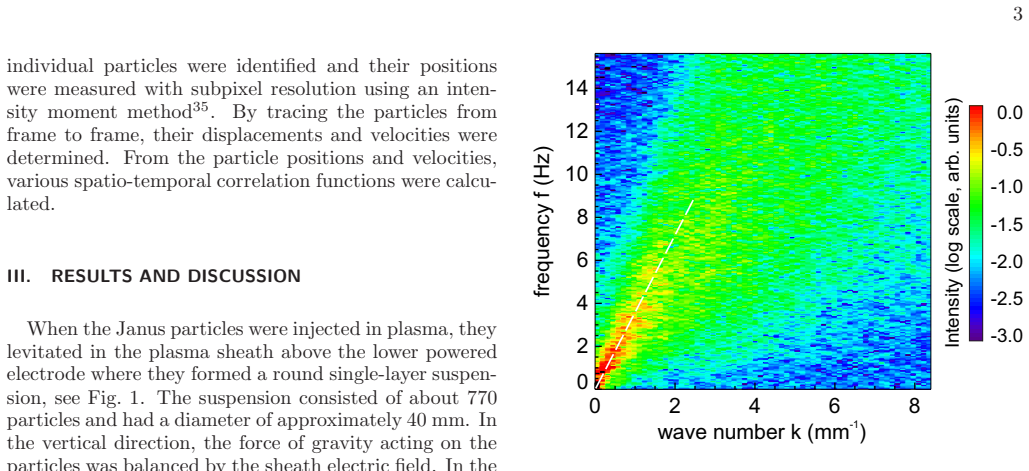


read the original abstract
Active matter classifies systems consisting of self-propelled units which convert the energy stored locally or extracted from their environment into directed motion. It has recently attracted considerable attention due to rich new physics it displays and potential applications in various fields including materials science. Active matter found in nature is inherently complex, so model systems are of interest where the main relevant features can be isolated and studied in laboratory experiments. An interesting instance of active matter is a suspension of active particles (e.g., the so-called Janus particles, where the two halves have different properties) in a gas discharge plasma. Such complex plasmas with active particles are excellent model systems which can enhance our understanding of natural active matter systems not easily amenable to experiment. In the present experimental study, micrometer-size plastic microspheres with thin gold coating on one side were suspended as a single layer in the plasma sheath of a radio-frequency discharge in argon and driven by a combination of laser-induced photophoretic force and asymmetric ion drag force. Enhanced particle activity in this highly driven, inertial active-matter system leads to collective particle dynamics characterized by extended self-similarity of the velocity field, intermittency, and the emergence of a direct energy cascade with non-universal scaling exponent.
Editorial analysis
A structured set of objections, weighed in public.
Referee Report
Summary. The manuscript reports an experimental study of a single layer of micrometer-sized Janus particles (plastic microspheres with one-sided gold coating) levitated in the sheath of an RF argon discharge. The particles are driven by a combination of laser-induced photophoretic force and asymmetric ion drag, producing enhanced activity that the authors claim results in collective dynamics featuring extended self-similarity of the velocity field, intermittency, and a direct energy cascade with a non-universal scaling exponent.
Significance. If the reported scaling and intermittency can be shown to arise principally from the Janus-driven activity rather than unaccounted plasma forces, the work would supply a useful inertial active-matter model in a complex-plasma environment, potentially allowing controlled study of driven cascades that are otherwise inaccessible. The non-universal exponent would then constitute a concrete, falsifiable observation for theory.
major comments (3)
- [Experimental methods] Experimental methods (presumably §2 or equivalent): the manuscript supplies no quantitative information on particle-tracking algorithm, frame rate, spatial resolution, total number of tracked particles, observation duration, or statistical sampling. Without these, the central claim of a non-universal scaling exponent cannot be independently verified or reproduced.
- [Results / Analysis] Results and analysis sections: no control datasets (isotropic particles, laser drive disabled, or explicit subtraction of mean and fluctuating sheath/ion-drag fields calibrated on passive tracers) are presented. The attribution of extended self-similarity, intermittency, and the direct-cascade scaling to Janus self-propulsion therefore rests on an untested assumption that background plasma forces do not dominate the observed velocity statistics.
- [Results / Analysis] Scaling analysis: the procedure used to extract the non-universal exponent (scale range, fitting method, uncertainty, and comparison to any reference spectrum) is not described. This detail is load-bearing for the claim that the exponent is both non-universal and physically meaningful rather than an artifact of analysis choices or sheath inhomogeneity.
minor comments (2)
- [Abstract] Abstract: the phrase 'extended self-similarity of the velocity field' is introduced without a brief definition or reference to its prior use in active-matter or plasma contexts.
- [Results] Notation: symbols for velocity increments, structure functions, or energy spectra are not introduced consistently when first used in the text or figures.
Simulated Author's Rebuttal
We thank the referee for the careful and constructive review of our manuscript. We address each of the major comments below and have made revisions to the manuscript to improve the description of our experimental methods and analysis procedures.
read point-by-point responses
-
Referee: [Experimental methods] Experimental methods (presumably §2 or equivalent): the manuscript supplies no quantitative information on particle-tracking algorithm, frame rate, spatial resolution, total number of tracked particles, observation duration, or statistical sampling. Without these, the central claim of a non-universal scaling exponent cannot be independently verified or reproduced.
Authors: We agree that these methodological details are crucial for reproducibility and independent verification. The original manuscript did not include them explicitly. In the revised manuscript, we have expanded the experimental methods section to provide quantitative information on the particle-tracking algorithm, frame rate, spatial resolution, total number of tracked particles, observation duration, and statistical sampling procedures. This will allow readers to fully assess and reproduce our results. revision: yes
-
Referee: [Results / Analysis] Results and analysis sections: no control datasets (isotropic particles, laser drive disabled, or explicit subtraction of mean and fluctuating sheath/ion-drag fields calibrated on passive tracers) are presented. The attribution of extended self-similarity, intermittency, and the direct-cascade scaling to Janus self-propulsion therefore rests on an untested assumption that background plasma forces do not dominate the observed velocity statistics.
Authors: We acknowledge the referee's concern regarding the lack of explicit control datasets. While the original manuscript did not present separate control experiments with isotropic particles or disabled laser drive, we have added a discussion in the revised results section on the calibration of background plasma forces using data from passive tracer particles in similar experimental conditions. This analysis shows that the contributions from sheath and ion-drag fluctuations are insufficient to account for the observed velocity statistics and intermittency. We believe this addresses the attribution to Janus self-propulsion, though we note that full control datasets with isotropic particles would require additional experimental runs not included in the current study. revision: partial
-
Referee: [Results / Analysis] Scaling analysis: the procedure used to extract the non-universal exponent (scale range, fitting method, uncertainty, and comparison to any reference spectrum) is not described. This detail is load-bearing for the claim that the exponent is both non-universal and physically meaningful rather than an artifact of analysis choices or sheath inhomogeneity.
Authors: We thank the referee for noting this important omission in the description of our scaling analysis. The original manuscript did not detail the specific procedure. In the revised manuscript, we have included a new paragraph in the analysis section that describes the scale range over which the exponent was fitted, the fitting method used, the method for estimating uncertainties, and comparisons to reference spectra from non-active complex plasma systems. These details confirm that the non-universal scaling exponent is robust and physically meaningful. revision: yes
Circularity Check
No circularity: purely observational experimental report with no derivations or self-referential reductions.
full rationale
The manuscript is an experimental study describing the suspension and driving of Janus particles in a plasma sheath, followed by direct measurement of their velocity statistics. It reports observed features (extended self-similarity, intermittency, direct cascade with non-universal exponent) without presenting any equations, models, or derivations that could reduce those features to fitted inputs, self-definitions, or self-citations. All load-bearing claims rest on empirical data acquisition and standard statistical analysis of particle trajectories, rendering the work self-contained against external benchmarks.
Axiom & Free-Parameter Ledger
Lean theorems connected to this paper
-
IndisputableMonolith/Cost/FunctionalEquation.leanwashburn_uniqueness_aczel unclear?
unclearRelation between the paper passage and the cited Recognition theorem.
Extended self-similarity of the particle velocity field... scaling exponents... deviations toward smaller values... associated with intermittency... energy cascade... scaling exponent is approximately -0.9
-
IndisputableMonolith/Foundation/DimensionForcing.leanalexander_duality_circle_linking unclear?
unclearRelation between the paper passage and the cited Recognition theorem.
direct energy cascade with non-universal scaling exponent
What do these tags mean?
- matches
- The paper's claim is directly supported by a theorem in the formal canon.
- supports
- The theorem supports part of the paper's argument, but the paper may add assumptions or extra steps.
- extends
- The paper goes beyond the formal theorem; the theorem is a base layer rather than the whole result.
- uses
- The paper appears to rely on the theorem as machinery.
- contradicts
- The paper's claim conflicts with a theorem or certificate in the canon.
- unclear
- Pith found a possible connection, but the passage is too broad, indirect, or ambiguous to say the theorem truly supports the claim.
Reference graph
Works this paper leans on
- [1]
- [2]
-
[3]
C. Bechinger, R. Di Leonardo, H. L\" o wen, Ch. Reichhardt, G. Volpe, G. Volpe, Rev. Mod. Phys. 88 , 045006 (2016)
work page 2016
-
[4]
C. Bechinger, R. Di Leonardo, H. L\" o wen, Ch. Reichhardt, G. Volpe, G. Volpe, Active Particles in Complex and Crowded Environments, Rev. Mod. Phys. 88 , 045006 (2016)
work page 2016
- [5]
-
[6]
S. Nunomura, D. Samsonov, S. Zhdanov, and G. Morfill, Phys. Rev. Lett. 96 , 015003 (2006)
work page 2006
- [7]
-
[8]
A. Gavrikov, I. Shakhova, A. Ivanov, O. Petrov, N. Vorona, and V. Fortov, Phys. Lett. A 336 , 378 (2005)
work page 2005
-
[9]
P. Hartmann, M. C. S\' a ndor, A. Kov\' a cs, and Z. Donk\' o , Phys. Rev. E 84 , 016404 (2011)
work page 2011
-
[10]
V. Nosenko, S. K. Zhdanov, A. V. Ivlev, G. E. Morfill, J. Goree, and A. Piel, Phys. Rev. Lett. 100 , 025003 (2008)
work page 2008
-
[11]
H. M. Thomas and G. E. Morfill, Nature (London) 379 , 806 (1996)
work page 1996
-
[12]
V. Nosenko, S. K. Zhdanov, A. V. Ivlev, C. A. Knapek, and G. E. Morfill, Phys. Rev. Lett. 103 , 015001 (2009)
work page 2009
- [13]
-
[14]
A. Piel, V. Nosenko, J. Goree, Phys. Rev. Lett. 89 , 085004 (2002)
work page 2002
-
[15]
S. K. Zhdanov, S. Nunomura, D. Samsonov, and G. Morfill, Phys. Rev. E 68 , 035401 (2003)
work page 2003
-
[16]
K. Avinash, P. Zhu, V. Nosenko, and J. Goree, Phys. Rev. E 68 , 046402 (2003)
work page 2003
-
[17]
L. Cou\"edel, V. Nosenko, A. V. Ivlev, S. K. Zhdanov, H. M. Thomas, and G. E. Morfill, Phys. Rev. Lett. 104 , 195001 (2010)
work page 2010
-
[18]
L. Cou\"edel, V. Nosenko, A. V. Ivlev, S. K. Zhdanov, H. M. Thomas, and G. E. Morfill, Direct Observation of Mode-Coupling Instability in Two-Dimensional Plasma Crystals, Phys. Rev. Lett. 104 , 195001 (2010)
work page 2010
-
[19]
S. Nunomura, J. Goree, S. Hu, X. Wang, A. Bhattacharjee, and K. Avinash, Phys. Rev. Lett. 89 , 035001 (2002)
work page 2002
- [20]
-
[21]
A. Walther and A. H. E. M\" u ller, Janus Particles: Synthesis, Self-Assembly, Physical Properties, and Applications, Chem. Rev. 113 , 5194 (2013)
work page 2013
-
[22]
V. Nosenko, F. Luoni, A. Kaouk, M. Rubin-Zuzic, and H. Thomas, Phys. Rev. Research 2 , 033226 (2020)
work page 2020
-
[23]
V. Nosenko, F. Luoni, A. Kaouk, M. Rubin-Zuzic, and H. Thomas, Active Janus particles in a complex plasma, Phys. Rev. Research 2 , 033226 (2020)
work page 2020
- [24]
- [25]
- [26]
-
[27]
C. R. Du, V. Nosenko, H. M. Thomas, A. M\" u ller, A. M. Lipaev, V. I. Molotkov, V. E. Fortov, and A. V. Ivlev, New J. Phys. 19 , 073015 (2017)
work page 2017
-
[28]
C. R. Du, V. Nosenko, H. M. Thomas, A. M\" u ller, A. M. Lipaev, V. I. Molotkov, V. E. Fortov, and A. V. Ivlev, Photophoretic force on microparticles in complex plasmas, New J. Phys. 19 , 073015 (2017)
work page 2017
- [29]
-
[30]
F. Wieben and D. Block, Photophoretic force measurement on microparticles in binary complex plasmas, Phys. Plasmas 25 , 123705 (2018)
work page 2018
-
[31]
S. I. Krasheninnikov and R. D. Smirnov, Phys. Plasmas 31 , 023702 (2024)
work page 2024
- [32]
-
[33]
J. M. Martins and R. Wittkowski, Phys. Rev. E 106 , 034616 (2022)
work page 2022
-
[34]
A. R. Sprenger, L. Caprini, H. L\" o wen, and R. Wittmann, J. Phys.: Condens. Matter 35 , 305101 (2023)
work page 2023
-
[35]
E. A. Lisin and I. I. Lisina, Phys. Rev. E 113 , 015417 (2026)
work page 2026
-
[36]
L. D. Landau and E. M. Lifshitz, Fluid Mechanics (Butterworth-Heinemann, Boston, 1997), Vol. 6
work page 1997
-
[37]
P. J. Hargis, Jr., K. E. Greenberg, P. A. Miller, J. B. Gerardo, J. R. Torczynski, M. E. Riley, G. A. Hebner, J. R. Roberts, J. K. Olthoff, J. R. Whetstone et al. , Rev. Sci. Instrum. 65 , 140 (1994)
work page 1994
- [38]
-
[39]
Purchased from Microparticles GmbH, see http://microparticles.de
- [40]
-
[41]
E. A. Kononov, M. M. Vasiliev, E. V. Vasilieva, O.F. Petrov, Nanomaterials 11 , 2931 (2021)
work page 2021
-
[42]
Konopka ``Super Particle Identification and Tracking'' (unpublished)
U. Konopka ``Super Particle Identification and Tracking'' (unpublished)
-
[43]
B. M. Annaratone, A. V. Ivlev, V. E. Fortov, A. G. Khrapak, S. A. Khrapak, V. I. Molotkov, and G. E. Morfill, IEEE Trans. Plasma Sci. 39 , 2732 (2011)
work page 2011
- [44]
-
[45]
B. Liu, J. Goree, V. Nosenko, and L. Boufendi, Phys. Plasmas 10 , 9 (2003)
work page 2003
-
[46]
B. Liu, J. Goree, V. Nosenko, and L. Boufendi, Radiation pressure and gas drag forces on a melamine-formaldehyde microsphere in a dusty plasma, Phys. Plasmas 10 , 9 (2003)
work page 2003
- [47]
-
[48]
V. Nosenko, J. Goree, and A. Piel, Laser method of heating monolayer dusty plasmas, Phys. Plasmas 13 , 032106 (2006)
work page 2006
-
[49]
M. M. Vasiliev, A. A. Alekseevskaya, K. G. Koss, E. V. Vasilieva, and O. F. Petrov, High Temperature 61 , 759 (2023)
work page 2023
-
[50]
L. Cou\"edel, S. K. Zhdanov, A. V. Ivlev, V. Nosenko, H. M. Thomas, G. E. Morfill, Phys. Plasmas 18 , 083707 (2011)
work page 2011
-
[51]
This was verified for the (near-) central vertical cross-section shown in the lower panel in Fig. Fig_traj . The central part of a particle suspension is the most MCI-prone location in it because the particle number density is the largest here Couedel:2011 . Therefore, the absence of vertical oscillations and MCI in the central location can be generalized...
work page 2011
-
[52]
S. Nunomura, S. Zhdanov, D. Samsonov, and G. Morfill, Phys. Rev. Lett. 94 , 045001 (2005)
work page 2005
-
[53]
As calculated for uncoated particles
- [54]
-
[55]
Q.-H. Wei, C. Bechinger, P. Leiderer, Science 287 , 625 (2000)
work page 2000
- [56]
-
[57]
V. I. Nikora, D. G. Goring, Mathematical Geology 33 , 251 (2001)
work page 2001
-
[58]
R. H. Kraichnan, Phys. Fluids 10 , 1417 (1967)
work page 1967
- [59]
-
[60]
M. Bourgoin, R. Kervil, C. Cottin-Bizonne, F. Raynal, R. Volk, and Ch. Ybert, Phys. Rev. X 10 , 021065 (2020)
work page 2020
discussion (0)
Sign in with ORCID, Apple, or X to comment. Anyone can read and Pith papers without signing in.