Recognition: no theorem link
Untangling the heavy-flavor mess: status of the Fermilab-MILC calculation of the B_{(s)}to D^{(ast)}_{(s)}ellν form factors
Pith reviewed 2026-05-10 18:14 UTC · model grok-4.3
The pith
A lattice QCD effort with physical-mass quarks on fine grids computes correlated form factors for B to D decays to address current discrepancies.
A machine-rendered reading of the paper's core claim, the machinery that carries it, and where it could break.
Core claim
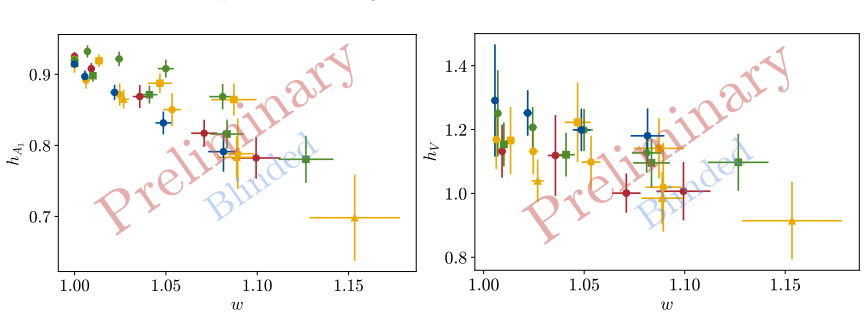
We present the status of calculations of the form factors of the most relevant heavy-to-heavy and heavy-to-light decay channels using seven N_f = 2+1+1 HISQ ensembles with lattice spacings ranging from 0.15 fm down to 0.06 fm. More than half of the ensembles have physical pion masses, and heavy quarks are simulated at physical masses with the Wilson-clover action in the Fermilab interpretation. The form factors are computed including correlations among them, as an attempt to resolve the current unclear situation in the B to D* ell nu channel and unexplained tensions in heavy-to-light form factors.
What carries the argument
Seven HISQ gauge ensembles with physical pion masses on most and physical heavy quarks via Wilson-clover action in the Fermilab interpretation, used to extract correlated form factors for B_{(s)} to D^{(*)}_{(s)} ell nu decays.
If this is right
- The B to D* ell nu form factors will be determined with improved control over lattice spacing and quark mass effects.
- Correlations among multiple decay channels will enable tighter constraints in global fits to data.
- Heavy-to-light form factor tensions will be directly confronted with the same controlled setup.
- Inputs for |V_cb| extractions from exclusive decays and lepton flavor universality ratios will become more precise.
Where Pith is reading between the lines
- If the results align with one set of prior lattice calculations over another, it would favor that approach for future precision work.
- The same ensemble set could be reused for related quantities like decay constants or other semileptonic modes without additional generation cost.
- Resolution of the form factor issues would tighten the unitarity triangle constraints from B physics.
Load-bearing premise
The seven HISQ ensembles with physical pion and heavy quark masses will control all systematic errors sufficiently to resolve the current tensions without introducing new uncontrolled effects.
What would settle it
Final numerical values for the B to D* ell nu form factors that fail to reduce the discrepancy with experiment or other lattice results, or that introduce new tensions in heavy-to-light channels, would show the approach has not resolved the issues.
Figures




read the original abstract
We present the status of calculations of the form factors of the most relevant heavy-to-heavy and heavy-to-light decay channels. Using seven $N_f = 2+1+1$ HISQ ensembles, with lattice spacings ranging from 0.15 fm down to 0.06 fm, we calculate the form factors of the decays, including correlations among them. More than half of our ensembles feature physical pion masses, and the heavy quarks are simulated at their physical masses using the Wilson-clover action with the Fermilab interpretation. Even though we have recently seen huge qualitative and quantitative leaps in the characterization of heavy-to-heavy decays, these advances have failed to translate into improvements for the inclusive vs exclusive question, or the matter of the Lepton Flavor Universality ratios. In particular, in the $B\to D^{\ast}\ell\nu$ channel, the current situation of the lattice-QCD form factors is far from clear. Further, the latest lattice-QCD results on the heavy-to-light form factors display unexplained tensions that must urgently be resolved. The work presented here is an attempt to address these issues.
Editorial analysis
A structured set of objections, weighed in public.
Referee Report
Summary. The manuscript is a status report on the Fermilab-MILC collaboration's ongoing lattice QCD calculation of form factors for the B_{(s)} → D^{(*)}_{(s)} ℓν decays and related heavy-to-light channels. It employs seven N_f=2+1+1 HISQ ensembles spanning lattice spacings a=0.15–0.06 fm (more than half at physical pion masses) with physical heavy-quark masses simulated via the Fermilab interpretation of the Wilson-clover action, and computes the form factors including correlations among channels. The text reviews persistent tensions between inclusive and exclusive determinations as well as lepton-flavor-universality ratios (especially in B→D*ℓν) and positions the calculation as an effort to clarify the unclear lattice-QCD situation for these quantities.
Significance. If the final results achieve the targeted control over systematics, the work will be significant for heavy-flavor phenomenology. The use of physical light- and heavy-quark masses, a broad range of lattice spacings, and explicit inclusion of correlations among form factors are clear strengths that could help resolve the unexplained tensions in heavy-to-light channels and improve constraints on |V_cb| and new-physics searches in LFU ratios.
minor comments (3)
- The abstract states that the calculation includes 'correlations among them' but provides no detail on which channels or form factors are correlated; a brief enumeration in the introduction would improve clarity.
- A summary table of the seven ensembles (lattice spacing, pion mass, volume, number of configurations) is missing; its addition would make the setup description more accessible without lengthening the text.
- The manuscript refers to 'the latest lattice-QCD results on the heavy-to-light form factors' displaying tensions but does not cite the specific prior works; adding the relevant references would strengthen the motivation section.
Simulated Author's Rebuttal
We thank the referee for their positive assessment of our status report on the Fermilab-MILC lattice QCD calculations of the B_{(s)} to D^{(*)} form factors. We appreciate the recommendation for minor revision and the recognition of the strengths of our approach, including the use of physical masses, multiple lattice spacings, and correlations among channels. No specific major comments were provided in the report, so we have no points requiring point-by-point rebuttal. We will incorporate any minor editorial suggestions in the revised manuscript.
Circularity Check
No significant circularity; status report with no derivations or predictions
full rationale
This is a status report describing an ongoing lattice-QCD calculation on seven HISQ ensembles with physical pion and heavy-quark masses. The text contains no equations, no fitted parameters, no quantitative predictions, and no load-bearing derivations that could reduce to inputs by construction. No self-citations, ansatze, or uniqueness theorems are invoked to justify results. The discussion of known tensions in B→D*ℓν and heavy-to-light channels is external to the present work and does not create internal circularity.
Axiom & Free-Parameter Ledger
Reference graph
Works this paper leans on
- [1]
-
[2]
B. Grinstein and A. Kobach,Model-independent extraction of|𝑉𝑐𝑏 |from ¯𝐵→𝐷 ∗ℓ¯𝜈,Phys. Lett. B771(2017) 359 [1703.08170]. [7]Fermilab Lattice, MILCcollaboration,Semileptonic form factors for𝐵→𝐷 ∗ℓ𝜈at nonzerorecoilfrom2+1-flavorlatticeQCD,Eur.Phys.J.C82(2022)1141[2105.14019]. [8]JLQCDcollaboration,𝐵→𝐷 ∗ℓ𝜈ℓ semileptonic form factors from lattice QCD with Möbi...
-
[3]
M. Bordone, B. Capdevila and P. Gambino,Three loop calculations and inclusive Vcb,Phys. Lett. B822(2021) 136679 [2107.00604]
-
[4]
F. Bernlochner, M. Fael, K. Olschewsky, E. Persson, R. van Tonder, K.K. Vos et al.,First extraction of inclusive𝑉𝑐𝑏 from𝑞 2 moments,JHEP10(2022) 068 [2205.10274]
-
[5]
The𝑞2 moments in inclusive semileptonic𝑏decays, 2024
G. Finauri and P. Gambino,The𝑞2 moments in inclusive semileptonic𝐵decays,JHEP02 (2024) 206 [2310.20324]. [13]Bellecollaboration,Measurement of the CKM matrix element|𝑉𝑐𝑏 |from𝐵 0 →𝐷 ∗− ℓ+𝜈ℓ at Belle,Phys. Rev. D100(2019) 052007 [1809.03290]. [14]BaBarcollaboration,Extraction of form factors from a four-dimensional angular analysis of 𝐵→𝐷 ∗ℓ− ¯𝜈ℓ,Phys. Rev...
-
[6]
Chauhan et al.,𝐵→𝜋, 𝐵 (𝑠) →𝐷 (𝑠) from2+1+1flavor Lattice QCD,PoS LATTICE2025(2026) 252
A. Chauhan et al.,𝐵→𝜋, 𝐵 (𝑠) →𝐷 (𝑠) from2+1+1flavor Lattice QCD,PoS LATTICE2025(2026) 252
2026
-
[7]
A.X. El-Khadra, A.S. Kronfeld and P.B. Mackenzie,Massive fermions in lattice gauge theory,Phys. Rev. D55(1997) 3933 [hep-lat/9604004]. 10
discussion (0)
Sign in with ORCID, Apple, or X to comment. Anyone can read and Pith papers without signing in.