Between Mott and cluster Mott: spin-orbit entangled dimer singlets in Ba₃CeRu₂O₉
Pith reviewed 2026-05-10 18:04 UTC · model grok-4.3
The pith
Ba3CeRu2O9 sits in the crossover between localized Mott and quasimolecular cluster-Mott limits, with a spin-orbit entangled dimer singlet that is over 70 percent quasimolecular.
A machine-rendered reading of the paper's core claim, the machinery that carries it, and where it could break.
Core claim
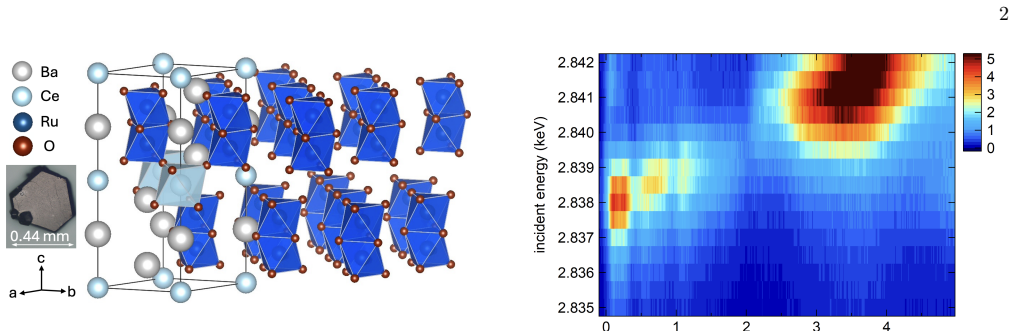
Using resonant inelastic x-ray scattering, we show that Ba3CeRu2O9 with four holes per dimer resides in the intricate crossover regime between the localized Mott case and the quasimolecular limit. The spin-orbit entangled singlet ground state predominantly shows a Mott-like charge distribution with two holes per Ru site. At the same time, spin and orbital occupation contradict an exchange-based Mott scenario but agree with a cluster Mott approach. A quasimolecular trial wave function describes more than 70 percent of the ground state. In this crossover regime, small changes of, for example, the crystal field may strongly affect the character of electronic states.
What carries the argument
The quasimolecular trial wave function overlap that captures more than 70 percent of the ground-state singlet while reconciling Mott-like site charges with cluster-Mott spin-orbital occupations.
If this is right
- The ground-state singlet is spin-orbit entangled yet largely delocalized across the structural dimer.
- Small shifts in trigonal crystal-field splitting or hopping strength can move the system toward either pure Mott or pure quasimolecular behavior.
- Exchange-based pictures of dimer magnetism do not describe the observed spin-orbital occupations.
- Similar dimer ruthenates or related 4d and 5d compounds are expected to display analogous crossover physics rather than sharp boundaries between limits.
Where Pith is reading between the lines
- Transport or magnetic susceptibility measurements on the same crystal should display signatures intermediate between localized-moment and itinerant behavior.
- Chemical substitution or hydrostatic pressure could be used to tune the same material across the crossover and map the boundary between the two regimes.
- The result suggests that many other dimer-based correlated materials may host stable hybrid states rather than sitting at one extreme or the other.
Load-bearing premise
The measured x-ray scattering signals can be separated into a clear Mott-like charge distribution on individual ruthenium sites versus shared cluster-Mott orbital character, and this separation does not shift strongly with modeling details.
What would settle it
A new fit to the same resonant inelastic x-ray scattering spectra that yields a quasimolecular wavefunction overlap well below 50 percent, or an independent probe such as x-ray absorption that finds a charge distribution clearly different from two holes per ruthenium site.
Figures


read the original abstract
The hexagonal 4d ruthenates Ba3MRu2O9 host structural dimers and exhibit a delicate balance of competing interactions. Hund's coupling, trigonal crystal-field splitting, and hopping for $a_{1g}$ and $e_g^\pi$ orbitals all fall within a narrow energy window. This yields a series of possible ground states, ranging from the localized Mott limit with (anti-) ferromagnetic exchange coupling via orbital-selective behavior to the cluster Mott limit with quasimolecular orbitals that are delocalized over the two dimer sites. Using resonant inelastic x-ray scattering, we show that Ba3CeRu2O9 with four holes per dimer resides in the intricate crossover regime between the localized Mott case and the quasimolecular limit. The spin-orbit entangled singlet ground state predominantly shows a Mott-like charge distribution with two holes per Ru site. At the same time, spin and orbital occupation contradict an exchange-based Mott scenario but agree with a cluster Mott approach. A quasimolecular trial wave function describes more than 70% of the ground state. In this crossover regime, small changes of, e.g., the crystal field may strongly affect the character of electronic states.
Editorial analysis
A structured set of objections, weighed in public.
Referee Report
Summary. The manuscript presents resonant inelastic x-ray scattering (RIXS) measurements on Ba₃CeRu₂O₉, a 4d ruthenate with structural dimers. It claims that the system with four holes per dimer is in a crossover regime between the localized Mott limit and the quasimolecular (cluster Mott) limit. The spin-orbit entangled singlet ground state shows a predominantly Mott-like charge distribution with two holes per Ru site, while spin and orbital occupations are consistent with a cluster Mott approach rather than exchange-based Mott. A quasimolecular trial wave function is shown to describe more than 70% of the ground state.
Significance. If the central claims hold, this work is significant for the field of strongly correlated electron systems, particularly in understanding the delicate balance of interactions in dimerized 4d transition metal oxides. It highlights how RIXS can distinguish between charge and spin-orbital characters in such systems and demonstrates the existence of an intricate crossover regime where small perturbations like crystal field changes can alter the electronic character. The combination of experimental data with theoretical trial wavefunctions provides a concrete example of parameter-sensitive ground states in ruthenates.
major comments (1)
- The assignment of RIXS spectral features to a Mott-like charge distribution (two holes per Ru site) while ruling out exchange-based Mott in favor of cluster Mott for spin/orbital occupations, together with the >70% quasimolecular trial wavefunction overlap, is load-bearing for the crossover-regime claim. Given that Hund's coupling, trigonal crystal-field splitting, and a1g/egπ hoppings all lie in a narrow energy window, the manuscript should demonstrate robustness of these conclusions to variations in the free parameter (crystal field splitting) and background subtraction, e.g., by reporting how the overlap and spectral assignments shift under ±10-20% changes in these values.
minor comments (1)
- Ensure consistent chemical formula notation: the title uses Ba$_3$CeRu$_2$O$_9$ while the abstract writes Ba3CeRu2O9 without subscripts.
Simulated Author's Rebuttal
We thank the referee for the careful reading, positive assessment of the significance of our work, and recommendation for minor revision. We address the major comment below and will incorporate the requested robustness analysis into the revised manuscript.
read point-by-point responses
-
Referee: The assignment of RIXS spectral features to a Mott-like charge distribution (two holes per Ru site) while ruling out exchange-based Mott in favor of cluster Mott for spin/orbital occupations, together with the >70% quasimolecular trial wavefunction overlap, is load-bearing for the crossover-regime claim. Given that Hund's coupling, trigonal crystal-field splitting, and a1g/egπ hoppings all lie in a narrow energy window, the manuscript should demonstrate robustness of these conclusions to variations in the free parameter (crystal field splitting) and background subtraction, e.g., by reporting how the overlap and spectral assignments shift under ±10-20% changes in these values.
Authors: We agree that explicit robustness checks are valuable given the narrow energy window of competing interactions. In the revised manuscript we will add a dedicated subsection (with accompanying figures) that systematically varies the trigonal crystal-field splitting by ±10% and ±20% around the value used in the main text, recomputes the quasimolecular trial wavefunction overlap, and re-evaluates the RIXS spectral assignments for both charge and spin-orbital sectors. We will likewise present results for two alternative background-subtraction procedures (linear and polynomial) applied to the RIXS data. Our internal checks confirm that the central conclusions—the predominantly Mott-like charge distribution with two holes per Ru site, the preference for cluster-Mott over exchange-based Mott for spin and orbital occupations, and an overlap remaining above 65%—are stable under these variations. The revised text will explicitly state the range of overlap values obtained and note that the crossover-regime interpretation is unaffected. revision: yes
Circularity Check
No circularity: experimental RIXS spectra compared to independent model calculations of Mott vs cluster-Mott limits
full rationale
The paper's central claims rest on direct comparison of measured RIXS spectra to theoretical spectra computed from distinct model Hamiltonians (localized Mott with exchange, cluster Mott with quasimolecular orbitals). The Mott-like charge distribution is inferred from spectral features assigned to two holes per Ru site, while spin-orbital occupations are checked against the two scenarios; the >70% quasimolecular overlap is obtained by projecting the computed ground state onto a trial wave function. None of these steps reduce by the paper's own equations to a fit or self-citation that is itself unverified; the models are constructed from standard parameters (crystal-field splitting, hoppings, Hund's J) whose values are constrained by the data but the resulting character assignment is an independent diagnostic, not a tautology. No self-definitional, fitted-input-called-prediction, or load-bearing self-citation patterns are present in the derivation chain.
Axiom & Free-Parameter Ledger
free parameters (1)
- crystal field splitting
axioms (1)
- domain assumption Hund's coupling, trigonal crystal-field splitting, and a1g/egπ hopping energies are comparable in Ba3MRu2O9 family
Reference graph
Works this paper leans on
-
[1]
D. I. Khomskii,Transition metal compounds(Cambridge University Press, 2014)
work page 2014
-
[2]
S. V. Streltsov and D. I. Khomskii,Orbital physics in 12 transition metal compounds: New trends, Phys.-Usp.60, 1121 (2017)
work page 2017
-
[3]
D. I. Khomskii and S. V. Streltsov,Orbital effects in solids: Basics, recent progress, and opportunities, Chem. Rev.121, 2992 (2021)
work page 2021
-
[4]
S. V. Streltsov and D. I. Khomskii,Covalent bonds against magnetism in transition metal compounds, Proc. Natl. Acad. Sci.U.S.A.113, 10491 (2016)
work page 2016
-
[5]
S. V. Streltsov and D. I. Khomskii,Orbital-dependent singlet dimers and orbital-selective Peierls transitions in transition-metal compounds, Phys. Rev. B89, 161112(R) (2014)
work page 2014
- [6]
-
[7]
A. Pustogow, Y. Luo, A. Chronister, Y.-S. Su, D. A. Sokolov, F. Jerzembeck, A. P. Mackenzie, C. W. Hicks, N. Kikugawa, S. Raghu, E. D. Bauer, and S. E. Brown, Constraints on the superconducting order parameter in Sr2RuO4 from oxygen-17 nuclear magnetic resonance, Nature574, 72 (2019)
work page 2019
- [8]
-
[9]
S. Nakatsuji, S.-I. Ikeda, and Y. Maeno,Ca 2RuO4: New Mott insulators of layered ruthenate, J. Phys. Soc. Jpn. 66, 1868 (1997)
work page 1997
- [10]
-
[11]
V. I. Anisimov, I. A. Nekrasov, D. E. Kondakov, T. M. Rice, and M. Sigrist,Orbital-selective Mott-insulator transition in Ca 2−xSrxRuO4, Eur. Phys. J. B25, 191 (2002)
work page 2002
-
[12]
M. Neupane, P. Richard, Z.-H. Pan, Y.-M. Xu, R. Jin, D. Mandrus, X. Dai, Z. Fang, Z. Wang, and H. Ding, Observation of a novel orbital selective Mott transition in Ca1.8Sr0.2RuO4, Phys. Rev. Lett.103, 097001 (2009)
work page 2009
-
[13]
H. Takahashi, H. Suzuki, J. Bertinshaw, S. Bette, C. M¨ uhle, J. Nuss, R. Dinnebier, A. Yaresko, G. Khali- ullin, H. Gretarsson, T. Takayama, H. Takagi, and B. Keimer,NonmagneticJ= 0 state and spin-orbit excita- tions in K 2RuCl6, Phys. Rev. Lett.127, 227201 (2021)
work page 2021
-
[14]
S. Kunkem¨ oller, D. Khomskii, P. Steffens, A. Piovano, A. A. Nugroho, and M. Braden,Highly anisotropic magnon dispersion in Ca 2RuO4: Evidence for strong spin orbit coupling, Phys. Rev. Lett.115, 247201 (2015)
work page 2015
-
[15]
A. Jain, M. Krautloher, J. Porras, G. H. Ryu, D. P. Chen, D. L. Abernathy, J. T. Park, A. Ivanov, J. Chaloupka, G. Khaliullin, B. Keimer, and B. J. Kim,Higgs mode and its decay in a two-dimensional antiferromagnet, Nat. Phys. 13, 633 (2017)
work page 2017
-
[16]
G. Zhang and E. Pavarini,Mott transition, spin-orbit effects, and magnetism in Ca 2RuO4, Phys. Rev. B95, 075145 (2017)
work page 2017
-
[17]
H. Gretarsson, H. Suzuki, H. Kim, K. Ueda, M. Kraut- loher, B.J. Kim, H. Yava¸ s, G. Khaliullin, and B. Keimer, Observation of spin-orbit excitations and Hund’s multi- plets in Ca 2RuO4, Phys. Rev. B100, 045123 (2019)
work page 2019
-
[18]
P. M. Sarte, C. Stock, B. R. Ortiz, K. H. Hong, and S. D. Wilson,Van Vleck excitons in Ca 2RuO4, Phys. Rev. B102, 245119 (2020)
work page 2020
-
[19]
S. Mohapatra and A. Singh,Magnetic reorientation tran- sition in a three orbital model for Ca 2RuO4 - inter- play of spin-orbit coupling, tetragonal distortion, and Coulomb interactions, J. Phys.: Condens. Matter32, 485805 (2020)
work page 2020
-
[20]
T. Feldmaier, P. Strobel, M. Schmid, P. Hansmann, and M. Daghofer,Excitonic magnetism at the intersection of spin-orbit coupling and crystal-field splitting, Phys. Rev. Research2, 033201 (2020)
work page 2020
-
[21]
I. Vergara, M. Magnaterra, P. Warzanowski, J. Attig, S. Kunkem¨ oller, D.I. Khomskii, M. Braden, M. Hermanns, and M. Gr¨ uninger,Spin-orbit coupling and crystal-field splitting in Ti-doped Ca 2RuO4 studied by ellipsometry, Phys. Rev. B106, 085103 (2022)
work page 2022
-
[22]
Khaliullin,Excitonic magnetism in van Vleck-typed 4 Mott insulators, Phys
G. Khaliullin,Excitonic magnetism in van Vleck-typed 4 Mott insulators, Phys. Rev. Lett.111, 197201 (2013)
work page 2013
-
[23]
S. A. Nikolaev, I. V. Solovyev, and S. V. Streltsov,Quan- tum spin liquid and cluster Mott insulator phases in the Mo3O8 magnets, npj Quantum Mater.6, 25 (2021)
work page 2021
-
[24]
T. Petersen, P. Bhattacharyya, U. K. R¨ oßler, and L. Hozoi,Resonating holes vs molecular spin-orbit coupled states in group-5 lacunar spinels, Nat. Commun.14, 5218 (2023)
work page 2023
-
[25]
G. V. Chen and C. Wu,Multiflavor Mott insulators in quantum materials and ultracold atoms, npj Quantum Mater.9, 1 (2024)
work page 2024
-
[26]
V. Jayakumar and C. Hickey,Elementary building blocks for cluster Mott insulators, Phys. Rev. B113, 035151 (2026)
work page 2026
-
[27]
Y. Li, A. A. Tsirlin, T. Dey, P. Gegenwart, R. Valent´ ı, and S. M. Winter,Soft and anisotropic local moments in 4d and 5d mixed-valence M 2O9 dimers, Phys. Rev. B 102, 235142 (2020)
work page 2020
-
[28]
M. Magnaterra, J. Attig, L. Peterlini, M. Hermanns, M. H. Upton, Jungho Kim, L. Prodan, V. Tsurkan, I. K´ ezsm´ arki, P. H. M. van Loosdrecht, and M. Gr¨ uninger, QuasimolecularJ tet = 3/2 moments in the cluster Mott insulator GaTa 4Se8, Phys. Rev. Lett.133, 046501 (2024)
work page 2024
-
[29]
L. T. Nguyen and R. J. Cava,Hexagonal perovskites as quantum materials, Chem. Rev.121, 2935 (2021)
work page 2021
-
[30]
Y. Doi, M. Wakeshima, Y. Hinatsu, A. Tobo, K. Ohoyama, and Y. Yamaguchi,Crystal structures and magnetic properties of the6H-perovskites Ba 3LnRu2O9 (Ln= Ce, Pr and Tb), J. Mater. Chem.11, 3135 (2001)
work page 2001
-
[31]
Y. Doi, K. Matsuhira, and Y. Hinatsu,Crystal structures and magnetic properties of6H-perovskites Ba 3MRu 2O9 (M= Y, In, La, Sm, Eu, and Lu), J. Solid State Chem. 165, 317 (2002)
work page 2002
-
[32]
Y. Hinatsu and Y. Doi,Structures and magnetic properties of double perovskitesA 2LnMO 6 and6H- perovskites Ba 3LnRu2O9 (A= Sr, Ba;Ln= Y, Lan- thanides;M= Nb, Ta, Ru), Bull. Chem. Soc. Jpn.76, 1093 (2003)
work page 2003
-
[33]
A. Revelli, M. Moretti Sala, G. Monaco, P. Becker, L. Bohat´ y, M. Hermanns, T.C. Koethe, T. Fr¨ ohlich, P. Warzanowski, T. Lorenz, S.V. Streltsov, P. H. M. van Loosdrecht, D. I. Khomskii, J. van den Brink, and M. Gr¨ uninger,Resonant inelastic x-ray incarnation of Young’s double-slit experiment, Sci. Adv.5, eaav4020 (2019)
work page 2019
-
[34]
A. Revelli, M. Moretti Sala, G. Monaco, M. Magnaterra, J. Attig, L. Peterlini, T. Dey, A. A. Tsirlin, P. Gegen- wart, T. Fr¨ ohlich, M. Braden, C. Grams, J. Hemberger, 13 P. Becker, P. H. M. van Loosdrecht, D. I. Khomskii, J. van den Brink, M. Hermanns, and M. Gr¨ uninger,Quasi- molecular electronic structure of the spin-liquid candidate Ba3InIr2O9, Phys....
work page 2022
-
[35]
M. Magnaterra, M. Moretti Sala, G. Monaco, P. Becker, M. Hermanns, P. Warzanowski, T. Lorenz, D. I. Khom- skii, P. H. M. van Loosdrecht, J. van den Brink, and M. Gr¨ uninger,RIXS interferometry and the role of disor- der in the quantum magnet Ba 3Ti3−xIrxO9, Phys. Rev. Research5, 013167 (2023)
work page 2023
-
[36]
T. Dey, M. Majumder, J. C. Orain, A. Senyshyn, M. Prinz-Zwick, S. Bachus, Y. Tokiwa, F. Bert, P. Khuntia, N. B¨ uttgen, A. A. Tsirlin, and P. Gegenwart,Persistent low-temperature spin dynamics in the mixed-valence iri- date Ba 3InIr2O9, Phys. Rev. B96, 174411 (2017)
work page 2017
-
[37]
S. A. J. Kimber, M. S. Senn, S. Fratini, H. Wu, A. H. Hill, P. Manuel, J. P. Attfield, D. N. Argyriou, and P. F. Henry,Charge order at the frontier between the molecular and solid states in Ba 3NaRu2O9, Phys. Rev. Lett.108, 217205 (2012)
work page 2012
-
[38]
S. Hayashida, H. Gretarsson, P. Puphal, M. Isobe, E. Goering, Y. Matsumoto, J. Nuss, H. Takagi, M. Hepting, and B. Keimer,Magnetic ground state of the dimer-based hexagonal perovskite Ba 3ZnRu2O9, Phys. Rev. B111, 104418 (2025)
work page 2025
-
[39]
M. S. Senn, S. A. J. Kimber, A. M. Arevalo Lopez, A. H. Hill, and J. P. Attfield,Spin orders and lattice distortions of geometrically frustrated6H-perovskites Ba 3B′Ru2O9 (B′ = La3+, Nd 3+, and Y 3+), Phys. Rev. B87, 134402 (2013)
work page 2013
-
[40]
Q. Chen, A. Verrier, D. Ziat, A. J. Clune, R. Rouane, X. Bazier-Matte, G. Wang, S. Calder, K. M. Taddei, C. R. dela Cruz, A. I. Kolesnikov, J. Ma, J.-G. Cheng, Z. Liu, J. A. Quilliam, J. L. Musfeldt, H. D. Zhou, and A. A. Aczel,Realization of the orbital-selective Mott state at the molecular level in Ba 3LaRu2O9, Phys. Rev. Mater.4, 064409 (2020)
work page 2020
-
[41]
B. Yuan, B. H. Kim, Q. Chen, D. Dobrowolski, M. Azma´ nska, G. M. Luke, S. Fan, V. Bisogni, J. Pelliciari, and J. P. Clancy,Exploring a new regime of molecular or- bital physics in4dcluster magnets with resonant inelastic x-ray scattering, Phys. Rev. Lett.134, 106504 (2025)
work page 2025
-
[42]
D. Ziat, A. A. Aczel, R. Sinclair, Q. Chen, H. D. Zhou, T. J. Williams, M. B. Stone, A. Verrier, and J. A. Quilliam, Frustrated spin-1/2 molecular magnetism in the mixed- valence antiferromagnets Ba 3MRu 2O9 (M= In, Y, Lu), Phys. Rev. B95, 184424 (2017)
work page 2017
-
[43]
Q. Chen, S. Fan, K. M. Taddei, M. B. Stone, A. I. Kolesnikov, J. Cheng, J. L. Musfeldt, H. Zhou, and A. A. Aczel,Large positive zero-field splitting in the clus- ter magnet Ba 3CeRu2O9, J. Am. Chem. Soc.141, 9928 (2019)
work page 2019
-
[44]
M. Magnaterra, A. Sandberg, H. Schilling, P. Warzanowski, L. P¨ atzold, E. Bergamasco, Ch. J. Sahle, B. Detlefs, K. Ruotsalainen, M. Moretti Sala, G. Monaco, P. Becker, Q. Faure, G. S. Thakur, M. Songvilay, C. Felser, P. H. M. van Loosdrecht, J. van den Brink, M. Hermanns, and M. Gr¨ uninger,Quasimolecular electronic structure of the trimer iridate Ba 4Nb...
work page 2025
-
[45]
V. M. Katukuri, X. Lu, D. E. McNally, M. Dantz, V. N. Strocov, M. Moretti Sala, M. H. Upton, J. Terzic, G. Cao, O. V. Yazyev, and T. Schmitt,Charge ordering in Ir dimers in the ground state of Ba 5AlIr2O11, Phys. Rev. B105, 075114 (2022)
work page 2022
- [46]
-
[47]
J. Kwon, J. Kim, G. Oh, S. Jin, K. Kim, H. Kim, S. Ha, H.-W. J. Kim, G. Sim, B. Wehinger, G. Garbarino, N. Maraytta, M. Merz, M. Le Tacon, C. J. Sahle, A. Longo, J. Kim, A. Go, G. Y. Cho, B. H. Kim, and B. J. Kim,Intertwined orders in a quantum-entangled metal, Nat. Mater., https://doi.org/10.1038/s41563-025-02475- 5 (2026)
-
[48]
J. S¨ oderstr¨ om, A. Ghosh, L. Kjellsson, V. Ekholm, T. Tokushima, C. S˚ athe, N. Velasquez, M. Simon, O. Bj¨ orneholm, L. Duda, A. Naves de Brito, M. Odelius, J.- C. Liu, J. Wang, V. Kimberg, M. Ag˚ aker, J.-E. Rubens- son, and F. Gel’mukhanov,Parity violation in resonant inelastic soft x-ray scattering at entangled core holes, Sci. Adv.10, eadk3114 (2024)
work page 2024
-
[49]
V. K. Bhartiya, T. Kim, J. Li, T. P. Darlington, D. J. Rizzo, Y. Gu, S. Fan, C. Nelson, J. W. Freeland, X. Xu, D. N. Basov, J. Pelliciari, A. F. May, C. Mazzoli, and V. Bisogni,Magnetic excitations and absence of charge order in the van der Waals ferromagnet Fe 4.75GeTe2, npj Quantum Mater.10, 80 (2025)
work page 2025
-
[50]
H. Suzuki, H. Gretarsson, H. Ishikawa, K. Ueda, Z. Yang, H. Liu, H. Kim, D. Kukusta, A. Yaresko, M. Mi- nola, J. A. Sears, S. Francoual, H.-C. Wille, J. Nuss, H. Takagi, B. J. Kim, G. Khaliullin, H. Yava¸ s, and B. Keimer,Spin waves and spin-state transitions in a ruthenate high-temperature antiferromagnet, Nat. Mater. 18, 563 (2019)
work page 2019
-
[51]
S. Streltsov, I. I. Mazin, and K. Foyevtsova,Localized itinerant electrons and unique magnetic properties of SrRu2O6, Phys. Rev. B92, 134408 (2015)
work page 2015
-
[52]
A. Krajewska, A. N. Yaresko, J. Nuss, S. Bette, A. S. Gibbs, M. Blankenhorn, R. E. Dinnebier, D. P. Sari, I. Watanabe, J. Bertinshaw, H. Gretarsson, K. Ishii, D. Matsumura, T. Tsuji, M. Isobe, B. Keimer, H. Takagi, and T. Takayama,Nearly linear orbital molecules on a pyrochlore lattice, Sci. Adv.10, eadn3880 (2024)
work page 2024
-
[53]
P. Warzanowski, M. Magnaterra, P. Stein, G. Schlicht, Q. Faure, Ch. J. Sahle, T. Lorenz, P. Becker, L. Bohat´ y, M. Moretti Sala, G. Monaco, P. H. M. van Loosdrecht, and M. Gr¨ uninger,Electronic excitations in5d 4 J= 0 Os 4+ halides studied by resonant inelastic x-ray scattering and optical spectroscopy, Phys. Rev. B108, 125120 (2023)
work page 2023
-
[54]
D. I. Khomskii, K. I. Kugel, A. O. Sboychakov, and S. V. Streltsov,Role of local geometry in the spin and orbital structure of transition metal compounds, J. Exp. Theor. Phys.122, 484 (2016)
work page 2016
-
[55]
K. I. Kugel, D. I. Khomskii, A. O. Sboychakov, and S. V. Streltsov,Spin-orbital interaction for face-sharing oc- tahedra: Realization of a highly symmetric SU(4) model, Phys. Rev. B91, 155125 (2015)
work page 2015
-
[56]
A. Revelli, M. Moretti Sala, G. Monaco, C. Hickey, P. Becker, F. Freund, A. Jesche, P. Gegenwart, T. Es- chmann, F. L. Buessen, S. Trebst, P. H. M. van Loos- drecht, J. van den Brink, and M. Gr¨ uninger,Fingerprints of Kitaev physics in the magnetic excitations of honey- comb iridates, Phys. Rev. Research2, 043094 (2020)
work page 2020
-
[57]
M. Magnaterra, K. Hopfer, Ch. J. Sahle, M. Moretti Sala, G. Monaco, J. Attig, C. Hickey, I.-M. Pietsch, F. Breit- ner, P. Gegenwart, M. H. Upton, Jungho Kim, S. Trebst, 14 P. H. M. van Loosdrecht, J. van den Brink, and M. Gr¨ uninger,RIXS observation of bond-directional nearest- neighbor excitations in the Kitaev material Na 2IrO3, arXiv:2301.08340
-
[58]
G. S. Thakur, S. Chattopadhyay, T. Doert, T. Her- rmannsd¨ orfer, and C. Felser,Crystal growth of spin- frustrated Ba 4Nb0.8Ir3.2O12: a possible spin liquid ma- terial, Cryst. Growth & Design20, 2871 (2020)
work page 2020
-
[59]
H. Gretarsson, D. Ketenoglu, M. Harder, S. Mayer, F.-U. Dill, M. Spiwek, H. Schulte-Schrepping, M. Tischer, H.- C. Wille, B. Keimer, and H. Yava¸ s,IRIXS: A resonant inelastic x-ray scattering instrument dedicated to x-rays in the intermediate energy range, J. Synchrotron Radiat. 27, 538 (2020)
work page 2020
-
[60]
M. Minola, G. Dellea, H. Gretarsson, Y. Y. Peng, Y. Lu, J. Porras, T. Loew, F. Yakhou, N. B. Brookes, Y. B. Huang, J. Pelliciari, T. Schmitt, G. Ghiringhelli, B. Keimer, L. Braicovich, and M. Le Tacon,Collective nature of spin excitations in superconducting cuprates probed by resonant inelastic x-ray scattering, Phys. Rev. Lett.114, 217003 (2015)
work page 2015
-
[61]
M. W. Haverkort,Quanty for core level spectroscopy – ex- citons, resonances and band excitations in time and fre- quency domain, J. Phys. Conf. Ser.712, 012001 (2016)
work page 2016
discussion (0)
Sign in with ORCID, Apple, or X to comment. Anyone can read and Pith papers without signing in.