Magnetic-Field-Induced Inspiral of Binaries with Circumbinary Disk: Black Hole and Protostellar Systems
Pith reviewed 2026-05-10 18:07 UTC · model grok-4.3
The pith
Magnetic fields in circumbinary disks drive binary orbital decay at 0.3-0.7% per period.
A machine-rendered reading of the paper's core claim, the machinery that carries it, and where it could break.
Core claim
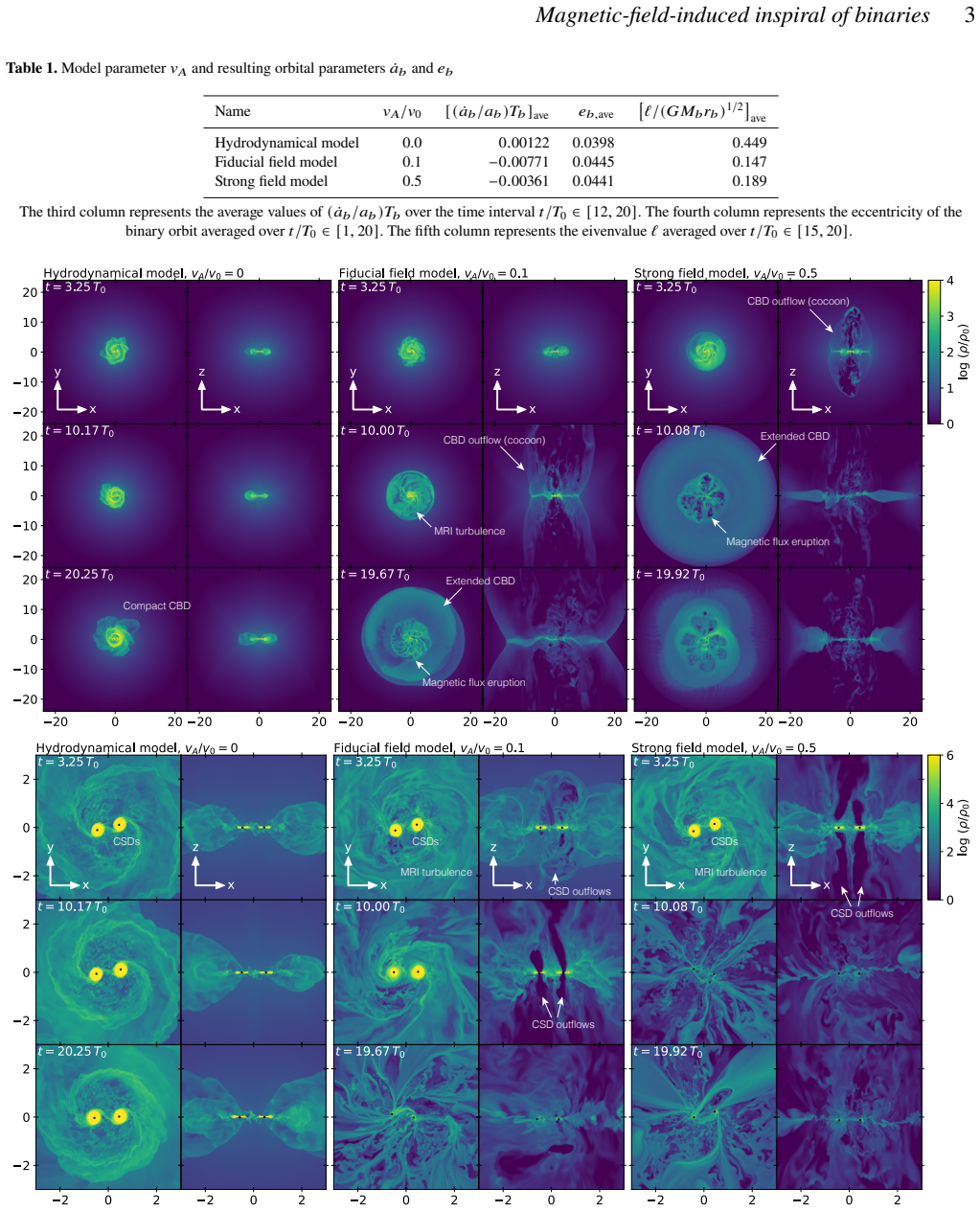
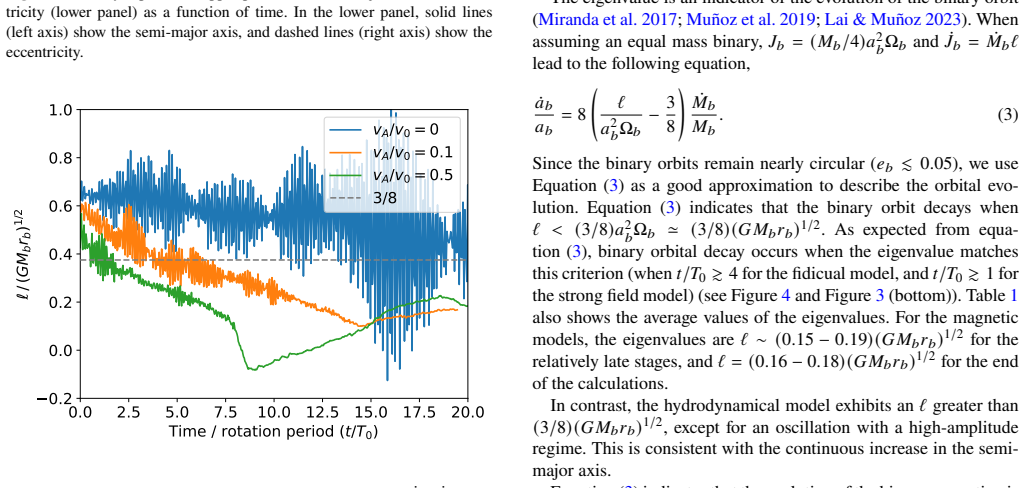
Our simulations reveal the presence of outflows/jets launched from both the circumstellar (mini) disks and the circumbinary disk (CBD). The magneto-rotational instability is also excited within the CBD. These magnetic processes efficiently transport angular momentum in the gas surrounding the binary and thereby drive orbital decay, while a purely hydrodynamical model exhibits orbital expansion. The decay rate reaches ∼0.3-0.7% per orbital period, depending on the initial magnetic field strength. By appropriately scaling these numerical results, we propose a new mechanism for MBBHs mergers within a Hubble time, overcoming the bottlenecks encountered at separations near the final parsec scales
What carries the argument
Magnetic torques and the magneto-rotational instability inside the circumbinary disk, which extract angular momentum from the orbiting gas and carry it outward.
Load-bearing premise
The initial conditions modeled after molecular-cloud collapse and the scaling of the simulated decay rates apply to real massive black hole binaries at final-parsec separations.
What would settle it
A simulation or observation in which a binary with a strong circumbinary magnetic field shows orbital expansion or no decay would falsify the claim that magnetic transport is what drives the inspiral.
Figures


read the original abstract
The orbital decay of binary systems is a critical process for understanding the evolution of massive binary black holes (MBBHs) and binary star formation. Performing high-resolution three-dimensional magnetohydrodynamic (MHD) simulations, we investigate a binary system that accretes gas from an infalling envelope analogous to the collapse of molecular cloud cores in the context of binary star formation. Our simulations reveal the presence of outflows/jets launched from both the circumstellar (mini) disks and the circumbinary disk (CBD). The magneto-rotational instability is also excited within the CBD. These magnetic processes efficiently transport angular momentum in the gas surrounding the binary and thereby drive orbital decay, while a purely hydrodynamical model exhibits orbital expansion. The decay rate reaches $\sim 0.3-0.7\%$ per orbital period, depending on the initial magnetic field strength. By appropriately scaling these numerical results, we propose a new mechanism for MBBHs mergers within a Hubble time, overcoming the bottlenecks encountered at separations near the final parsec scales. Additionally, we present a formation scenario for close twin binary star systems, emphasizing the significant role of magnetic processes in driving orbital evolution across various astrophysical systems.
Editorial analysis
A structured set of objections, weighed in public.
Referee Report
Summary. The paper reports high-resolution 3D MHD simulations of a binary system accreting from an infalling molecular-cloud-like envelope. It finds that magnetic processes (outflows/jets from mini-disks and circumbinary disk, plus MRI-driven turbulence) transport angular momentum outward and drive orbital decay at 0.3–0.7 % per orbital period, while purely hydrodynamic runs show expansion. The authors scale these rates to argue that the mechanism can solve the final-parsec problem for massive black-hole binaries and can produce close twin protostellar binaries.
Significance. If the numerical decay rates are robust and the scaling to parsec-scale, steady-state disks is justified, the result would supply a concrete, magnetically mediated channel for binary inspiral that is absent from standard hydrodynamic treatments. This could alter merger-rate predictions for LISA-band MBHBs and revise formation pathways for close stellar binaries.
major comments (2)
- [Abstract] Abstract: the quoted decay rate (0.3–0.7 % per orbit) is stated without reference to any figure, table, or time-series data showing the evolution of semi-major axis or specific angular momentum; no resolution study, convergence test, or error estimate is mentioned, which is load-bearing for the central quantitative claim.
- [Discussion] The scaling argument (Abstract and final section): the measured per-orbit decay is obtained under continuous infall boundary conditions; the manuscript does not demonstrate that the same angular-momentum extraction efficiency persists when the gas supply is removed and the circumbinary disk reaches a steady-state configuration appropriate to final-parsec MBHB separations.
minor comments (1)
- [Methods] Notation for the initial magnetic-field strength and its normalization should be made explicit in the methods section so that the dependence of the decay rate on B can be reproduced.
Simulated Author's Rebuttal
We thank the referee for the detailed and constructive report. The comments highlight important points regarding the presentation of our quantitative results and the justification of our scaling arguments. We address each major comment below and will revise the manuscript accordingly.
read point-by-point responses
-
Referee: [Abstract] Abstract: the quoted decay rate (0.3–0.7 % per orbit) is stated without reference to any figure, table, or time-series data showing the evolution of semi-major axis or specific angular momentum; no resolution study, convergence test, or error estimate is mentioned, which is load-bearing for the central quantitative claim.
Authors: We agree that the abstract should explicitly reference the supporting data for the central claim. In the revised version we will update the abstract to cite the relevant figures (specifically those showing the time evolution of the binary semi-major axis and specific angular momentum) and include a concise statement that the quoted rates are robust across the resolution study performed. A dedicated paragraph summarizing the resolution and convergence tests, including error estimates on the decay rate, will be added to the methods section. revision: yes
-
Referee: [Discussion] The scaling argument (Abstract and final section): the measured per-orbit decay is obtained under continuous infall boundary conditions; the manuscript does not demonstrate that the same angular-momentum extraction efficiency persists when the gas supply is removed and the circumbinary disk reaches a steady-state configuration appropriate to final-parsec MBHB separations.
Authors: The referee correctly notes that our simulations use continuous infall to model the formation phase. However, the angular-momentum extraction is effected by local disk processes (MRI-driven turbulence and magnetically launched outflows) whose efficiency depends on the disk's internal magnetic field strength and rotation profile rather than on the external mass supply. Once a circumbinary disk is assembled, these mechanisms operate independently of ongoing infall. We will expand the discussion section to clarify this distinction, provide a qualitative estimate of the expected efficiency in a steady-state disk, and note the limitations of the current setup while emphasizing that the reported rates already represent a conservative lower bound for the mechanism's efficacy. revision: partial
Circularity Check
No significant circularity; orbital decay rates obtained directly from MHD simulations
full rationale
The paper's central result—the reported 0.3-0.7% per-orbit decay—is extracted from the output of three-dimensional MHD simulations initialized with an infalling envelope. No equation or parameter is defined in terms of the target decay rate, no fitted quantity is relabeled as a prediction, and the scaling to parsec-scale binaries is presented as an extrapolation rather than a self-consistent derivation. The hydro-versus-MHD contrast is shown within the simulated domain without reduction to prior self-citations or ansatzes. The derivation chain therefore remains self-contained in the numerical data.
Axiom & Free-Parameter Ledger
free parameters (1)
- initial magnetic field strength
axioms (2)
- standard math Ideal MHD equations plus standard numerical dissipation accurately capture angular-momentum transport in the circumbinary disk.
- domain assumption The infalling-envelope initial condition is representative of both protostellar collapse and gas-rich massive black hole binary environments.
Reference graph
Works this paper leans on
-
[1]
Agazie G., et al., 2023a, ApJ, 951, L8 Agazie G., et al., 2023b, ApJ, 952, L37 Alves F. O., Caselli P., Girart J. M., Segura-Cox D., Franco G. A. P., Schmiedeke A., Zhao B., 2019, Science, 366, 90 Armitage P. J., Natarajan P., 2002, ApJ, 567, L9 Assef R. J., et al., 2015, ApJ, 804, 27 Avara M. J., Krolik J. H., Campanelli M., Noble S. C., Bowen D., Ryu T....
discussion (0)
Sign in with ORCID, Apple, or X to comment. Anyone can read and Pith papers without signing in.