When Market Prices Drive the Load: Modeling, Grid-Security Analysis, and Mitigation of Data Center Workload Scheduling
Pith reviewed 2026-05-10 18:36 UTC · model grok-4.3
The pith
Price-driven data center workload shifts improve operator economics but heighten grid voltage risks and congestion through localized demand spikes.
A machine-rendered reading of the paper's core claim, the machinery that carries it, and where it could break.
Core claim
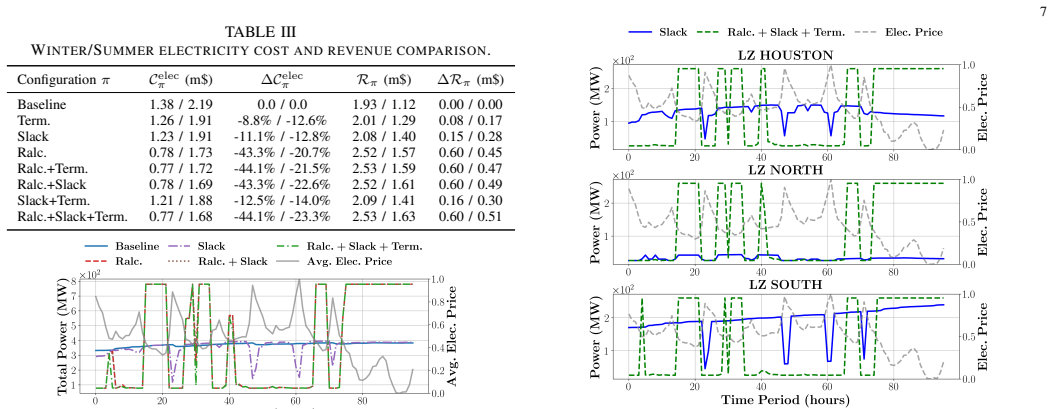
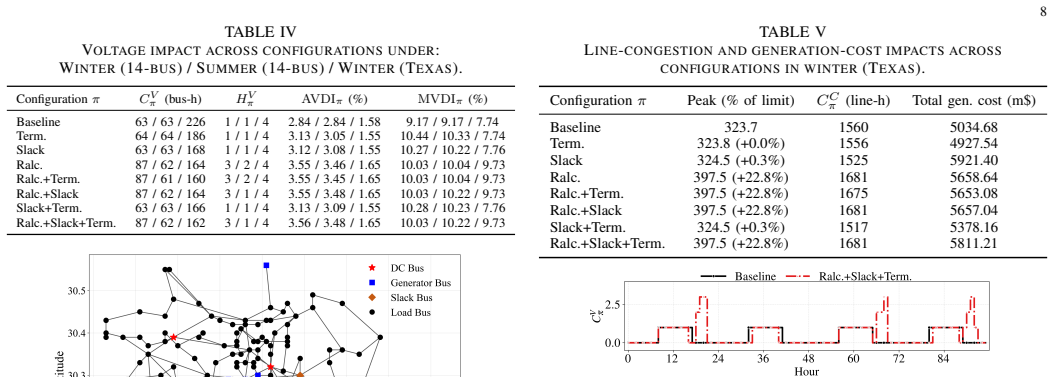
When data centers optimize job placement solely against exogenous market prices using a mixed-integer model that includes QoS penalties, their operating costs fall, yet the resulting demand concentration and site-level load variability increase voltage-security violations and transmission congestion; case studies on a modified IEEE 14-bus system and a Travis County, Texas network quantify these effects and demonstrate that simple load-redistribution policies can reduce the grid impacts.
What carries the argument
Mixed-integer job-level scheduling model that assigns workloads across sites under fixed prices while enforcing execution logic and service-quality constraints.
If this is right
- Data centers achieve lower energy costs by routing jobs to cheaper-price locations.
- Grid voltage profiles become more stressed and transmission lines see higher congestion risk.
- Load-redistribution policies can curb the worst demand spikes while preserving part of the economic benefit.
- Grid operators need tools to anticipate and manage rapid, site-specific load changes driven by market signals.
- Coordination between data-center schedulers and grid security constraints becomes necessary for stable operation.
Where Pith is reading between the lines
- Future scheduling models may need to treat prices as partially endogenous so that large load shifts feed back into market clearing.
- The same price-driven concentration pattern could interact with high renewable penetration, amplifying variability on both supply and demand sides.
- Real-time grid state signals sent directly to data-center optimizers could serve as a practical extension of the redistribution policies.
- Testing the approach on larger multi-region networks would reveal whether the security risks scale or saturate.
Load-bearing premise
Electricity prices remain fixed regardless of how much load the data centers move, and the simplified scheduling model fully captures real operating constraints and grid responses.
What would settle it
Measure whether voltage limit violations or line overload events rise measurably in an actual transmission network on days when participating data centers switch to price-based job shifting versus days they use fixed-location schedules.
Figures
read the original abstract
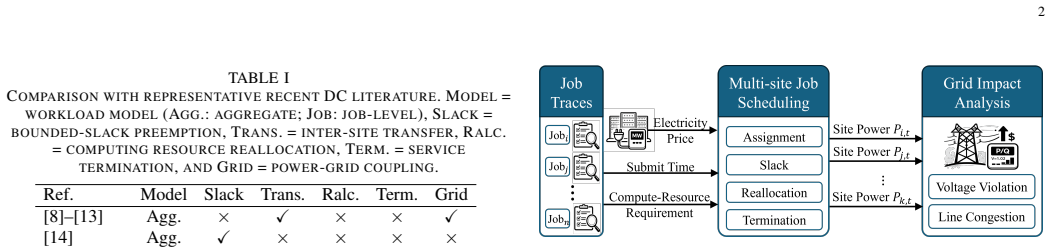
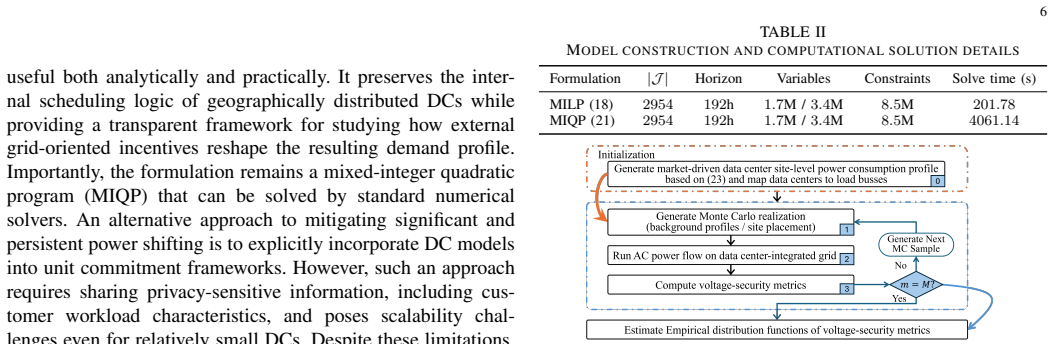
Data centers (DCs) are emerging as large, geographically distributed, controllable loads whose participation in electricity markets can significantly affect grid operation, especially when cloud platforms shift workloads across sites to exploit energy-arbitrage opportunities. This paper analyzes and seeks to mitigate the grid impacts of geographically distributed multi-site DCs under exogenous electricity prices. It develops a detailed job-level scheduling framework for market-driven DCs, formulated as a mixed-integer model that preserves execution logic and captures a unified set of implementable control actions. It also incorporates service-side quality-of-service (QoS) constraints and penalty terms to improve fidelity. Case studies on a modified IEEE 14-bus system, complemented by a more realistic network based on Travis County, Texas, show that purely price-driven scheduling improves economic performance, but also increases voltage-security risk and congestion exposure by inducing localized demand concentration and sharp site-level load variation. To mitigate these effects, this work introduces load-redistribution policies that curb extreme load shifting and support grid operators in managing such conditions.
Editorial analysis
A structured set of objections, weighed in public.
Referee Report
Summary. The paper develops a mixed-integer programming framework for job-level workload scheduling across geographically distributed data centers that exploits exogenous locational electricity prices while enforcing execution logic and QoS constraints with penalty terms. Case studies on a modified IEEE 14-bus system and a Travis County, Texas network show that purely price-driven scheduling improves economic performance yet raises voltage-security and congestion risks through localized demand concentration and sharp site-level load swings; load-redistribution policies are introduced to mitigate these effects.
Significance. If the quantitative results and mitigation policies hold under scrutiny, the work is significant for quantifying the grid-security trade-offs of flexible, market-responsive loads. It supplies a concrete modeling tool and policy levers that can help grid operators anticipate and manage the impacts of large-scale data-center arbitrage, an increasingly relevant issue as DCs scale.
major comments (2)
- [Abstract and Model Formulation] The headline claim that price-driven scheduling increases voltage-security risk and congestion exposure is load-bearing on the exogenous-price assumption (Abstract). The open-loop formulation induces localized spikes solely because the scheduler sees fixed LMPs; no sensitivity analysis, bilevel formulation, or bounding exercise is supplied to show how much the reported risk metrics depend on this exogeneity. If large DCs were cleared inside the market, the same arbitrage opportunities would be attenuated, potentially eliminating the extreme load variations that drive the security violations.
- [Case Studies] The abstract and case-study description supply no quantitative results, validation against real data, error analysis, or sensitivity checks on the QoS penalty coefficients (the only free parameters listed). Without these, it is impossible to verify the magnitude of the claimed economic gains versus risk increases or to assess whether the mitigation policies actually restore security margins.
minor comments (2)
- [Model Formulation] Clarify the exact definition and units of all decision variables and parameters in the mixed-integer model, especially how the unified set of control actions maps to implementable DC operations.
- [Case Studies] Add a table or figure summarizing the key risk metrics (voltage violation counts, congestion indices) before and after the proposed load-redistribution policies for both test systems.
Simulated Author's Rebuttal
We thank the referee for the constructive comments. We address each major point below, indicating planned revisions where appropriate.
read point-by-point responses
-
Referee: [Abstract and Model Formulation] The headline claim that price-driven scheduling increases voltage-security risk and congestion exposure is load-bearing on the exogenous-price assumption (Abstract). The open-loop formulation induces localized spikes solely because the scheduler sees fixed LMPs; no sensitivity analysis, bilevel formulation, or bounding exercise is supplied to show how much the reported risk metrics depend on this exogeneity. If large DCs were cleared inside the market, the same arbitrage opportunities would be attenuated, potentially eliminating the extreme load variations that drive the security violations.
Authors: The exogenous LMP assumption is deliberate: it models data-center operators as price-takers and isolates the grid impacts of purely price-driven scheduling. This open-loop framing is standard when the aggregate DC load remains modest relative to the market. We acknowledge that a closed-loop or bilevel formulation could dampen the observed spikes. In revision we will add a dedicated limitations subsection that qualitatively contrasts the open-loop results with potential market-clearing effects and will include a sensitivity study that perturbs the LMP profiles to bound the reported voltage and congestion metrics. revision: yes
-
Referee: [Case Studies] The abstract and case-study description supply no quantitative results, validation against real data, error analysis, or sensitivity checks on the QoS penalty coefficients (the only free parameters listed). Without these, it is impossible to verify the magnitude of the claimed economic gains versus risk increases or to assess whether the mitigation policies actually restore security margins.
Authors: The case-study section already reports concrete numerical outcomes (cost savings, peak load shifts, voltage violation counts, and line loading percentages) for both the IEEE 14-bus and Travis County networks. We will expand the abstract to highlight the principal quantitative deltas. The networks are drawn from a standard test system and a publicly documented regional model; proprietary real-time DC workload and grid telemetry are not available to us. We will add (i) a sensitivity sweep over the QoS penalty coefficients with tabulated effects on the economic-security trade-off and (ii) solver tolerance and duality-gap metrics as error indicators. Direct validation against operational DC traces remains outside the present scope. revision: partial
- Direct validation against proprietary real-world data-center workload traces and contemporaneous grid measurements.
Circularity Check
No circularity: standard optimization model evaluated on test networks
full rationale
The paper formulates a mixed-integer scheduling model with exogenous prices and QoS penalties, then runs case studies on modified IEEE 14-bus and Travis County networks to observe economic and security outcomes. No derivation step reduces to a self-defined quantity, a fitted parameter renamed as prediction, or a load-bearing self-citation; the reported voltage and congestion effects are direct simulation outputs under the stated open-loop assumption rather than tautological re-expressions of the inputs.
Axiom & Free-Parameter Ledger
free parameters (1)
- QoS penalty coefficients
axioms (2)
- domain assumption Electricity prices are exogenous and unaffected by data-center actions
- standard math Standard DC power-flow and voltage-security constraints apply to the test networks
Lean theorems connected to this paper
-
IndisputableMonolith/Cost/FunctionalEquation.leanwashburn_uniqueness_aczel unclear?
unclearRelation between the paper passage and the cited Recognition theorem.
max R − Cgrid − PQoS s.t. (1)–(9) ... Cramp = γ Σ max(0, |Ps,t − Ps,t−1| − δs)²
-
IndisputableMonolith/Foundation/RealityFromDistinction.leanreality_from_one_distinction unclear?
unclearRelation between the paper passage and the cited Recognition theorem.
purely price-driven scheduling improves economic performance, but also increases voltage-security risk ... by inducing localized demand concentration
What do these tags mean?
- matches
- The paper's claim is directly supported by a theorem in the formal canon.
- supports
- The theorem supports part of the paper's argument, but the paper may add assumptions or extra steps.
- extends
- The paper goes beyond the formal theorem; the theorem is a base layer rather than the whole result.
- uses
- The paper appears to rely on the theorem as machinery.
- contradicts
- The paper's claim conflicts with a theorem or certificate in the canon.
- unclear
- Pith found a possible connection, but the passage is too broad, indirect, or ambiguous to say the theorem truly supports the claim.
Reference graph
Works this paper leans on
-
[1]
Power-flexible AI factories: A UK-first demonstration of grid-responsive AI infrastructure,
Emerald AIet al., “Power-flexible AI factories: A UK-first demonstration of grid-responsive AI infrastructure,” https://shorturl.at/5hrns, 2026
work page 2026
-
[2]
Data centres as a source of flexibility for power systems,
M. T. Takci, M. Qadrdan, J. Summers, and J. Gustafsson, “Data centres as a source of flexibility for power systems,”Energy Reports, vol. 13, pp. 3661–3671, 2025
work page 2025
-
[3]
AI data centres as grid-interactive assets,
P. Colangeloet al., “AI data centres as grid-interactive assets,”Nature Energy, pp. 1–8, 2025
work page 2025
-
[4]
The potential of data center energy demand to provide grid flexibility,
C. Crozier and M. Liska, “The potential of data center energy demand to provide grid flexibility,”Curr. Sustain. Renew. Energy Rep., vol. 12, no. 1, p. 12, 2025
work page 2025
-
[5]
A. Pavlenkoet al., “Vertically autoscaling monolithic applications with caasper: Scalable c ontainer as a service performance enhanced resizing algorithm for the cloud,” inCompanion of the Int’l conf. on management of data, 2024, pp. 241–254
work page 2024
-
[6]
Sponge: Inference serving with dynamic slos using in-place vertical scaling,
K. Razaviet al., “Sponge: Inference serving with dynamic slos using in-place vertical scaling,” inEuroMLSys ’24, 2024
work page 2024
-
[7]
Smartoclock: Workload-and risk-aware overclocking in the cloud,
J. Stojkovicet al., “Smartoclock: Workload-and risk-aware overclocking in the cloud,” inISCA 2024. IEEE, 2024
work page 2024
-
[8]
M. Chenet al., “Internet data center load modeling for demand response considering the coupling of multiple regulation methods,”IEEE Trans. Smart Grid, vol. 12, no. 3, pp. 2060–2076, 2020
work page 2060
-
[9]
T. Jinet al., “Unlocking spatio-temporal flexibility of data centers in multiple regional peer-to-peer energy transaction markets,”IEEE Trans. Power Syst., vol. 40, no. 5, pp. 3914–3927, 2025
work page 2025
-
[10]
B. Chenet al., “Spatial flexibility provision from geographically dis- persed data centers enabling coordinated operation of multi-local flexi- bility markets,”IEEE Trans. on Smart Grid, 2025
work page 2025
-
[11]
Energy-aware coordinated operation strategy of geo- graphically distributed data centers,
S. Zhouet al., “Energy-aware coordinated operation strategy of geo- graphically distributed data centers,”Int. J. Electr. Power Energy Syst., vol. 159, p. 110032, 2024
work page 2024
-
[12]
Agent coordination via contextual regression (agentconcur) for data center flexibility,
V . Dvorkin, “Agent coordination via contextual regression (agentconcur) for data center flexibility,”IEEE Trans. Power Syst., vol. 40, no. 2, pp. 1832–1842, 2024
work page 2024
-
[13]
Dynamic modeling of a data center for power system stability studies,
P. P. Gyanget al., “Dynamic modeling of a data center for power system stability studies,”IEEE Trans. Power Syst., 2025
work page 2025
-
[14]
HPC data center participation in demand response: An adaptive policy with QoS assurance,
Y . Zhanget al., “HPC data center participation in demand response: An adaptive policy with QoS assurance,”IEEE Trans. Sustainable Comput., vol. 7, no. 1, pp. 157–171, 2021
work page 2021
-
[15]
Low-carbon operation of data centers with joint workload sharing and carbon allowance trading,
D. Yan, M.-Y . Chow, and Y . Chen, “Low-carbon operation of data centers with joint workload sharing and carbon allowance trading,”IEEE Trans. Cloud Comput., vol. 12, no. 2, pp. 750–761, 2024
work page 2024
-
[16]
Z. Yanget al., “Distribution locational marginal pricing based equilibrium optimization strategy for data center park with spatial-temporal demand- side resources,”J. of Mod. Power Syst. and Clean Energy, vol. 11, no. 6, pp. 1959–1970, 2023
work page 1959
-
[17]
Computation-power coupled modeling for IDCs and collaborative optimization in ADNs,
C. Liet al., “Computation-power coupled modeling for IDCs and collaborative optimization in ADNs,”IEEE Trans. Smart Grid, vol. 15, no. 3, pp. 2762–2775, 2023
work page 2023
-
[18]
J. Jianet al., “Supply restoration of data centers in flexible distribution networks with spatial-temporal regulation,”IEEE Trans. Smart Grid, vol. 15, no. 1, pp. 340–354, 2023
work page 2023
-
[19]
T. Wanet al., “Flexible energy storage system and renewable energy planning for sustainable internet data center considering temporal and spatial load regulation,”IEEE Trans. Ind. Appl., 2025
work page 2025
-
[20]
Incentivizing the spatiotemporal flexibility of data centers toward power system coordination,
Z. Wuet al., “Incentivizing the spatiotemporal flexibility of data centers toward power system coordination,”IEEE Trans. Netw. Sci. Eng., vol. 10, no. 3, pp. 1766–1778, 2023
work page 2023
-
[21]
Managing data center cluster as non-wire alternative: A case in balancing market,
Y . Caoet al., “Managing data center cluster as non-wire alternative: A case in balancing market,”Applied Energy, vol. 360, p. 122769, 2024
work page 2024
-
[22]
Y . Zhanget al., “Constrained semi-MDP formulation and perception- enhanced safe policy learning for efficient dynamic task scheduling of data centers,”IEEE Trans. Smart Grid, 2025
work page 2025
-
[23]
Y . Wanget al., “Multi-objective low-carbon scheduling method for data centers based on ensemble reinforcement learning,”IEEE Trans. Smart Grid, 2025
work page 2025
- [24]
-
[25]
E. Chocronet al., “Delay prediction for managing multiclass service systems: An investigation of queueing theory and machine learning approaches,”IEEE Trans. Eng. Manag., vol. 71, pp. 4469–4479, 2024
work page 2024
-
[26]
A. Jayanettiet al., “Multi-agent deep reinforcement learning framework for renewable energy-aware workflow scheduling on distributed cloud data centers,”IEEE Trans. Parallel Distrib. Syst., vol. 35, no. 4, pp. 604–615, 2024
work page 2024
-
[27]
Data center energy consumption modeling: A survey,
M. Dayarathnaet al., “Data center energy consumption modeling: A survey,”IEEE Commun. Surveys Tuts., vol. 18, no. 1, pp. 732–794, 2015
work page 2015
-
[28]
H. Liet al., “Building highly detailed synthetic electric grid data sets for combined transmission and distribution systems,”IEEE OAJPE, vol. 7, pp. 478–488, 2020
work page 2020
-
[29]
GFS: A preemptive scheduling framework for GPU clusters with predictive spot management,
J. Duanet al., “GFS: A preemptive scheduling framework for GPU clusters with predictive spot management,” inASPLOS ’26. ACM, 2026
work page 2026
-
[30]
Traces for AI jobs leveraging spot GPU resources,
Alibaba, “Traces for AI jobs leveraging spot GPU resources,” https:// shorturl.at/eiD0Z, 2026
work page 2026
- [31]
-
[32]
EMT modeling of large data centers for grid-level studies,
B. A. Ross and J. D. Follum, “EMT modeling of large data centers for grid-level studies,” PNNL, Richland, W A (U.S.), Tech. Rep., 2026
work page 2026
-
[33]
Daily load profiles for residential, commercial and industrial low voltage consumers,
J. A. Jardiniet al., “Daily load profiles for residential, commercial and industrial low voltage consumers,”IEEE Trans. Power Deliv., vol. 15, no. 1, pp. 375–380, 2000
work page 2000
-
[34]
Multi-objective adaptive robust voltage/var control for high-pv penetrated distribution networks,
C. Zhanget al., “Multi-objective adaptive robust voltage/var control for high-pv penetrated distribution networks,”IEEE Trans. Smart Grid, vol. 11, no. 6, pp. 5288–5300, 2020
work page 2020
-
[35]
Baxtel, “Texas data center market,” https://shorturl.at/gcH9v, 2026
work page 2026
discussion (0)
Sign in with ORCID, Apple, or X to comment. Anyone can read and Pith papers without signing in.