An algorithm to Legendrian realize a curve on a ribbon surface
Pith reviewed 2026-05-10 17:47 UTC · model grok-4.3
The pith
An explicit algorithm turns any homologically nontrivial simple closed curve on a ribbon surface into a Legendrian knot in standard contact R^3.
A machine-rendered reading of the paper's core claim, the machinery that carries it, and where it could break.
Core claim
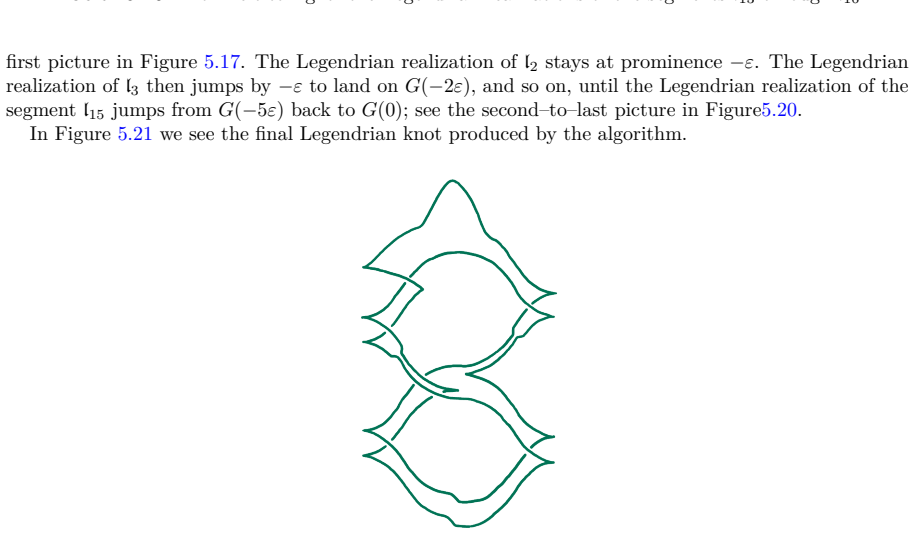
We give an explicit algorithm to Legendrian realize a homologically nontrivial simple closed curve on a ribbon surface of a Legendrian graph in the standard contact structure (R^3, ξ_st). As an application, we obtain an algorithm that converts an abstract open book whose monodromy is written as a product of Dehn twists along homologically nontrivial curves into a contact surgery diagram for the supported contact manifold. Any two Legendrian realizations of the same curve on a ribbon surface are Legendrian isotopic, and likewise for Legendrian knots lying on pages of open books and representing the same isotopy class on the page.
What carries the argument
The explicit algorithm that constructs a Legendrian realization from a given homologically nontrivial curve on the ribbon surface of a Legendrian graph, together with the uniqueness statement that all such realizations are Legendrian isotopic.
If this is right
- Any abstract open book with monodromy given by Dehn twists along homologically nontrivial curves can be converted algorithmically into a contact surgery diagram.
- Legendrian knots on pages of open books that represent the same isotopy class on the page are Legendrian isotopic.
- Legendrian realizations of curves on ribbon surfaces are unique up to Legendrian isotopy whenever the homology condition holds.
Where Pith is reading between the lines
- The uniqueness result implies that the Legendrian isotopy class of such a knot is completely determined by its isotopy class on the ribbon surface or page.
- The algorithms make it possible in principle to compute contact-geometric invariants directly from combinatorial data on surfaces or open books.
- The method may extend to producing Legendrian representatives for other classes of curves or surfaces, though the paper restricts to the homologically nontrivial case.
Load-bearing premise
The input curve on the ribbon surface must be homologically nontrivial.
What would settle it
A concrete homologically nontrivial simple closed curve on the ribbon surface of some Legendrian graph in (R^3, ξ_st) for which no Legendrian realization exists, or two non-isotopic Legendrian realizations of the same curve.
Figures




read the original abstract
We give an explicit algorithm to Legendrian realize a homologically nontrivial simple closed curve on a ribbon surface of a Legendrian graph in the standard contact structure $(\mathbb{R}^3,\xi_{\rm st})$. As an application, we obtain an algorithm that converts an abstract open book whose monodromy is written as a product of Dehn twists along homologically nontrivial curves into a contact surgery diagram for the supported contact manifold. Along the way, we also record a uniqueness statement which is implicit in earlier work but, to our knowledge, was never written in the form needed here: any two Legendrian realizations of the same curve on a ribbon surface are Legendrian isotopic, and likewise for Legendrian knots lying on pages of open books and representing the same isotopy class on the page.
Editorial analysis
A structured set of objections, weighed in public.
Referee Report
Summary. The manuscript gives an explicit algorithm to Legendrian realize a homologically nontrivial simple closed curve on the ribbon surface of a Legendrian graph in (R^3, xi_st). It applies the algorithm to produce contact surgery diagrams from abstract open books whose monodromy is a product of Dehn twists along such curves, and records a uniqueness statement that any two Legendrian realizations of the same curve on a ribbon surface (or of the same isotopy class on an open-book page) are Legendrian isotopic.
Significance. The explicit, constructive nature of the algorithm, built from standard contact-geometric operations (Legendrian isotopy, stabilization, and framing adjustments), supplies a practical tool for realizing curves on surfaces while respecting the Thurston-Bennequin inequality via the homological nontriviality hypothesis. The uniqueness result formalizes an implicit fact from earlier literature in a form directly usable for open-book applications. These features strengthen the manuscript's utility for constructing and comparing contact structures via surgery diagrams and open books.
minor comments (3)
- The algorithm is presented as a sequence of moves; adding a short pseudocode block or numbered checklist in the main algorithm section would make the steps easier to follow and verify.
- The uniqueness statement is described as implicit in prior work; a brief sentence recalling the precise earlier reference (e.g., the relevant theorem number) would clarify what is being recorded versus newly proved.
- Figure captions for the illustrative diagrams of the realization process could explicitly label the successive stabilizations and isotopies to match the textual steps.
Simulated Author's Rebuttal
We thank the referee for the positive assessment of the manuscript, including recognition of the explicit algorithm's practical value and the utility of the uniqueness result for open-book applications. We appreciate the recommendation for minor revision.
Circularity Check
No significant circularity; explicit algorithmic construction is self-contained
full rationale
The paper presents an explicit algorithm for Legendrian realization of a homologically nontrivial simple closed curve on a ribbon surface, built from standard contact-geometric operations (Legendrian isotopy, stabilization, and surface framing adjustments) that are fully described without reduction to fitted parameters or self-referential definitions. The homological nontriviality condition is stated upfront as an assumption to ensure compatibility with the Thurston-Bennequin inequality. The uniqueness statement is recorded as implicit in prior work but is not used as a load-bearing self-citation chain for the main algorithm; it is presented separately for the needed form. No predictions, ansatzes, or renamings reduce by construction to the inputs. The result is a constructive procedure, self-contained against external contact-geometric benchmarks.
Axiom & Free-Parameter Ledger
axioms (1)
- domain assumption The standard contact structure on R^3 satisfies the usual contact condition and admits Legendrian realizations of suitable curves.
Lean theorems connected to this paper
-
IndisputableMonolith/Foundation/AlexanderDuality.leanalexander_duality_circle_linking unclear?
unclearRelation between the paper passage and the cited Recognition theorem.
We give an explicit algorithm to Legendrian realize a homologically nontrivial simple closed curve on a ribbon surface of a Legendrian graph in the standard contact structure (R^3, ξ_st).
-
IndisputableMonolith/Cost/FunctionalEquation.leanwashburn_uniqueness_aczel unclear?
unclearRelation between the paper passage and the cited Recognition theorem.
STEP 2: relative gain (displacement index) in a 1-handle... Δ(l_ji) := δ_ji * Δ̃(l_ji)
What do these tags mean?
- matches
- The paper's claim is directly supported by a theorem in the formal canon.
- supports
- The theorem supports part of the paper's argument, but the paper may add assumptions or extra steps.
- extends
- The paper goes beyond the formal theorem; the theorem is a base layer rather than the whole result.
- uses
- The paper appears to rely on the theorem as machinery.
- contradicts
- The paper's claim conflicts with a theorem or certificate in the canon.
- unclear
- Pith found a possible connection, but the passage is too broad, indirect, or ambiguous to say the theorem truly supports the claim.
Reference graph
Works this paper leans on
-
[1]
Lefschetz fibrations on compact Stein surfaces
[AO01] S. Akbulut and B. Ozbagci: “Lefschetz fibrations on compact Stein surfaces”.Geom. Topol.5 (2001), 319–334. [Avd13] R. Avdek: “Contact surgery and supporting open books”.Algebr. Geom. Topol.13.3 (2013), 1613–1660. [BHH24] J. Breen, K. Honda, and Y. Huang:The Giroux correspondence in arbitrary dimensions
work page 2001
-
[2]
A Legendrian surgery presentation of contact 3-manifolds
arXiv:2307.02317 [math.SG]. [DG04] F. Ding and H. Geiges: “A Legendrian surgery presentation of contact 3-manifolds”.Mathe- matical Proceedings of the Cambridge Philosophical Society136.3 (2004), 583–598. [Etn04] J. B. Etnyre:Convex surfaces in contact geometry: class notes.https://etnyre.math.gatech. edu/preprints/papers/surfaces.pdf
-
[3]
Fibered transverse knots and the Bennequin bound
Clay Math. Proc. Amer. Math. Soc., Providence, RI, 2006, 103–141. [EV11] J. B. Etnyre and J. Van Horn-Morris: “Fibered transverse knots and the Bennequin bound”. Int. Math. Res. Not. IMRN7 (2011), 1483–1509. [Gay02] D. T. Gay: “Explicit concave fillings of contact three-manifolds”.Math. Proc. Cambridge Philos. Soc.133.3 (2002), 431–441. [Gei08] H. Geiges:...
work page 2006
-
[4]
Structures de contact en dimension trois et bifurcations des feuilletages de surfaces
Cambridge Studies in Advanced Mathematics. Cambridge University Press, Cambridge, 2008, xvi+440. [Gir00] E. Giroux: “Structures de contact en dimension trois et bifurcations des feuilletages de surfaces”. Invent. Math.141.3 (2000), 615–689. [Gir02] E. Giroux: “Géométrie de contact: de la dimension trois vers les dimensions supérieures”. Proceedings of the...
work page 2008
- [5]
-
[6]
Topological methods in 3-dimensional contact geometry
arXiv:2408.01079 [math.GT]. [Mas14] P. Massot: “Topological methods in 3-dimensional contact geometry”.Contact and symplectic topology. Vol
-
[7]
An open book decomposition compatible with rational contact surgery
Bolyai Soc. Math. Stud. János Bolyai Math. Soc., Budapest, 2014, 27–83. [Ozb06] B. Ozbagci: “An open book decomposition compatible with rational contact surgery”.Proceed- ings of Gökova Geometry-Topology Conference
work page 2014
-
[8]
Contact structures, Legendrian knots and open book decompositions
Gökova Geometry/Topology Conference (GGT), Gökova, 2006, 175–186. [Ste26] E. Stenhede: “Contact structures, Legendrian knots and open book decompositions”. PhD thesis. University of Vienna,
work page 2006
-
[9]
Surgery diagrams and open book decompositions of contact 3-manifolds
[Sti05] A. I. Stipsicz: “Surgery diagrams and open book decompositions of contact 3-manifolds”.Acta Math. Hungar.108.1-2 (2005), 71–86. University of Vienna, F aculty of Mathematics, Oskar-Morgenstern-Platz 1, 1090 Wien, Austria Email address:eric.stenhede@univie.ac.at
work page 2005
discussion (0)
Sign in with ORCID, Apple, or X to comment. Anyone can read and Pith papers without signing in.