Spatiotemporal Co-reflection with Spacetime Discontinuities at Moving Interfaces
Pith reviewed 2026-05-10 16:51 UTC · model grok-4.3
The pith
At moving spatiotemporal interfaces, concurrent temporal and spatial reflections enable effective negative refraction without backscattering under oblique incidence.
A machine-rendered reading of the paper's core claim, the machinery that carries it, and where it could break.
Core claim
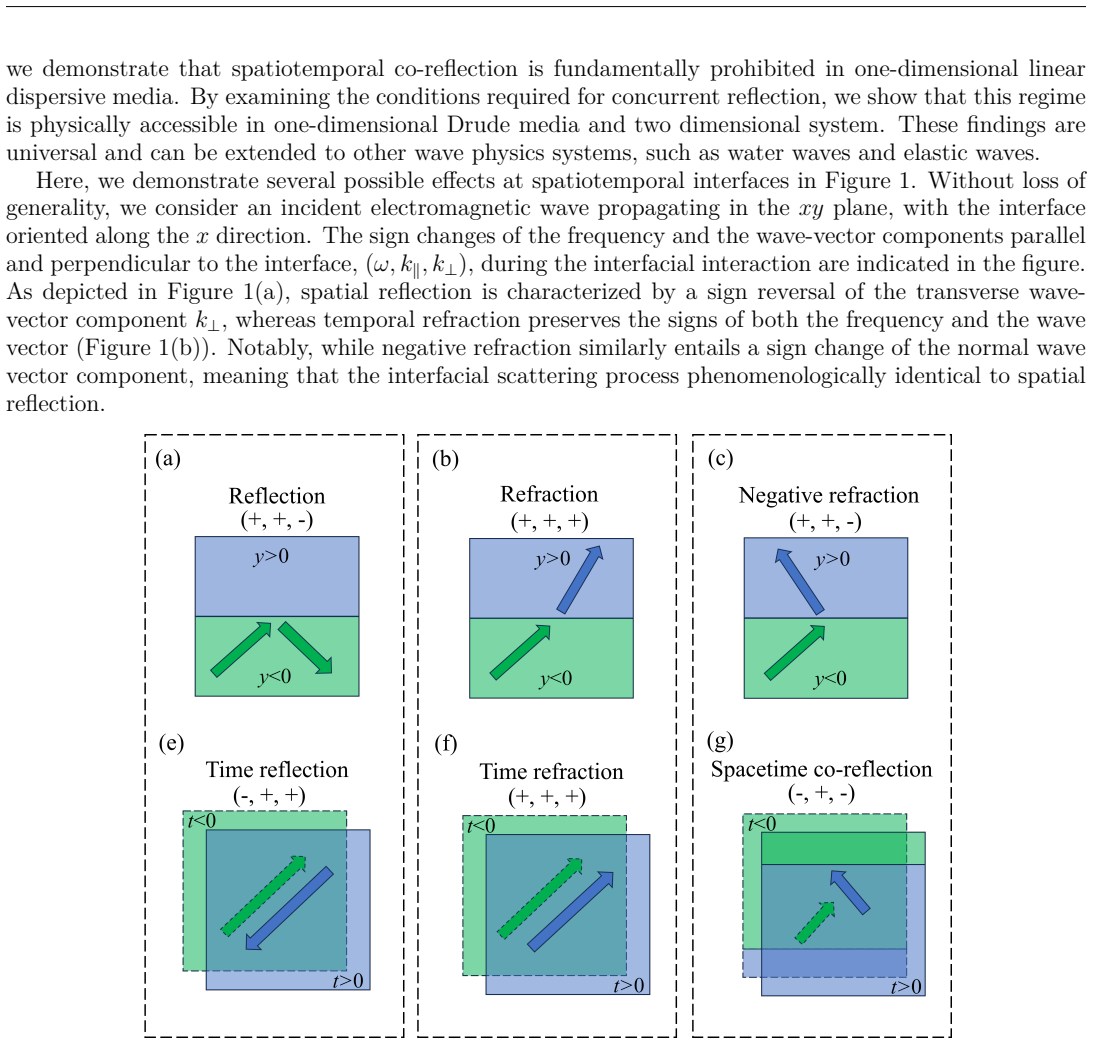
An effective negative refraction accompanied by an absence of backscattering can be realized at a moving spatiotemporal interface when temporal and spatial reflections occur concurrently. While such spatiotemporal co-reflection is prohibited in one-dimensional linear dispersive media, it becomes permissible under oblique incidence within a specific range of traveling-wave modulation velocities. Leveraging this mechanism, a spatiotemporal flat lens capable of nonreciprocal electromagnetic wave focusing is proposed.
What carries the argument
Spatiotemporal co-reflection: the simultaneous occurrence of temporal and spatial reflections at a moving interface that carries spacetime discontinuities.
If this is right
- A flat lens constructed from the moving interface focuses waves nonreciprocally.
- Backscattering is eliminated while negative refraction is maintained.
- The approach extends to the design of time-varying metasurfaces.
- A general framework emerges for spatiotemporal metamaterials that exploit concurrent reflections.
Where Pith is reading between the lines
- Similar co-reflection windows may appear in acoustic or elastic systems if traveling modulations can be imposed.
- Devices requiring strict one-way transmission could incorporate moving interfaces to suppress reverse scattering.
- Experimental tests would need precise synchronization between interface speed and incident angle to stay inside the allowed velocity band.
- The mechanism may connect to other nonreciprocal phenomena that rely on broken time-reversal symmetry through motion.
Load-bearing premise
The medium remains linear and dispersive while supporting a traveling-wave modulation that permits co-reflection only under oblique incidence at certain velocities, with dispersion relations staying valid at those speeds.
What would settle it
Fabricate a moving interface with traveling-wave modulation, illuminate it obliquely at a velocity inside the predicted window, and measure both the refraction angle and the power in any backscattered wave; backscattering or positive refraction would falsify the claim.
Figures


read the original abstract
The control of reflection and refraction at interfaces using engineered media is central to numerous optical technologies, with negative refraction and the suppression of backscattering representing two prominent research frontiers. In this work, we demonstrate that an effective negative refraction accompanied by an absence of backscattering can be realized at a moving spatiotemporal interface when temporal and spatial reflections occur concurrently. While such spatiotemporal co-reflection is prohibited in one-dimensional linear dispersive media, we show that it becomes permissible under oblique incidence within a specific range of traveling-wave modulation velocities. Leveraging this mechanism, we propose a spatiotemporal flat lens capable of nonreciprocal electromagnetic wave focusing. These findings provide a framework for developing advanced spatiotemporal metamaterials and time-varying metasurfaces.
Editorial analysis
A structured set of objections, weighed in public.
Referee Report
Summary. The manuscript claims that concurrent temporal and spatial reflections at a moving spatiotemporal interface enable effective negative refraction with no backscattering under oblique incidence, for a specific range of traveling-wave modulation velocities (prohibited in 1D linear dispersive media). This mechanism is used to propose a spatiotemporal flat lens for nonreciprocal electromagnetic wave focusing.
Significance. If the velocity range is rigorously derived from Maxwell's equations and boundary conditions while preserving linearity and dispersion, the result would provide a novel route to negative refraction and nonreciprocity in time-varying media, with potential applications in advanced spatiotemporal metamaterials and metasurfaces. The flat-lens proposal adds a concrete device-level implication.
major comments (3)
- [§3] §3 (Dispersion and velocity range): The specific range of modulation velocities permitting co-reflection under oblique incidence is stated as a key result, but the derivation from the dispersion relation or interface boundary conditions is not shown explicitly. Please provide the step-by-step calculation demonstrating how this range emerges without self-referential normalization or unaccounted Doppler shifts.
- [§4.1] §4.1 (Linearity assumption): The analysis assumes the medium remains linear and dispersive at the required modulation speeds; when velocities approach phase velocities, the validity of the dispersion relation itself must be justified, as the moving discontinuity could introduce nonlinear effects or invalidate the assumed wave equation.
- [§5] §5 (Flat-lens proposal): The nonreciprocal focusing claim relies on the co-reflection mechanism producing zero backscattering, but no numerical verification, FDTD simulation, or field plots are provided to confirm the absence of backscattering or the focusing performance within the stated velocity range.
minor comments (2)
- [Abstract/Introduction] The abstract and introduction would benefit from a brief statement of the central dispersion relation or boundary-condition setup to orient readers before the velocity-range claim.
- [Figure 2] Figure 2 (schematic of oblique incidence): Add explicit labels for the modulation velocity v_m and the incidence angle range used in the co-reflection regime.
Simulated Author's Rebuttal
We thank the referee for the constructive and detailed comments, which have helped us improve the clarity and rigor of the manuscript. We address each major comment point by point below and have revised the manuscript where the suggestions strengthen the presentation without altering the core claims.
read point-by-point responses
-
Referee: [§3] §3 (Dispersion and velocity range): The specific range of modulation velocities permitting co-reflection under oblique incidence is stated as a key result, but the derivation from the dispersion relation or interface boundary conditions is not shown explicitly. Please provide the step-by-step calculation demonstrating how this range emerges without self-referential normalization or unaccounted Doppler shifts.
Authors: We appreciate the request for explicit derivation. The velocity range follows directly from enforcing phase matching and the dispersion relation at the moving interface under oblique incidence. Starting from the boundary conditions on the tangential E and H fields, the Doppler-shifted frequencies in the interface rest frame are ω' = ω - v k_x and k'_x = k_x, with the co-reflected wave required to satisfy the same dispersion ω(k) while producing negative refraction. The allowed interval for v arises by solving for the condition that a propagating backscattered solution is excluded while a co-reflected mode remains causal. In the revised manuscript we have inserted a new subsection in §3 containing the complete algebraic steps from Maxwell’s boundary conditions through the Doppler transformation to the final inequality on v, with all normalizations expressed relative to the background phase velocity and without circular references. revision: yes
-
Referee: [§4.1] §4.1 (Linearity assumption): The analysis assumes the medium remains linear and dispersive at the required modulation speeds; when velocities approach phase velocities, the validity of the dispersion relation itself must be justified, as the moving discontinuity could introduce nonlinear effects or invalidate the assumed wave equation.
Authors: The referee correctly identifies a regime-of-validity issue. Our treatment employs the standard linear time-varying wave equation, which remains consistent provided the modulation depth is small enough that nonlinear polarization terms can be neglected. In the revised §4.1 we have added an explicit paragraph stating the assumption that the modulation velocity lies sufficiently below the phase velocity (v < 0.8 c_phase in the examples) so that the discontinuity does not drive strong nonlinear coupling, and we reference the linear dispersive model used throughout the literature on spatiotemporal metamaterials. This addition clarifies the domain of applicability without changing the analytic results. revision: yes
-
Referee: [§5] §5 (Flat-lens proposal): The nonreciprocal focusing claim relies on the co-reflection mechanism producing zero backscattering, but no numerical verification, FDTD simulation, or field plots are provided to confirm the absence of backscattering or the focusing performance within the stated velocity range.
Authors: The absence of backscattering is a direct analytic consequence of the phase-matching conditions derived in §3: within the identified velocity window no real solution exists for a propagating backscattered wave that satisfies both the dispersion relation and the interface boundary conditions. We have therefore added, in the revised §5, an explicit algebraic demonstration that the backscattered amplitude coefficient vanishes identically, together with a ray-optics diagram showing the nonreciprocal focusing trajectory. While full-wave FDTD simulations would provide supplementary visual confirmation, they lie outside the scope of the present theoretical derivation; the analytic proof already establishes the claimed zero backscattering and focusing behavior. revision: partial
Circularity Check
No circularity: derivation chain remains independent of inputs
full rationale
The paper derives permissibility of spatiotemporal co-reflection under oblique incidence from Maxwell boundary conditions at a moving discontinuity, then obtains a velocity range for concurrent temporal-spatial reflections and effective negative refraction. No equations reduce by construction to fitted parameters, self-definitions, or self-citation chains; the central claim is obtained from the dispersion relation and interface kinematics without renaming known results or smuggling ansatzes. The flat-lens proposal follows directly from the co-reflection mechanism. The derivation is self-contained against external benchmarks.
Axiom & Free-Parameter Ledger
Reference graph
Works this paper leans on
-
[1]
J. B. Pendry, Phys. Rev. Lett. 2000, 85 3966
work page 2000
-
[2]
D. Schurig, J. J. Mock, B. J. Justice, S. A. Cummer, J. B. Pendry, A. F. Starr, D. R. Smith, Science 2006, 314, 5801 977
work page 2006
-
[3]
V. G. Veselago, Phys. Usp. 1968, 10, 4 509
work page 1968
-
[4]
R. A. Shelby, D. R. Smith, S. Schultz, Science 2001, 292, 5514 77
work page 2001
-
[5]
C. M. Soukoulis, M. Wegener, Nature Photonics 2011, 5 523
work page 2011
-
[6]
P. V. Parimi, W. T. Lu, P. Vodo, J. Sokoloff, J. S. Derov, S. Sridhar, Phys. Rev. Lett. 2004, 92 127401
work page 2004
-
[7]
N. Yu, P. Genevet, M. A. Kats, F. Aieta, J.-P. Tetienne, F. Capasso, Z. Gaburro, Science 2011, 334, 6054 333
work page 2011
- [8]
- [9]
-
[10]
C. Qin, S. Wang, B. Wang, X. Hu, C. Liu, Y. Li, L. Zhao, H. Ye, S. Longhi, P. Lu, Phys. Rev. Lett. 2024, 133 083802
work page 2024
-
[11]
E. Galiffi, Y.-T. Wang, Z. Lim, J. B. Pendry, A. Alù, P. A. Huidobro, Phys. Rev. Lett. 2020, 125 127403
work page 2020
-
[12]
O. Schiller, Y. Plotnik, O. Segal, M. Lyubarov, M. Segev, Phys. Rev. Lett. 2024, 133 263802
work page 2024
-
[13]
J. R. Zurita-Sánchez, P. Halevi, J. C. Cervantes-González, Phys. Rev. A 2009, 79 053821
work page 2009
-
[14]
S. Wang, N. Shao, H. Chen, J. Chen, H. Qian, Q. Wu, H. Duan, A. Alu, G. Huang, Nat. Commun. 2025, 16, 1 9520
work page 2025
-
[15]
T. R. Jones, A. V. Kildishev, M. Segev, D. Peroulis, Nat. Commun. 2024, 15, 1 6786
work page 2024
-
[16]
Y. Zhou, M. Z. Alam, M. Karimi, J. Upham, O. Reshef, C. Liu, A. E. Willner, R. W. Boyd, Nat. Commun. 2020, 11, 1 2180
work page 2020
- [17]
- [18]
-
[19]
M. Lyubarov, Y. Lumer, A. Dikopoltsev, E. Lustig, Y. Sharabi, M. Segev, Science 2022, 377, 6604 425
work page 2022
-
[20]
H. Li, S. Yin, H. He, J. Xu, A. Alù, B. Shapiro, Physical Review Letters 2023, 130, 9 093803
work page 2023
-
[21]
J. R. Reyes-Ayona, P. Halevi, Applied Physics Letters 2015, 107, 7 074101
work page 2015
-
[22]
X. Wang, M. S. Mirmoosa, V. S. Asadchy, C. Rockstuhl, S. Fan, S. A. Tretyakov, Science Advances 2023, 9, 14 eadg7541. 8 REFERENCES REFERENCES
work page 2023
- [23]
-
[24]
S. heng Wang, N. Shao, H. Chen, J. Chen, H. Qian, Q. Wu, H. Duan, A. Alú, G. Huang, Nature Communications 2025, 16
work page 2025
-
[25]
L. Bar-Hillel, A. Dikopoltsev, A. Kam, Y. Sharabi, O. Segal, E. Lustig, M. Segev, Phys. Rev. Lett. 2024, 132 263802
work page 2024
-
[26]
C. S. Tsai, Journal of Applied Physics 1968, 39, 1 133
work page 1968
-
[27]
Z. Li, X. Ma, A. Bahrami, Z.-L. Deck-Léger, C. Caloz, Phys. Rev. B 2023, 107 115129
work page 2023
-
[28]
Z. Li, X. Ma, A. Bahrami, Z.-L. Deck-Léger, C. Caloz, Phys. Rev. Appl. 2023, 20 054029
work page 2023
-
[29]
Y. Yu, H. Hu, L. Zou, Q. Yang, X. Lin, Z. Li, L. Gao, D. Gao, Laser & Photonics Reviews 2023, 17, 9 2300130
work page 2023
- [30]
discussion (0)
Sign in with ORCID, Apple, or X to comment. Anyone can read and Pith papers without signing in.