On d-stochastic measures with fractal support and uniform (d-1)-marginals, and related results
Pith reviewed 2026-05-10 16:54 UTC · model grok-4.3
The pith
For d at least 3, Hausdorff dimensions of supports for measures with uniform (d-1)-marginals are dense in [d-1,d], with fractal-supported ones dense in the Wasserstein metric.
A machine-rendered reading of the paper's core claim, the machinery that carries it, and where it could break.
Core claim
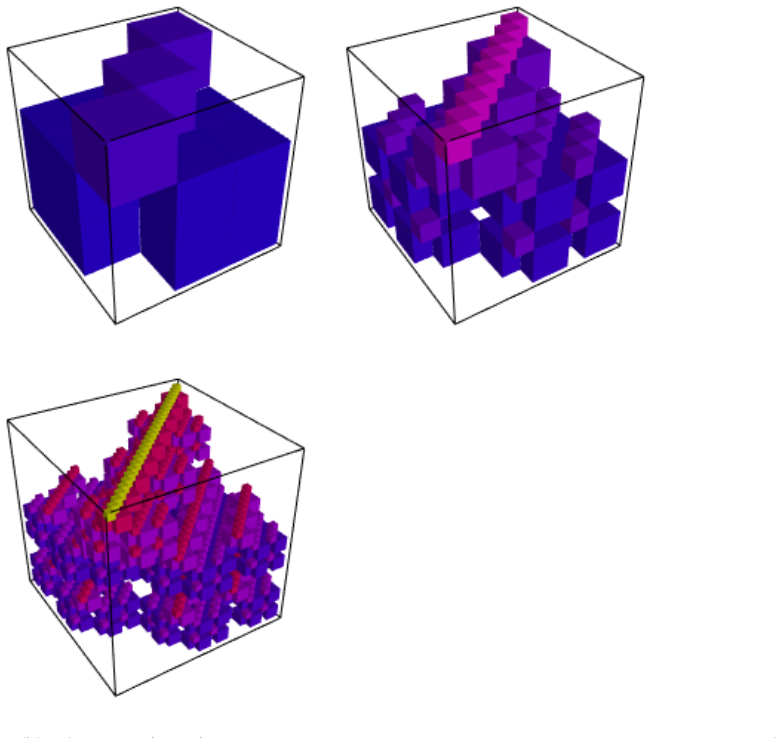
Working with iterated function systems with probabilities, we construct elements of P_d^{λ_{d-1}} that have self-similar fractal support. We prove that for every d ≥ 3 the set D_d of Hausdorff dimensions of the supports of elements in P_d^{λ_{d-1}} is dense in [d-1,d], and that the subset of elements having fractal support is dense in P_d^{λ_{d-1}} with respect to the Wasserstein metric. We also exhibit an element in P_3^{λ_2} whose support is a Sierpinski tetrahedron.
What carries the argument
Iterated function systems with probabilities (IFSPs) chosen so the invariant measure satisfies the uniform (d-1)-marginal condition while retaining a self-similar fractal support of prescribed dimension.
If this is right
- The possible Hausdorff dimensions of supports inside the family fill [d-1,d] densely for every d ≥ 3.
- Fractal-supported members can approximate every element of the family to any desired accuracy in Wasserstein distance.
- There exist elements with self-similar support that realize complete functional dependence in every direction, such as the Sierpinski tetrahedron in dimension three.
- The same IFSP construction technique extends to produce further examples of type-(ii) measures with prescribed self-similar supports.
Where Pith is reading between the lines
- The constructions indicate that uniform lower-dimensional marginals do not preclude fractal geometry in the joint support, even when the dimension is arbitrarily close to the ambient space dimension.
- Density in the Wasserstein metric suggests that fractal supports are not rare or pathological within the family but can serve as approximations to smoother measures.
- Similar density statements might be investigated for other marginal constraints or for infinite-dimensional analogues on the unit cube.
Load-bearing premise
Suitable iterated function systems exist that produce invariant measures obeying the uniform (d-1)-marginal condition while having the claimed self-similar fractal supports and exact Hausdorff dimensions.
What would settle it
An explicit gap of positive length inside [d-1,d] containing no achievable Hausdorff dimension for any such measure, or a concrete measure in the family that cannot be approximated arbitrarily closely in Wasserstein distance by any sequence of fractal-supported ones.
Figures


read the original abstract
The family $\mathcal{P}_{d}^{\lambda_{d-1}}$ of all probability measures on $[0,1]^d$ whose $(d-1)$-dimensional marginals are all equal to the Lebesgue measure $\lambda_{d-1}$ on $[0,1]^{d-1}$ contains remarkably pathological elements: Working with Iterated Function Systems with Probabi\-lities (IFSPs) we construct measures $\mu \in \mathcal{P}_{d}^{\lambda_{d-1}}$ of the following two types: (i) $\mu$ has self-similar fractal support; (ii) $\mu$ has self-similar support and models the situation of complete/functional dependence in each direction.As our main results concerning type (i) we prove, firstly, that for every $d\geq 3$ the set $\mathcal{D}_d$ of Hausdorff dimensions of the supports of elements in $\mathcal{P}_{d}^{\lambda_{d-1}}$ is dense in $[d-1,d]$; and, secondly, that the subset of elements in $\mathcal{P}_{d}^{\lambda_{d-1}}$ having fractal support is dense in $\mathcal{P}_{d}^{\lambda_{d-1}}$ with respect to the Wasserstein metric. Moreover, we show the existence of an element in $\mathcal{P}_{3}^{\lambda_{2}}$ of type (ii) whose support is a Sierpinski tetrahedron and study some generalizations.
Editorial analysis
A structured set of objections, weighed in public.
Referee Report
Summary. The manuscript constructs elements of the family P_d^{λ_{d-1}} of probability measures on [0,1]^d with all (d-1)-marginals equal to Lebesgue measure λ_{d-1}, using iterated function systems with probabilities (IFSPs). The main results are that for d ≥ 3 the set D_d of Hausdorff dimensions of supports of self-similar fractal elements is dense in [d-1,d], and that the fractal-supported measures are dense in P_d^{λ_{d-1}} under the Wasserstein metric. It also constructs an explicit element in P_3^{λ_2} whose support is a Sierpinski tetrahedron and models complete dependence in each coordinate direction, along with some generalizations.
Significance. If the IFSP constructions are valid, the results establish that the uniform marginal constraint permits a rich variety of self-similar fractal supports whose dimensions fill [d-1,d] densely, together with density of such measures in the Wasserstein topology. This clarifies the geometric flexibility of measures with fixed marginals and connects iterated-function-system techniques to the study of singular measures with prescribed projections.
major comments (2)
- [Main results on type-(i) measures] The central density claims for D_d and for the Wasserstein density of fractal elements rest on the existence of IFSPs whose unique invariant measure μ satisfies π_i#μ = λ_{d-1} exactly for every coordinate projection π_i while the attractor has Hausdorff dimension taking values arbitrarily close to any point of [d-1,d]. The manuscript must supply the explicit maps and probability vectors for a sequence of such systems (at least for dimensions approaching d-1) and verify that the projected IFS reproduces Lebesgue measure without additional assumptions on the contraction ratios.
- [Type-(ii) construction] For the Sierpinski-tetrahedron example in P_3^{λ_2}, the paper asserts that the support models complete/functional dependence in each direction while preserving uniform marginals. The verification that the three coordinate projections of the invariant measure are exactly λ_2 (rather than merely having full support) should be written out explicitly, including the algebraic relations imposed on the contraction ratios and probabilities.
minor comments (2)
- [Introduction] Notation for the family P_d^{λ_{d-1}} and for the Wasserstein metric should be introduced once in the preliminaries and used consistently; the current usage mixes script and calligraphic fonts without explicit definition.
- [Abstract] The statement that the fractal-supported measures are dense should specify the topology on the space of measures (Wasserstein) already in the abstract for clarity.
Simulated Author's Rebuttal
We thank the referee for their careful reading and constructive comments. We address each major comment below.
read point-by-point responses
-
Referee: [Main results on type-(i) measures] The central density claims for D_d and for the Wasserstein density of fractal elements rest on the existence of IFSPs whose unique invariant measure μ satisfies π_i#μ = λ_{d-1} exactly for every coordinate projection π_i while the attractor has Hausdorff dimension taking values arbitrarily close to any point of [d-1,d]. The manuscript must supply the explicit maps and probability vectors for a sequence of such systems (at least for dimensions approaching d-1) and verify that the projected IFS reproduces Lebesgue measure without additional assumptions on the contraction ratios.
Authors: We appreciate the referee's emphasis on explicitness. The manuscript presents a parameterized family of IFSPs whose attractors achieve the required marginals exactly and whose dimensions are dense in [d-1,d]. To strengthen the presentation, the revised version will include an explicit sequence of maps and probability vectors (for d=3 and higher) realizing dimensions approaching d-1, together with a direct verification that each projected IFS has Lebesgue measure as its unique invariant measure. This verification proceeds from the invariance equation and the chosen positive probabilities summing to one, without further assumptions on the contraction ratios. revision: yes
-
Referee: [Type-(ii) construction] For the Sierpinski-tetrahedron example in P_3^{λ_2}, the paper asserts that the support models complete/functional dependence in each direction while preserving uniform marginals. The verification that the three coordinate projections of the invariant measure are exactly λ_2 (rather than merely having full support) should be written out explicitly, including the algebraic relations imposed on the contraction ratios and probabilities.
Authors: We agree that an expanded verification improves clarity. The revised manuscript will contain an explicit computation of the three coordinate projections of the invariant measure for the Sierpinski tetrahedron example. We will derive and display the algebraic relations satisfied by the contraction ratios and probabilities that force each marginal to be exactly λ_2, thereby confirming both the uniform marginals and the complete dependence property. revision: yes
Circularity Check
No significant circularity detected
full rationale
The paper constructs the required measures explicitly via iterated function systems with probabilities (IFSPs) chosen to satisfy the uniform (d-1)-marginal condition while producing self-similar supports of controlled Hausdorff dimension. The density statements for D_d in [d-1,d] and for fractal-supported elements in the Wasserstein topology follow directly from varying the contraction ratios and probabilities within the standard IFS framework and applying classical results on Hausdorff dimension and weak convergence; no equation reduces a claimed prediction back to a fitted input, no load-bearing uniqueness theorem is imported via self-citation, and no ansatz is smuggled in. The derivation chain is therefore self-contained against external benchmarks of IFS theory.
Axiom & Free-Parameter Ledger
axioms (2)
- standard math Invariant measures of contractive IFS exist and are unique when the maps are contractions on a complete metric space.
- standard math Hausdorff dimension of a self-similar set equals the solution of the similarity-dimension equation under the open-set condition or equivalent separation.
Reference graph
Works this paper leans on
-
[1]
M.F. Barnsley,Fractals everywhere. Academic Press, Cambridge, 1993
work page 1993
-
[2]
Dudley,Real Analysis and Probability, Cambridge University Press, 2002
R.M. Dudley,Real Analysis and Probability, Cambridge University Press, 2002
work page 2002
-
[3]
F. Durante, C. Sempi,Principles of copula theory, CRC Press, Boca Raton, FL, 2016
work page 2016
-
[4]
Falconer,Fractal geometry, John Wiley & Sons, Ltd, 2003
K. Falconer,Fractal geometry, John Wiley & Sons, Ltd, 2003
work page 2003
-
[5]
Feldman, Extreme doubly stochastic measures with full support,Proc
D. Feldman, Extreme doubly stochastic measures with full support,Proc. Am. Math. Soc.114 (1992), no. 4, 919–927
work page 1992
-
[6]
G. Fredricks, R.B. Nelsen, J.A. Rodríguez-Lallena, Copulas with fractal supports,Insur. Math. Econ.37(2005), 42-48
work page 2005
-
[7]
F. Griessenberger, R.R. Junker, W. Trutschnig, On a multivariate copula-based dependence mea- sure and its estimation,Electron. J. Stat.16(2022), 2206-2251
work page 2022
-
[8]
Edgar,Measure, Topology, and Fractal Geometry, Springer Verlag, New York, 2008
G. Edgar,Measure, Topology, and Fractal Geometry, Springer Verlag, New York, 2008
work page 2008
-
[9]
Kallenberg,Foundations of modern probability, Springer Verlag, New York, 1997
O. Kallenberg,Foundations of modern probability, Springer Verlag, New York, 1997
work page 1997
-
[10]
Lindenstrauss, A remark on extreme doubly stochastic measures,Amer
J. Lindenstrauss, A remark on extreme doubly stochastic measures,Amer. Math. Monthly(1965) 72, 379–382 17
work page 1965
-
[11]
P. Mikusinski, M.D. Taylor, Some approximations ofn-copulas,Metrika72(2010), 385–414
work page 2010
- [12]
-
[13]
Losert: Counterexamples to some conjectures about doubly stochastic measures,Pacific J
V. Losert: Counterexamples to some conjectures about doubly stochastic measures,Pacific J. Math.99no. 2 (1982), 387-397
work page 1982
-
[14]
T. Mroz, S. Fuchs, W. Trutschnig, How simplifying and flexible is the simplifying assumption in pair-copula constructions - analytic answers in dimension three and a glimpse beyond,Electron. J. Stat.15(2021), 1951-1992
work page 2021
-
[15]
Nelsen,An Introduction to Copulas, Springer, New York, 2006
R.B. Nelsen,An Introduction to Copulas, Springer, New York, 2006
work page 2006
-
[16]
Royden,Real Analysis(2nd Ed.), MacMillan New York, 1968
H.L. Royden,Real Analysis(2nd Ed.), MacMillan New York, 1968
work page 1968
-
[17]
Trutschnig, On a strong metric on the space of copulas and its induced dependence measure, J
W. Trutschnig, On a strong metric on the space of copulas and its induced dependence measure, J. Math. Anal. Appl.384(2011), 690-705
work page 2011
-
[18]
W. Trutschnig, J. Fernández Sánchez, Idempotent and multivariate copulas with fractal support, J. Stat. Plan. Infer.142(2012), 3086-3096
work page 2012
-
[19]
Tsuiki, Projected images of the Sierpinski tetrahedron and other layered fractal imaginary cubes,J
H. Tsuiki, Projected images of the Sierpinski tetrahedron and other layered fractal imaginary cubes,J. Fractal Geom.12no. 3/4 (2025), 303–339
work page 2025
-
[20]
Walters,An Introduction to Ergodic Theory, Springer New York, 1982
P. Walters,An Introduction to Ergodic Theory, Springer New York, 1982
work page 1982
-
[21]
Weisstein,Tetrix, From MathWorld - A Wolfram Resource.https://mathworld.wolfram.com/ Tetrix.html 18
E. Weisstein,Tetrix, From MathWorld - A Wolfram Resource.https://mathworld.wolfram.com/ Tetrix.html 18
discussion (0)
Sign in with ORCID, Apple, or X to comment. Anyone can read and Pith papers without signing in.