Recognition: unknown
EPISODE IV: Ice Inventory in the Envelope of EC 53
Pith reviewed 2026-05-10 16:48 UTC · model grok-4.3
The pith
Accretion bursts in EC 53 produce no detectable changes in envelope ice absorption features.
A machine-rendered reading of the paper's core claim, the machinery that carries it, and where it could break.
Core claim
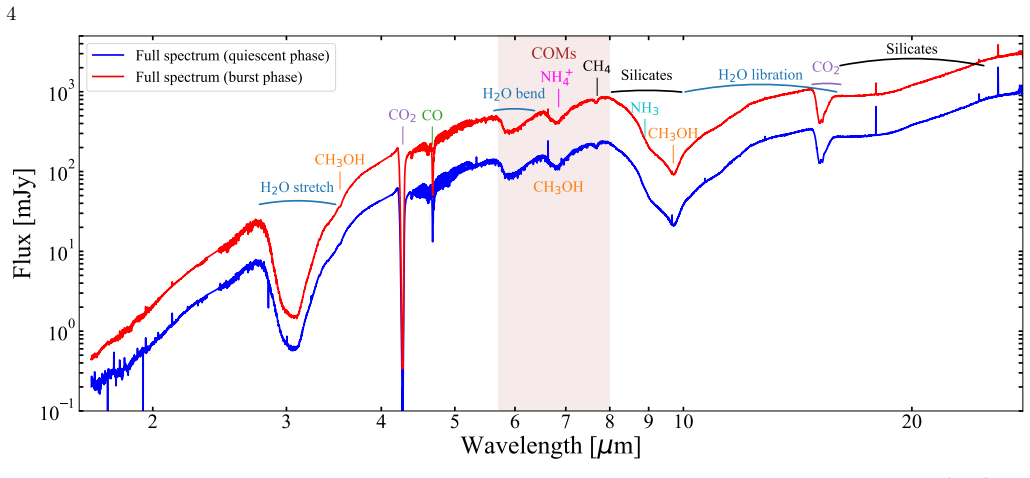
The silicate-corrected spectra of EC 53 show no measurable change in any ice absorption band between quiescent and burst phases. This indicates that moderate and short-period accretion bursts do not significantly alter the physical or chemical state of the ices within its envelope. The ice abundances relative to water exceed those in other protostars, providing a chemically rich, thermally quiescent reservoir for comparison.
What carries the argument
Silicate dust absorption modeling and removal via dedicated continuum-fitting, followed by decomposition of ice bands matching laboratory spectra for pure and mixed ices.
If this is right
- Moderate accretion bursts in young protostars like EC 53 preserve the ice inventory without significant processing.
- The high abundances of major ice species provide a reference point for chemical models of protostellar envelopes.
- EC 53 serves as a benchmark system for tracking ice evolution in the presence of episodic accretion.
- Minor contributions from complex organic molecules are present but do not vary with phase.
- Periodic brightness variations do not induce observable thermal or chemical changes in envelope ices on short timescales.
Where Pith is reading between the lines
- Similar observations of other bursting protostars could test if this stability holds across different burst amplitudes or periods.
- Models of ice mantle processing may need to incorporate thresholds for burst intensity before significant desorption or reaction occurs.
- Longer-term monitoring could reveal cumulative effects not captured in single burst cycles.
- Comparisons with non-bursting protostars would clarify the role of accretion history in setting ice compositions.
Load-bearing premise
The dedicated continuum-fitting procedure for silicate dust absorption accurately isolates ice features without introducing residuals that could hide small phase-dependent changes.
What would settle it
Detection of a statistically significant difference in optical depth of any ice band, such as the 3 micron water ice feature, between future quiescent and burst spectra after identical silicate correction.
Figures


read the original abstract
We present the 1.6$-$28 $\mu$m spectra of the young protostar EC 53, obtained with JWST NIRSpec IFU and MIRI MRS during the quiescent and burst phases of its periodic brightness variations. To isolate ice absorption features, we modeled and removed the mid-infrared silicate dust absorption using a dedicated continuum-fitting procedure. In the optical depth spectrum, we first fit the broad H$_2$O ice features and then decomposed the major ice components, including NH$_3$, CO$_2$, CH$_3$OH, CO, and CH$_4$, by matching laboratory profiles for both pure and H$_2$O-mixed ices. The 4.62 $\mu$m and 6.85 $\mu$m bands are attributed to OCN$^-$ and NH$_4^+$ ions, respectively. Minor or tentative contributions from complex species (HCOOH, H$_2$CO, CH$_3$COOH, CH$_3$CHO, CH$_3$CH$_2$OH, and NH$_2$CHO) are also considered to our global ice analysis. The silicate-corrected spectra reveal no measurable change in any ice absorption band between the two phases, indicating that moderate and short-period accretion bursts in EC~53 do not significantly alter the physical or chemical state of the ices within its envelope. The derived abundances of these major species relative to H$_2$O significantly exceed the values typically observed toward other embedded protostars. Finally, we place the ice inventory of EC~53 in the context of other protostellar systems observed with JWST, highlighting that its chemically rich, thermally quiescent ice reservoir provides a benchmark for studying ice evolution under episodic accretion.
Editorial analysis
A structured set of objections, weighed in public.
Referee Report
Summary. The manuscript presents 1.6-28 μm JWST NIRSpec IFU and MIRI MRS spectra of the young protostar EC 53 obtained during quiescent and burst phases of its periodic brightness variations. After modeling and removing mid-infrared silicate dust absorption via a dedicated continuum-fitting procedure, the authors isolate the optical depth spectrum and decompose major ice components (H2O, NH3, CO2, CH3OH, CO, CH4) plus ions (OCN− at 4.62 μm, NH4+ at 6.85 μm) by matching laboratory profiles for pure and H2O-mixed ices, with minor/tentative contributions from complex organics. They report no measurable change in any ice absorption band between phases, unusually high abundances relative to H2O compared to other embedded protostars, and position EC 53 as a benchmark for ice evolution under episodic accretion.
Significance. If the no-change result holds after rigorous validation of the silicate subtraction, the work provides an important observational constraint showing that moderate, short-period accretion bursts do not significantly alter the physical or chemical state of ices in the envelope. The detailed, chemically rich ice inventory and direct comparison to other JWST-observed protostellar systems establish a valuable reference point for models of ice chemistry and thermal processing.
major comments (1)
- The central claim of no measurable change in ice bands (and thus no significant alteration by bursts) is load-bearing on the silicate-corrected spectra. The dedicated continuum-fitting procedure for removing the 9.7 and 18 μm silicate features must be described with the specific functional form or template library, whether the fit is performed independently for each phase or jointly, and quantified residuals in the 3–8 μm and 15–20 μm windows to demonstrate that phase-dependent artifacts are smaller than noise and do not mask small variations in ice column or temperature.
minor comments (2)
- The statement that abundances 'significantly exceed' typical values for other protostars would be strengthened by a table comparing the derived column densities or relative abundances (with uncertainties) to literature values from other JWST or ground-based observations.
- Clarify how 'no measurable change' is assessed quantitatively (e.g., via upper limits on ΔN or formal statistical comparison of the two optical depth spectra) rather than relying solely on visual inspection of the silicate-corrected spectra.
Simulated Author's Rebuttal
We thank the referee for their positive assessment of the significance of our results and for the constructive major comment. We address it point by point below and will revise the manuscript accordingly.
read point-by-point responses
-
Referee: The central claim of no measurable change in ice bands (and thus no significant alteration by bursts) is load-bearing on the silicate-corrected spectra. The dedicated continuum-fitting procedure for removing the 9.7 and 18 μm silicate features must be described with the specific functional form or template library, whether the fit is performed independently for each phase or jointly, and quantified residuals in the 3–8 μm and 15–20 μm windows to demonstrate that phase-dependent artifacts are smaller than noise and do not mask small variations in ice column or temperature.
Authors: We agree that additional detail on the silicate subtraction is required to fully support the central no-change result. In the revised manuscript we will expand Section 3.2 (or equivalent) to specify the exact functional form and/or template library used for the continuum fit, state whether the fit was performed jointly across both phases or independently, and include quantified residuals (with direct comparison to the noise level) in the 3–8 μm and 15–20 μm windows. These additions will explicitly demonstrate that any residual artifacts are smaller than the noise and cannot mask the reported ice-band variations. revision: yes
Circularity Check
No significant circularity in observational spectral comparison
full rationale
The paper performs a direct observational comparison of JWST NIRSpec/MIRI spectra of EC 53 in quiescent vs. burst phases. Ice bands are isolated by subtracting a silicate continuum model (described as a dedicated fitting procedure) and then matched to independent laboratory ice templates for H2O, CO2, CH3OH, etc. No derivation chain, prediction, or uniqueness claim reduces to its own inputs by construction; the no-measurable-change result is a direct data comparison after standard processing. Abundances are reported relative to H2O from the same spectra. No self-citation load-bearing steps or ansatz smuggling appear in the provided text. This is a self-contained observational analysis against external lab benchmarks.
Axiom & Free-Parameter Ledger
free parameters (2)
- Continuum fitting parameters
- Ice component scaling factors
axioms (2)
- domain assumption Laboratory spectra of pure and mixed ices at relevant temperatures accurately represent the composition and band shapes in the protostellar envelope.
- domain assumption Silicate dust absorption can be modeled independently and subtracted without affecting the underlying ice optical depth spectrum.
Reference graph
Works this paper leans on
-
[1]
2012, A&A, 538, A57, doi: 10.1051/0004-6361/201015999 Altwegg, K., Combi, M., Fuselier, S
Aikawa, Y., Kamuro, D., Sakon, I., et al. 2012, A&A, 538, A57, doi: 10.1051/0004-6361/201015999
-
[2]
Walker, R. L. 1999, SSRv, 90, 219, doi: 10.1023/A:1005210417396 46
-
[3]
Argyriou, I., Glasse, A., Law, D. R., et al. 2023, A&A, 675, A111, doi: 10.1051/0004-6361/202346489
-
[4]
2001, MNRAS, 322, 231, doi: 10.1046/j.1365-8711.2001.04022.x
Armitage, P. J., Livio, M., & Pringle, J. E. 2001, MNRAS, 324, 705, doi: 10.1046/j.1365-8711.2001.04356.x
-
[5]
Baek, G., MacFarlane, B. A., Lee, J.-E., et al. 2020, ApJ, 895, 27, doi: 10.3847/1538-4357/ab8ad4
-
[6]
Bell, K. R., & Lin, D. N. C. 1994, ApJ, 427, 987, doi: 10.1086/174206
-
[7]
Linnartz, H. 2007, A&A, 474, 1061, doi: 10.1051/0004-6361:20078210 B¨ oker, T., Arribas, S., L¨ utzgendorf, N., et al. 2022, A&A, 661, A82, doi: 10.1051/0004-6361/202142589
-
[8]
1992, ApJL, 401, L31, doi: 10.1086/186663
Bonnell, I., & Bastien, P. 1992, ApJL, 401, L31, doi: 10.1086/186663
-
[9]
Boogert, A. C. A., Blake, G. A., & ¨Oberg, K. 2004, ApJ, 615, 344, doi: 10.1086/423979
-
[10]
Boogert, A. C. A., Gerakines, P. A., & Whittet, D. C. B. 2015, ARA&A, 53, 541, doi: 10.1146/annurev-astro-082214-122348
work page Pith review doi:10.1146/annurev-astro-082214-122348 2015
-
[11]
Boogert, A. C. A., Schutte, W. A., Helmich, F. P., Tielens, A. G. G. M., & Wooden, D. H. 1997, A&A, 317, 929
1997
-
[12]
Boogert, A. C. A., Pontoppidan, K. M., Knez, C., et al. 2008, ApJ, 678, 985, doi: 10.1086/533425
-
[13]
Boogert, A. C. A., Huard, T. L., Cook, A. M., et al. 2011, ApJ, 729, 92, doi: 10.1088/0004-637X/729/2/92
-
[14]
Bottinelli, S., Boogert, A. C. A., Bouwman, J., et al. 2010, ApJ, 718, 1100, doi: 10.1088/0004-637X/718/2/1100
-
[15]
2015, MNRAS, 451, 2145, doi: 10.1093/mnras/stv1021
Bouilloud, M., Fray, N., B´ enilan, Y., et al. 2015, MNRAS, 451, 2145, doi: 10.1093/mnras/stv1021
-
[16]
Y., Sellgren, K., & Geballe, T
Brooke, T. Y., Sellgren, K., & Geballe, T. R. 1999, ApJ, 517, 883, doi: 10.1086/307237
-
[17]
Brunken, N. G. C., Rocha, W. R. M., van Dishoeck, E. F., et al. 2024a, A&A, 685, A27, doi: 10.1051/0004-6361/202348718
-
[18]
Brunken, N. G. C., van Dishoeck, E. F., Slavicinska, K., et al. 2024b, A&A, 692, A163, doi: 10.1051/0004-6361/202451794
-
[19]
Chen, Y., Rocha, W. R. M., van Dishoeck, E. F., et al. 2024, A&A, 690, A205, doi: 10.1051/0004-6361/202450706
-
[20]
A., Casassus, S., Tobin, J., et al
Cieza, L. A., Casassus, S., Tobin, J., et al. 2016, Nature, 535, 258, doi: 10.1038/nature18612
-
[21]
2023, MNRAS, 523, 5522, doi: 10.1093/mnras/stad1784
Cleaver, J., Hartmann, L., & Bae, J. 2023, MNRAS, 523, 5522, doi: 10.1093/mnras/stad1784
-
[22]
Dartois, E., Noble, J. A., Caselli, P., et al. 2024, Nature Astronomy, 8, 359, doi: 10.1038/s41550-023-02155-x D’Hendecourt, L. B., & Allamandola, L. J. 1986, A&AS, 64, 453
-
[23]
2021, OpTool: Command-line driven tool for creating complex dust opacities, Astrophysics Source Code Library, record ascl:2104.010
Dominik, C., Min, M., & Tazaki, R. 2021, OpTool: Command-line driven tool for creating complex dust opacities, Astrophysics Source Code Library, record ascl:2104.010
2021
-
[24]
1995, A&A, 300, 503
Mutschke, H. 1995, A&A, 300, 503
1995
-
[25]
Dunham, M. M., Arce, H. G., Mardones, D., et al. 2014, ApJ, 783, 29, doi: 10.1088/0004-637X/783/1/29
-
[26]
Dunham, M. M., Crapsi, A., Evans, II, N. J., et al. 2008, ApJS, 179, 249, doi: 10.1086/591085
-
[27]
Tielens, A. G. G. M., & van Dishoeck, E. F. 1997, A&A, 328, 649
1997
-
[28]
A., et al
Ehrenfreund, P., Kerkhof, O., Schutte, W. A., et al. 1999, A&A, 350, 240
1999
-
[29]
Enoch, M. L., Evans, II, N. J., Sargent, A. I., & Glenn, J. 2009, ApJ, 692, 973, doi: 10.1088/0004-637X/692/2/973
-
[30]
doi:10.1088/0067-0049/181/2/321 , eprint =
Evans, Neal J., I., Dunham, M. M., Jørgensen, J. K., et al. 2009, ApJS, 181, 321, doi: 10.1088/0067-0049/181/2/321
-
[31]
2015, MNRAS, 446, 439, doi: 10.1093/mnras/stu2028
Linnartz, H. 2015, MNRAS, 446, 439, doi: 10.1093/mnras/stu2028
-
[32]
J., Hillenbrand, L
Fischer, W. J., Hillenbrand, L. A., Herczeg, G. J., et al. 2023, in Astronomical Society of the Pacific Conference
2023
-
[33]
Protostars and Planets VII , year = 2023, editor =
Series, Vol. 534, Protostars and Planets VII, ed. S. Inutsuka, Y. Aikawa, T. Muto, K. Tomida, & M. Tamura, 355, doi: 10.48550/arXiv.2203.11257
-
[34]
and Lang, Dustin and Goodman, Jonathan , title =
Foreman-Mackey, D., Hogg, D. W., Lang, D., & Goodman, J. 2013, PASP, 125, 306, doi: 10.1086/670067
-
[35]
2022, ApJ, 937, 29, doi: 10.3847/1538-4357/ac8a9e
Francis, L., Johnstone, D., Lee, J.-E., et al. 2022, ApJ, 937, 29, doi: 10.3847/1538-4357/ac8a9e
-
[36]
J., & van Dishoeck, E
Fraser, H. J., & van Dishoeck, E. F. 2004, Advances in Space Research, 33, 14
2004
-
[37]
Gardner, J. P., Mather, J. C., Clampin, M., et al. 2006, SSRv, 123, 485, doi: 10.1007/s11214-006-8315-7
-
[38]
A., Schutte, W
Gerakines, P. A., Schutte, W. A., & Ehrenfreund, P. 1996, A&A, 312, 289
1996
-
[39]
Gibb, E. L., & Whittet, D. C. B. 2002, ApJL, 566, L113, doi: 10.1086/339633
-
[40]
Tielens, A. G. G. M. 2004, ApJS, 151, 35, doi: 10.1086/381182
-
[41]
Greenberg, J. M., Li, A., Mendoza-Gomez, C. X., et al. 1995, ApJL, 455, L177, doi: 10.1086/309834
-
[42]
Hagen, W., Tielens, A. G. G. M., & Greenberg, J. M. 1983, A&AS, 51, 389
1983
-
[43]
1998, ApJ, 495, 385, doi: 10.1086/305277
Hartmann, L., Calvet, N., Gullbring, E., & D’Alessio, P. 1998, ApJ, 495, 385, doi: 10.1086/305277
-
[44]
2010, ARA&A, 48, 21, doi: 10.1146/annurev-astro-081309-130815 47
Henning, T. 2010, ARA&A, 48, 21, doi: 10.1146/annurev-astro-081309-130815 47
-
[45]
Herbst, E., & van Dishoeck, E. F. 2009, ARA&A, 47, 427, doi: 10.1146/annurev-astro-082708-101654
-
[46]
Hodapp, K. W. 1999, AJ, 118, 1338, doi: 10.1086/301003
-
[47]
W., Chini, R., Watermann, R., & Lemke, R
Hodapp, K. W., Chini, R., Watermann, R., & Lemke, R. 2012, ApJ, 744, 56, doi: 10.1088/0004-637X/744/1/56
-
[48]
2013, ApJS, 205, 5, doi: 10.1088/0067-0049/205/1/5
Hsieh, T.-H., & Lai, S.-P. 2013, ApJS, 205, 5, doi: 10.1088/0067-0049/205/1/5
-
[49]
Hsieh, T.-H., Murillo, N. M., Belloche, A., et al. 2019, ApJ, 884, 149, doi: 10.3847/1538-4357/ab425a —. 2018, ApJ, 854, 15, doi: 10.3847/1538-4357/aaa7f6
-
[50]
Hudson, R. L. 2017, Spectrochimica Acta Part A: Molecular Spectroscopy, 187, 82, doi: 10.1016/j.saa.2017.06.027
-
[51]
Hudson, R. L., & Moore, M. H. 1999, Icarus, 140, 451, doi: 10.1006/icar.1999.6144
-
[52]
2022, A&A, 661, A80, doi: 10.1051/0004-6361/202142663
Jakobsen, P., Ferruit, P., Alves de Oliveira, C., et al. 2022, A&A, 661, A80, doi: 10.1051/0004-6361/202142663
work page internal anchor Pith review doi:10.1051/0004-6361/202142663 2022
-
[53]
Jin, M., Lam, K. H., McClure, M. K., et al. 2022, ApJ, 935, 133, doi: 10.3847/1538-4357/ac8006
-
[54]
Kadam, K., Vorobyov, E., Reg´ aly, Z., K´ osp´ al,´A., & ´Abrah´ am, P. 2020, ApJ, 895, 41, doi: 10.3847/1538-4357/ab8bd8 Kakkenpara Suresh, S., Sipil¨ a, O., Caselli, P., & Dulieu, F. 2025, A&A, 696, A71, doi: 10.1051/0004-6361/202451665
-
[55]
Schutte, W. A., & Whittet, D. C. B. 2001, A&A, 376, 254, doi: 10.1051/0004-6361:20010936
-
[56]
Kemper, F., Vriend, W. J., & Tielens, A. G. G. M. 2004, ApJ, 609, 826, doi: 10.1086/421339
-
[57]
Pontoppidan, K. M. 2012, ApJ, 758, 38, doi: 10.1088/0004-637X/758/1/38
-
[58]
2025, Journal of Korean Astronomical Society, 58, 111, doi: 10.5303/JKAS.2025.58.1.111
Kim, J., Lee, J.-E., Kim, C.-H., Jeong, W.-S., & Yang, Y.-L. 2025, Journal of Korean Astronomical Society, 58, 111, doi: 10.5303/JKAS.2025.58.1.111
-
[59]
2022, ApJ, 935, 137, doi: 10.3847/1538-4357/ac7f9f
Kim, J., Lee, J.-E., Jeong, W.-S., et al. 2022, ApJ, 935, 137, doi: 10.3847/1538-4357/ac7f9f
-
[60]
Knez, C., Boogert, A. C. A., Pontoppidan, K. M., et al. 2005, ApJL, 635, L145, doi: 10.1086/499584
-
[61]
Law, D. R., E. Morrison, J., Argyriou, I., et al. 2023, AJ, 166, 45, doi: 10.3847/1538-3881/acdddc
-
[62]
2007, Journal of Korean Astronomical Society, 40, 83, doi: 10.5303/JKAS.2007.40.4.083
Lee, J.-E. 2007, Journal of Korean Astronomical Society, 40, 83, doi: 10.5303/JKAS.2007.40.4.083
-
[63]
Lee, J.-E., Bergin, E. A., & Evans, II, N. J. 2004, ApJ, 617, 360, doi: 10.1086/425153
-
[64]
Lee, J.-E., Evans, N. J., Baek, G., et al. 2025, ApJL, 978, L3, doi: 10.3847/2041-8213/ad841f
-
[65]
2019, Nature Astronomy, 3, 314, doi: 10.1038/s41550-018-0680-0
Lee, J.-E., Lee, S., Baek, G., et al. 2019, Nature Astronomy, 3, 314, doi: 10.1038/s41550-018-0680-0
-
[66]
2026a, Nature, 649, 853, doi: 10.1038/s41586-025-09939-3
Lee, J.-E., Kim, C.-H., Kim, J., et al. 2026a, Nature, 649, 853, doi: 10.1038/s41586-025-09939-3
-
[67]
2020a, ApJ, 889, 20, doi: 10.3847/1538-4357/ab5a7e
Lee, S., Lee, J.-E., Aikawa, Y., Herczeg, G., & Johnstone, D. 2020a, ApJ, 889, 20, doi: 10.3847/1538-4357/ab5a7e
-
[68]
2026b, ApJ, 1000, 83, doi: 10.3847/1538-4357/ae4234
Lee, S., Lee, J.-E., Kim, C.-H., et al. 2026b, ApJ, 1000, 83, doi: 10.3847/1538-4357/ae4234
-
[69]
2020b, ApJ, 903, 5, doi: 10.3847/1538-4357/abb6fe
Lee, Y.-H., Johnstone, D., Lee, J.-E., et al. 2020b, ApJ, 903, 5, doi: 10.3847/1538-4357/abb6fe
-
[70]
N., Inutsuka, S.-i., & Matsumoto, T
Machida, M. N., Inutsuka, S.-i., & Matsumoto, T. 2011, ApJ, 729, 42, doi: 10.1088/0004-637X/729/1/42
-
[71]
McClure, M. K., Rocha, W. R. M., Pontoppidan, K. M., et al. 2023, Nature Astronomy, 7, 431, doi: 10.1038/s41550-022-01875-w
-
[72]
2005, SSRv, 119, 3, doi: 10.1007/s11214-005-8066-x
Molster, F., & Kemper, C. 2005, SSRv, 119, 3, doi: 10.1007/s11214-005-8066-x
-
[73]
2018, ApJ, 866, 46, doi: 10.3847/1538-4357/aadfd9
Molyarova, T., Akimkin, V., Semenov, D., et al. 2018, ApJ, 866, 46, doi: 10.3847/1538-4357/aadfd9
-
[74]
Moore, M. H., Ferrante, R. F., Hudson, R. L., & Stone, J. N. 2007, Icarus, 190, 260, doi: 10.1016/j.icarus.2007.02.020
-
[75]
Nayakshin, S., & Lodato, G. 2012, MNRAS, 426, 70, doi: 10.1111/j.1365-2966.2012.21612.x
-
[76]
Nazari, P., Rocha, W. R. M., Rubinstein, A. E., et al. 2024, A&A, 686, A71, doi: 10.1051/0004-6361/202348695
-
[77]
Noble, J. A., Fraser, H. J., Aikawa, Y., Pontoppidan, K. M., & Sakon, I. 2013, ApJ, 775, 85, doi: 10.1088/0004-637X/775/2/85
-
[78]
Novozamsky, J. H., Schutte, W. A., & Keane, J. V. 2001, A&A, 379, 588, doi: 10.1051/0004-6361:20011332 ¨Oberg, K. I. 2016, Chemical Reviews, 116, 9631, doi: 10.1021/acs.chemrev.5b00694 ¨Oberg, K. I., Boogert, A. C. A., Pontoppidan, K. M., et al. 2008, ApJ, 678, 1032, doi: 10.1086/533432 —. 2011, ApJ, 740, 109 ¨Oberg, K. I., Fayolle, E. C., Cuppen, H. M., ...
-
[79]
2011, Journal of Machine Learning Research, 12, 2825
Pedregosa, F., Varoquaux, G., Gramfort, A., et al. 2011, Journal of Machine Learning Research, 12, 2825
2011
-
[80]
Perotti, G., Rocha, W. R. M., Jørgensen, J. K., et al. 2020, A&A, 643, A48, doi: 10.1051/0004-6361/202038102
discussion (0)
Sign in with ORCID, Apple, or X to comment. Anyone can read and Pith papers without signing in.