Validating a Non-conventional Method for Expansion of Coronal Mass Ejections (CMEs) and Investigating the Evolution of a CME Substructures Using Solar Orbiter and Wind Observations
Pith reviewed 2026-05-10 18:12 UTC · model grok-4.3
The pith
The CAAP method gives reliable instantaneous expansion speeds for CMEs from single-spacecraft data, as confirmed by aligned Solar Orbiter and Wind observations.
A machine-rendered reading of the paper's core claim, the machinery that carries it, and where it could break.
Core claim
The paper establishes that the Constant Acceleration Accounted Perspective (CAAP) method produces instantaneous expansion speed estimates that match direct measurements from radially aligned spacecraft observations of a magnetic cloud. In the 3-5 November 2021 event, Solar Orbiter at the trailing edge and Wind at the center provided simultaneous data, confirming the CAAP estimates at both locations. The study also documents the temporal evolution of CME substructures, noting an increase in magnetic flux, strengthening of the shock, and near-constant sheath thickness between the two spacecraft.
What carries the argument
The Constant Acceleration Accounted Perspective (CAAP) method, which accounts for constant acceleration to derive instantaneous expansion speed from single-point in situ observations of CMEs.
If this is right
- CAAP estimates can be applied to historical single-spacecraft data sets to study CME expansion over time.
- The observed discrepancy in magnetic flux suggests that flux conservation assumptions in CME models may need revision.
- CME substructures like shock and sheath can change significantly during propagation due to interactions with ambient solar wind.
- Space weather forecasting can incorporate CAAP-derived expansion speeds for better arrival time predictions.
Where Pith is reading between the lines
- Applying CAAP to more events could reveal if expansion behavior is consistent across different CME types.
- The noted MC axis discrepancy between MVA and visual inspection points to limitations in current magnetic field analysis techniques for inclined structures.
- Future multi-spacecraft missions could routinely use such alignments to further test and refine non-conventional expansion methods.
- Accounting for temporal evolution of substructures may improve predictions of geomagnetic impacts beyond simple speed estimates.
Load-bearing premise
The two spacecraft are sampling equivalent parts of the same CME without significant azimuthal or latitudinal variations that would affect the expansion speed comparison.
What would settle it
A mismatch between CAAP-derived and directly measured expansion speeds in another radially aligned multi-spacecraft CME observation would falsify the method's reliability.
Figures


read the original abstract
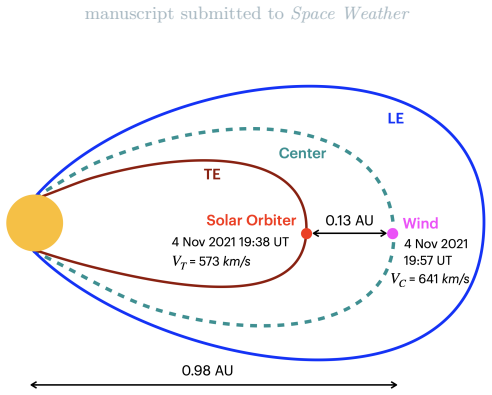
We present a validation of our recently proposed non-conventional method, Constant Acceleration Accounted Perspective (CAAP), for estimating the instantaneous expansion speed of coronal mass ejection (CMEs), even when only single-point in situ observations are available. This validation is enabled by the radial alignment of SolO and Wind spacecraft (0.13 AU radial and 2.3 deg angular separation), providing simultaneous observations of the center (at Wind) and trailing edge (at SolO) of a CME associated magnetic cloud (MC) during 3-5 November 2021, allowing a direct measurement of its instantaneous expansion speed. These measurements are compared with CAAP-derived instantaneous expansion speed estimates at both spacecraft. The favorable spacecraft configuration also enables tracking the temporal evolution of CME substructures, including the shock, sheath, and MC. A discrepancy is noted between the low-inclination MC axis estimated from minimum variance analysis (MVA) and the highly inclined ENW-type MC axis suggested by visual inspection of in situ measurements. We also observe an apparent increase in the magnetic flux within the MC from SolO to Wind, indicating a noticeable deviation from magnetic flux conservation. During the CME's propagation from SolO to Wind, the shock becomes unexpectedly stronger at Wind, while the sheath thickness remains nearly the same, likely due to MC acceleration from back compression by a high-speed stream and ambient solar wind variability. Our results demonstrate the applicability of the CAAP method and the importance of accounting for temporal evolution in CME substructures for space weather studies.
Editorial analysis
A structured set of objections, weighed in public.
Referee Report
Summary. The manuscript validates the Constant Acceleration Accounted Perspective (CAAP) method for estimating instantaneous CME expansion speeds from single-point in-situ data. It uses the radial alignment of Solar Orbiter and Wind (0.13 AU radial, 2.3° angular separation) during the 3-5 November 2021 event to obtain a direct expansion-speed benchmark by comparing Wind (MC center) and SolO (trailing edge) observations of the same magnetic cloud, then compares these to CAAP-derived values at both locations. The work also tracks evolution of the shock, sheath, and MC substructures, reports a low-inclination MVA axis versus highly inclined ENW-type visual axis, an apparent magnetic-flux increase between spacecraft, and unexpected shock strengthening at Wind.
Significance. If the sampling-equivalence assumption holds, the result would be useful for space-weather applications because single-spacecraft observations are far more common than radial alignments; the CAAP approach would then supply reliable instantaneous expansion speeds without multi-point data. The manuscript correctly credits the rare geometry for enabling a direct test and emphasizes temporal evolution of substructures. However, the noted MVA-visual axis discrepancy and flux increase already signal possible azimuthal or structural mismatch, which would reduce the independence of the benchmark and limit the strength of the validation claim.
major comments (2)
- Abstract and validation section: The direct expansion-speed benchmark rests on the premise that Wind samples near the MC axis while SolO samples the trailing edge of the identical structure. With only 2.3° angular separation, the reported low-inclination MVA axis at both locations versus the highly inclined ENW-type structure by eye, and the apparent magnetic-flux increase from SolO to Wind, the radial separation may not map cleanly to radial thickness change; this assumption is load-bearing for the claim that CAAP matches an independent measurement and requires quantitative justification (e.g., via flux-rope fitting or additional positional constraints).
- Abstract: The observed increase in magnetic flux between SolO and Wind is presented as a deviation from conservation, yet its magnitude, uncertainty, and possible effect on the MC boundary identification or expansion-speed comparison are not quantified; if the spacecraft are not traversing equivalent flux surfaces, both the direct benchmark and the CAAP comparison lose reliability.
minor comments (1)
- Abstract: Error propagation for both the CAAP estimates and the direct velocity/position differencing is not described; data-selection criteria for the event and the precise method used to quantify the axis-orientation discrepancy and flux increase should be added for reproducibility.
Simulated Author's Rebuttal
We thank the referee for their thorough review and valuable feedback on our manuscript. We have carefully considered the major comments concerning the assumptions underlying our validation of the CAAP method and the quantification of the magnetic flux increase. Below, we provide point-by-point responses and indicate the revisions we will make to address these concerns.
read point-by-point responses
-
Referee: Abstract and validation section: The direct expansion-speed benchmark rests on the premise that Wind samples near the MC axis while SolO samples the trailing edge of the identical structure. With only 2.3° angular separation, the reported low-inclination MVA axis at both locations versus the highly inclined ENW-type structure by eye, and the apparent magnetic-flux increase from SolO to Wind, the radial separation may not map cleanly to radial thickness change; this assumption is load-bearing for the claim that CAAP matches an independent measurement and requires quantitative justification (e.g., via flux-rope fitting or additional positional constraints).
Authors: We agree that the validation depends on the spacecraft sampling equivalent parts of the same MC structure. The small angular separation of 2.3 degrees supports the assumption that differences are primarily radial, allowing a direct measure of expansion. The manuscript explicitly discusses the MVA axis discrepancy and the flux increase as noteworthy observations. To provide the requested quantitative justification, we will add results from flux-rope fitting to better determine the spacecraft's position relative to the MC axis and evaluate the mapping of radial separation to thickness change. This will enhance the robustness of our benchmark without changing the main conclusions. revision: yes
-
Referee: Abstract: The observed increase in magnetic flux between SolO and Wind is presented as a deviation from conservation, yet its magnitude, uncertainty, and possible effect on the MC boundary identification or expansion-speed comparison are not quantified; if the spacecraft are not traversing equivalent flux surfaces, both the direct benchmark and the CAAP comparison lose reliability.
Authors: The flux increase is presented as an apparent deviation from conservation, which we attribute to possible non-equivalent sampling or evolution. We acknowledge that its magnitude, uncertainty, and implications for boundary identification and speed comparison were not fully quantified in the original submission. In the revised manuscript, we will include specific flux calculations with uncertainties at both locations and analyze their potential impact on the expansion speed estimates and CAAP validation. This will help assess the reliability of the comparisons. revision: yes
Circularity Check
No circularity: validation rests on independent two-spacecraft observations.
full rationale
The paper applies the previously proposed CAAP method to single-spacecraft data at each location and compares the resulting expansion-speed estimates against a direct differencing of radial velocities (or positions) obtained from the radially aligned SolO-Wind pair. This comparison is enabled by external in-situ measurements whose acquisition and reduction are independent of the CAAP equations; the paper does not fit any CAAP parameter to the two-spacecraft data nor redefine the direct benchmark in terms of CAAP outputs. Self-citation to the original CAAP derivation exists but is not load-bearing for the validation claim, which stands or falls on the stated assumptions about spacecraft placement within the MC rather than on any internal re-derivation.
Axiom & Free-Parameter Ledger
axioms (2)
- domain assumption CME magnetic clouds can be treated as structures with definable center and trailing edge whose expansion follows a constant acceleration profile in the CAAP framework
- domain assumption Minimum variance analysis and visual inspection reliably determine magnetic cloud axis orientation and boundaries
Lean theorems connected to this paper
-
IndisputableMonolith/Cost/FunctionalEquation.leanwashburn_uniqueness_aczel unclear?
unclearRelation between the paper passage and the cited Recognition theorem.
We validate our proposed constant acceleration accounted perspective (CAAP) method for estimating the instantaneous expansion speed of CMEs... radial size... using the trapezoidal rule... MVA technique
-
IndisputableMonolith/Foundation/RealityFromDistinction.leanreality_from_one_distinction unclear?
unclearRelation between the paper passage and the cited Recognition theorem.
The instantaneous expansion speed... Vexpinst(t′2∼t3)=VCWind(t′2)−VTSolO(t3)
What do these tags mean?
- matches
- The paper's claim is directly supported by a theorem in the formal canon.
- supports
- The theorem supports part of the paper's argument, but the paper may add assumptions or extra steps.
- extends
- The paper goes beyond the formal theorem; the theorem is a base layer rather than the whole result.
- uses
- The paper appears to rely on the theorem as machinery.
- contradicts
- The paper's claim conflicts with a theorem or certificate in the canon.
- unclear
- Pith found a possible connection, but the passage is too broad, indirect, or ambiguous to say the theorem truly supports the claim.
Reference graph
Works this paper leans on
-
[1]
Agarwal2024 APACrefauthors Agarwal, A. \ Mishra, W. APACrefauthors \ 2024 10 . Non-conventional approach for deriving the radial sizes of coronal mass ejections at different instances: discrepancies in the estimates between remote and in situ observations Non-conventional approach for deriving the radial sizes of coronal mass ejections at different instan...
-
[2]
Agarwal2025 APACrefauthors Agarwal , A. \ Mishra , W. APACrefauthors \ 2025 04 . Disparities in Magnetic Cloud Observations between Two Spacecraft Having Small Radial and Angular Separations near 1 au Disparities in Magnetic Cloud Observations between Two Spacecraft Having Small Radial and Angular Separations near 1 au . 982 2 183 . APACrefDOI doi:10.3847...
-
[3]
Amerstorfer2021 APACrefauthors Amerstorfer , T. , Hinterreiter , J. , Reiss , M A. , M \"o stl , C. , Davies , J A. , Bailey , R L. Harrison , R A. APACrefauthors \ 2021 01 . Evaluation of CME Arrival Prediction Using Ensemble Modeling Based on Heliospheric Imaging Observations Evaluation of CME Arrival Prediction Using Ensemble Modeling Based on Heliosph...
-
[4]
Barnard2022 APACrefauthors Barnard , L. \ Owens , M. APACrefauthors \ 2022 10 . HUXt An open source, computationally efficient reduced-physics solar wind model, written in Python HUXt An open source, computationally efficient reduced-physics solar wind model, written in Python . Frontiers in Physics 10 1005621 . APACrefDOI doi:10.3389/fphy.2022.1005621 APACrefDOI
-
[5]
Borovsky2016 APACrefauthors Borovsky , J E. APACrefauthors \ 2016 06 . The plasma structure of coronal hole solar wind: Origins and evolution The plasma structure of coronal hole solar wind: Origins and evolution . Journal of Geophysical Research (Space Physics) 121 6 5055-5087 . APACrefDOI doi:10.1002/2016JA022686 APACrefDOI
-
[6]
Bothmer1994 APACrefauthors Bothmer , V. \ Schwenn , R. APACrefauthors \ 1994 10 . Eruptive prominences as sources of magnetic clouds in the solar wind Eruptive prominences as sources of magnetic clouds in the solar wind . 70 1-2 215-220 . APACrefDOI doi:10.1007/BF00777872 APACrefDOI
-
[7]
1998, 16, 1, doi: 10.1007/s00585-997-0001-x ˇCalogovi´ c, J., Dumbovi´ c, M., Sudar, D., et al
Bothmer1998 APACrefauthors Bothmer , V. \ Schwenn , R. APACrefauthors \ 1998 01 . The structure and origin of magnetic clouds in the solar wind The structure and origin of magnetic clouds in the solar wind . Annales Geophysicae 16 1 1-24 . APACrefDOI doi:10.1007/s00585-997-0001-x APACrefDOI
-
[8]
F., Sittler, E., Mariani, F., & Schwenn, R
Burlaga1981 APACrefauthors Burlaga , L. , Sittler , E. , Mariani , F. \ Schwenn , R. APACrefauthors \ 1981 08 . Magnetic loop behind an interplanetary shock: Voyager, Helios, and IMP 8 observations Magnetic loop behind an interplanetary shock: Voyager, Helios, and IMP 8 observations . 86 A8 6673-6684 . APACrefDOI doi:10.1029/JA086iA08p06673 APACrefDOI
-
[9]
Chi2023 APACrefauthors Chi , Y. , Shen , C. , Liu , J. , Zhong , Z. , Owens , M. , Scott , C. Lockwood , M. APACrefauthors \ 2023 07 . The Dynamic Evolution of Multipoint Interplanetary Coronal Mass Ejections Observed with BepiColombo, Tianwen-1, and MAVEN The Dynamic Evolution of Multipoint Interplanetary Coronal Mass Ejections Observed with BepiColombo,...
-
[10]
Chi2016 APACrefauthors Chi , Y. , Shen , C. , Wang , Y. , Xu , M. , Ye , P. \ Wang , S. APACrefauthors \ 2016 10 . Statistical Study of the Interplanetary Coronal Mass Ejections from 1995 to 2015 Statistical Study of the Interplanetary Coronal Mass Ejections from 1995 to 2015 . 291 8 2419-2439 . APACrefDOI doi:10.1007/s11207-016-0971-5 APACrefDOI
-
[11]
Chi2024 APACrefauthors Chi , Y. , Shen , C. , Zhang , Z. , Xu , M. , Mao , D. , Liu , J. Wang , Y. APACrefauthors \ 2024 11 . Direct Observations of a Shock Traversing Preceding Two Coronal Mass Ejections: Insights from Solar Orbiter, Wind, and STEREO Observations Direct Observations of a Shock Traversing Preceding Two Coronal Mass Ejections: Insights fro...
-
[12]
Crooker1996 APACrefauthors Crooker , N U. \ Intriligator , D S. APACrefauthors \ 1996 11 . A magnetic cloud as a distended flux rope occlusion in the heliospheric current sheet A magnetic cloud as a distended flux rope occlusion in the heliospheric current sheet . 101 A11 24343-24348 . APACrefDOI doi:10.1029/96JA02129 APACrefDOI
-
[13]
Dasso2006 APACrefauthors Dasso , S. , Mandrini , C H. , D \'e moulin , P. \ Luoni , M L. APACrefauthors \ 2006 08 . A new model-independent method to compute magnetic helicity in magnetic clouds A new model-independent method to compute magnetic helicity in magnetic clouds . 455 1 349-359 . APACrefDOI doi:10.1051/0004-6361:20064806 APACrefDOI
-
[14]
EmmaDavies2020 APACrefauthors Davies , E E. , Forsyth , R J. , Good , S W. \ Kilpua , E K J. APACrefauthors \ 2020 11 . On the Radial and Longitudinal Variation of a Magnetic Cloud: ACE, Wind, ARTEMIS and Juno Observations On the Radial and Longitudinal Variation of a Magnetic Cloud: ACE, Wind, ARTEMIS and Juno Observations . 295 11 157 . APACrefDOI doi:1...
-
[15]
EmmaDavies2021 APACrefauthors Davies , E E. , Forsyth , R J. , Winslow , R M. , M \"o stl , C. \ Lugaz , N. APACrefauthors \ 2021 12 . A Catalog of Interplanetary Coronal Mass Ejections Observed by Juno between 1 and 5.4 au A Catalog of Interplanetary Coronal Mass Ejections Observed by Juno between 1 and 5.4 au . 923 2 136 . APACrefDOI doi:10.3847/1538-43...
-
[16]
EmmaDavies2021a APACrefauthors Davies , E E. , M \"o stl , C. , Owens , M J. , Weiss , A J. , Amerstorfer , T. , Hinterreiter , J. Harrison , R A. APACrefauthors \ 2021 12 . In situ multi-spacecraft and remote imaging observations of the first CME detected by Solar Orbiter and BepiColombo In situ multi-spacecraft and remote imaging observations of the fir...
-
[17]
Demoulin2009 APACrefauthors D \'e moulin , P. \ Dasso , S. APACrefauthors \ 2009 05 . Causes and consequences of magnetic cloud expansion Causes and consequences of magnetic cloud expansion . 498 2 551-566 . APACrefDOI doi:10.1051/0004-6361/200810971 APACrefDOI
-
[18]
Demoulin2020 APACrefauthors D \'e moulin , P. , Dasso , S. , Lanabere , V. \ Janvier , M. APACrefauthors \ 2020 07 . Contribution of the ageing effect to the observed asymmetry of interplanetary magnetic clouds Contribution of the ageing effect to the observed asymmetry of interplanetary magnetic clouds . 639 A6 . APACrefDOI doi:10.1051/0004-6361/20203807...
-
[19]
Dumbovic2018 APACrefauthors Dumbovi \'c , M. , Heber , B. , Vr s nak , B. , Temmer , M. \ Kirin , A. APACrefauthors \ 2018 06 . An Analytical Diffusion-Expansion Model for Forbush Decreases Caused by Flux Ropes An Analytical Diffusion-Expansion Model for Forbush Decreases Caused by Flux Ropes . 860 1 71 . APACrefDOI doi:10.3847/1538-4357/aac2de APACrefDOI
-
[20]
Good2015 APACrefauthors Good , S W. , Forsyth , R J. , Raines , J M. , Gershman , D J. , Slavin , J A. \ Zurbuchen , T H. APACrefauthors \ 2015 07 . Radial Evolution of a Magnetic Cloud: MESSENGER, STEREO, and Venus Express Observations Radial Evolution of a Magnetic Cloud: MESSENGER, STEREO, and Venus Express Observations . 807 2 177 . APACrefDOI doi:10....
-
[21]
Gopalswamy2006 APACrefauthors Gopalswamy , N. APACrefauthors \ 2006 06 . Properties of Interplanetary Coronal Mass Ejections Properties of Interplanetary Coronal Mass Ejections . 124 1-4 145-168 . APACrefDOI doi:10.1007/s11214-006-9102-1 APACrefDOI
-
[22]
2009, Journal of Geophysical Research (Space Physics), 114, A00A22, doi: 10.1029/2008JA013686
Gopalswamy2009a APACrefauthors Gopalswamy , N. , M \"a kel \"a , P. , Xie , H. , Akiyama , S. \ Yashiro , S. APACrefauthors \ 2009 03 . CME interactions with coronal holes and their interplanetary consequences CME interactions with coronal holes and their interplanetary consequences . Journal of Geophysical Research (Space Physics) 114 A3 A00A22 . APACref...
-
[23]
Gopalswamy2015 APACrefauthors Gopalswamy , N. , Yashiro , S. , Xie , H. , Akiyama , S. \ M \"a kel \"a , P. APACrefauthors \ 2015 11 . Properties and geoeffectiveness of magnetic clouds during solar cycles 23 and 24 Properties and geoeffectiveness of magnetic clouds during solar cycles 23 and 24 . Journal of Geophysical Research (Space Physics) 120 11 922...
-
[24]
Gosling1990 APACrefauthors Gosling , J T. APACrefauthors \ 1990 01 . Coronal mass ejections and magnetic flux ropes in interplanetary space Coronal mass ejections and magnetic flux ropes in interplanetary space . Geophysical Monograph Series 58 343-364 . APACrefDOI doi:10.1029/GM058p0343 APACrefDOI
-
[25]
Gosling2005 APACrefauthors Gosling , J T. , Skoug , R M. , McComas , D J. \ Smith , C W. APACrefauthors \ 2005 01 . Direct evidence for magnetic reconnection in the solar wind near 1 AU Direct evidence for magnetic reconnection in the solar wind near 1 AU . Journal of Geophysical Research (Space Physics) 110 A1 A01107 . APACrefDOI doi:10.1029/2004JA010809...
-
[26]
Grandin2019 APACrefauthors Grandin , M. , Aikio , A T. \ Kozlovsky , A. APACrefauthors \ 2019 06 . Properties and Geoeffectiveness of Solar Wind High-Speed Streams and Stream Interaction Regions During Solar Cycles 23 and 24 Properties and Geoeffectiveness of Solar Wind High-Speed Streams and Stream Interaction Regions During Solar Cycles 23 and 24 . Jour...
-
[27]
Gulisano2010 APACrefauthors Gulisano , A M. , D \'e moulin , P. , Dasso , S. , Ruiz , M E. \ Marsch , E. APACrefauthors \ 2010 01 . Global and local expansion of magnetic clouds in the inner heliosphere Global and local expansion of magnetic clouds in the inner heliosphere . 509 A39 . APACrefDOI doi:10.1051/0004-6361/200912375 APACrefDOI
-
[28]
Harrison2018 APACrefauthors Harrison , R A. , Davies , J A. , Barnes , D. , Byrne , J P. , Perry , C H. , Bothmer , V. Odstr c il , D. APACrefauthors \ 2018 05 . CMEs in the Heliosphere: I. A Statistical Analysis of the Observational Properties of CMEs Detected in the Heliosphere from 2007 to 2017 by STEREO/HI-1 CMEs in the Heliosphere: I. A Statistical A...
-
[29]
S., O’Brien, H., Carrasco Blazquez, I., et al
Horbury2020 APACrefauthors Horbury , T S. , O'Brien , H. , Carrasco Blazquez , I. , Bendyk , M. , Brown , P. , Hudson , R. Walsh , A P. APACrefauthors \ 2020 10 . The Solar Orbiter magnetometer The Solar Orbiter magnetometer . 642 A9 . APACrefDOI doi:10.1051/0004-6361/201937257 APACrefDOI
-
[30]
Hsieh1986 APACrefauthors Hsieh , K C. \ Richter , A K. APACrefauthors \ 1986 04 . The importance of being earnest about shock fitting The importance of being earnest about shock fitting . 91 4157-4162 . APACrefDOI doi:10.1029/JA091iA04p04157 APACrefDOI
-
[31]
Huttunen2004 APACrefauthors Huttunen , K. \ Koskinen , H. APACrefauthors \ 2004 05 . Importance of post-shock streams and sheath region as drivers of intense magnetospheric storms and high-latitude activity Importance of post-shock streams and sheath region as drivers of intense magnetospheric storms and high-latitude activity . Annales Geophysicae 22 5 1...
-
[32]
Huttunen2002 APACrefauthors Huttunen , K E J. , Koskinen , H E J. \ Schwenn , R. APACrefauthors \ 2002 07 . Variability of magnetospheric storms driven by different solar wind perturbations Variability of magnetospheric storms driven by different solar wind perturbations . Journal of Geophysical Research (Space Physics) 107 A7 1121 . APACrefDOI doi:10.102...
-
[33]
Janvier2019 APACrefauthors Janvier , M. , Winslow , R M. , Good , S. , Bonhomme , E. , D \'e moulin , P. , Dasso , S. Boakes , P D. APACrefauthors \ 2019 02 . Generic Magnetic Field Intensity Profiles of Interplanetary Coronal Mass Ejections at Mercury, Venus, and Earth From Superposed Epoch Analyses Generic Magnetic Field Intensity Profiles of Interplane...
-
[34]
Khuntia2025 APACrefauthors Khuntia , S. , Mishra , W. \ Agarwal , A. APACrefauthors \ 2025 06 . Evolution of the interacting coronal mass ejections that drove the great geomagnetic storm of 10 May 2024 Evolution of the interacting coronal mass ejections that drove the great geomagnetic storm of 10 May 2024 . 698 A79 . APACrefDOI doi:10.1051/0004-6361/2024...
-
[35]
Khuntia2023 APACrefauthors Khuntia , S. , Mishra , W. , Mishra , S K. , Wang , Y. , Zhang , J. \ Lyu , S. APACrefauthors \ 2023 11 . Unraveling the Thermodynamic Enigma between Fast and Slow Coronal Mass Ejections Unraveling the Thermodynamic Enigma between Fast and Slow Coronal Mass Ejections . 958 1 92 . APACrefDOI doi:10.3847/1538-4357/ad00ba APACrefDOI
-
[36]
Kilpua2021 APACrefauthors Kilpua , E K J. , Good , S W. , Dresing , N. , Vainio , R. , Davies , E E. , Forsyth , R J. Wimmer-Schweingruber , R. APACrefauthors \ 2021 12 . Multi-spacecraft observations of the structure of the sheath of an interplanetary coronal mass ejection and related energetic ion enhancement Multi-spacecraft observations of the structu...
-
[37]
In: 2019 IEEE International Conference on Software Maintenance and Evolution (ICSME)
Kilpua2019 APACrefauthors Kilpua , E K J. , Good , S W. , Palmerio , E. , Asvestari , E. , Lumme , E. , Ala-Lahti , M. Futaana , Y. APACrefauthors \ 2019 07 . Multipoint Observations of the June 2012 Interacting Interplanetary Flux Ropes Multipoint Observations of the June 2012 Interacting Interplanetary Flux Ropes . Frontiers in Astronomy and Space Scien...
-
[38]
Kilpua2011 APACrefauthors Kilpua , E K J. , Jian , L K. , Li , Y. , Luhmann , J G. \ Russell , C T. APACrefauthors \ 2011 06 . Multipoint ICME encounters: Pre-STEREO and STEREO observations Multipoint ICME encounters: Pre-STEREO and STEREO observations . Journal of Atmospheric and Solar-Terrestrial Physics 73 10 1228-1241 . APACrefDOI doi:10.1016/j.jastp....
-
[39]
Kilpua2015 APACrefauthors Kilpua , E K J. , Lumme , E. , Andreeova , K. , Isavnin , A. \ Koskinen , H E J. APACrefauthors \ 2015 06 . Properties and drivers of fast interplanetary shocks near the orbit of the Earth (1995-2013) Properties and drivers of fast interplanetary shocks near the orbit of the Earth (1995-2013) . Journal of Geophysical Research (Sp...
-
[40]
Leitner2007 APACrefauthors Leitner , M. , Farrugia , C J. , M \"o stl , C. , Ogilvie , K W. , Galvin , A B. , Schwenn , R. \ Biernat , H K. APACrefauthors \ 2007 06 . Consequences of the force-free model of magnetic clouds for their heliospheric evolution Consequences of the force-free model of magnetic clouds for their heliospheric evolution . Journal of...
-
[41]
Lepping1995 APACrefauthors Lepping , R P. , Ac \ u na , M H. , Burlaga , L F. , Farrell , W M. , Slavin , J A. , Schatten , K H. Worley , E M. APACrefauthors \ 1995 02 . The Wind Magnetic Field Investigation The Wind Magnetic Field Investigation . 71 1-4 207-229 . APACrefDOI doi:10.1007/BF00751330 APACrefDOI
-
[42]
Lepping1980 APACrefauthors Lepping , R P. \ Behannon , K W. APACrefauthors \ 1980 09 . Magnetic field directional discontinuities: 1. Minimum variance errors Magnetic field directional discontinuities: 1. Minimum variance errors . 85 A9 4695-4704 . APACrefDOI doi:10.1029/JA085iA09p04695 APACrefDOI
-
[43]
Lepping2006 APACrefauthors Lepping , R P. , Berdichevsky , D B. , Wu , C C. , Szabo , A. , Narock , T. , Mariani , F. Quivers , A J. APACrefauthors \ 2006 03 . A summary of WIND magnetic clouds for years 1995-2003: model-fitted parameters, associated errors and classifications A summary of WIND magnetic clouds for years 1995-2003: model-fitted parameters,...
-
[44]
Li2022 APACrefauthors Li, X. , Wang, Y. , Guo, J. \ Lyu, S. APACrefauthors \ 2022 mar . Solar Energetic Particles Produced during Two Fast Coronal Mass Ejections Solar energetic particles produced during two fast coronal mass ejections . The Astrophysical Journal Letters 928 1 L6 . APACrefURL https://dx.doi.org/10.3847/2041-8213/ac5b72 APACrefURL APACrefD...
-
[45]
Lin1995 APACrefauthors Lin , R P. , Anderson , K A. , Ashford , S. , Carlson , C. , Curtis , D. , Ergun , R. Paschmann , G. APACrefauthors \ 1995 02 . A Three-Dimensional Plasma and Energetic Particle Investigation for the Wind Spacecraft A Three-Dimensional Plasma and Energetic Particle Investigation for the Wind Spacecraft . 71 1-4 125-153 . APACrefDOI ...
-
[46]
Liu2008 APACrefauthors Liu , Y. , Luhmann , J G. , Huttunen , K E J. , Lin , R P. , Bale , S D. , Russell , C T. \ Galvin , A B. APACrefauthors \ 2008 04 . Reconstruction of the 2007 May 22 Magnetic Cloud: How Much Can We Trust the Flux-Rope Geometry of CMEs? Reconstruction of the 2007 May 22 Magnetic Cloud: How Much Can We Trust the Flux-Rope Geometry of...
-
[47]
Liu2005 APACrefauthors Liu , Y. , Richardson , J D. \ Belcher , J W. APACrefauthors \ 2005 01 . A statistical study of the properties of interplanetary coronal mass ejections from 0.3 to 5.4 AU A statistical study of the properties of interplanetary coronal mass ejections from 0.3 to 5.4 AU . 53 1-3 3-17 . APACrefDOI doi:10.1016/j.pss.2004.09.023 APACrefDOI
-
[48]
Liu2006 APACrefauthors Liu , Y. , Richardson , J D. , Belcher , J W. , Kasper , J C. \ Elliott , H A. APACrefauthors \ 2006 01 . Thermodynamic structure of collision-dominated expanding plasma: Heating of interplanetary coronal mass ejections Thermodynamic structure of collision-dominated expanding plasma: Heating of interplanetary coronal mass ejections ...
-
[49]
Lugaz2018 APACrefauthors Lugaz , N. , Farrugia , C J. , Winslow , R M. , Al-Haddad , N. , Galvin , A B. , Nieves-Chinchilla , T. Janvier , M. APACrefauthors \ 2018 09 . On the Spatial Coherence of Magnetic Ejecta: Measurements of Coronal Mass Ejections by Multiple Spacecraft Longitudinally Separated by 0.01 au On the Spatial Coherence of Magnetic Ejecta: ...
-
[50]
Lugaz2017 APACrefauthors Lugaz , N. , Farrugia , C J. , Winslow , R M. , Small , C R. , Manion , T. \ Savani , N P. APACrefauthors \ 2017 10 . Importance of CME Radial Expansion on the Ability of Slow CMEs to Drive Shocks Importance of CME Radial Expansion on the Ability of Slow CMEs to Drive Shocks . 848 2 75 . APACrefDOI doi:10.3847/1538-4357/aa8ef9 APACrefDOI
-
[51]
Lugaz2020a APACrefauthors Lugaz , N. , Salman , T M. , Winslow , R M. , Al-Haddad , N. , Farrugia , C J. , Zhuang , B. \ Galvin , A B. APACrefauthors \ 2020 08 . Inconsistencies Between Local and Global Measures of CME Radial Expansion as Revealed by Spacecraft Conjunctions Inconsistencies Between Local and Global Measures of CME Radial Expansion as Revea...
-
[52]
Lugaz2022 APACrefauthors Lugaz , N. , Salman , T M. , Zhuang , B. , Al-Haddad , N. , Scolini , C. , Farrugia , C J. Galvin , A B. APACrefauthors \ 2022 04 . A Coronal Mass Ejection and Magnetic Ejecta Observed In Situ by STEREO-A and Wind at 55 Angular Separation A Coronal Mass Ejection and Magnetic Ejecta Observed In Situ by STEREO-A and Wind at 55 Angul...
-
[53]
Lugaz2020 APACrefauthors Lugaz , N. , Winslow , R M. \ Farrugia , C J. APACrefauthors \ 2020 01 . Evolution of a Long-Duration Coronal Mass Ejection and Its Sheath Region Between Mercury and Earth on 9-14 July 2013 Evolution of a Long-Duration Coronal Mass Ejection and Its Sheath Region Between Mercury and Earth on 9-14 July 2013 . Journal of Geophysical ...
-
[54]
Manchester2014 APACrefauthors Manchester , W B., IV , van der Holst , B. \ Lavraud , B. APACrefauthors \ 2014 06 . Flux rope evolution in interplanetary coronal mass ejections: the 13 May 2005 event Flux rope evolution in interplanetary coronal mass ejections: the 13 May 2005 event . Plasma Physics and Controlled Fusion 56 6 064006 . APACrefDOI doi:10.108...
-
[55]
Mayank2024 APACrefauthors Mayank , P. , Vaidya , B. , Mishra , W. \ Chakrabarty , D. APACrefauthors \ 2024 01 . SWASTi-CME: A Physics-based Model to Study Coronal Mass Ejection Evolution and Its Interaction with Solar Wind SWASTi-CME: A Physics-based Model to Study Coronal Mass Ejection Evolution and Its Interaction with Solar Wind . 270 1 10 . APACrefDOI...
-
[56]
Mishra2021 APACrefauthors Mishra , W. , Dave , K. , Srivastava , N. \ Teriaca , L. APACrefauthors \ 2021 09 . Multipoint remote and in situ observations of interplanetary coronal mass ejection structures during 2011 and associated geomagnetic storms Multipoint remote and in situ observations of interplanetary coronal mass ejection structures during 2011 a...
-
[57]
Mishra2021a APACrefauthors Mishra , W. , Doshi , U. \ Srivastava , N. APACrefauthors \ 2021 09 . Radial sizes and expansion behavior of ICMEs in solar cycles 23 and 24 Radial sizes and expansion behavior of ICMEs in solar cycles 23 and 24 . Frontiers in Astronomy and Space Sciences 8 142 . APACrefDOI doi:10.3389/fspas.2021.713999 APACrefDOI
-
[58]
Mishra2013 APACrefauthors Mishra , W. \ Srivastava , N. APACrefauthors \ 2013 07 . Estimating the Arrival Time of Earth-directed Coronal Mass Ejections at in Situ Spacecraft Using COR and HI Observations from STEREO Estimating the Arrival Time of Earth-directed Coronal Mass Ejections at in Situ Spacecraft Using COR and HI Observations from STEREO . 772 1 ...
-
[59]
Mishra2014 APACrefauthors Mishra , W. \ Srivastava , N. APACrefauthors \ 2014 10 . Morphological and Kinematic Evolution of Three Interacting Coronal Mass Ejections of 2011 February 13-15 Morphological and Kinematic Evolution of Three Interacting Coronal Mass Ejections of 2011 February 13-15 . 794 1 64 . APACrefDOI doi:10.1088/0004-637X/794/1/64 APACrefDOI
-
[60]
Mishra2015 APACrefauthors Mishra , W. \ Srivastava , N. APACrefauthors \ 2015 07 . Heliospheric tracking of enhanced density structures of the 6 October 2010 CME Heliospheric tracking of enhanced density structures of the 6 October 2010 CME . Journal of Space Weather and Space Climate 5 A20 . APACrefDOI doi:10.1051/swsc/2015021 APACrefDOI
-
[61]
Mishra2015a APACrefauthors Mishra , W. , Srivastava , N. \ Singh , T. APACrefauthors \ 2015 12 . Kinematics of interacting CMEs of 25 and 28 September 2012 Kinematics of interacting CMEs of 25 and 28 September 2012 . Journal of Geophysical Research (Space Physics) 120 12 10,221-10,236 . APACrefDOI doi:10.1002/2015JA021415 APACrefDOI
-
[62]
Mishra2023 APACrefauthors Mishra , W. \ Teriaca , L. APACrefauthors \ 2023 06 . Propagation of coronal mass ejections from the Sun to the Earth Propagation of coronal mass ejections from the Sun to the Earth . Journal of Astrophysics and Astronomy 44 1 20 . APACrefDOI doi:10.1007/s12036-023-09910-6 APACrefDOI
-
[63]
Mishra2018 APACrefauthors Mishra , W. \ Wang , Y. APACrefauthors \ 2018 09 . Modeling the Thermodynamic Evolution of Coronal Mass Ejections Using Their Kinematics Modeling the Thermodynamic Evolution of Coronal Mass Ejections Using Their Kinematics . 865 1 50 . APACrefDOI doi:10.3847/1538-4357/aadb9b APACrefDOI
-
[64]
Mishra2017 APACrefauthors Mishra , W. , Wang , Y. , Srivastava , N. \ Shen , C. APACrefauthors \ 2017 09 . Assessing the Nature of Collisions of Coronal Mass Ejections in the Inner Heliosphere Assessing the Nature of Collisions of Coronal Mass Ejections in the Inner Heliosphere . 232 1 5 . APACrefDOI doi:10.3847/1538-4365/aa8139 APACrefDOI
-
[65]
Mishra2020 APACrefauthors Mishra , W. , Wang , Y. , Teriaca , L. , Zhang , J. \ Chi , Y. APACrefauthors \ 2020 01 . Probing the thermodynamic state of a Coronal Mass Ejection (CME) up to 1 AU Probing the thermodynamic state of a Coronal Mass Ejection (CME) up to 1 AU . Frontiers in Astronomy and Space Sciences 7 1 . APACrefDOI doi:10.3389/fspas.2020.00001...
-
[66]
Mostl2012 APACrefauthors M \"o stl , C. , Farrugia , C J. , Kilpua , E K J. , Jian , L K. , Liu , Y. , Eastwood , J P. Anderson , B J. APACrefauthors \ 2012 10 . Multi-point Shock and Flux Rope Analysis of Multiple Interplanetary Coronal Mass Ejections around 2010 August 1 in the Inner Heliosphere Multi-point Shock and Flux Rope Analysis of Multiple Inter...
-
[67]
Mostl2022 APACrefauthors M \"o stl , C. , Weiss , A J. , Reiss , M A. , Amerstorfer , T. , Bailey , R L. , Hinterreiter , J. Bale , S D. APACrefauthors \ 2022 01 . Multipoint Interplanetary Coronal Mass Ejections Observed with Solar Orbiter, BepiColombo, Parker Solar Probe, Wind, and STEREO-A Multipoint Interplanetary Coronal Mass Ejections Observed with ...
-
[68]
Mulligan1998 APACrefauthors Mulligan , T. , Russell , C T. \ Luhmann , J G. APACrefauthors \ 1998 08 . Solar cycle evolution of the structure of magnetic clouds in the inner heliosphere Solar cycle evolution of the structure of magnetic clouds in the inner heliosphere . 25 15 2959-2962 . APACrefDOI doi:10.1029/98GL01302 APACrefDOI
-
[69]
Neugebauer2013 APACrefauthors Neugebauer , M. APACrefauthors \ 2013 06 . Propagating Shocks Propagating Shocks . 176 1-4 125-132 . APACrefDOI doi:10.1007/s11214-010-9707-2 APACrefDOI
-
[70]
Nieves-Chinchilla2012 APACrefauthors Nieves-Chinchilla , T. , Colaninno , R. , Vourlidas , A. , Szabo , A. , Lepping , R P. , Boardsen , S A. Korth , H. APACrefauthors \ 2012 06 . Remote and in situ observations of an unusual Earth-directed coronal mass ejection from multiple viewpoints Remote and in situ observations of an unusual Earth-directed coronal ...
-
[71]
Nieves-Chinchilla2019 APACrefauthors Nieves-Chinchilla , T. , Jian , L K. , Balmaceda , L. , Vourlidas , A. , dos Santos , L F G. \ Szabo , A. APACrefauthors \ 2019 07 . Unraveling the Internal Magnetic Field Structure of the Earth-directed Interplanetary Coronal Mass Ejections During 1995 - 2015 Unraveling the Internal Magnetic Field Structure of the Ear...
-
[72]
Nieves-Chinchilla2018 APACrefauthors Nieves-Chinchilla , T. , Linton , M G. , Hidalgo , M A. \ Vourlidas , A. APACrefauthors \ 2018 07 . Elliptic-cylindrical Analytical Flux Rope Model for Magnetic Clouds Elliptic-cylindrical Analytical Flux Rope Model for Magnetic Clouds . 861 2 139 . APACrefDOI doi:10.3847/1538-4357/aac951 APACrefDOI
-
[73]
Nieves-Chinchilla2013 APACrefauthors Nieves-Chinchilla , T. , Vourlidas , A. , Stenborg , G. , Savani , N P. , Koval , A. , Szabo , A. \ Jian , L K. APACrefauthors \ 2013 12 . Inner Heliospheric Evolution of a ``Stealth'' CME Derived from Multi-view Imaging and Multipoint in Situ observations. I. Propagation to 1 AU Inner Heliospheric Evolution of a ``Ste...
-
[74]
Odstrcil2003 APACrefauthors Odstrcil , D. APACrefauthors \ 2003 08 . Modeling 3-D solar wind structure Modeling 3-D solar wind structure . Advances in Space Research 32 4 497-506 . APACrefDOI doi:10.1016/S0273-1177(03)00332-6 APACrefDOI
-
[75]
Ogilvie1995 APACrefauthors Ogilvie , K W. , Chornay , D J. , Fritzenreiter , R J. , Hunsaker , F. , Keller , J. , Lobell , J. Gergin , E. APACrefauthors \ 1995 02 . SWE, A Comprehensive Plasma Instrument for the Wind Spacecraft SWE, A Comprehensive Plasma Instrument for the Wind Spacecraft . 71 1-4 55-77 . APACrefDOI doi:10.1007/BF00751326 APACrefDOI
-
[76]
J., Bruno, R., Livi, S., et al
Owen2020 APACrefauthors Owen , C J. , Bruno , R. , Livi , S. , Louarn , P. , Al Janabi , K. , Allegrini , F. Zouganelis , I. APACrefauthors \ 2020 10 . The Solar Orbiter Solar Wind Analyser (SWA) suite The Solar Orbiter Solar Wind Analyser (SWA) suite . 642 A16 . APACrefDOI doi:10.1051/0004-6361/201937259 APACrefDOI
-
[77]
Owens2025 APACrefauthors Owens, M J. , Barnard, L A. , Verbeke, C. , McGinness, B P S. , Turner, H. , Chi, Y. Lockwood, M. APACrefauthors \ 2025 . Implications of Using Spheroidal “Cone Model” CMEs in Solar-Wind Models Implications of using spheroidal “cone model” cmes in solar-wind models . Space Weather 23 6 e2025SW004397 . APACrefURL https://agupubs.on...
-
[78]
Owens2005 APACrefauthors Owens , M J. , Cargill , P J. , Pagel , C. , Siscoe , G L. \ Crooker , N U. APACrefauthors \ 2005 01 . Characteristic magnetic field and speed properties of interplanetary coronal mass ejections and their sheath regions Characteristic magnetic field and speed properties of interplanetary coronal mass ejections and their sheath reg...
-
[79]
Owens2006 APACrefauthors Owens , M J. \ Crooker , N U. APACrefauthors \ 2006 10 . Coronal mass ejections and magnetic flux buildup in the heliosphere Coronal mass ejections and magnetic flux buildup in the heliosphere . Journal of Geophysical Research (Space Physics) 111 A10 A10104 . APACrefDOI doi:10.1029/2006JA011641 APACrefDOI
-
[80]
J., Lockwood, M., & Barnard, L
Owens2017 APACrefauthors Owens , M J. , Lockwood , M. \ Barnard , L A. APACrefauthors \ 2017 06 . Coronal mass ejections are not coherent magnetohydrodynamic structures Coronal mass ejections are not coherent magnetohydrodynamic structures . Scientific Reports 7 4152 . APACrefDOI doi:10.1038/s41598-017-04546-3 APACrefDOI
discussion (0)
Sign in with ORCID, Apple, or X to comment. Anyone can read and Pith papers without signing in.