Wiener and Average Distance of Irregular Square-Cell Configuration
Pith reviewed 2026-05-10 18:06 UTC · model grok-4.3
The pith
Generalized closed-form expressions exist for the Wiener index and average distance of square-cell graphs with irregular boundaries.
A machine-rendered reading of the paper's core claim, the machinery that carries it, and where it could break.
Core claim
The central claim is that the Wiener index and average distance of an irregular square-cell configuration can be expressed in closed form by summing pairwise distances after encoding the boundary irregularities with a finite set of combinatorial parameters; these expressions reduce to the known formulas for hexagonal, trapezium, and bitrapezium configurations when the parameters enforce full symmetry.
What carries the argument
A finite set of parameters that encode combinatorial and structural variations of the irregular boundary, used to construct closed-form summations of all pairwise vertex distances.
If this is right
- The total distance grows differently under boundary perturbations than under perfect symmetry.
- Symmetric configurations appear as the special case in which all irregularity parameters vanish.
- The same summation technique supplies a single computational method for both regular and perturbed lattice subgraphs.
- Average distance can be obtained from the Wiener index by simple division by the number of vertex pairs.
Where Pith is reading between the lines
- The same parametric approach might extend to distance sums in other grid graphs whose faces are not all squares.
- The formulas could be turned into an algorithm that accepts an arbitrary polyomino boundary description and returns its Wiener index without enumerating pairs.
- Comparing the expressions against brute-force distance tables on randomly generated irregular examples would provide a direct numerical test of correctness.
Load-bearing premise
The irregularities along the boundary can be captured completely by a finite collection of parameters that still allow the sum of all pairwise distances to be written in closed form.
What would settle it
Compute the exact Wiener index by enumerating all pairwise distances on a small, explicitly drawn irregular square-cell graph and check whether it equals the value produced by the paper's generalized formula for the same boundary parameters.
Figures
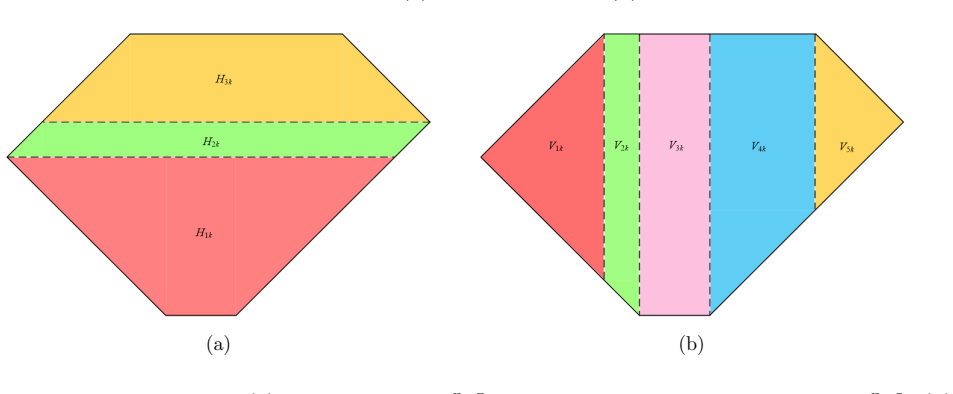
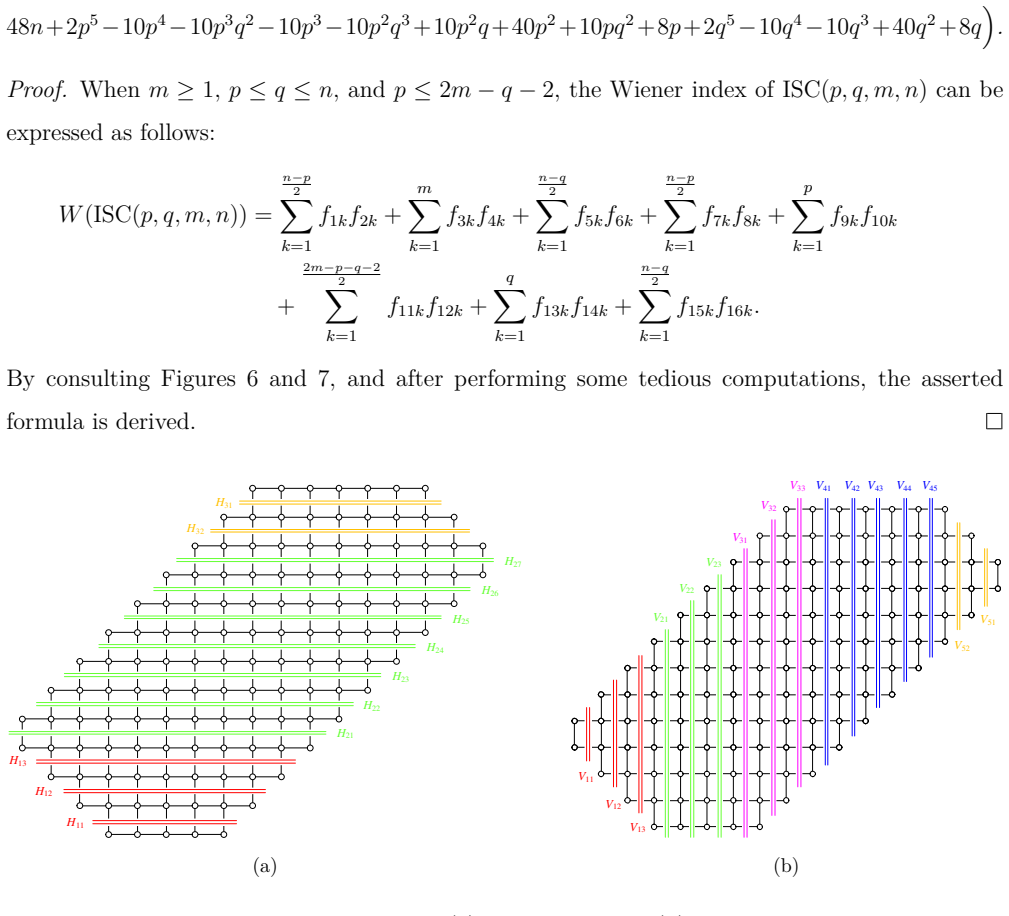
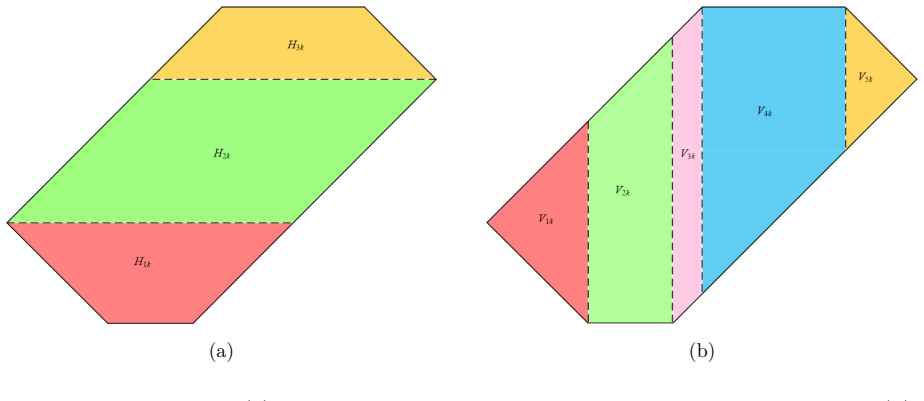
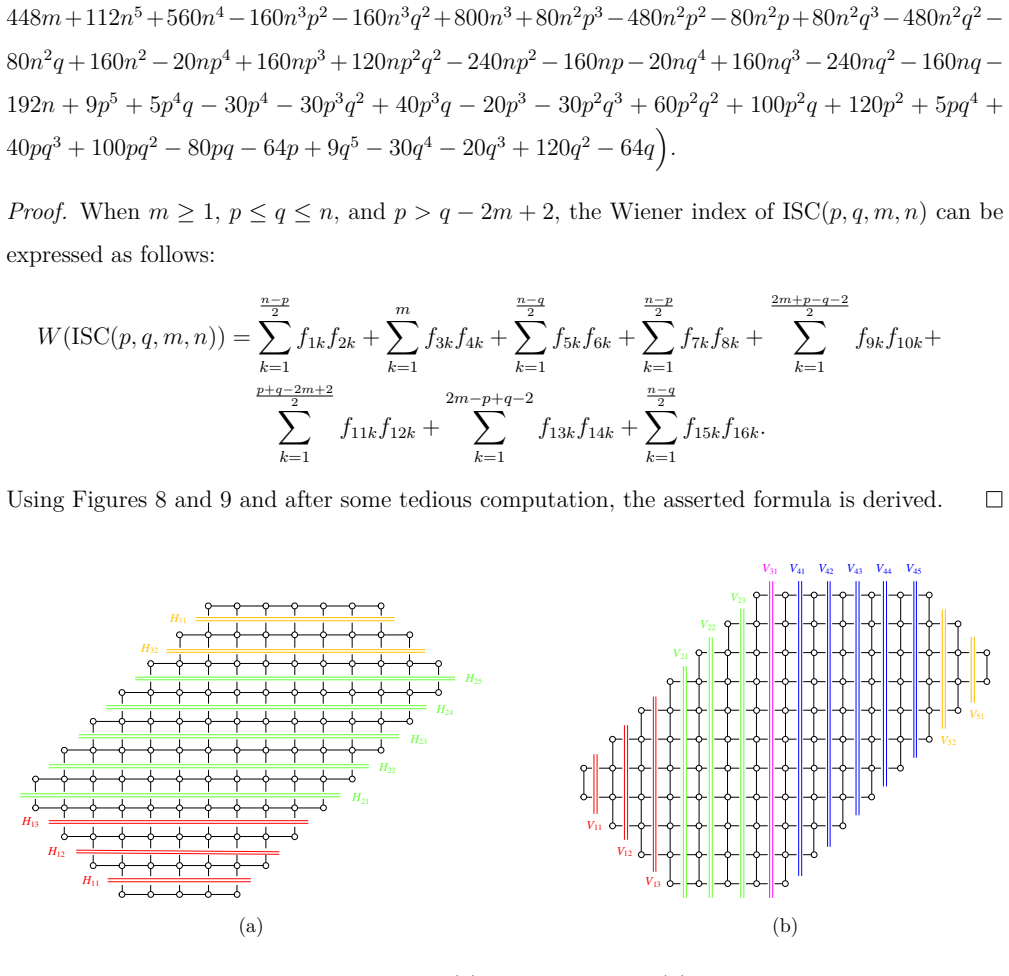
read the original abstract
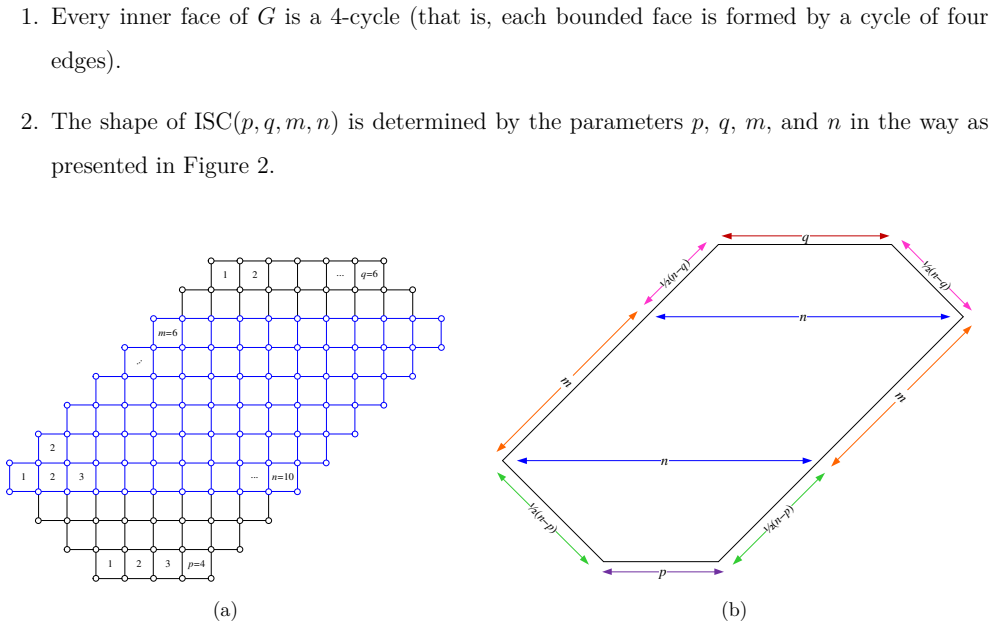
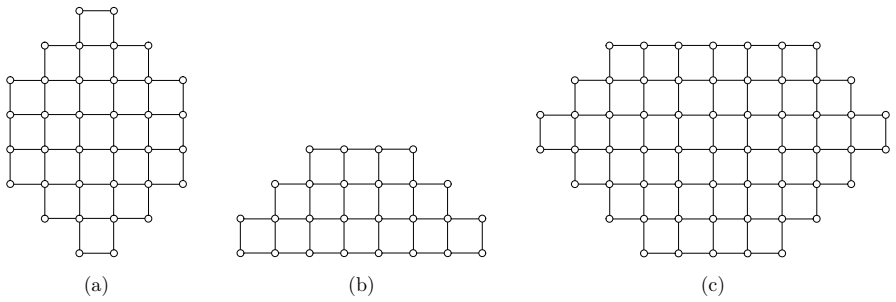
A subgraph of the square lattice with all of its inner faces being 4-cycles is called a square-cell configuration. Prior work has provided explicit expressions for the total and average distances between vertex pairs in symmetric square-cell configurations, including well-structured families such as hexagonal square-cell configurations $H(n)$, trapezium square-cell configurations $T(n,k)$, and bitrapezium square-cell configurations $BT(n,k_1,k_2)$. In this article, we further extend the square-cell configuration from regular boundaries to irregular boundaries, which do not exhibit complete regularity or symmetry in their structure. We find the generalized expressions for the Wiener index and average distance of such irregular configurations, incorporating combinatorial and structural variations. Our results demonstrate how irregularity affects the growth and distribution of pairwise distances and provide a unifying framework that includes both symmetric and asymmetric square-cell graphs as exceptional cases. This generalization provides novel insights into the structural behaviour of square-cell frameworks characterized by complex or perturbed geometries.
Editorial analysis
A structured set of objections, weighed in public.
Referee Report
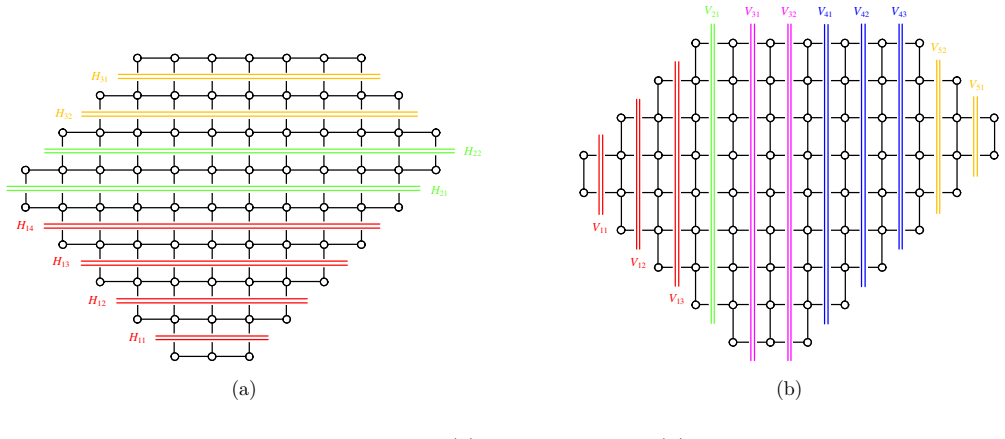
Summary. The paper extends prior explicit formulas for the Wiener index and average distance in symmetric square-cell configurations (hexagonal H(n), trapezium T(n,k), bitrapezium BT(n,k1,k2)) to irregular boundaries. Irregularity is captured by a finite collection of boundary perturbation parameters; the authors derive explicit (lengthy) polynomial expressions for the Wiener index and average distance by summing coordinate-wise distances over the perturbed vertex set, with the symmetric families recovered as special cases.
Significance. If the derivations hold, the work supplies a unifying closed-form framework for distance sums in a wider class of square-cell graphs. This is useful for analytical study of how boundary irregularities affect pairwise distance growth and distribution, and it strengthens the combinatorial toolkit for lattice graphs arising in chemical graph theory.
minor comments (3)
- [§2] §2 (Definitions): the precise algebraic definition of the boundary perturbation parameters (e.g., how each parameter modifies the coordinate ranges of the vertex set) should be stated before the summation formulas are introduced, to make the transition from symmetric to irregular cases fully transparent.
- The lengthy polynomial expressions in the main theorems would benefit from a compact summation notation or a generating-function representation rather than fully expanded monomials, to improve readability while preserving explicitness.
- A short table (or corollary) explicitly recovering the known formulas for H(n), T(n,k) and BT(n,k1,k2) by setting the perturbation parameters to zero would strengthen the claim that the new expressions are genuine generalizations.
Simulated Author's Rebuttal
We thank the referee for the positive assessment of our manuscript and the recommendation for minor revision. The referee's summary correctly identifies the extension from symmetric families (H(n), T(n,k), BT(n,k1,k2)) to irregular square-cell configurations via boundary perturbation parameters, and we appreciate the recognition that the resulting closed-form expressions provide a unifying framework for analyzing distance sums in lattice graphs arising in chemical graph theory.
Circularity Check
No significant circularity; derivations are explicit summations from parameterized graph definitions
full rationale
The paper defines irregular square-cell configurations via a finite collection of boundary perturbation parameters, then computes the Wiener index and average distance through direct, coordinate-wise summation of pairwise distances over the resulting vertex set. The output formulas are explicit (lengthy) polynomials in those parameters together with the usual indices n and k; symmetric families appear simply as special cases when perturbation parameters are set to zero. No step reduces the claimed result to a fitted input, a self-referential definition, or a load-bearing self-citation; the summation steps are self-contained combinatorial derivations that stand independently of the final expressions they produce.
Axiom & Free-Parameter Ledger
axioms (2)
- standard math The square lattice is the infinite grid graph with vertices at integer coordinates and edges between nearest neighbors.
- standard math The Wiener index is the sum of shortest-path distances over all unordered pairs of vertices.
Lean theorems connected to this paper
-
IndisputableMonolith/Foundation/RealityFromDistinction.leanreality_from_one_distinction unclear?
unclearRelation between the paper passage and the cited Recognition theorem.
We find the generalized expressions for the Wiener index and average distance of such irregular configurations, incorporating combinatorial and structural variations... W(ISC(p,q,m,n)) = 1/960 (−32m⁵ + … ) (Theorem 2 and analogous for other cases)
What do these tags mean?
- matches
- The paper's claim is directly supported by a theorem in the formal canon.
- supports
- The theorem supports part of the paper's argument, but the paper may add assumptions or extra steps.
- extends
- The paper goes beyond the formal theorem; the theorem is a base layer rather than the whole result.
- uses
- The paper appears to rely on the theorem as machinery.
- contradicts
- The paper's claim conflicts with a theorem or certificate in the canon.
- unclear
- Pith found a possible connection, but the passage is too broad, indirect, or ambiguous to say the theorem truly supports the claim.
Reference graph
Works this paper leans on
- [1]
-
[2]
Wiener, Structural determination of paraffin boiling points, J
H. Wiener, Structural determination of paraffin boiling points, J. Amer. Chem. Soc. 69 (1947) 17–20
work page 1947
-
[3]
Dankelmann, Computing the average distance of an interval graph, Inform
P. Dankelmann, Computing the average distance of an interval graph, Inform. Proc. Lett. 48 (1993) 311–314
work page 1993
-
[4]
J.K. Doyle, J.E. Graver, Mean distance in a graph, Discrete Math. 17 (1977) 147–154
work page 1977
-
[5]
S. Prabhu, D.S.R. Jeba, M. Arulperumjothi, S. Klavžar, Metric dimension of irregular convex triangular networks, AKCE Int. J. Graphs Combin. 21 (2024) 225–231
work page 2024
-
[6]
V. Gayathri, R. Muthucumaraswamy, S. Prabhu, M.R. Farahani, Omega, theta, PI, Sad- hana polynomials, and subsequent indices of convex benzenoid system, Comp. Theor. Chem. 1203 (2021) 113310
work page 2021
-
[7]
M. Arockiaraj, J. Clement, K. Balasubramanian, Analytical expressions for topological properties of polycyclic benzenoid networks, J. Chemometrics 30 (2016) 682–697
work page 2016
-
[8]
Plesník, On the sum of all distances in a graph or digraph, J
J. Plesník, On the sum of all distances in a graph or digraph, J. Graph Theory 8 (1984) 1–21
work page 1984
-
[9]
Chung, The average distance and the independence number, J
F.R.K. Chung, The average distance and the independence number, J. Graph Theory 12 (1988) 229–235
work page 1988
-
[10]
Althöfer, A verage distances in undirected graphs and the removal of vertices, J
I. Althöfer, A verage distances in undirected graphs and the removal of vertices, J. Combin. Theory Ser. B 48 (1990) 140–142
work page 1990
-
[11]
W.K. Chiang, R.J. Chen, Topological properties of the (n, k)-star graph, Int. J. Found. Comput. Sci. 9 (1998) 235–248
work page 1998
-
[12]
W.K. Chiang, R.J. Chen, On the arrangement graph, Inform. Process. Lett. 66 (1998) 215–219
work page 1998
-
[13]
P. Dankelmann, W. Goddard, P. Slater, A verage distance in colored graphs, J. Graph Theory 38 (2001) 1–17
work page 2001
- [14]
-
[15]
Dankelmann, A verage distance in weighted graphs, Discrete Math
P. Dankelmann, A verage distance in weighted graphs, Discrete Math. 312 (2012) 12–20
work page 2012
-
[16]
A.M. Hinz, A. Schief, The average distance on the Sierpiński gasket, Prob. Theory Relat. Fields 87 (1990) 129–138
work page 1990
-
[17]
S. Klavžar, P. Manuel, M.J. Nadjafi-Arani, R.S. Rajan, C. Grigorious, S. Stephen, A verage distance in interconnection networks via reduction theorems for vertex-weighted graphs, Computer J. 59 (2016) 1900–1910. 17
work page 2016
-
[18]
Dankelmann, A verage distance and domination number, Discrete Appl
P. Dankelmann, A verage distance and domination number, Discrete Appl. Math. 80 (1997) 21–35
work page 1997
- [19]
-
[20]
P. Dankelmann, R. Entringer, A verage distance, minimum degree and spanning trees, J. Graph Theory 33 (2000) 1–13
work page 2000
-
[21]
Mukwembi, A verage distance, independence number, and spanning trees, J
S. Mukwembi, A verage distance, independence number, and spanning trees, J. Graph The- ory 76 (2014) 194–199
work page 2014
-
[22]
D. Bienstock, E. Györi, A verage distance in graphs with removed elements, J. Graph Theory 12 (1988) 375–390
work page 1988
-
[23]
P. Dankelmann, S. Mukwembi, H.C. Swart, A verage distance and vertex‐connectivity, J. Graph Theory 62 (2009) 157–177
work page 2009
-
[24]
Dankelmann, A verage distance and generalised packing in graphs, Discrete Math
P. Dankelmann, A verage distance and generalised packing in graphs, Discrete Math. 310 (2010) 2334–2344
work page 2010
-
[25]
B. Wu, W. Zhang, A verage distance, radius and remoteness of a graph, Ars Math. Contemp. 7 (2014) 441–452
work page 2014
-
[26]
S.J. Xu, R. Gysel, D. Gusfield, Minimum average distance clique trees, SIAM J. Discrete Math. 29 (2015) 1706–1734
work page 2015
-
[27]
B. Ma, B. Wu, W. Zhang, Proximity and average eccentricity of a graph, Inform. Proc. Lett. 112 (2012) 392–395
work page 2012
-
[28]
L.W. Beineke, O.R. Oellermann, R.E. Pippert, The average connectivity of a graph, Dis- crete Math. 252 (2002) 31–45
work page 2002
- [29]
-
[30]
P. Dankelmann, O.R. Oellermann, J.L. Wu, Minimum average distance of strong orienta- tions of graphs, Discrete Appl. Math. 143 (2004) 204–212
work page 2004
-
[31]
Sivasubramanian, A verage distance in graphs and eigenvalues, Discrete Math
S. Sivasubramanian, A verage distance in graphs and eigenvalues, Discrete Math. 309 (2009) 3458–3462
work page 2009
-
[32]
M. Jurkiewicz, A verage distance is submultiplicative and subadditive with respect to the strong product of graphs, Appl. Math. Comput. 315 (2017) 278–285
work page 2017
-
[33]
B. Burgstaller, F. Pillichshammer, The average distance between two points, Bull. Austral. Math. Soc. 80 (2009) 353–359
work page 2009
-
[34]
Winkler, Isometric embeddings in products of complete graphs, Discrete Appl
P. Winkler, Isometric embeddings in products of complete graphs, Discrete Appl. Math. 7 (1984) 221–225. 18
work page 1984
-
[35]
Djoković, Distance preserving subgraphs of hypercubes, J
D. Djoković, Distance preserving subgraphs of hypercubes, J. Combin. Theory Ser. B 14 (1973) 263–267
work page 1973
-
[36]
S. Klavžar, I. Gutman, B. Mohar, Labeling of benzenoid systems which reflects the vertex- distance relation, J. Chem. Inf. Comput. Sci. 35 (1995) 590–593
work page 1995
-
[37]
S. Klavžar, On the canonical metric representation, average distance, and partial Hamming graphs, European J. Combin. 27 (2006) 68–73
work page 2006
-
[38]
S. Klavžar, M.J. Nadjafi-Arani, Cut method: Update on recent developments and equiva- lence of independent approaches, Current Org. Chem. (2015) 348–358
work page 2015
-
[39]
S. Brezovnik, N. Tratnik, General cut method for computing Szeged-like topological indices with applications to molecular graphs, Int. J. Quantum Chem. 121 (2021) #e26530
work page 2021
-
[40]
S. Brezovnik, N. Tratnik, Generalized cut method for computing Szeged-like polynomials with applications to polyphenyls and carbon nanocones, MATCH Commun. Math. Comput. Chem. 90 (2023) 401–427
work page 2023
-
[41]
Tratnik, The Graovac-Pisanski index of zig-zag tubulenes and the generalized cut method, J
N. Tratnik, The Graovac-Pisanski index of zig-zag tubulenes and the generalized cut method, J. Math. Chem. 55 (2017) 1622–1637
work page 2017
-
[42]
Tratnik, Generalized cut method for computing the edge-Wiener index, Discrete Appl
N. Tratnik, Generalized cut method for computing the edge-Wiener index, Discrete Appl. Math. 282 (2020) 222–233
work page 2020
-
[43]
Romih, An extended hypergraph cut method for the Wiener index, Discrete Appl
G.D. Romih, An extended hypergraph cut method for the Wiener index, Discrete Appl. Math. 367 (2025) 80–88. 19
work page 2025
discussion (0)
Sign in with ORCID, Apple, or X to comment. Anyone can read and Pith papers without signing in.