Social Reality Construction via Active Inference: Modeling the Dialectic of Conformity and Creativity
Pith reviewed 2026-05-10 16:56 UTC · model grok-4.3
The pith
Active inference simulations show social groups emerging endogenously as creative acts reshape shared observations in a mutual cycle.
A machine-rendered reading of the paper's core claim, the machinery that carries it, and where it could break.
Core claim
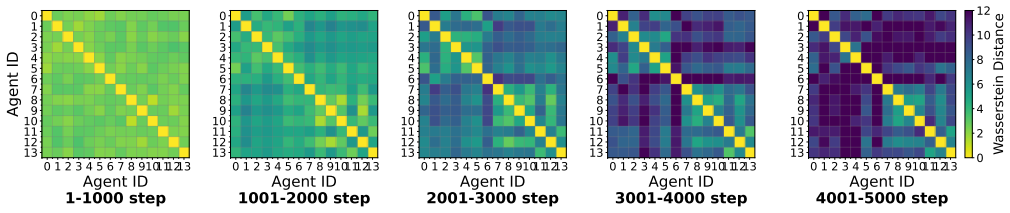
Each agent maintains an internal generative model, communicates with neighbors to form social priors, creates novel observations, and selectively incorporates others' creations into memory. Simulation experiments demonstrate three main findings: informationally cohesive social groups emerge endogenously, with representational alignment mirroring the cluster topology of the underlying network; a circular mutual constitution arises between social representations and the observation distribution, maintained through agents' creative acts that project representational structure onto the external world; and the propagation of creations exhibits selective, heterogeneous patterns distinct from the稳定
What carries the argument
Active inference generative models with neighbor communication for social priors and selective memory incorporation of creative observations on a structured social network.
If this is right
- Informationally cohesive social groups emerge endogenously with representational alignment that mirrors network clusters.
- A circular mutual constitution is maintained between social representations and the observation distribution through creative projection acts.
- Propagation of creations follows selective heterogeneous patterns that differ from stable diffusion of representations.
- Agents construct differentiated cultural niches through these local interaction dynamics.
Where Pith is reading between the lines
- Testing the model with altered network densities could identify conditions under which cohesion forms rapidly versus slowly.
- Incorporating external media or platform filters into the observation distribution might shift the cycle toward greater conformity or faster niche differentiation.
- Empirical tracking of belief updates and innovation adoption in real communities could check whether selective incorporation produces the predicted heterogeneous spread.
Load-bearing premise
The active inference generative models, communication rules, and selective memory incorporation sufficiently capture the bidirectional dialectic of conformity and creativity without missing key social mechanisms such as power asymmetries or external media influences.
What would settle it
If running the simulations on varied network topologies or with added external observation sources fails to produce emergent groups whose representations align to clusters or fails to show heterogeneous creative propagation distinct from representation diffusion, the claims of endogenous formation and mutual constitution would not hold.
Figures



read the original abstract
Social agents both internalize collective norms and reshape them through creative action, yet computational models have not captured this bidirectional process within a unified framework. We propose a multi-agent simulation model grounded in active inference that formalizes the dialectical constitution of social reality on a structured social network. Each agent maintains an internal generative model, communicates with neighbors to form social priors, creates novel observations, and selectively incorporates others' creations into memory. Simulation experiments demonstrate three main findings. First, informationally cohesive social groups emerge endogenously, with representational alignment mirroring the cluster topology of the underlying network. Second, a circular mutual constitution arises between social representations and the observation distribution, maintained through agents' creative acts that project representational structure onto the external world. Third, the propagation of creations exhibits selective, heterogeneous patterns distinct from the stable diffusion of social representations, indicating that agents construct cultural niches through local interaction dynamics. These results suggest that the interplay between social conformity and creative deviation can give rise to the endogenous formation and differentiation of shared social reality.
Editorial analysis
A structured set of objections, weighed in public.
Referee Report
Summary. The manuscript introduces a multi-agent simulation framework using active inference to model the dialectic between social conformity and creative action in constructing social reality on a network. Agents maintain generative models, communicate with neighbors to form social priors, create novel observations, and selectively incorporate others' creations. The simulations are reported to show three key results: endogenous emergence of cohesive groups with representational alignment matching network clusters; a circular mutual constitution between representations and the observation distribution; and selective heterogeneous patterns in the propagation of creations distinct from stable diffusion of representations.
Significance. If the simulation results are robust and the circular constitution is shown to be emergent rather than definitional, this paper would provide a valuable computational model bridging active inference with social theory, offering a unified way to study how shared social realities form and differentiate through local interactions. It highlights the potential of active inference for capturing bidirectional social processes, which could influence future work in computational sociology and multi-agent systems.
major comments (2)
- [Model Description] In the model description, the process by which agents generate novel observations from their current generative model (after forming social priors via neighbor communication) risks rendering the claimed circular mutual constitution between social representations and the observation distribution tautological rather than emergent. If creation is sampled from the generative model that already encodes the priors, the projection of representational structure onto the external world holds by construction independent of interaction dynamics, which would undermine the claim that the dialectic arises endogenously from the three mechanisms.
- [Simulation Experiments] The simulation experiments section reports three main findings on group emergence, circular constitution, and heterogeneous propagation without supplying the active inference update equations, parameter values, network details (e.g., topology or size), number of agents, time steps, or any statistical validation procedures. This absence prevents assessment of whether the patterns are robust or artifacts of unstated choices, directly affecting the soundness of all three central claims.
minor comments (1)
- [Abstract] The abstract would benefit from a brief mention of simulation scale (e.g., number of agents or time steps) to provide immediate context for the reported emergence and propagation patterns.
Simulated Author's Rebuttal
We thank the referee for their constructive and insightful comments, which have helped us identify areas where the manuscript can be strengthened for clarity and reproducibility. We respond to each major comment below, offering our strongest honest defense of the work while committing to revisions where appropriate.
read point-by-point responses
-
Referee: [Model Description] In the model description, the process by which agents generate novel observations from their current generative model (after forming social priors via neighbor communication) risks rendering the claimed circular mutual constitution between social representations and the observation distribution tautological rather than emergent. If creation is sampled from the generative model that already encodes the priors, the projection of representational structure onto the external world holds by construction independent of interaction dynamics, which would undermine the claim that the dialectic arises endogenously from the three mechanisms.
Authors: We appreciate the referee highlighting this potential issue. In the model, the generative model is not fixed but is updated at each timestep through selective incorporation of neighbors' creations, which are themselves shaped by prior communication rounds and network topology. Creation involves active inference sampling that balances the social prior against the agent's current likelihood, permitting novelty and deviation rather than direct projection. The circular constitution is emergent because the global observation distribution evolves via heterogeneous propagation of creations (distinct from stable representation diffusion), which feeds back to reshape local priors and group alignments only through the interaction dynamics. We agree the original description could invite misreading as definitional. In revision we will add the explicit update equations, pseudocode for the three mechanisms, and an ablation analysis demonstrating that removing neighbor communication or selective incorporation eliminates the circular pattern. revision: partial
-
Referee: [Simulation Experiments] The simulation experiments section reports three main findings on group emergence, circular constitution, and heterogeneous propagation without supplying the active inference update equations, parameter values, network details (e.g., topology or size), number of agents, time steps, or any statistical validation procedures. This absence prevents assessment of whether the patterns are robust or artifacts of unstated choices, directly affecting the soundness of all three central claims.
Authors: We fully agree that the absence of these details limits evaluation of robustness. This was an oversight in the initial submission focused on the high-level results. In the revised manuscript we will insert a new subsection containing: the full active inference equations (variational free-energy minimization for perception, policy selection, and learning); all parameter values (precisions, learning rates, incorporation thresholds); network specifications (agent count, topology such as stochastic block model with given cluster probabilities); simulation length and initialization protocol; and statistical validation (ensemble averages over multiple random seeds, standard deviations on alignment and propagation metrics, and sensitivity checks). These additions will directly support the soundness of the three findings. revision: yes
Circularity Check
No significant circularity; simulation outcomes are independent of definitional inputs
full rationale
The paper defines an active inference multi-agent model with explicit mechanisms (neighbor communication for social priors, generative-model sampling for novel observations, and selective memory incorporation). The three reported findings—including the mutual constitution between representations and observation distribution—are presented as emergent simulation results on a structured network, not as identities or forced fits. No equations reduce the claimed dialectic to a tautology by construction, no parameters are fitted to force the target patterns, and no load-bearing self-citations or uniqueness theorems are invoked. The derivation chain therefore remains self-contained against external benchmarks of the simulation dynamics.
Axiom & Free-Parameter Ledger
axioms (1)
- domain assumption Active inference provides a sufficient generative-model account of both belief updating and action selection in social contexts
Reference graph
Works this paper leans on
-
[1]
Baronchelli, A., Felici, M., Loreto, V ., Caglioti, E., and Steels, L. (2006). Sharp transition towards shared vocabularies in multi- agent systems.J. Stat. Mech., 2006(06):P06014–P06014. Berger, P. L. and Luckmann, T. (1966).The social construction of reality: a treatise in the sociology of knowledge. Doubleday, Garden City, N.Y ., [1st ed.] edition. Cha...
work page 2006
-
[2]
MIT Press. Friston, K. and Frith, C. (2015a). A duet for one.Conscious. Cogn., 36:390–405. Friston, K. J. and Frith, C. D. (2015b). Active inference, commu- nication and hermeneutics.Cortex, 68:129–143. Goodfellow, I. J., Pouget-Abadie, J., Mirza, M., Xu, B., Warde- Farley, D., Ozair, S., Courville, A., and Bengio, Y . (2014). Generative adversarial nets....
work page 2014
-
[3]
Hagiwara, Y ., Kobayashi, H., Taniguchi, A., and Taniguchi, T. (2019). Symbol emergence as an interpersonal multimodal categorization.Front. Robot. AI, 6:134. Heins, C., Millidge, B., Da Costa, L., Mann, R. P., Friston, K. J., and Couzin, I. D. (2024). Collective behavior from surprise minimization.Proc. Natl. Acad. Sci. U. S. A., 121(17):e2320239121. Inu...
work page 2019
-
[4]
Odling-Smee, F. J., Laland, K. N., and Feldman, M. W. (2003). Niche construction: The neglected process in evolution (MPB-37). Monographs in Population Biology. Princeton University Press, Princeton, NJ. Parr, T., Pezzulo, G., and Friston, K. J. (2022).Active Inference: The Free Energy Principle in Mind, Brain, and Behavior. The MIT Press. Smith, K., Kirb...
work page 2003
discussion (0)
Sign in with ORCID, Apple, or X to comment. Anyone can read and Pith papers without signing in.