A Fully Electromagnetic Hybrid PIC-Fluid Model for Predictive Fusion Neutron Yield in Dense Plasma Focus
Pith reviewed 2026-05-10 16:45 UTC · model grok-4.3
The pith
A hybrid electromagnetic PIC-fluid model for dense plasma focus devices produces a D-D neutron yield of 0.296e7 at 180 kA, matching the order of magnitude of fully kinetic simulations.
A machine-rendered reading of the paper's core claim, the machinery that carries it, and where it could break.
Core claim
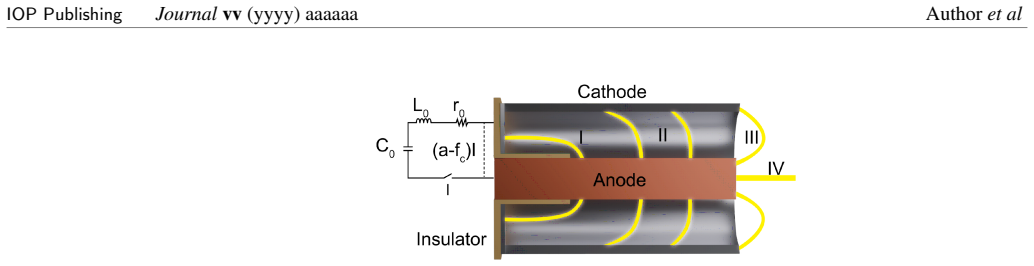
The fully electromagnetic hybrid simulation framework, with kinetic particle-in-cell ions, quasi-neutral electron fluid, generalized Ohm's law including resistive, pressure-gradient, and Hall terms, and predictor-corrector current density update, when applied to a non-hollow 180 kA DPF geometry, reproduces sheath formation, axial rundown, radial compression, and post-pinch expansion, and yields a total neutron output of 0.296e7 that is comparable in order of magnitude to fully kinetic results at similar currents.
What carries the argument
The hybrid simulation framework that advances ions kinetically via particle-in-cell while evolving electrons as a quasi-neutral fluid under the generalized Ohm's law and solves Maxwell's equations in both plasma and vacuum regions.
If this is right
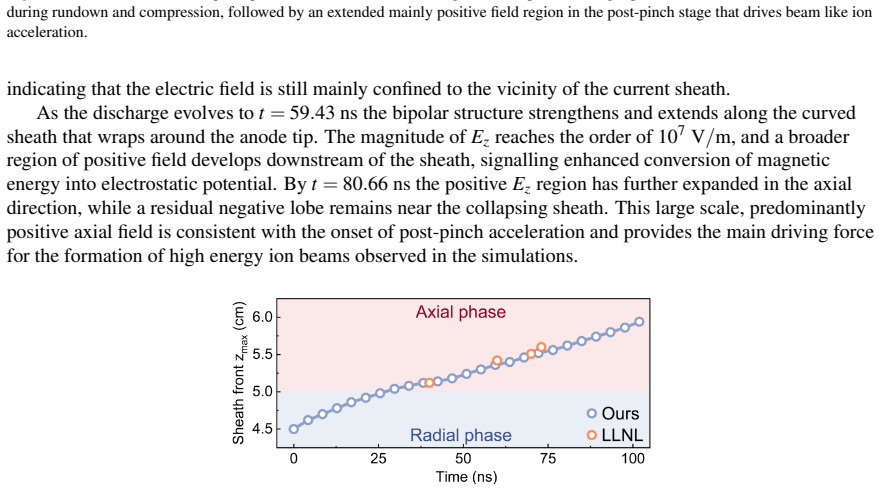
- The outer sheath front position matches fully kinetic benchmarks within 10 percent over the comparison interval.
- The predicted neutron yield is nearly two orders of magnitude higher than earlier hybrid results at comparable currents.
- The model self-consistently captures post-pinch expansion dynamics that contribute to neutron production.
- Quantitative neutron yield forecasts become feasible without resolving full electron kinetics.
Where Pith is reading between the lines
- The framework could be applied to other pulsed-power geometries to estimate yields more efficiently than full kinetic runs.
- Validation against measured ion temperature profiles in the post-pinch phase would strengthen in the electron fluid approximation.
- Insights from the reproduced axial electric field evolution might inform design adjustments to enhance neutron output in compact devices.
Load-bearing premise
Treating electrons as a quasi-neutral fluid with the generalized Ohm's law and predictor-corrector update captures the essential kinetic ion motion and electromagnetic coupling for accurate neutron yield prediction after the pinch.
What would settle it
Experimental measurement of total neutron yield in a non-hollow 180 kA DPF matching the simulated geometry would directly test whether the predicted 0.296e7 value holds.
Figures






read the original abstract
While magnetic confinement fusion (MCF) and inertial confinement fusion (ICF) remain the primary routes toward controlled fusion, progress is still constrained by energy loss, plasma instabilities, and the cost and complexity of large-scale facilities. The Dense Plasma Focus (DPF) device presents a compact, pulsed-power-driven alternative for producing fusion-relevant conditions and neutron emissions. However, the quantitative prediction of neutron yield in DPF devices poses a significant numerical challenge, primarily due to the imperative of self-consistently resolving kinetic ion behavior, electromagnetic energy coupling, and vacuum field evolution. This complexity often impedes a definitive understanding of the underlying neutron production mechanisms. To address this, we develop a fully electromagnetic hybrid simulation framework: ions are advanced kinetically with particle-in-cell, electrons are a quasi-neutral fluid, and Maxwell's equations are solved in both plasma and vacuum. The generalized Ohm law includes resistive, electron pressure-gradient, and Hall terms, with a predictor-corrector update for current density. We apply the model to a non-hollow 180 kA DPF geometry similar to the LLNL configuration. The simulated ion density, ion temperature, and axial electric field reproduce sheath formation, axial rundown, radial compression, and post-pinch expansion. The outer sheath front position agrees with fully kinetic benchmarks within 10\% over the available comparison interval. With a compact fit to the D-D fusion cross section, the predicted total neutron yield is 0.296e7, comparable in order of magnitude to reported fully kinetic results at similar currents and nearly two orders of magnitude higher than earlier hybrid results.
Editorial analysis
A structured set of objections, weighed in public.
Referee Report
Summary. The manuscript introduces a fully electromagnetic hybrid PIC-fluid model for Dense Plasma Focus (DPF) simulations, treating ions kinetically via PIC and electrons as a quasi-neutral fluid with a generalized Ohm's law including resistive, pressure gradient, and Hall terms, solved with Maxwell's equations in plasma and vacuum regions. Applied to a non-hollow 180 kA DPF similar to LLNL configuration, the model reproduces sheath formation, rundown, compression, and post-pinch expansion, with outer sheath front position agreeing within 10% of fully kinetic benchmarks. Using a compact fit to the D-D fusion cross section, it predicts a total neutron yield of 0.296e7, which is order-of-magnitude consistent with fully kinetic results at similar currents and significantly higher than prior hybrid models.
Significance. If the post-pinch ion distributions and fields prove accurate, the hybrid framework offers a computationally tractable route to neutron-yield predictions in DPF devices that improves on earlier hybrid results while retaining key electromagnetic and kinetic-ion physics. This could support parameter studies that remain prohibitive for fully kinetic codes.
major comments (2)
- [Abstract] Abstract: the central claim that the model is 'predictive' for fusion neutron yield rests on integrating a compact D-D cross-section fit over the simulated ion distribution, yet the only quantitative benchmark reported is 10% agreement on outer sheath front position; no error bars, ion velocity spectra, time-resolved fusion-rate histories, or post-pinch E-field comparisons against fully kinetic references are supplied, leaving the quantitative support for the 0.296e7 yield limited given the exponential sensitivity of the cross section above ~10 keV.
- [Model formulation] Model formulation (generalized Ohm's law and quasi-neutral closure): the electron fluid treatment with resistive + ∇p_e + Hall terms plus predictor-corrector current update is asserted to capture the electromagnetic coupling needed for accurate ion acceleration in the post-pinch phase, but the manuscript provides no test of whether non-thermal electron kinetics or inertia effects (suppressed by quasi-neutrality) alter the axial E-field or high-energy ion tail that dominate the yield integral.
minor comments (1)
- [Abstract] Abstract: the phrase 'compact fit to the D-D fusion cross section' is used without stating the functional form or fitted coefficients, which would improve reproducibility of the 0.296e7 result.
Simulated Author's Rebuttal
We thank the referee for the thorough review and constructive comments. We address each major comment point by point below and indicate where revisions have been made to the manuscript.
read point-by-point responses
-
Referee: [Abstract] Abstract: the central claim that the model is 'predictive' for fusion neutron yield rests on integrating a compact D-D cross-section fit over the simulated ion distribution, yet the only quantitative benchmark reported is 10% agreement on outer sheath front position; no error bars, ion velocity spectra, time-resolved fusion-rate histories, or post-pinch E-field comparisons against fully kinetic references are supplied, leaving the quantitative support for the 0.296e7 yield limited given the exponential sensitivity of the cross section above ~10 keV.
Authors: We agree that the neutron yield validation rests primarily on the 10% agreement in outer sheath front position, a key metric for the compression dynamics where fusion occurs. The reported yield of 0.296e7 is computed directly from the simulated ion distribution via the D-D cross-section fit and matches the order of magnitude of fully kinetic results at comparable currents. We acknowledge the exponential sensitivity of the cross section and the lack of additional benchmarks (spectra, time histories, E-field) in the original text. In revision we have updated the abstract and added a limitations paragraph noting that the model targets order-of-magnitude predictive capability rather than precise quantitative forecasts, while retaining the improvement over earlier hybrid results. revision: partial
-
Referee: [Model formulation] Model formulation (generalized Ohm's law and quasi-neutral closure): the electron fluid treatment with resistive + ∇p_e + Hall terms plus predictor-corrector current update is asserted to capture the electromagnetic coupling needed for accurate ion acceleration in the post-pinch phase, but the manuscript provides no test of whether non-thermal electron kinetics or inertia effects (suppressed by quasi-neutrality) alter the axial E-field or high-energy ion tail that dominate the yield integral.
Authors: Quasi-neutrality is a deliberate closure that removes electron inertia and non-thermal kinetics to enable tractable simulations. The generalized Ohm's law (resistive, ∇p_e, Hall) together with the predictor-corrector current update is intended to retain the dominant electromagnetic coupling. The 10% agreement with fully kinetic benchmarks on sheath position indicates that the essential ion-acceleration physics is captured for this regime. We have added a paragraph in the revised manuscript explicitly discussing the possible influence of the suppressed effects on post-pinch E-field and high-energy tails, together with supporting references from the hybrid-model literature. revision: partial
Circularity Check
No significant circularity; yield computed from independent cross-section data and standard governing equations
full rationale
The derivation chain begins from Maxwell's equations, the generalized Ohm's law (resistive + ∇p_e + Hall terms), quasi-neutral electron fluid, and kinetic PIC ions, all standard and not fitted to the target neutron yield. The yield is obtained by integrating a compact fit to the external D-D fusion cross-section data over the simulated ion distribution; this step does not reduce the output to the model's inputs by construction. No self-citations, uniqueness theorems, or ansatzes imported from prior author work appear in the provided text. The reported 10% agreement on sheath-front position against fully kinetic benchmarks supplies an independent check, confirming the central prediction retains content beyond its inputs.
Axiom & Free-Parameter Ledger
free parameters (1)
- compact fit to D-D fusion cross section
axioms (2)
- domain assumption Electrons form a quasi-neutral fluid
- domain assumption Generalized Ohm's law with resistive, electron pressure-gradient, and Hall terms governs current density
Reference graph
Works this paper leans on
-
[1]
Zylstra A, Hurricane O, Callahan D, Kritcher A, Ralph J, Robey H, Ross J, Young C, Baker K, Casey Det al.2022Nature601542–548
-
[2]
Matzen M K, Sweeney M, Adams R, Asay J, Bailey J, Bennett G, Bliss D, Bloomquist D, Brunner T, Campbell R eet al.2005Physics of Plasmas12
-
[3]
Zohuri B 2017Inertial confinement fusion driven thermonuclear energy(Springer)
-
[4]
Brezιnsek S, Dhard C P, Jakubowski M, König R, Masuzaki S, Mayer M, Naujoks D, Romazanov J, Schmid K, Schmitz Oet al.2021Nuclear Fusion62016006
-
[5]
Mather J 1964The Physics of Fluids7S28–S34
- [6]
-
[7]
Bernstein M and Hai F 1970Physical Review Letters25641
-
[8]
Schmidt A, Tang V and Welch D 2012Physical review letters109205003
-
[9]
Lee S 2014Journal of Fusion Energy33319–335
-
[10]
Milanese M and Pouzo J 1978Nuclear Fusion18533
-
[11]
Lerner E J, Hassan S M, Karamitsos I and V on Roessel F 2017Physics of Plasmas24
-
[12]
Lerner E J, Murali S K, Shannon D, Blake A M and Roessel F V 2012Physics of Plasmas19
-
[13]
Cicuttin A, Crespo M, Gribkov V , Niemela J, Tuniz C, Zanolli C, Chernyshova M, Demina E, Latyshev S, Pimenov Vet al.2015Nuclear Fusion55063037
-
[14]
Bernstein M, Lee C and Hai F 1971Physical Review Letters27844
-
[15]
Inestrosa-Izurieta M J, Ramos-Moore E and Soto L 2015Nuclear Fusion55093011
-
[16]
Lerner E J, Krupakar Murali S and Haboub A 2011Journal of fusion energy30367–376 21 IOP PublishingJournalvv(yyyy) aaaaaa Authoret al
-
[17]
Lerner E J, Hassan S M, Karamitsos-Zivkovic I and Fritsch R 2023Journal of Fusion Energy427
-
[18]
Kiai S S, Adlparvar S, Sadeghi H and Fazelpour S 2025Scientific Reports1514081
-
[19]
Yousefi H, Haruki T, Sakai J, Lumanta A and Masugata K 2009Physics Letters A3732360–2363
-
[20]
Bennett N, Blasco M, Breeding K, Constantino D, DeYoung A, DiPuccio V , Friedman J, Gall B, Gardner S, Gatling Jet al.2017Physics of Plasmas24
-
[21]
Tang V , Adams M and Rusnak B 2010IEEE transactions on plasma science38719–727
-
[22]
Mejia F C, Milanese M, Moroso R and Pouzo J 1997Journal of Physics D: Applied Physics301499
-
[23]
Johnson D J 1974Journal of Applied Physics451147–1153
-
[24]
Gratton F and Vargas J 1983 Two dimensional electromechanical model of the plasma focusEnergy storage, compression, and switchingpp 353–386
work page 1983
-
[25]
Schmidt A, Link A, Welch D, Ellsworth J, Falabella S and Tang V 2014Physical Review E89061101
-
[26]
Schmidt A, Welch D, Meehan B, Tang V , Halvorson C, May M and Hagen E 2014Physics of Plasmas 21
-
[27]
Mathuthu M, Zengeni T G and Gholap A V 2002IEEE transactions on plasma science251382–1388
-
[28]
Ay Y , Abd Al-Halim M A and Bourham M A 2015The European Physical Journal D69205
-
[29]
Li H, Li S, Jungman G and Hayes-Sterbenz A C 2017 Dense plasma focus modeling Tech. rep. Los Alamos National Laboratory (LANL), Los Alamos, NM (United States)
work page 2017
-
[30]
Beresnyak A, Giuliani J L, Jackson S L, Richardson A S, Swanekamp S B, Schumer J, Weber B V and Mosher D 2018IEEE Transactions on Plasma Science463881–3885
-
[31]
Jiang S, Higginson D, Holod I and Schmidt A 2019Physics of Plasmas26
-
[32]
Gribkov V , Van Oost G, Malaquias A and Herrera J 2006Nuclear Fusion46868
-
[33]
Thoma C, Welch D, Clark R, Rose D and Golovkin I 2017Physics of Plasmas24
-
[34]
Goyon C, Link A, Drury O and Schmidt A 2023
work page 2023
-
[35]
Goyon C, Drury O, Youmans A, Angus J, Jiang S, Rocco S, Chapman S, Cooper C, McMahon M, Jibodu Aet al.2025Physics of Plasmas32
-
[36]
Delzanno G and Camporeale E 2013Journal of Computational Physics253259–277
-
[37]
Zhao Y , Cui C and Hu Y 2022Computational Particle Mechanics
-
[38]
Inan U S and Marshall R A 2011Numerical Electromagnetics The FDTD Method(Cambridge University Press)
-
[39]
Marder B 1987Journal of Computational Physics6848–55
-
[40]
Nanbu K 1997Physical Review E554642–4652
-
[41]
Shaw B, Chapman S, Cooper C, Goyon C, Angus J, Higginson D, Liu J, Mitrani J, Podpaly Y , Povilus Aet al.2018Journal of Applied Physics124
-
[42]
Novotny J, Cikhardt J, Cikhardtova B, Klir D, Kravarik J, Kubes P, Malir J, Munzar V and Rezac K 2023Physics of Plasmas30 22
discussion (0)
Sign in with ORCID, Apple, or X to comment. Anyone can read and Pith papers without signing in.