Recognition: unknown
Hybrid Cold-Start Recommender System for Closure Model Selection in Multiphase Flow Simulations
Pith reviewed 2026-05-10 16:49 UTC · model grok-4.3
The pith
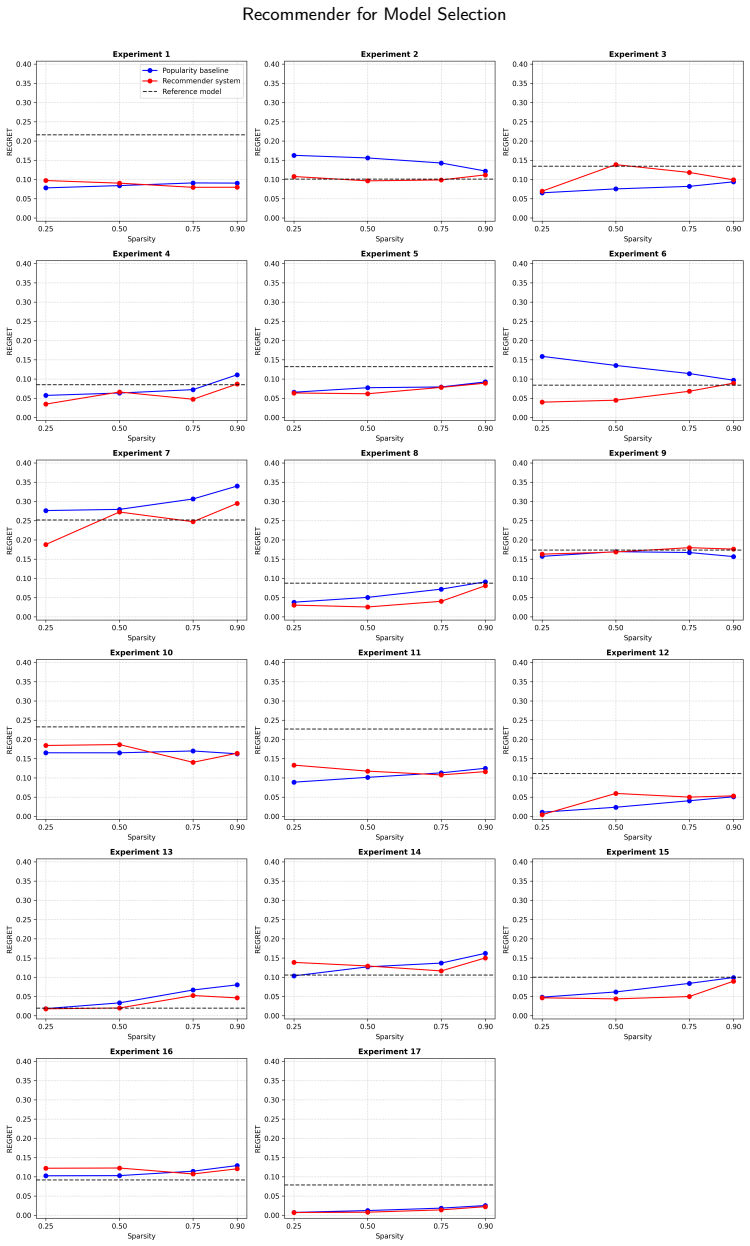
A hybrid recommender using case metadata and matrix completion selects closure models for new multiphase CFD simulations with lower regret than popularity or expert baselines.
A machine-rendered reading of the paper's core claim, the machinery that carries it, and where it could break.
Core claim
The central claim is that the hybrid recommender framework, which integrates metadata-driven case similarity with collaborative inference via matrix completion, enables effective case-specific recommendations for closure model combinations on entirely new CFD cases and reduces regret across varying data sparsities, outperforming both popularity-based and expert-designed reference models.
What carries the argument
The hybrid recommendation framework that combines metadata-driven case similarity and collaborative inference via matrix completion.
If this is right
- Case-specific model recommendations become feasible for new CFD cases using only their descriptive features and historical data from similar cases.
- Regret relative to the per-case optimum decreases across different levels of data sparsity in the simulation history.
- Recommendation quality improves on ranking-based metrics compared with simpler reference strategies.
- The approach supports complex scientific decision tasks that involve expensive evaluations and structured metadata with limited prior observations.
Where Pith is reading between the lines
- The same hybrid structure could transfer to model selection problems in other high-cost simulation domains that have descriptive case metadata.
- Enriching the metadata features with additional flow diagnostics might further tighten the link between case similarity and model performance.
- The regret metric could be expanded to weight computational cost or prediction uncertainty alongside accuracy loss.
Load-bearing premise
Descriptive metadata features of CFD cases sufficiently capture the similarities that determine which closure model combinations will perform well, enabling reliable generalization to new flow scenarios.
What would settle it
A new collection of flow scenarios where the hybrid recommender's top-ranked model combinations produce no lower average regret than the popularity-based or expert-designed baselines would falsify the central claim.
Figures


read the original abstract
Selecting appropriate physical models is a critical yet difficult step in many areas of computational science and engineering. In multiphase Computational Fluid Dynamics (CFD), practitioners must choose among numerous closure model combinations whose performance varies strongly across flow conditions. Sub-optimal choices can lead to inaccurate predictions, simulation failures, and wasted computational resources, making model selection a prime candidate for data-driven decision support. This work formulates closure model selection as a cold-start recommender system problem in a high-cost scientific domain. We propose a hybrid recommendation framework that combines (i) metadata-driven case similarity and (ii) collaborative inference via matrix completion. The approach enables case-specific model recommendations for entirely new CFD cases using their descriptive features, while leveraging historical simulation results from similar cases. The methodology is evaluated on 13,600 simulations across 136 validation cases and 100 model combinations. A nested cross-validation protocol with experiment-level holdout is employed to rigorously assess generalisation to unseen flow scenarios under varying levels of data sparsity. Recommendation quality is measured using ranking-based metrics and a domain-specific regret measure capturing performance loss relative to the per-case optimum. Results show that the proposed hybrid recommender consistently outperforms popularity-based and expert-designed reference models and reduces regret across the investigated sparsities. These findings demonstrate that recommender system methodology can effectively support complex scientific decision-making tasks characterised by expensive evaluations, structured metadata, and limited prior observations.
Editorial analysis
A structured set of objections, weighed in public.
Referee Report
Summary. The paper formulates closure model selection for multiphase CFD simulations as a cold-start recommender problem. It proposes a hybrid approach combining metadata-driven case similarity with matrix completion for collaborative inference, enabling recommendations for new cases. Evaluation uses 13,600 simulations over 136 cases and 100 model combinations, with nested cross-validation employing experiment-level holdout, ranking metrics, and a domain-specific regret measure. Results claim consistent outperformance over popularity-based and expert-designed baselines across sparsity levels.
Significance. If the central claims hold, the work provides a concrete demonstration of recommender-system techniques applied to expensive scientific model selection under data scarcity, with strengths in the experiment-level holdout protocol and regret metric that directly ties recommendations to simulation performance loss. This could inform similar decision-support tasks in computational engineering. However, significance is limited by the unverified assumption that chosen metadata features align with the physics governing model performance, which is load-bearing for generalization claims.
major comments (2)
- [Abstract and evaluation protocol] Abstract and evaluation protocol: The claim of reliable generalization to entirely new flow scenarios via case similarity is load-bearing but rests on the untested assumption that descriptive metadata features (e.g., flow conditions) sufficiently encode the physics determining which of the 100 closure combinations perform well. In multiphase CFD, optimal models depend on fine-grained aspects such as bubble size distributions, interfacial forces, and turbulence modulation that may not be captured by high-level metadata. The nested CV with experiment-level holdout tests performance within the observed metadata manifold but provides no direct evidence (e.g., via feature ablation or physics-based similarity checks) that metadata similarity predicts performance similarity outside it. With only 136 cases total, this risks overestimating robustness.
- [Methods and results sections] Methods and results sections: The hybrid framework's outperformance over baselines and regret reduction is reported across sparsities, but without explicit details on how metadata features are constructed, normalized, or selected (and whether they were tuned post-hoc), it is difficult to assess if the gains are driven by genuine similarity capture or by the matrix completion component alone. A concrete test—such as reporting correlation between metadata distance and optimal-model overlap—would strengthen the central claim.
minor comments (2)
- [Methods] Clarify the exact construction of the 13,600 simulations (e.g., how many per case, how sparsity is induced in the nested CV) and provide a table summarizing the metadata feature set and its dimensionality.
- [Results] The abstract states 'reduces regret across the investigated sparsities'—add quantitative regret values and confidence intervals in the main results table for reproducibility.
Simulated Author's Rebuttal
We thank the referee for the thoughtful and detailed review. The comments highlight important aspects of our evaluation protocol and methodological transparency. We address each major comment below and describe the revisions we will make to strengthen the manuscript.
read point-by-point responses
-
Referee: [Abstract and evaluation protocol] Abstract and evaluation protocol: The claim of reliable generalization to entirely new flow scenarios via case similarity is load-bearing but rests on the untested assumption that descriptive metadata features (e.g., flow conditions) sufficiently encode the physics determining which of the 100 closure combinations perform well. In multiphase CFD, optimal models depend on fine-grained aspects such as bubble size distributions, interfacial forces, and turbulence modulation that may not be captured by high-level metadata. The nested CV with experiment-level holdout tests performance within the observed metadata manifold but provides no direct evidence (e.g., via feature ablation or physics-based similarity checks) that metadata similarity predicts performance similarity outside it. With only 136 cases total, this risks overestimating robustness.
Authors: We agree that the metadata features are high-level descriptors of flow conditions and do not explicitly encode all fine-grained physics such as bubble size distributions or detailed turbulence modulation. The experiment-level holdout in the nested CV protocol evaluates generalization to unseen cases that lie within the sampled metadata manifold, and the domain-specific regret metric directly links recommendations to simulation performance loss. We acknowledge that this does not constitute direct evidence for extrapolation outside the observed manifold. In the revised manuscript we will add an explicit discussion of these assumptions and limitations, including the rationale for the chosen metadata based on domain knowledge of multiphase flow, and we will outline directions for physics-informed extensions. We will also report the precise list of metadata features and their construction. revision: partial
-
Referee: [Methods and results sections] Methods and results sections: The hybrid framework's outperformance over baselines and regret reduction is reported across sparsities, but without explicit details on how metadata features are constructed, normalized, or selected (and whether they were tuned post-hoc), it is difficult to assess if the gains are driven by genuine similarity capture or by the matrix completion component alone. A concrete test—such as reporting correlation between metadata distance and optimal-model overlap—would strengthen the central claim.
Authors: We will expand the Methods section to provide full details on metadata feature construction, normalization, and selection criteria. These features were predefined from standard flow-condition descriptors used in multiphase CFD literature and were not tuned post-hoc on the validation results. To directly address the suggested test, we will add an analysis in the Results section reporting the correlation between metadata-based distances and the overlap of optimal model combinations across cases. This will help quantify the extent to which metadata similarity aligns with performance similarity. revision: yes
Circularity Check
No circularity: standard recommender application with independent CV evaluation
full rationale
The paper applies established matrix completion and metadata similarity techniques to a new domain (CFD closure selection) and evaluates via nested experiment-level holdout on held-out cases. No derivation reduces a claimed prediction to a fitted parameter or self-citation by construction; the regret and ranking metrics are computed directly against per-case optima on unseen data. The methodology is self-contained against external benchmarks and does not invoke load-bearing self-citations or ansatzes that loop back to the inputs.
Axiom & Free-Parameter Ledger
Reference graph
Works this paper leans on
-
[1]
Investigation of drag models for simulation of gas-liquid two- phase flow systems
Adzaklo, S.Y., Sarkodie, K., Agyei, E., Yamoah, S., Asiedu, N.Y., 2025. Investigation of drag models for simulation of gas-liquid two- phase flow systems. Scientific Reports 15, 39440. URL:https://www.nature.com/articles/s41598-025-23038-3, doi:10.1038/ s41598-025-23038-3
2025
-
[2]
Regionalization-basedcollaborativefiltering:Harnessinggeographicalinformationinrecommenders
Alves,R.,2024. Regionalization-basedcollaborativefiltering:Harnessinggeographicalinformationinrecommenders. ACMTransactionson Spatial Algorithms and Systems 10, 1–23
2024
-
[3]
Analysis of phase distribution in fully developed laminar bubbly two-phase flow
Antal, S.P., Lahey Jr, R., Flaherty, J., 1991. Analysis of phase distribution in fully developed laminar bubbly two-phase flow. International Journal of Multiphase Flow 17, 635–652
1991
-
[4]
Turbulent bubbly two-phase flow in a triangular duct
Lopez de Bertodano, M., 1992. Turbulent bubbly two-phase flow in a triangular duct. Ph.D. thesis. Rensselaer Polytechnic Institution
1992
-
[5]
Computational fluid dynamics modelling of two-phase bubble columns: A comprehensive review
Besagni, G., Varallo, N., Mereu, R., 2023. Computational fluid dynamics modelling of two-phase bubble columns: A comprehensive review. Fluids 8, 91. URL:https://www.mdpi.com/2311-5521/8/3/91, doi:10.3390/fluids8030091. open Access under CC BY 4.0
-
[6]
The Favre averaged drag model for turbulent dispersion in Eulerian multi-phase flows, in: 5th International Conference on Multiphase Flow
Burns, A., Frank, T., Hamill, I., Shi, J.M., 2004. The Favre averaged drag model for turbulent dispersion in Eulerian multi-phase flows, in: 5th International Conference on Multiphase Flow
2004
-
[7]
Benchmarkingofcomputationalfluiddynamicmodelsforbubblyflows
Colombo,M.,Rzehak,R.,Fairweather,M.,Liao,Y.,Lucas,D.,2021. Benchmarkingofcomputationalfluiddynamicmodelsforbubblyflows. Nuclear Engineering and Design 375, 111075. doi:https://doi.org/10.1016/j.nucengdes.2021.111075
-
[8]
Sommerfeld, M., Tsuji, Y., 2011
Crowe, C., Schwarzkopf, J., M. Sommerfeld, M., Tsuji, Y., 2011. Multiphase Flows with Droplets and Particles
2011
-
[9]
Large eddy simulation of the gas–liquid flow in a square cross-sectioned bubble column
Deen, N.G., Solberg, T., Hjertager, B.H., 2001. Large eddy simulation of the gas–liquid flow in a square cross-sectioned bubble column. Chemical Engineering Science 56, 6341–6349. doi:10.1016/S0009-2509(01)00255-4
-
[10]
Fine-tuning a large language model for automating computational fluid dynamics simulations
Dong, Z., Lu, Z., Yang, Y., 2025. Fine-tuning a large language model for automating computational fluid dynamics simulations. Theoretical and Applied Mechanics Letters 15
2025
-
[11]
Practical Recommender Systems
Falk, K., 2019. Practical Recommender Systems. Manning Publications / Simon & Schuster, New York, NY
2019
-
[12]
Advanced Intelligent Discovery , year =
Fan, E., Hu, K., Wu, Z., Ge, J., Miao, J., Zhang, Y., Sun, H., Wang, W., Zhang, T., 2026. Chatcfd: A large language model-driven agent for end-to-end computational fluid dynamics automation with structured knowledge and reasoning. Advanced Intelligent Discovery URL: https://doi.org/10.1002/aidi.202500174, doi:10.1002/aidi.202500174
-
[13]
Advances in computational fluid dynamics (CFD) of 3-dimensional gas-liquid multiphase flows, in: NAFEMS Seminar: Simulation of Complex Flows (CFD)-Applications and Trends, pp
Frank, T., 2005. Advances in computational fluid dynamics (CFD) of 3-dimensional gas-liquid multiphase flows, in: NAFEMS Seminar: Simulation of Complex Flows (CFD)-Applications and Trends, pp. 1–18
2005
-
[14]
Numerical methods for multiphase flows
Garcia-Villalba, M., Colonius, T., Desjardins, O., Lucas, D., Mani, A., Marchisio, D., Matar, O.K., Picano, F., Zaleski, S., 2025. Numerical methods for multiphase flows. International Journal of Multiphase Flow 191, 105285. URL:https://www.sciencedirect.com/ science/article/pii/S0301932225001636, doi:10.1016/j.ijmultiphaseflow.2025.105285. S. Hänsch et a...
-
[15]
Deep Learning
Goodfellow, I., Bengio, Y., Courville, A., 2016. Deep Learning. MIT Press
2016
-
[16]
Multidimensional modeling of turbulent two-phase flows in stirred vessels
Gosman, A.D., Lekakou, C., Politis, S., Issa, R.I., Looney, M.K., 1992. Multidimensional modeling of turbulent two-phase flows in stirred vessels. AIChE Journal 38, 1946–1956
1992
-
[17]
AcomparativestudyofclosurerelationsforCFDmodellingofbubblyflowinaverticalpipe
Gray,G.S.,Ormiston,S.J.,2021. AcomparativestudyofclosurerelationsforCFDmodellingofbubblyflowinaverticalpipe. OpenJ.Fluid Dyn. 11, 98–134
2021
-
[18]
Lyu, H., Meller, R., Schlegel, F., Tekavčič, M., 2025a
Hänsch, S., Draw, M., Evdokimov, I., Khan, H., Krull, B., Lehnigk, R., Liao, Y., H. Lyu, H., Meller, R., Schlegel, F., Tekavčič, M., 2025a. Multiphase Cases Repository by HZDR for OpenFOAM Foundation Software.https://rodare.hzdr.de/record/3862. doi:10.14278/rodare.3862
-
[19]
A workflow for the sustainable development of closure models for bubbly flows
Hänsch, S., Evdokimov, I., Schlegel, F., Lucas, D., 2021. A workflow for the sustainable development of closure models for bubbly flows. Chemical Engineering Science 244, 116807
2021
-
[20]
Data-driven closure model selection for multiphase cfd via matrix completion
Hänsch, S., Sajdoková, A., Rabau, A., Rybář, V., Alves, R., Kordík, P., 2025b. Data-driven closure model selection for multiphase cfd via matrix completion. AI Thermal Fluids 4, 100019. doi:https://doi.org/10.1016/j.aitf.2025.100019
-
[21]
Lift force coefficient of ellipsoidal single bubbles in water
Hessenkemper, H., Ziegenhein, T., Rzehak, R., Lucas, D., Tomiyama, A., 2021. Lift force coefficient of ellipsoidal single bubbles in water. International Journal of Multiphase Flow 138, 103587
2021
-
[22]
Axial interfacial area transport of vertical bubbly flows
Hibiki, T., Ishii, M., Xiao, Z., 2001. Axial interfacial area transport of vertical bubbly flows. International Journal of Heat and Mass Transfer 44, 1869–1888. doi:10.1016/S0017-9310(00)00217-5
-
[23]
Multi-fluid simulation of turbulent bubbly pipe flows
Hosokawa, S., Tomiyama, A., 2009. Multi-fluid simulation of turbulent bubbly pipe flows. Chemical Engineering Science 64, 5308–5318. doi:10.1016/j.ces.2009.08.018
-
[24]
Bubble-inducedpseudoturbulenceinlaminarpipeflows
Hosokawa,S.,Tomiyama,A.,2013. Bubble-inducedpseudoturbulenceinlaminarpipeflows. InternationalJournalofHeatandFluidFlow40, 97–105. URL:http://www.sciencedirect.com/science/article/pii/S0142727X13000088,doi:https://doi.org/10.1016/ j.ijheatfluidflow.2013.01.004
2013
-
[25]
Lateralmigrationofsinglebubblesduetothepresenceofwall.,in:ASME2002 Joint US-European Fluids Engineering Division Conference
Hosokawa,S.,Tomiyama,A.,Misaki,S.,Hamada,T.,2002. Lateralmigrationofsinglebubblesduetothepresenceofwall.,in:ASME2002 Joint US-European Fluids Engineering Division Conference
2002
-
[26]
Huang, X., Chyczewski, T., Xia, Z., Kunz, R., Yang, X., 2023. Distilling experience into a physically interpretable recommender system for computational model selection. Scientific Reports 13, 2225. doi:https://doi.org/10.1038/s41598-023-27426-5
-
[27]
Thermo-Fluid Dynamics of Two-Phase Flow
Ishii, M., Hibiki, T., 2011. Thermo-Fluid Dynamics of Two-Phase Flow. 2 ed., Springer, New York. doi:10.1007/978-1-4419-7985-8
-
[28]
Drag coefficient and relative velocity in bubbly, droplet or particulate flows
Ishii, M., Zuber, N., 1979. Drag coefficient and relative velocity in bubbly, droplet or particulate flows. AIChE Journal 25, 843–855. URL: https://doi.org/10.1002/aic.690250513, doi:10.1002/aic.690250513
-
[29]
Logistic matrix factorization for implicit feedback data
Johnson, C.C., et al., 2014. Logistic matrix factorization for implicit feedback data. Advances in Neural Information Processing Systems 27, 1–9
2014
-
[30]
Kim, M., Lee, J.H., Park, H., 2016. Study of bubble-induced turbulence in upward laminar bubbly pipe flows measured with a two-phase particle image velocimetry. Experiments in Fluids 57, 186. doi:10.1007/s00348-016-2272-3
-
[31]
Orthogonalinductivematrixcompletion
Ledent,A.,Alves,R.,Kloft,M.,2021. Orthogonalinductivematrixcompletion. IEEETransactionsonNeuralNetworksandLearningSystems 34, 2259–2270
2021
-
[32]
The lift force on a spherical bubble in a viscous linear shear flow
Legendre, D., Magnaudet, J., 1998. The lift force on a spherical bubble in a viscous linear shear flow. J. Fluid Mech. 368, 81 – 126
1998
-
[33]
Sustainabledevelopmentofsimulationsetupsandaddons for openfoam for nuclear reactor safety research
Lehnigk,R.,Bruschewski,M.,Huste,T.,Lucas,D.,,Rehm,M.,Schlegel,F.,2023. Sustainabledevelopmentofsimulationsetupsandaddons for openfoam for nuclear reactor safety research. Kerntechnik 88, pp. 131–140. doi:10.1515/kern-2022-0107
-
[34]
Baselineclosuremodelfordispersedbubblyflow:Bubblecoalescenceandbreakup
Liao,Y.,Rzehak,R.,Lucas,D.,Krepper,E.,2015. Baselineclosuremodelfordispersedbubblyflow:Bubblecoalescenceandbreakup. Chem- ical Engineering Science 122, 336 – 349. URL:http://www.sciencedirect.com/science/article/pii/S0009250914005466, doi:https://doi.org/10.1016/j.ces.2014.09.042
-
[35]
Eulerian-Eulerian two-fluid model for laminar bubbly pipe flows: Validation of the baseline model
Liao, Y., Upadhyay, K., Schlegel, F., 2020. Eulerian-Eulerian two-fluid model for laminar bubbly pipe flows: Validation of the baseline model. Computers & Fluids 202, 104496. URL:http://www.sciencedirect.com/science/article/pii/S0045793020300694, doi:https://doi.org/10.1016/j.compfluid.2020.104496
-
[36]
The role of bubble size on liquid phase turbulent structure in two-phase bubbly flow, in: Proceedings of the 3rd International Conference on Multiphase Flow (ICMF’98), Lyon, France
Liu, T.J., 1998. The role of bubble size on liquid phase turbulent structure in two-phase bubbly flow, in: Proceedings of the 3rd International Conference on Multiphase Flow (ICMF’98), Lyon, France
1998
-
[37]
Structure of air–water bubbly flow in a vertical pipe
Liu, T.J., Bankoff, S.G., 1993. Structure of air–water bubbly flow in a vertical pipe. ii: Void fraction, bubble velocity and bubble size distribution. International Journal of Heat and Mass Transfer 36, 1061–1072. doi:10.1016/0017-9310(93)80029-8
-
[38]
doi:10.1016/j.ijthermalsci.2009.11.006
Lucas,D.,Beyer,M.,Szalinski,L.,Schütz,P.,2010.Anewdatabaseontheevolutionofair–waterflowsalongalargeverticalpipe.International Journal of Thermal Sciences 49, 664–674. doi:10.1016/j.ijthermalsci.2009.11.006
-
[39]
Developmentofco-currentair–waterflowinaverticalpipe
Lucas,D.,Krepper,E.,Prasser,H.M.,2005. Developmentofco-currentair–waterflowinaverticalpipe. InternationalJournalofMultiphase Flow 31, 1304–1328. doi:10.1016/j.ijmultiphaseflow.2005.07.002
-
[40]
A strategy for the qualification of multi-fluid approaches for nuclear reactor safety
Lucas, D., Rzehak, R., Krepper, E., Ziegenhein, T., Liao, Y., Kriebitzsch, S., Apanasevich, P., 2016. A strategy for the qualification of multi-fluid approaches for nuclear reactor safety. Nuclear Engineering and Design 299, 2–11. doi:10.1016/j.nucengdes.2015.07.007
-
[41]
Directnumericalsimulation-basedReynolds-averagedclosureforbubble- induced turbulence
Ma,T.,Santarelli,C.,Ziegenhein,T.,Lucas,D.,Fröhlich,J.,2017. Directnumericalsimulation-basedReynolds-averagedclosureforbubble- induced turbulence. Physical Review Fluids 2
2017
-
[42]
Spectral regularization algorithms for learning large incomplete matrices
Mazumder, R., Hastie, T., Tibshirani, R., 2010. Spectral regularization algorithms for learning large incomplete matrices. The Journal of Machine Learning Research 11, 2287–2322
2010
-
[43]
Ten years of industrial experience with the SST turbulence model
Menter, F., Kuntz, M., Langtry, R., 2003. Ten years of industrial experience with the SST turbulence model. Turbulence, Heat and Mass Transfer 4, 625 – 632
2003
-
[44]
Lateral forces on spheres in turbulent uniform shear flow
Moraga, F.J., Bonetto, F.J., Lahey, R.T., 1999. Lateral forces on spheres in turbulent uniform shear flow. International Journal of Multiphase Flow 25, 1321 – 1372
1999
-
[45]
Mudde,R.F.,Harteveld,W.K.,vandenAkker,H.E.A.,2009. Uniformflowinbubblecolumns. Industrial&EngineeringChemistryResearch 48, 148–158. doi:10.1021/ie800630v. S. Hänsch et al.:Preprint submitted to ElsevierPage 26 of 27 Recommender for Model Selection
-
[46]
Evaluating XAI: A Comparison of Rule-Based and Example-Based Ex- planations
Mısır, M., Sebag, M., 2017. Alors: An algorithm recommender system. Artificial Intelligence 244, 291–314. doi:10.1016/j.artint. 2016.12.001
-
[47]
Investigations on bubbly two-phase flow in a constricted vertical pipe
Neumann-Kipping, M., Bieberle, A., Hampel, U., 2020. Investigations on bubbly two-phase flow in a constricted vertical pipe. International Journal of Multiphase Flow 130, 103340. doi:10.1016/j.ijmultiphaseflow.2020.103340
-
[48]
Openfoamgpt: a rag-augmented llm agent for openfoam-based computational fluid dynamics
Pandey, S., Xu, R., Wang, W., Chu, X., 2025. Openfoamgpt: a rag-augmented llm agent for openfoam-based computational fluid dynamics. Physics of Fluids 37
2025
-
[49]
Scikit-learn: Machine learning in python
Pedregosa, F., Varoquaux, G., Gramfort, A., Michel, V., Thirion, B., Grisel, O., Blondel, M., Prettenhofer, P., Weiss, R., Dubourg, V., Vanderplas, J., Passos, A., Cournapeau, D., Brucher, M., Perrot, M., Duchesnay, É., 2011. Scikit-learn: Machine learning in python. Journal of Machine Learning Research 12, 2825–2830
2011
-
[50]
Pfleger,D.,Gomes,S.,Gilbert,N.,Wagner,H.G.,1999. Hydrodynamicsimulationsoflaboratoryscalebubblecolumns:Fundamentalstudies of the eulerian–eulerian modelling approach. Chemical Engineering Science 54, 5091–5099. doi:10.1016/S0009-2509(99)00279-2
-
[51]
Recommender systems: Techniques, applications, and challenges, in: Recommender Systems Handbook
Ricci, F., Rokach, L., Shapira, B., 2022. Recommender systems: Techniques, applications, and challenges, in: Recommender Systems Handbook. 3rd ed.. Springer, New York, NY. doi:10.1007/978-1-0716-2197-4_1
-
[52]
Unified modeling of bubbly flows in pipes, bubble columns, and airlift columns
Rzehak, R., Ziegenhein, T., Kriebitzsch, S., Krepper, E., Lucas, D., 2017. Unified modeling of bubbly flows in pipes, bubble columns, and airlift columns. Chemical Engineering Science 157, 147–158. URL:https://www.sciencedirect.com/science/article/pii/ S0009250916302226, doi:10.1016/j.ces.2016.04.056
-
[53]
Deep learning in music recommendation systems
Schedl, M., 2019. Deep learning in music recommendation systems. Frontiers in Applied Mathematics and Statistics 5, 44
2019
-
[54]
Schlegel, F., Bilde, K., Draw, M., Evdokimov, I., Hänsch, S., Kamble, V., Khan, H., Krull, B., Lehnigk, R., Li, J., Lyu., H., Meller, R., Petelin, G., Kota, S., Tekavčič, M., 2024. Multiphase Code Repository by HZDR for OpenFOAM Foundation Software.https: //rodare.hzdr.de/record/3284. doi:10.14278/rodare.3284
-
[55]
Multiphase Python Repository by HZDR.https: //rodare.hzdr.de/record/3569
Schlegel, F., Fombonne, C., Hänsch, S., Krull, B., Lehnigk, R., Meller, R., 2025. Multiphase Python Repository by HZDR.https: //rodare.hzdr.de/record/3569. doi:10.14278/rodare.3569
-
[56]
Bubble and liquid turbulence characteristics of bubbly flow in a large diameter vertical pipe
Shawkat, M.E., Ching, C.Y., Shoukri, M., 2008. Bubble and liquid turbulence characteristics of bubbly flow in a large diameter vertical pipe. International Journal of Multiphase Flow 34, 767–785. doi:10.1016/j.ijmultiphaseflow.2008.02.002
-
[57]
SnakemakeDevelopers,2025.Snakemake:Aframeworkforreproducibledataanalysis.URL:https://snakemake.github.io/.accessed: July 9, 2025
2025
-
[58]
Hydrodynamics in a bubble column – part 1: Two-phase flow
Sommer, A.E., Draw, M., Wang, L., Schmidtpeter, J., Hessenkemper, H., Gatter, J., Nam, H., Eckert, K., Rzehak, R., 2023. Hydrodynamics in a bubble column – part 1: Two-phase flow. Chemical Engineering & Technology 46, 1763–1772. doi:10.1002/ceat.202300130
-
[59]
Spišák, M., Alves, R., Kelleher, T., Sheppard, J., Fiedler, O., Kosovrasti, E., Vančura, V., Kasalick`y, P., Kordík, P., 2025. Segment-aware analyticsforreal-timeeditorialsupportinmediagroups,in:INRA2025:13thInternationalWorkshoponNewsRecommendationandAnalytics co-located with the 19th ACM Conference on Recommender Systems, Prague, Czech Republic, Septemb...
2025
-
[60]
Structure of turbulent bubbly jets—ii
Sun, T.Y., Faeth, G.M., 1986. Structure of turbulent bubbly jets—ii. International Journal of Multiphase Flow 12, 115–126. doi:10.1016/ 0301-9322(86)90010-4
1986
-
[61]
Struggle with computational bubble dynamics
Tomiyama, A., 1998. Struggle with computational bubble dynamics. Multiphase Science and Technology 10, 369–405
1998
-
[62]
Transverse migration of single bubbles in simple shear flows
Tomiyama, A., Tamai, H., Zun, I., Hosokawa, S., 2002. Transverse migration of single bubbles in simple shear flows. Chemical Engineering Science 57, 1849 – 1858
2002
-
[63]
3-dturbulencestructureandphasedistributionmeasurementsinbubblytwo-phase flows
Wang,S.K.,Lee,S.J.,Jones,O.C.,J.,Lahey,R.T.,J.,1987. 3-dturbulencestructureandphasedistributionmeasurementsinbubblytwo-phase flows. International Journal of Multiphase Flow 13, 327–343. doi:10.1016/0301-9322(87)90024-0
-
[64]
Computational Techniques for Multiphase Flows
Yeoh, G.H., Tu, J., 2019. Computational Techniques for Multiphase Flows. 2 ed., Butterworth-Heinemann, Oxford
2019
-
[65]
Deep learning based recommender system: A survey and new perspectives
Zhang, S., et al., 2019. Deep learning based recommender system: A survey and new perspectives. ACM Computing Surveys
2019
-
[66]
gcimpute:Apackageformissingdataimputation
Zhao,Y.,Udell,M.,2024. gcimpute:Apackageformissingdataimputation. JournalofStatisticalSoftware108. doi:10.18637/jss.v108. i04
-
[67]
Ziegenhein, T., Lucas, D., 2019. The critical bubble diameter of the lift force in technical and environmental, buoyancy-driven bubbly flows. International Journal of Multiphase Flow 116, 26–38. doi:10.1016/j.ijmultiphaseflow.2019.03.002. S. Hänsch et al.:Preprint submitted to ElsevierPage 27 of 27 Recommender for Model Selection Figure 12:MRR@1results ac...
discussion (0)
Sign in with ORCID, Apple, or X to comment. Anyone can read and Pith papers without signing in.